Research Article | | Peer-Reviewed

Accelerating the Elimination of Open Defecation by 2030: Deployment of Locally-adapted Ventilated Improved Pit Latrine Model in Resource-constrained Settings

Received: 7 September 2026     Accepted: 18 September 2026     Published: 14 October 2026
Views:       Downloads:
Abstract

In 2015, the United Nations adopted the elimination of open defecation as Sustainable Development Goal 6.2. Though modest progress has been achieved, about 673 million people still practise open defecation, prompting concerns on how to overcome these challenges and accelerate actions to meet the target. This study aims to proffer solutions to some of these challenges and contribute in accelerating actions to meet the target by proposing a new latrine model. Considering that cost is the most important factor challenging elimination of open defecation, a working assumption was made that delivery of functional latrines at zero-cost to households in need will generate acceptance and use. Two research questions were formulated pertaining to the feasibility of devising and deploying an alternative zero-cost latrine model across poor communities without endangering public health. Key informant interview and discussion were held with purposively selected community based stakeholders to explore the research questions and provide answers. It was found that: it is feasible to devise a model latrine at zero-cost to poor households; such feasibility will be achieved by simulating the conventional ventilated improved pit latrine and substituting its components with locally available alternatives; the local content achieved is applicable to local communities across countries and regions; and that the alternative model will achieve a cost reduction of about 80 – 90% of the cost of a conventional ventilated improved pit latrine. The study concludes that the alternative latrine model is a viable alternative to the conventional ventilated improved pit latrine in terms of basic functions, sanitary acceptability, and widespread adoption and use; coupled with its added advantage of cheapness and rapid deployment. If the model is adopted and supported with aggressive social marketing, will provide sustained rapid acceleration direly needed to pursue the Sustainable Development Goal target of eliminating open defecation by 2030, about four years ahead.

Published in Journal of Health and Environmental Research (Volume 12, Issue 4)
DOI 10.11648/j.jher.20261204.11
Page(s) 71-78
Creative Commons

This is an Open Access article, distributed under the terms of the Creative Commons Attribution 4.0 International License (http://creativecommons.org/licenses/by/4.0/), which permits unrestricted use, distribution and reproduction in any medium or format, provided the original work is properly cited.

Copyright

Copyright © The Author(s), 2026. Published by Science Publishing Group

Keywords

Basic Sanitation, Developing Countries, Open Defecation, Sanitation Ecosystem, SDG, VIP Latrine, WASH

1. Introduction
Like hand-washing, eliminating open defecation is an effective and efficient option that will greatly enhance positive health outcome for a community. This is additional to the dignity and human rights fulfilment it provides for all, and in particular, the privacy and safety it provides for women and girls . In 2015, the United Nations adopted the elimination of open defecation by 2030 as Sustainable Development Goal (SDG) 6.2 . Though modest progress has been made, challenges still remain , and concerns for possibly missing the global target is strong, especially for low-income countries . As the UN-Department of Economic and Social Affairs mildly put it, “the SDG target is not on track ” as 673 million people still practise open defecation, 91% of whom live in rural areas.
One of the key issues challenging the elimination of open defecation is the increasing number of refugees and internally displaced people (IDPs) whose displacement places them at a higher risk of lacking access to basic sanitation and other essential needs. According to the United Nations High Commission for Refugees (UNHCR), as at the end of June 2025, there were a combined total of 117.3 million people globally who were forced to flee their homes owing to various distresses including violence, conflict, persecution, human right abuses or other serious disturbances of public order. Of this number, 42.5 million are classified refugees and 71% of these refugees were hosted in low- and middle-income countries . These countries were already lacking access to water and sanitation, hence the influx of refugees compounds the problem.
Related to the forgoing, the Internal Displacement Monitoring Group (IDMC) reports that from 2018 to 2024, the number of internally displaced persons (IDPs) more than doubled, reaching 83.4 million across 117 countries and territories by the end of 2024. Of this figure, 38.8 million of the IDPs are in sub-Saharan Africa with 31.1 million and 5.7 million displaced by conflict/ violence and disasters, respectively . Sub-Saharan African (S-SA), with her inherent weak structures, has been a sore point for open defecation.
Another major issue challenging the elimination of open defecation is inadequate resources, whether in the form of inadequate funding on the part of intervening agencies and governments, or poverty and inaccessibility on the part of affected families and households. For instance, the United Nations Department of Social and Economic Affairs estimates that US$ 19.5 billion is required annually to provide even basic sanitation services but says that “right now, not enough funding is forthcoming ”. Similar scenario applies in many individual member-countries. For instances, evaluating from Nigeria’s previous target of ending open defecation by 2025, Adepoju relying on the views of Head of Water, Sanitation and Hygiene (WASH) at United Nations Children’s Fund (UNICEF) Nigeria, estimated that Nigeria needed N959 billion (US$ 2.7 billion) to eliminate open defecation by 2025. Of this amount, government was expected to provide 25% (N234 billion) while households will provide the rest 75%. This plan was expected to build 2 million toilets per year from 2019 to 2025. Incidentally and unfortunately, the combined total efforts only delivered about 100,000 toilets annually, translating to about 5% of estimated needs and expected capacity. A WASH specialist at UNICEF was reported to have described this effort as “a drop in the ocean ”.
A third, major issue challenging elimination of open defecation, but often over-looked, is endemic traditional and circumstantial poverty and marginalization. A poor household living in a mud or thatch house in a remote village may not be expected to have the capacity to key in to the provision of conventional ventilated improved pit (VIP) latrine which involves a concrete slab and superstructure made of permanent materials. The prevalence of such marginal poor housing is erroneously thought to be insignificant. According to Marsh and Kulshreshtha using data from the most populous 26 countries that constitute more than 75% of global population, the prevalence of households living in earthen dwellings globally is estimated at 8 - 10%, with the average for developing countries as high as 20 - 25%. For developing countries, the proportion of such marginal housing will be much higher if all-thatch dwellings and other make-shift shanty houses are included.
The purpose of this study, therefore, is to devise a strategic option that will navigate existing challenges and deliver functional latrines at affordable cost to all persons and households in need in order to accelerate efforts towards attaining the target of eliminating open defecation by 2030, less than 5 years ahead.
2. Method
1) Considering that cost is the singular, most important factor limiting the deployment and use of latrines, a working assumption was made that delivering a functional latrine to a household in need of a latrine, at zero cost or near-zero cost to the household, will be acceptable to most households and generate consistent use. In few cases where hesitancy to use a latrine exists, such hesitancy will abate over time owing to an induction-effect of nearby users and the impact of use-the-toilet campaigns.
2) Two research questions were formulated, thus:
a) Is it feasible to devise a model of cheap latrine with zero cost or near-zero cost to householders that will be widely affordable and acceptable across poor communities without compromising sanitary standards or endangering public health and safety?
b) If yes, how can this feasibility be actualized?
3) Key informant interview and follow-up discussions were held with relevant actors and stakeholders in community WASH system purposively selected to explore the above research questions and provide answers. The WASH stakeholders, selected in Anambra State, Nigeria, comprise as follows:
a) A Local Government Area (LGA)-level WASH Program Coordinator.
b) A Civil Engineer.
c) An Environmental Health Officer.
d) A Community Development Officer.
e) A community based woman leader.
f) A community based youth leader.
g) A Non-Governmental Organization (NGO) /civil society practitioner.
Feedback from various informants were progressively synthesized while emergent and outstanding issues were brought forward for further discussion and harmonization. Preliminary drafts of tables and designs of structures were made, discussed for further inputs and amendments, and subsequently endorsed.
3. Result
a) The interview and discussions answered the first research question in the affirmative. That it is feasible to devise a model of latrine with zero- or near-zero or minimal cost to a household, yet, modest sanitary requirements will be met without endangering public health and safety. The latrine model will be widely affordable and acceptable across many poor rural communities. This position was taken based on a local Igbo vernacular maxim that “nku di na mba na eghelu mba nni”. In the English language, this translates to “the type of firewood found in any community cooks the food for that community”. Hence, any peculiar local problem has a corresponding peculiar local solution to achieve expected objectives.
b) In respect of the second research question, it was found that such feasibility can be attained through local simulation of the conventional VIP latrine and substituting components of the conventional VIP latrine with locally available alternatives that are widely available and cheap to procure. The following substitution of components of the conventional VIP latrine were recommended as shown in the table below. See the Table in the supplementary file.
Source: AI-Assisted Image Generation.

Download: Download full-size image

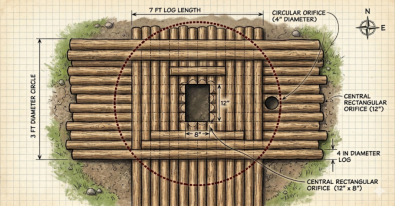
Figure 1. Layout of Wooden Skeleton of the Platform of the Proposed Locally Adapted (LA)-VIP Latrine (Showing Central Orifice for Defecation and Side Orifice for Insertion of the Vent Pipe).
Source: AI-Assisted Image Generation.

Download: Download full-size image

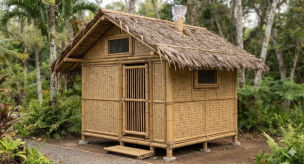
Figure 2. Sketch of the Superstructure of the Proposed LA-VIP Latrine (Showing Roof-work Plan).
Applying the above substitution will generate an innovative model of effective and efficient ‘locally adapted VIP latrine henceforth referred to as LA-VIP latrine. Such LA-VIP latrine model can be provided by many households on their own through direct labour of adult members. However, there may be few cases where a household is indisposed to muster direct labour to construct a unit of LA-VIP latrine either by itself or through any existing traditional social support mechanism. In such situation, such household may explore the option of incurring modest cost and pay for materials and labour involved in the construction. An estimate of the costs involved is provided in the table below.
Table 1. Estimated Cost of Providing One Unit of LA–VIP Latrine Where Family Direct Labor or Free Community-Assisted Construction Cannot be Procured.

S/No

Latrine Component/Activity

Estimated Minimal Cost of Materials / Labour Involved

Cost in Naira (N)

1

Digging of pit (average of 10ft deep, 30 inches diameter).

One-day job for 2 labourers @ N8,000 /labourer/day

N16,000

2

Cutting of logs; laying of logs and soil, tempering of soil.

Half-day job for 2 labourers @ N4, 000/labourer.

N8,000

3

Traditional superstructure. Actual Bill of Quality will depend on preferred size and height of superstructure

Purchase of woven mats, palm fronds, thatch, raffia, cane etc. (depending on preferred superstructure type).

N25,000

4

Erection of super structure with roof

One-day job for 2 labourer @ N8,000/labourer/day

N16,000

5

PVC pipe

One unit of pipe (4 inch diameter, length of 8 feet @ N5,000 /unit

N5,000

6

Miscellaneous Materials

Half-yard of white cloth; 4 hinges; 16 nails; orifice cover; basket (optional); ash bowel; etc.

N3,000

TOTAL

N73,000

Limitations on the Deployment of LA–VIP Latrine Model.
It was observed that deployment of the recommended LA-VIP latrine model may be limited in the following areas:
1) Areas with loose sandy soil.
2) Areas that are water-logged for long durations in a year.
3) Areas where the water table is so high as to yield pools of water on excavation of 5 feet (150 cm) or less.
4. Discussion
4.1. Cost Implications of Providing One Unit of Locally Adapted VIP (LA-VIP) Latrine
For a poor household that has two or more able-bodied adults, providing one unit of LA-VIP latrine for their own use can come at zero monetary cost. Through direct labor, two of the able-bodied adult family members can execute all the tasks involved in the construction of the latrine, from digging the pit to erecting the superstructure and roof. For a household that does not have able-bodied adult members, required manpower can be secured through any of the existing traditional social support systems such as extended family members, kindred group, in-laws, age-grades, etc. This can come at near-zero or minimal monetary cost given that what tradition requires is for the beneficiary household to provide kolanuts before the work and food after the work, or both food and palm-wine.
Additional to the above social support systems, the work of partner-organizations and other stakeholders in anti-open defecation campaigns has generated a robust toilet business ecosystem with diverse toilet financing options including soft loan and traditional bartering/exchange arrangements. Adepoju reports of a woman who bartered/exchanged her goat for a pour flush toilet. If a goat costing about ninety thousand Naira (N90, 000) can secure a pour flush toilet, then some tubers of yam or cock and hen or a keg of palm oil or a few heads of coconut can secure one unit of LA-VIP latrine in similar communities.
For a household that is indisposed to utilize direct labor or traditional social support options and wishes to procure the LA-VIP latrine at its market price, it is still reassuring that such household can procure the latrine at a modest cost not exceeding N75,000 (US $50) at 2026 price and exchange rate. This is still about 12 – 15% of the cost of constructing one unit of conventional VIP latrine in the same local environment estimated at N400, 000 – N700, 000 depending on finishing and location.
4.2. Sanitary Considerations
The basic and most critical function of a latrine is to secure immediate and general confinement of excreta so that the millions of harmful bacteria, viruses and protozoa cysts contained in the faces are barricaded from infecting man through contamination of our foods and water. The LA-VIP latrine, like the conventional VIP latrine and other latrine systems, effectively provides this first-order confinement of excreta.
An important hallmark of the VIP latrine, according to Water, Engineering and Development Centre (WEDC) is its effective control of odor and fly-trap provisions. But more important for public health concern is the fly-trap, which prevents contaminated flies from escaping from the latrine and perching thereafter to contaminate our foods, utensils and water. The LA-VIP latrine model’s vent-pipe and fly trap will effectively curtail odor and fly nuisances, also.
Actually, the LA-VIP latrine model carry two added features that may be considered an upgrade on sanitary status. First, the slim one-inch legs at the four corners of the orifice-cover ensures a tight-fittedness that effectively prevents ingress of flies without the cover making contact with any fecal matter that may accidentally drop at the latrine orifice. The tight-fitted cover will also assist to darken the interior of the pit thereby making more prominent the ingress of light from the fly-trap and vent pipe. This will increase the model’s fly trapping efficiency.
A second improved feature of the LA-VIP latrine is the single [or double] small permanent vent(s) at the top side of the superstructure. This, while principally working as a ventilating feature, will enable a slight illumination of the interior of the superstructure to enable users check that no dangerous vector or vermin is lurking in the latrine. As Middleton noted, fear of the dark interior of a conventional VIP latrine is a serious problem that may influence user behavior in various ways including apathy. Perhaps, such fear and an induced apathy may contribute to the ironic situations where high latrine ownership is not correlated with high latrine use that some scholars have reported, including Gbeti et al . Hence the proposed LA-VIP latrine will not compromise sanitary standard nor endanger public health and safety.
4.3. Wide Application and Acceptability
The most important innovation of the LA-VIP latrine model is its substitution of the concrete slab with logs of ever-living adventitious tree species laid with tempered soil. First, many species of such trees are available in different countries across various continents. Such trees include willows, poplars, figs, mulberry, chaya, olive, crepemyrtie, osage orange, the Gliricida sepium, Newbouldia leavis, Markhamia tomentosa, kapok, etc. Hence, logs of such trees are widely and readily available and so can be similarly used and deployed in latrine construction across regions. For the superstructure that may be made of bamboo, raffia, thatch, etc, the use of such materials in construction is almost a norm in many rural communities across countries where thatch buildings are predominant, particularly in sub-Saharan Africa. Hence, locally adapted superstructure of the LA-VIP latrine will be widely acceptable in many regions.
Ulrich et al citing Morgan, identified use of thatch, reeds, bamboo and other cheap and locally available materials as substitutes in latrine superstructure to reduce high cost of latrine construction. The rising global housing crises that have forced over 1 billion persons into “informal settlements and slums”, as highlighted by the UN-Habitat , makes the resourcefulness and adaptation contained in the LA-VIP latrine both rational and expedient, especially for regions under crises and severe resource-constrained settings.
4.4. Eliminating Open Defecation by 2030: Accelerating Efforts through Innovation
Both optimists and pessimists agree that efforts need to be intensified towards the pursuit of eliminating open defecation by 2030. Some views call for ‘acceleration’, or ‘substantial acceleration’ or ‘redoubling’ or ‘tripling’ of efforts. While improved funding is always expected by observers and intervening agencies, it does not appear that current political-economy will permit significantly improved funding at all levels.
Most of the major funders of global development initiatives are engaged in internal reviews or are directly or indirectly engaged or affected by the Russia-Ukraine war, the Iran-Israel-United States conflict, the Israeli-Palestinian conflict or the tension in Greenland. At regional levels for instance, many countries of Sub-Saharan Africa, especially the Sahel Region, are contending with various armed insurgencies, terrorism, banditry and militancy. At the national level, many low- and middle-income countries are contending with debt burden, recession, and economic meltdown or running on deficit budgets. Climate change pressures, national disasters, food insecurities and epidemics are challenging many other countries. Hence, substantial acceleration needed to attain elimination of open defecation by 2030 may depend less on increased funding but more on strategic innovation. The LA-VIP latrine model devised and proposed in this study is only one of such needed strategic innovation. Being an innovation, further research, trials and adjustments are needed to improve the model, subsequently.
Three advantages of the LA-VIP latrine model combine to render the model a good candidate for strategic deployment. Its cheapness; its assembly with locally available inputs; and its quick deployment even within 24 - 48 hours. Hence, the model may be quickly deployed in areas and circumstances of special needs and contingency interest such as:
1) Where absence of latrine in schools constrain menstrual hygiene management (MHM) for school girls, escalate school absenteeism for girls, and prompt the girl-students to drop out of school as previously identified by Obiano et al .
2) Where reports of lack of access to basic sanitation in healthcare facilities, schools, markets and motor parks [as in Nigeria as reported by Onyedika-Ugoeze and Musa constitute an affront to human dignity.
3) Where persons displaced from their homes cluster without formal assistance in informal IDP camps.
4) In severe resource-constrained, marginal, hard-to-reach communities who dwell in mud and thatch houses and obviously cannot afford the conventional VIP latrines and other superior and costlier latrine models.
5) In dwellings and settlements of quick and transient nature where duration of residency cannot be determined and de-commissioning may be contemplated in the near term.
There are many success stories on attainment of open defecation free (ODF) status from which we can learn, replicate, adapt, consolidate and expand upon. Without prejudice to others, two very commendable examples are India’s attainment of national ODF status in five years from 2014 – 2019 and the pioneer attainment of state-wide ODF status by Jigawa State in North-West Nigeria within 6 years under UNICEF assistance . Of course, many other community-level successes as well as regional and national level success stories afford us many useful lessons.
Apart from funding and hardware provision, we now have more understanding of how effective software component actions can be, including but not limited to forging partnerships, consultations, community involvement and community mobilization for self-help, supportive supervision, strong governance and accountability, sustained behavior change communication, volunteering, sanitation marketing, and motivational rewards. If more innovations are introduced in the foregoing soft components and efforts intensified, we will achieve a substantial and sustained acceleration towards eliminating open defecation. If, to this substantial acceleration, we add the adoption and deployment of LA-VIP latrine model, then we would have achieved sustained rapid acceleration needed to eliminate open defecation by 2030.
There is a misconception that needs to be corrected. Owing to the popularity of conventional VIP latrine and the importance of its concrete slab, some commentators create the erroneous impression that a concrete slab is an indispensable perquisite for a facility to be classified as meeting basic sanitation or improved sanitation level. Though concrete slab platform is most preferred, industry standard accepts platforms made of other materials including reinforced plastic, tight timber and cured wood. What are required of a pit latrine platform are that it is easy to clean; is non-slip; will not harbor vectors and vermin; and most important, that it is structurally secure so that users have the confidence that the platform will not break and collapse.
For the avoidance of doubt, the platform of the proposed LA-VIP latrine model is structurally strong enough to carry even the weight of a small car. The logs of ever-living trees are laid double-layered, and tightly parked. The first layer of logs is laid North-South, while the second layer is laid East-West directions; with a thin layer of soil in-between the first and second layers of logs to bind the logs from shifting against each other. Tempering the top soil cover with laterite or clay ensures that the top of the platform does not slip nor stain and is easy to keep clean.
5. Conclusion
It is feasible to devise and deploy a new latrine model that can come at zero-cost or minimal cost to some poor rural dwellers. This feasibility can be achieved through local content by simulating the conventional VIP latrine and substituting its components with locally available alternatives. The proposed LA-VIP latrine model is very cheap; of hygienically acceptable standard; has an optimized design principle compatible with local content; and has potentials for quick and immediate deployment. Adopting the latrine model will ensure that adequate number of latrines are delivered to all areas of need within the shortest period practicable and at affordable cost to user-households, displaced persons and intervening agencies. For the avoidance of doubt, this work is not canvassing for the discontinuation of deployment and use of the conventional VIP latrine. The work proposes a model that can be relied upon as a backstop where resource-constraints dissuade adequate provision of conventional VIP latrines.
For intervening agencies and governments, the adoption of the proposed model will ensure that henceforth, even greater number of latrines are provided than would have been the case within the context of un-improved funding. If funding improves, it will translate to exponential expansion in the delivery of LA-VIP model latrines, as well as saving more funds for other sanitation related needs if basic latrine provision is satisfied.
Wide-scale adoption and deployment of LA-VIP model latrine, if supported with robust social marketing, will transform the sanitation ecosystem of low-income countries; provide higher pedestal for collective engagement and self-help especially for severe resource-constrained communities; and, to use the words of the UN Secretary-General, “shift into overdrive ”. that is direly needed to attain the noble target of eliminating open defecation by 2030, less than 5 years ahead. This target must not be missed.
Abbreviations

AI

Artificial Intelligence

CDO

Community Development Officer

IDMC

Internal Displacement Monitoring Group

IDP

Internally Displaced Persons

LGA

Local Government Area

LA-VIP

Locally Adapted Ventilated Improved Pit

MHM

Menstrual Hygiene Management

NGO

Non-Governmental Organization

OD / ODF

Open Defecation / Open Defecation Free

PVC

Polyvinyl Chloride

SDGs

Sustainable Development Goals

A-SA

Sub-Saharan Africa

UN

United Nations

UN-DESA

United Nations Department of Economic and Social Affairs

UN-Habitat

United Nations Human Settlement Programme

UNHCR

United Nations High Commission for Refugees

UNICEF

United Nations Children’s Fund

VIP

Ventilated Improved Pit

WASH

Water, Sanitation and Hygiene

WHO

World Health Organization

Acknowledgments
Our gratitude goes to the following persons for making out time to be interviewed, as well as contributing in further discussion: Okolo Blessing Ebele, Engineer Edmund Nkala, Sanitarian Joseph Edochie, Izuorah Winifred Ndidi, Florence N. Nnoli, Hon. Onyeka Nzeakor and Elder Eloka Okafor.
Author Contributions
Emmanuel Chukwuma Obiano: Conceptualization, Visualization, Writing – original draft
Christopher Emeka Anaebonam: Data curation, Investigation, Methodology, Supervision
Valentine Chukwuka Agubuokwu: Project administration, Validation, Writing – review & editing
Data Availability Statement
Relevant data and information leading to the conclusion of this work are contained in the work.
Conflicts of Interest
The Authors declare no conflicts of interest.
Supplementary Material

Below is the link to the supplementary material:

Supplementary Material 1

References
[1] Adepoju P. Why Nigeria’s campaign to end open defecation is failing. News/Water and Sanitation. DEVEX IMPACT HOUSE AT LONDON CLIMATE WEEK. 13 August 2019. devex. Avalable at:
[2] Gauri V, Rahman T, & Sen I. ‘Shifting Social Norms to Reduce Open Defecation in Rural India’. Policy Research Working Paper, 2018, No 8684. The World Bank.
[3] Gbeti C, Donkor I A & Wumbei. Predictions of open defecation amidst community- led total sanitation approach. Discover Public Health 2016, 23, 685.
[4] Marsh ATM and Kulshreshtha Y. The state of earthen housing worldwide: how development affects attitude and adoption. Building Research & Information, 2022, 50(5), 485-501.
[5] Middleton RN. Making VIP latrines succeed. Waterlines, Vol. 13, No. 4, April 1995. pp. 27-29. Available @ IRC Wash.
[6] Obiano EC, Umahi EN, Isikekpei B, Sodeinde K, Atinge S, Okondu E O, Okoye H C, and Okorie P C. Assessment of Menstruation-Associated Absenteeism among School Girls in Jalingo: Cost-Effective Interventions for Resource-Constrained Settings. Journal of Health and Environmental Research, 2023, 9(3); 76-82.
[7] Onyedika-Ugoeze N and Musa N. Nigeria may miss national, global targets on being open defecation-free, UNICEF warns. THE GUARDIAN, 16 June, 2023.
[8] Ulrich L, Salian P, Saul C, Justrich S & Luthi C (2016) Assessing the Cost of on-Site Sanitation Facilities. Study Report by Eawag-Sandec, Sanitation, Water and Solid Waste for Development, 2016. Dubendorf, Switzerland.
[9] UN. The 17 Goals. United Nations Department of Economic and Social Affairs. Sustainable Development, 2026.
[10] UN (b). The Sustainable Development Goals Report 2025. UN Sustainable Development Goals. Cc. UN 2026.
[11] UN-DSEA ‘Transformational benefits’ of ending outdoor defecation: Why toilets matter. United Nations (UN)/ Department of Social and Economic Affairs (DSEA), 2026. Available at:
[12] UN-Habitat. The Global Housing Crises: Pathways to Action. World Cities Report 2026. United Nations Human Settlement Programme (UN-Habitat).
[13] UNICEF. Fast facts: 1 in 4 people globally still lack access to safe drinking water – WHO, UNICEF. Press Release jointly made by WHO and UNICEF on 25 August 2025 at the occasion to mark the World Water Week 2025. [Online] Available at:
[14] UNICEF. A decade of India’s transformative Sanitation Mission. 08 November 2024. By Arjan De Wagt, Deputy Representative, UNICEF India. [Online] Available at:
[15] UNICEF. Achieving State-Wide Open Defecation Free Status in Nigeria. UNICEF WASH Field Note FN21/2023. UNICEF-Nigeria. [Online] Available at:
[16] UNHCR. Figures at a glance. Topline global statistics on forced displacement, including current and historical numbers of refugees, asylum-seekers and internally displaced people. Unite Nations High Commission for Refugees (UNHCR). [Online] 2025. Available at:
[17] WEDC Ventilated improved pit (VIP) latrines. WEDC GUIDE 27. Water, Engineering and Development Centre (WEDC), School of Civil and Building Engineering, Loughborough University.
[18] WHO. WASH exposure, defecation: population practicing open defecation (%). World Health Organization (WHO), 2026. [Online] Available at:
[19] IDMC. Global Report on Internal Displacement. Internal Displacement Monitoring Group (IDMC) 2025.
Cite This Article
  • APA Style

    Obiano, E. C., Anaebonam, C. E., Agubuokwu, V. C. (2026). Accelerating the Elimination of Open Defecation by 2030: Deployment of Locally-adapted Ventilated Improved Pit Latrine Model in Resource-constrained Settings. Journal of Health and Environmental Research, 12(4), 71-78. https://doi.org/10.11648/j.jher.20261204.11

    Copy | Download

    ACS Style

    Obiano, E. C.; Anaebonam, C. E.; Agubuokwu, V. C. Accelerating the Elimination of Open Defecation by 2030: Deployment of Locally-adapted Ventilated Improved Pit Latrine Model in Resource-constrained Settings. J. Health Environ. Res. 2026, 12(4), 71-78. doi: 10.11648/j.jher.20261204.11

    Copy | Download

    AMA Style

    Obiano EC, Anaebonam CE, Agubuokwu VC. Accelerating the Elimination of Open Defecation by 2030: Deployment of Locally-adapted Ventilated Improved Pit Latrine Model in Resource-constrained Settings. J Health Environ Res. 2026;12(4):71-78. doi: 10.11648/j.jher.20261204.11

    Copy | Download

  • @article{10.11648/j.jher.20261204.11,
      author = {Emmanuel Chukwuma Obiano and Christopher Emeka Anaebonam and Valentine Chukwuka Agubuokwu},
      title = {Accelerating the Elimination of Open Defecation by 2030: Deployment of Locally-adapted Ventilated Improved Pit Latrine Model in Resource-constrained Settings},
      journal = {Journal of Health and Environmental Research},
      volume = {12},
      number = {4},
      pages = {71-78},
      doi = {10.11648/j.jher.20261204.11},
      url = {https://doi.org/10.11648/j.jher.20261204.11},
      eprint = {https://article.sciencepublishinggroup.com/pdf/10.11648.j.jher.20261204.11},
      abstract = {In 2015, the United Nations adopted the elimination of open defecation as Sustainable Development Goal 6.2. Though modest progress has been achieved, about 673 million people still practise open defecation, prompting concerns on how to overcome these challenges and accelerate actions to meet the target. This study aims to proffer solutions to some of these challenges and contribute in accelerating actions to meet the target by proposing a new latrine model. Considering that cost is the most important factor challenging elimination of open defecation, a working assumption was made that delivery of functional latrines at zero-cost to households in need will generate acceptance and use. Two research questions were formulated pertaining to the feasibility of devising and deploying an alternative zero-cost latrine model across poor communities without endangering public health. Key informant interview and discussion were held with purposively selected community based stakeholders to explore the research questions and provide answers. It was found that: it is feasible to devise a model latrine at zero-cost to poor households; such feasibility will be achieved by simulating the conventional ventilated improved pit latrine and substituting its components with locally available alternatives; the local content achieved is applicable to local communities across countries and regions; and that the alternative model will achieve a cost reduction of about 80 – 90% of the cost of a conventional ventilated improved pit latrine. The study concludes that the alternative latrine model is a viable alternative to the conventional ventilated improved pit latrine in terms of basic functions, sanitary acceptability, and widespread adoption and use; coupled with its added advantage of cheapness and rapid deployment. If the model is adopted and supported with aggressive social marketing, will provide sustained rapid acceleration direly needed to pursue the Sustainable Development Goal target of eliminating open defecation by 2030, about four years ahead.},
     year = {2026}
    }
    

    Copy | Download

  • TY  - JOUR
    T1  - Accelerating the Elimination of Open Defecation by 2030: Deployment of Locally-adapted Ventilated Improved Pit Latrine Model in Resource-constrained Settings
    AU  - Emmanuel Chukwuma Obiano
    AU  - Christopher Emeka Anaebonam
    AU  - Valentine Chukwuka Agubuokwu
    Y1  - 2026/10/14
    PY  - 2026
    N1  - https://doi.org/10.11648/j.jher.20261204.11
    DO  - 10.11648/j.jher.20261204.11
    T2  - Journal of Health and Environmental Research
    JF  - Journal of Health and Environmental Research
    JO  - Journal of Health and Environmental Research
    SP  - 71
    EP  - 78
    PB  - Science Publishing Group
    SN  - 2472-3592
    UR  - https://doi.org/10.11648/j.jher.20261204.11
    AB  - In 2015, the United Nations adopted the elimination of open defecation as Sustainable Development Goal 6.2. Though modest progress has been achieved, about 673 million people still practise open defecation, prompting concerns on how to overcome these challenges and accelerate actions to meet the target. This study aims to proffer solutions to some of these challenges and contribute in accelerating actions to meet the target by proposing a new latrine model. Considering that cost is the most important factor challenging elimination of open defecation, a working assumption was made that delivery of functional latrines at zero-cost to households in need will generate acceptance and use. Two research questions were formulated pertaining to the feasibility of devising and deploying an alternative zero-cost latrine model across poor communities without endangering public health. Key informant interview and discussion were held with purposively selected community based stakeholders to explore the research questions and provide answers. It was found that: it is feasible to devise a model latrine at zero-cost to poor households; such feasibility will be achieved by simulating the conventional ventilated improved pit latrine and substituting its components with locally available alternatives; the local content achieved is applicable to local communities across countries and regions; and that the alternative model will achieve a cost reduction of about 80 – 90% of the cost of a conventional ventilated improved pit latrine. The study concludes that the alternative latrine model is a viable alternative to the conventional ventilated improved pit latrine in terms of basic functions, sanitary acceptability, and widespread adoption and use; coupled with its added advantage of cheapness and rapid deployment. If the model is adopted and supported with aggressive social marketing, will provide sustained rapid acceleration direly needed to pursue the Sustainable Development Goal target of eliminating open defecation by 2030, about four years ahead.
    VL  - 12
    IS  - 4
    ER  - 

    Copy | Download

Author Information
  • Department of Public Health Science, Tansian University, Umunya, Nigeria

  • Department of Public Health Science, Tansian University, Umunya, Nigeria

  • Department of Environmental Health Science, Nnamdi Azikiwe University, Awka, Nigeria