Abstract
Context: Malaria during pregnancy is characterized by significant maternal and fetal morbidity and mortality due to non-compliance with preventive measures, particularly intermittent preventive treatment. The objective of this study is to assess the knowledge and practices of pregnant women in the HEAL Africa health area regarding intermittent preventive treatment with sulfadoxine-pyrimethamine. Methodology: The presentThis cross-sectional and analytical study was conducted among pregnant women in the HEAL Africa health district in Goma over a four-month period. A quantitative approach and a standardized questionnaire were used. Interviews provided information from which chi-square and Student's t-tests were performed. The determinants were identified using logistic regression with the calculation of ORs and 95% CIs. A p-value < 0.05 was considered the threshold for statistical significance. Results: The pregnant women, with a pregnancy of more than 16 weeks, represented 93% of the group. They were married (94%), had a secondary education (90%), and were over 20 years old (93%). They knew that malaria is transmitted by mosquito bites (91%) and understood its severity during pregnancy (99%). They understood the importance of malaria prevention for pregnant women (94%). However, only 30% knew that the first dose should be received in the second trimester, and 37% knew the interval between two doses (1 month). Conclusion: Pregnant women who consulted the HEAL Africa health center during the period of our survey have inadequate knowledge and irregular practice of intermittent preventive treatment.
|
Published in
|
Medicine and Health Sciences (Volume 2, Issue 6)
|
|
DOI
|
10.11648/j.mhs.20260206.11
|
|
Page(s)
|
151-159 |
|
Creative Commons
|

This is an Open Access article, distributed under the terms of the Creative Commons Attribution 4.0 International License (http://creativecommons.org/licenses/by/4.0/), which permits unrestricted use, distribution and reproduction in any medium or format, provided the original work is properly cited.
|
|
Copyright
|
Copyright © The Author(s), 2026. Published by Science Publishing Group
|
Keywords
IPT-SP, Knowledge, Practice, Malaria, Pregnancy
1. Introduction
Malaria during pregnancy is an obstetric, medical, social, and economic emergency. It is a cause of preventable morbidity and mortality in pregnant women
| [1] | Amoran OE, Ariba AA, Iyaniwura CA. (2012). Determinants of intermittent preventive treatment for malaria use during pregnancy (IPTp) in a rural town in western Nigeria. Reproductive Health; (9): 12. |
| [2] | Ankomah et al. (2012). Determinants of ownership and use of insecticide-treated bed nets among pregnant women in Nigeria. BMC Public Heal.; 12: 105. |
[1, 2]
. It is a contributing factor to 5.5 million stillbirths and neonatal deaths each year
| [3] | Kerryn A. Moore, JA Simpson, MJL Scoullar, R McGready, FJI Fowkes (2017). Quantification of the association between malaria in pregnancy and stillbirth: a systematic review and meta-analysis. The Lancet Global Health 5 (11), e1101-e1112. |
[3]
. In 2007, approximately 125 million pregnant women were recorded in malaria-endemic areas. In regions with unstable or low transmission, such as Asia-Pacific, malaria affected 62%, or 77 million, of pregnant women
| [4] | Briand V, Hesran JYL, Mayxay M, Newton PN, Bertin G, Houzé S, et al. Prevalence of malaria in pregnancy in southern Laos: a cross-sectional survey. Malaria Journal [Internet]. 2016 Aug 26; 15(1): 436. Available from:
https://doi.org/10.1186/s12936-016-1492-2 |
[4]
.
Nearly 11 million pregnant women living in areas of moderate to high malaria transmission in sub-Saharan Africa were exposed to malaria infection, of which approximately 6 million contracted the disease and 10.000 resulted in maternal deaths. Nearly 39% of this prevalence was concentrated in the Democratic Republic of Congo and Nigeria
| [5] | World Health Organization (WHO) (2017). Global Malaria Programme. Intermittent Preventive Treatment. World malaria report 2017. 2017. p. |
[5]
.
The prevalence of malaria among pregnant women varies across different African regions. Prevalences of 5%, 28% and 68.3% have been reported in Ghana, Uganda and Nigeria respectively
| [6] | Amuta E., Houmsou R., Wama E., Ameh M. (2014). Malaria infection in patients of the prenatal and maternal clinics of the Federal Medical Centre, Makurdi, Benue State, Nigeria. |
| [7] | De Beaudrap P., Turyakira E., White LJ, et al. (2013). Impact of malaria during pregnancy on pregnancy outcome in a prospective Ugandan cohort with intensive malaria screening and rapid treatment. Journal of Malaria.; 12 (1, article 139)
https://doi.org/10.1186/1475-2875-12-139 |
| [8] | Stephens, JK, Ofori, MF., Quakyi, IA, Wilson, ML, Akanmori, BD (2014) ''Prevalence of peripheral blood parasitemia, anemia and low birth weight among pregnant women in a suburban coastal area of Ghana.' Pan-African Journal of Medicine. |
[6-8]
.
In Nigeria in 2012, malaria was the cause of 11% of maternal deaths, 3-8% of infant deaths, 8-15% of low birth weight newborns and 2-5% of maternal anemia
| [1] | Amoran OE, Ariba AA, Iyaniwura CA. (2012). Determinants of intermittent preventive treatment for malaria use during pregnancy (IPTp) in a rural town in western Nigeria. Reproductive Health; (9): 12. |
| [2] | Ankomah et al. (2012). Determinants of ownership and use of insecticide-treated bed nets among pregnant women in Nigeria. BMC Public Heal.; 12: 105. |
[1, 2]
.
In the DRC, malaria is the leading cause of death and illness. It accounts for 40% of all outpatient consultations. In 2016, SP3 was poorly observed, averaging 34.5%, and SP2 was 69%
.
However, to address this scourge of malaria during pregnancy, the WHO recommends two preventive actions: the use of insecticide-treated mosquito nets and intermittent preventive treatment; and a curative action which is the management of confirmed malaria
.
Low use of intermittent preventive treatment has been observed in several sub-Saharan African countries
| [11] | S. Yaya, OA Uthman, A Amouzou, G Bishwajit (2018). Use of IPT in pregnant women in sub-Saharan Africa: evidence from a malaria indicator survey. Trop. Med. Infecter. Dis 2018, 3(1); 18. https://doi.org/10.3390/tropicaled3010018 |
[11]
.
The Democratic Republic of Congo, which set itself the objective of achieving 80% in malaria prevention among pregnant women in 2015
, found itself with a low compliance of 52% in Goma in 2017
.
Several authors note that the adoption of the ITC is a consequence of the knowledge of the ITC
| [1] | Amoran OE, Ariba AA, Iyaniwura CA. (2012). Determinants of intermittent preventive treatment for malaria use during pregnancy (IPTp) in a rural town in western Nigeria. Reproductive Health; (9): 12. |
| [14] | Frederick Dun-Dery, PeterMeissner and Olaf Muller (2019). Uptake challenger of intermittent preventive malaria therapy care among pregnant women and their health care providers in the upper west region of Ghana: A mixed-methods study parasite epidemiology and control Elsevier. |
| [15] | Witness Mkalukwatage Mcwampaka, Donath Tarimo, AndAngela Samwel (2019). Factors influencing the use of ≥ 3 doses of sulfadoxine-pyrimethamine for malaria prevention during pregnancy in selected health facilities, Arusha region, TanzaniaBMC Pregnancy Childbirth2019; 19: 440.
https://doi.org/10.1186/s12884-019-2592-0 |
| [16] | National Malaria Control Programme (PNLP) (2017). 2016 Activity Report.
https://pnlprdc.org/wp-content/uploads/2021/03/Rapport-annuel-2016-des-activites-de-lutte-contre-le-Paludisme-draft-2-du-19-avril-2017.pdf |
| [17] | SNEsomonu, EN Ossai, AD Gadzama (2022). Knowledge and preventive practices against malaria among pregnant women in urban and rural public healthcare facilities in Nigeria's Federal Capital Territory. Journal of Medicine…, 2022 -
journals.lww.com |
[1, 14-17]
.
We found no evidence that a study on pregnant women's knowledge and practices regarding intermittent preventive treatment had previously been conducted in our setting.
It is with the aim of filling this gap that we undertook this study which aims to evaluate the knowledge and practices of pregnant women in the HEAL Africa health area on intermittent preventive treatment in the prevention of malaria during pregnancy.
2. Method
2.1. Study Framework and Period
This study took place at the HEAL Africa health center, located in the southern part of Goma, specifically in the Goma Urban Health Zone, in the Democratic Republic of Congo. It was conducted between August 23 and December 23, 2021.
2.2. Type and Population of Study
This study is cross-sectional and analytical, conducted in the population of pregnant women receiving care at the Heal Africa Health Center in the city of Goma in the DRC.
2.3. Sample Size and Sampling
The sample size was calculated using Fischer's formula n=z2. p. (1-p)/u2. Thus, the sample size was: (1.96)2 x 0.14 (1-0.14)/(0.05)2 = 185.01N = 2n = 2 x 185 = 370. Given that n = sample size per site, Z = confidence level, p = prevalence, u = margin of error, N = total sample size. Using p = 0.14 as the frequency of IPT use in pregnant women (23).
2.4. Data Collection
For this study, the pregnant women included were recruited using simple random sampling. All pregnant women seen for prenatal consultations were selected using a sampling interval of 2 with a single visit to ensure an equal chance of being chosen. Therefore, pregnant women were admitted by selecting the first, third, fifth, and so on.
A standard questionnaire was used to collect data using the interview technique over 38 sessions with a trained nurse under the supervision of the study's principal correspondent.
2.5. Variables of Interest
Socio-demographic variables, knowledge and practice, and factors influencing the use of TPIs were the variables of interest in this study.
2.6. Selection Criteria
2.6.1. Inclusion Criteria
1) Being pregnant women;
2) Be between 15 and 49 years old;
3) Attend the prenatal consultation session at the HEAL Africa health center during the study period;
4) Having given written consent to participate in the study.
2.6.2. Exclusion Criteria
1) Pregnant women who did not attend prenatal consultations;
2) Pregnant women with an allergy to Fansidar or those on cotriprophylaxis;
3) Pregnant women with a mental disorder;
4) The respondents did not answer the questions.
2.7. Statistical Analyses
The data were encoded in MS Excel 2010 software and analyzed using SPSS version 20.0 software. For descriptive analyses, standard deviation, Student's t-test, and absolute frequency were used for quantitative data. A p-value < 0.05 was considered statistically significant.
2.8. Ethical Considerations
This study has received ethical approval fromInstitutional Ethics Committee of the Protestant University in Congo (UPC) referenced under No. CEUPC0090. Authorization to continue the research was also obtained from the Chief Medical Officer of the Goma Zone, reference No. 254 /ZSUG/BCZS/181/2021.
3. Results
3.1. Sociodemographic Characteristics of the Study Population
The sociodemographic characteristics of pregnant women are presented in
Table 1.
Table 1. Sociodemographic characteristics of the study population.
Variables | All n=371 | Health Area n=217 | Outside the health zone n=244 | P |
Age | | | | 0.585 |
≤20 years old | 23(6.2) | 6(4.7) | 17(7.0) | |
21-34 years old | 229(61.7) | 82(64.6) | 147(60.2) | |
≥35 years old | 119(32.1) | 39(30.7) | 80(32.8) | |
Study level | | | | 0.344 |
None/Primary | 41(11.1) | 10(7.9) | 31(12.7) | |
Secondary | 152(41.0) | 52(40.9) | 100(41.0) | |
University | 178(48.0) | 65(51.2) | 113(46.3) | |
Religion | | | | 0.267 |
Catholic | 115(31.0) | 34(26.8) | 81(33.2) | |
Protestant | 142(38.3) | 49(38.6) | 93(38.1) | |
Revival Church | 61(16.4) | 27(21.3) | 34(13.9) | |
Others | 53(14.3) | 17(13.4) | 36(14.8) | |
Occupation | | | | 0.035 |
None | 185(49.9) | 67(52.8) | 118(48.4) | |
Informal | 77(20.8) | 17(13.4) | 60(24.6) | |
Pupil/student | 109(29.4) | 43(33.9) | 66(27.0) | |
Marital status | | | | 0.441 |
Bride | 348(93.8) | 120(94.5) | 228(93.4) | |
Not married | 23(6.2) | 7(5.5) | 16(6.6) | |
Parity | | | | 0.026 |
First-time mother | 85(22.9) | 24(18.9) | 61(25.0) | |
Paucipare | 163(43.9) | 68(53.5) | 95(38.9) | |
Multiparous | 123(33.2) | 35(27.6) | 88(36.1) | |
Gestational age | | | | 0.633 |
3-15 weeks | 27(7.3) | 8(6.3) | 19(7.8) | |
16-28 Weeks | 93(25.1) | 29(22.8) | 64(26.2) | |
>28 weeks | 251(67.7) | 90(70.9) | 161(66.0) | |
The study population consisted of 93% pregnant women with a pregnancy of more than 16 weeks, 94% married, of whom 90% had a secondary education level and 93% were over 20 years old.
3.2. Knowledge About Malaria and IPT
Table 2 illustrates the pregnant women's knowledge of malaria.
Table 2. Pregnant women's knowledge about malaria.
Knowledge about malaria about pregnancy | All n=371 | Health Area n=217 | Outside the health zone n=244 | P |
Malaria transmission | | | | |
Piqûmosquito breeding ground | 339(91.4) | 111(87.4) | 228(93.4) | 0.040 |
Lack of personal hygiene | 19(5.1) | 7(5.5) | 12(4.9) | 0.491 |
Consumption of alcoholic beverages | 7(1.9) | 1(0.8) | 6(2.5) | 0.245 |
NSP | 17(4.6) | 9(7.1) | 8(3.3) | 0.083 |
The dangers of malaria during pregnancy | 367(98.9) | 125(98.4) | 242(99.2) | 0.423 |
Consequences of malaria on pregnancy | | | | |
Anemia | 166(44.7) | 50(39.4) | 116(47.5) | 0.082 |
Abortion | 214(57.7) | 67(52.8) | 147(60.2) | 0.101 |
Death in utero | 130(35.0) | 38(29.9) | 92(37.7) | 0.084 |
Low birth weight | 156(42.2) | 43(33.9) | 113(46.5) | 0.013 |
Premature birth | 127(34.3) | 35(27.6) | 92(37.9) | 0.030 |
More than 91% of our study population know that malaria is transmitted by mosquito bites and about 99% know the seriousness of malaria in case of pregnancy.
3.3. Knowledge About Intermittent Preventive Treatment (IPT)
Table 3 presents the knowledge of pregnant women on malaria prevention and intermittent preventive treatment.
Table 3. Knowledge about malaria prevention.
Knowledge about malaria prevention | All n=371 | Health Area n=217 | Outside the health zone n=244 | P |
The importance of prevention in pregnant women | 351(94.6) | 118(92.9) | 233(95.5) | 0.209 |
Prevention methods | | | | |
Fansidar | 275(74.3) | 85(66.9) | 190(78.2) | 0.014 |
Chloroquine | 43(11.6) | 12(9, 4) | 31(12.7) | 0.226 |
MILD | 162(43.7) | 48(378) | 114(46.7) | 0.062 |
Knowledge of the purpose of the Fansidar | 245(66.0) | 75(59.1) | 170(69.7) | 0.027 |
The number of times to receive it | | | | 0.595 |
0 | 3(1.2) | 0(0.0) | 3(1.8) | |
1 | 49(20.0) | 17(22.7) | 32(18.8) | |
2 | 39(15.9) | 13(17.3) | 26(15.3) | |
3 | 62(25.3) | 15(20.0) | 47(27.6) | |
4 | 92(37.6) | 30(40.0) | 62(36.5) | |
The start of treatment | | | | 0.430 |
1st Quarter | 141(38.0) | 5(39.4) | 91(373) | |
2nd Quarter | 110(29.6) | 31(24.4) | 79(32.4) | |
3rd Quarter | 18(4.9) | 7(5.5) | 11(4.5) | |
Don't know | 102(27.5) | 39(30.7) | 63(25.8) | |
The time between two doses | | | | 0.497 |
1 month | 138(37.2) | 41(32.3) | 97(398) | |
2 months | 32(8.6) | 11(8.7) | 21(8.6) | |
3 months | 65(17.5) | 26(20.5) | 39(16.0) | |
Don't know | 136(36.7) | 49(38.6) | 87(35.7) | |
The dose of the TPI | | | | 0.742 |
Single dose | 229(61.7) | 74(58.3) | 155(63.5) | |
twice a day | 34(9.2) | 12(9.4) | 22(9.0) | |
3 times a day | 15(4.0) | 5(3.9) | 10(4.1) | |
Don't know | 93(25.1) | 36(28.3) | 57(23.4) | |
Over 94% of our study population are aware of the importance of malaria prevention in pregnant women, and 66% of respondents know the preventive purpose of the SP (sperm). Only 30% of the study population knows that the first dose should be received in the second trimester, and 37% know that the interval between two doses is 1 month.
3.4. Practices on the ITC
3.4.1. Frequency of Pregnant Women Who Used the IPT
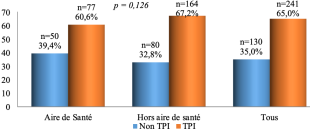
We will be informed about the frequency of pregnant women who used intermittent preventive treatment from
Figure 1.
Only 65% of our study population had already received intermittent preventive treatment.
Figure 1. The frequency of pregnant women who used the TPI.
3.4.2. Characteristics of the ITP Used by Pregnant Women
The table below will show us how the TPI was used by pregnant women in the present study.
Table 4. Characteristics of the IPTp used by the pregnant woman.
Variables | All n=241 | Health Area n=77 | Outside the health zone n=164 | p |
Number of doses taken | | | | 0.315 |
1 time | 89(36.9) | 35(45.5) | 54(32.9) | |
twice | 78(32.4) | 21(27.3) | 57(34.8) | |
≥3 times | 64(26.6) | 18(23.4) | 46(28.0) | |
Ignore | 10(4.1) | 3(3.9) | 7(4.3) | |
Time between doses | | | | 0.198 |
<1 month | 32(13.3) | 12(15.6) | 20(12.2) | |
1 month | 99(41.1) | 30(39.0) | 69(42.1) | |
≥2 months | 40(16.6) | 8(10.4) | 32(19.5) | |
Ignore | 70(29.0) | 27(35.1) | 43(26.2) | |
Start of TPI | | | | 0.690 |
1st Quarter | 84(34.9) | 26(33.8) | 58(35.4) | |
2nd Quarter | 125(51.9) | 43(55.8) | 82(50.0) | |
3rd Quarter | 15(6.2) | 3(3.9) | 12(7.3) | |
Ignore | 17(7.1) | 5(6.5) | 12(7.3) | |
Place of seizure of TPI | | | | 0.452 |
at the hospital | 203(84.2) | 65(84.4) | 138(84.1) | |
at home | 30(12.4) | 11(14.3) | 19(11.6) | |
Elsewhere | 8(3.3) | 1(1.3) | 7(4.3) | |
The pregnant woman received it in front of healthcare staff. | 178(89.0) | 53(84.1) | 125(91.2) | 0.107 |
A rate of 26% of respondents claim to have received the optimal dose, 41% claim to have received IPT at one-month intervals, 52% confirm to have started IPT in the second trimester, 89% claim to have taken IPT in the presence of a healthcare professional.
4. Discussion
4.1. Sociodemographic Characteristic
In the present study, over 60% of the pregnant women interviewed were between 20 and 34 years old. Approximate proportions have been reported by other authors: in Nigeria, Tobin-West et al.
| [18] | Charles I Tobin-WestandEme O Asuquo (2013). Utilization of Intermittent Preventive Treatment of Malaria by Pregnant Women in Rivers State, NigeriaInt J Prev Med. Jan; 4(1): 63-71. |
[18]
, Hajira et al.
| [19] | Hajira Ibrahim, Ernest Tei Maya, AndCharles Lwanga Noora (2017). Factors influencing the adoption of intermittent preventive treatment for malaria during pregnancy using sulfadoxine-pyrimethamine in the municipality of Sunyani, Ghana; 28: 122. Centre For Reproductive Health Research, Abuja, Nigeria
https://doi.org/10.11604/pamj.2017.28.122.12611 |
[19]
, and Titilope et al.
| [20] | Olukemi Titilope Olugbade, Olayinka Stephen Ilesanmi, Aishatu Bintu Gubio, Ikeoluwapo Ajayi, Patrick Mboya Nguku, AndOlufemi Ajumobi (2019). Sociodemographic and regional disparities in the use of intermittent preventive treatment for malaria during pregnancy - Demographic and Health Survey in Nigeria 2013Pan Afr Med J2019; 32 (Suppl 1): 13. |
[20]
; in Benin, Chabi et al.
| [21] | Chabi Olaniran Alphonse Biaou et al. Intermittent preventive treatment with sulfadoxine-pyrimethamine in pregnant women and its effect on infant birth weight: application of the 3-dose policy in an urban area of southern Benin in 2017. Pan African Medical Journal. 2019; 34: 155.
https://doi.org/10.11604/pamj.2019.34.155.19357 |
[21]
; and in Ghana, Owusu et al.
| [22] | Owusu-Boateng I, Anto F. Intermittent preventive treatment of malaria in pregnancy: a cross-sectional survey to assess uptake of the new sulfadoxine-pyrimethamine five dose policy in Ghana. Malaria Journal [Internet]. 2017 Aug 10; 16(1): 323. Available from: https://doi.org/10.1186/s12936-017-1969-7 |
[22]
. In a study conducted in Tanzania, Mkamuchwapa et al.
| [15] | Witness Mkalukwatage Mcwampaka, Donath Tarimo, AndAngela Samwel (2019). Factors influencing the use of ≥ 3 doses of sulfadoxine-pyrimethamine for malaria prevention during pregnancy in selected health facilities, Arusha region, TanzaniaBMC Pregnancy Childbirth2019; 19: 440.
https://doi.org/10.1186/s12884-019-2592-0 |
[15]
found that 82% of women were in this age group. of age.
Furthermore, in this study, over 89% of pregnant women had at least a secondary education. Similar results were found in urban Cameroon by Bertrand et al.
| [23] | Eric Bertrand Fokam, Leonard Ngimuh, AndSamuel Wanji (2016). Evaluation of the use and effectiveness of intermittent preventive treatment and insecticide-treated bed nets on malaria indicators among pregnant women attending prenatal care in the Buea health district, Cameroon.J malaire; 15: 172. |
[23]
, with 77% of pregnant women having this secondary level of education.
However, other studies, especially those carried out in rural African settings, have had contrary results, such as those by Owusu et al
| [22] | Owusu-Boateng I, Anto F. Intermittent preventive treatment of malaria in pregnancy: a cross-sectional survey to assess uptake of the new sulfadoxine-pyrimethamine five dose policy in Ghana. Malaria Journal [Internet]. 2017 Aug 10; 16(1): 323. Available from: https://doi.org/10.1186/s12936-017-1969-7 |
[22]
, Mkamuchwapa et al
| [15] | Witness Mkalukwatage Mcwampaka, Donath Tarimo, AndAngela Samwel (2019). Factors influencing the use of ≥ 3 doses of sulfadoxine-pyrimethamine for malaria prevention during pregnancy in selected health facilities, Arusha region, TanzaniaBMC Pregnancy Childbirth2019; 19: 440.
https://doi.org/10.1186/s12884-019-2592-0 |
[15]
, Hill et al
| [24] | Jenny Hill, Stephanie Dellicour, 1, 2Jane Bruce3Peter OumaJayne Webster et al. (2013). Effectiveness of antenatal clinics in providing intermittent preventive treatment and insecticide-treated bed nets for malaria control during pregnancy in KenyaPLOS One.; 8 (6): e64913.
https://doi.org/10.1371/journal.pone.0064913 |
[24]
, but also the study by Titilope et al
| [20] | Olukemi Titilope Olugbade, Olayinka Stephen Ilesanmi, Aishatu Bintu Gubio, Ikeoluwapo Ajayi, Patrick Mboya Nguku, AndOlufemi Ajumobi (2019). Sociodemographic and regional disparities in the use of intermittent preventive treatment for malaria during pregnancy - Demographic and Health Survey in Nigeria 2013Pan Afr Med J2019; 32 (Suppl 1): 13. |
[20]
.
In this study, 94% of respondents were married. These proportions are similar to those of Owusu et al.
| [22] | Owusu-Boateng I, Anto F. Intermittent preventive treatment of malaria in pregnancy: a cross-sectional survey to assess uptake of the new sulfadoxine-pyrimethamine five dose policy in Ghana. Malaria Journal [Internet]. 2017 Aug 10; 16(1): 323. Available from: https://doi.org/10.1186/s12936-017-1969-7 |
[22]
and Titilope et al.
| [20] | Olukemi Titilope Olugbade, Olayinka Stephen Ilesanmi, Aishatu Bintu Gubio, Ikeoluwapo Ajayi, Patrick Mboya Nguku, AndOlufemi Ajumobi (2019). Sociodemographic and regional disparities in the use of intermittent preventive treatment for malaria during pregnancy - Demographic and Health Survey in Nigeria 2013Pan Afr Med J2019; 32 (Suppl 1): 13. |
[20]
, whose respective results were 83% and 93%. These results can be explained by the fact that in Africa only married women have the right to be pregnant, and that pregnancies outside of marriage are also considered shameful.
This study reveals that 70% were pauciparous, Briand andal
| [4] | Briand V, Hesran JYL, Mayxay M, Newton PN, Bertin G, Houzé S, et al. Prevalence of malaria in pregnancy in southern Laos: a cross-sectional survey. Malaria Journal [Internet]. 2016 Aug 26; 15(1): 436. Available from:
https://doi.org/10.1186/s12936-016-1492-2 |
[4]
found that approximately 60% of respondents had at most three or fewer children. The results of Chabi et al
| [21] | Chabi Olaniran Alphonse Biaou et al. Intermittent preventive treatment with sulfadoxine-pyrimethamine in pregnant women and its effect on infant birth weight: application of the 3-dose policy in an urban area of southern Benin in 2017. Pan African Medical Journal. 2019; 34: 155.
https://doi.org/10.11604/pamj.2019.34.155.19357 |
[21]
were almost identical; indeed, approximately 81% of respondents had at most three children. However, Andrews et al
| [25] | Andrews KG, Lynch M, Eckert E, Gutman J. (2015) Missed opportunities to deliver intermittent preventive treatment for malaria to pregnant women 2003-2013: a systematic analysis of 58 household surveys in sub-Saharan Africa. Malar J.; 14: 1-10. |
[25]
found the opposite result: approximately 23% of their participants were primiparous while 54% were multiparous.
4.2. Knowledge About Malaria During Pregnancy and Intermittent Preventive Treatment
Our study shows that 66% of pregnant women admit to knowing the preventive purpose of Fansidar. This proportion is similar to that reported by Nsibu et al.
| [26] | Nsibu CN, Manianga C, Kapanga S, Mona E, Pululu P, Aloni MN. Determinants of Antenatal Care Attendance among Pregnant Women Living in Endemic Malaria Settings: Experience from the Democratic Republic of Congo. Obstetrics and Gynecology International [Internet]. 2016 Jan 1; 2016: 1-7. Available from: https://doi.org/10.1155/2016/5423413 |
[26]
in the DRC; Hajira et al.
| [19] | Hajira Ibrahim, Ernest Tei Maya, AndCharles Lwanga Noora (2017). Factors influencing the adoption of intermittent preventive treatment for malaria during pregnancy using sulfadoxine-pyrimethamine in the municipality of Sunyani, Ghana; 28: 122. Centre For Reproductive Health Research, Abuja, Nigeria
https://doi.org/10.11604/pamj.2017.28.122.12611 |
[19]
; and Wanzira et al.
| [27] | Wanzira H, Katamba H, Okullo AE, Rubahika D. (2016). The challenge of using intermittent preventive treatment with sulfadoxine/pyrimethamine in pregnant women in Uganda. Malar J. 2016; 15: 401. ArticlePubMedPubMed CentralGoogle Scholar |
[27]
, but lower than that of Akaba et al.
| [28] | GO Akaba JAM Otubu and Agida O Onafowokan. Knowledge and use of malaria prevention measures among pregnant women in a tertiary hospital in the Federal Capital Territory of Nigeria. https://doi.org/10.4103/1119-3077.110162 |
[28]
and significantly higher than that of Chukwurah et al.
| [29] | Josephine N. Chukwurah, Emmanuel T. Idowu, Adeniyi K. Adeneye 2, Oluwagbemiga O. Aina2, Philip U. Agomo2, Adetoro O. Otubanjo1, (2016). Knowledge, attitude and practice on malaria prevention and sulfadoxine pyrimethamine use among pregnant women in Badagry, Lagos State, Nigeria Malaria World Journal, www.malariaworld.org |
[29]
. We conducted the study in a malaria-endemic but also urban setting where the population has multiple sources of information about malaria.
Regarding the start of intermittent preventive treatment, only 29.6% of pregnant women are aware that ITP begins in the second trimester (from the 16th week). This result is almost identical to that produced by Hajira et al
| [19] | Hajira Ibrahim, Ernest Tei Maya, AndCharles Lwanga Noora (2017). Factors influencing the adoption of intermittent preventive treatment for malaria during pregnancy using sulfadoxine-pyrimethamine in the municipality of Sunyani, Ghana; 28: 122. Centre For Reproductive Health Research, Abuja, Nigeria
https://doi.org/10.11604/pamj.2017.28.122.12611 |
[19]
.
In our study, only 37.2% of pregnant women were aware of the one-month interval between doses. In Nigeria, Hajira et al.
| [19] | Hajira Ibrahim, Ernest Tei Maya, AndCharles Lwanga Noora (2017). Factors influencing the adoption of intermittent preventive treatment for malaria during pregnancy using sulfadoxine-pyrimethamine in the municipality of Sunyani, Ghana; 28: 122. Centre For Reproductive Health Research, Abuja, Nigeria
https://doi.org/10.11604/pamj.2017.28.122.12611 |
[19]
found 95.3%, significantly higher than our result.
Regarding pregnant women's knowledge of the number of doses, 62.9% of pregnant women in this study reported receiving three or more doses of sulfadoxine-pyrimethamine. This proportion is higher than that reported by Hajira et al.
| [19] | Hajira Ibrahim, Ernest Tei Maya, AndCharles Lwanga Noora (2017). Factors influencing the adoption of intermittent preventive treatment for malaria during pregnancy using sulfadoxine-pyrimethamine in the municipality of Sunyani, Ghana; 28: 122. Centre For Reproductive Health Research, Abuja, Nigeria
https://doi.org/10.11604/pamj.2017.28.122.12611 |
[19]
in which only less than half (35%) knew that five doses were required, and in the study by Tobin-West et al.
| [30] | Charles Ibiene TobinWest, Esther Njideka Kanu1, (2016). Factors Influencing the Use of Malaria Prevention Methods Among Women of Reproductive Age in Periurban Communities of Port Harcourt City, Nigeria. Nigeria postgraduate medical journal. |
[30]
where only 5% recognized that three doses are necessary for malaria prevention in pregnant women. In this same study, the majority (approximately 75%) of pregnant women recognized that SP should be taken only once during the entire pregnancy period
| [30] | Charles Ibiene TobinWest, Esther Njideka Kanu1, (2016). Factors Influencing the Use of Malaria Prevention Methods Among Women of Reproductive Age in Periurban Communities of Port Harcourt City, Nigeria. Nigeria postgraduate medical journal. |
[30]
.
4.3. Practical Advice on Intermittent Preventive Treatment
In our study, we found that 65% of pregnant women used at least one dose of IPT (intermittent preventive treatment), while 35% received none. In Nigeria, Tobin-West et al.
| [18] | Charles I Tobin-WestandEme O Asuquo (2013). Utilization of Intermittent Preventive Treatment of Malaria by Pregnant Women in Rivers State, NigeriaInt J Prev Med. Jan; 4(1): 63-71. |
[18]
reported similar results (62.8%). However, in Ghana and Burkina Faso, respectively, Owusu et al.
| [22] | Owusu-Boateng I, Anto F. Intermittent preventive treatment of malaria in pregnancy: a cross-sectional survey to assess uptake of the new sulfadoxine-pyrimethamine five dose policy in Ghana. Malaria Journal [Internet]. 2017 Aug 10; 16(1): 323. Available from: https://doi.org/10.1186/s12936-017-1969-7 |
[22]
and Bamba et al.
| [31] | Bamba S, Séré A, Nikiéma R, Halidou T, Thiéba B, Dao B, et al. Traitement préventif intermittent à la sulfadoxine - pyriméthamine du paludisme chez les femmes enceintes: efficacité et observance dans deux hôpitaux urbains du Burkina Faso. Pan African Medical Journal [Internet]. 2013 Jan 1; 14: 105. Available from: https://doi.org/10.11604/pamj.2013.14.105.1331 |
[31]
obtained significantly higher results. In the DRC, in the study by Nsibu et al
| [26] | Nsibu CN, Manianga C, Kapanga S, Mona E, Pululu P, Aloni MN. Determinants of Antenatal Care Attendance among Pregnant Women Living in Endemic Malaria Settings: Experience from the Democratic Republic of Congo. Obstetrics and Gynecology International [Internet]. 2016 Jan 1; 2016: 1-7. Available from: https://doi.org/10.1155/2016/5423413 |
[26]
, approximately 52% received intermittent preventive treatment. In North Kivu, Kapiteni
found that only 52.4% had received sulfadoxine-pyrimethamine. Following widespread awareness in recent years, the use of sulfadoxine-pyrimethamine has increased.
Regarding the start of intermittent preventive treatment, dIn this study, we found that 51.9% of our respondents started intermittent preventive treatment in the second trimester, 34.9% in the first trimester, 6.2% in the third trimester, and 7.1% did not know. Our results do not differ significantly from those found in Nigeria by Oluwaseum et al.
. This is due to the fact that awareness campaigns are in place, but are not yet satisfactory.
As for the treatment directly observed in the case of intermittent preventive treatment atsufadoxine-pyrimethamine, In the present study, 89% of respondents reported taking IPT in the presence of a healthcare professional. This contrasts with two studies conducted in Nigeria by Oluwaseum et al.
, who noted only 35%, and Tobin-West et al.
| [18] | Charles I Tobin-WestandEme O Asuquo (2013). Utilization of Intermittent Preventive Treatment of Malaria by Pregnant Women in Rivers State, NigeriaInt J Prev Med. Jan; 4(1): 63-71. |
[18]
, who found only about 16%. This is because the patients had already been educated about this practice.
Regarding the number of intermittent preventive treatments, we found that only 26.6% took the optimal dose, i.e., three or more doses, while 36.9% and 34.2% took one and two doses, respectively. This result is on average similar to all the African results we found. In a study conducted in 7 African countries (Burkina Faso, Mali, Malawi, Kenya, Nigeria, Sierra Leone and Uganda), Yaya et al
| [11] | S. Yaya, OA Uthman, A Amouzou, G Bishwajit (2018). Use of IPT in pregnant women in sub-Saharan Africa: evidence from a malaria indicator survey. Trop. Med. Infecter. Dis 2018, 3(1); 18. https://doi.org/10.3390/tropicaled3010018 |
[11]
found a result almost similar to ours, an overall prevalence of taking 3 doses of Sulfadoxine Pyrimethamine which was about 30%.
In 2014, in Tanzania, Exavery et al.
| [32] | Amon Exavery, Godfrey Mbaruku, Hadija Kweka et al (2014). Factors affecting the intake of optimal doses of sulfadoxine-pyrimethamine for intermittent preventive treatment of malaria during pregnancy in six districts of Tanzania. Journal of Malaria, Volume 13, Article Number: 22. |
[32]
found that the proportion of women who received two or more doses was higher than that of women who received only one dose (approximately 44% versus 29%). In Burkina Faso, Bamba et al.
| [31] | Bamba S, Séré A, Nikiéma R, Halidou T, Thiéba B, Dao B, et al. Traitement préventif intermittent à la sulfadoxine - pyriméthamine du paludisme chez les femmes enceintes: efficacité et observance dans deux hôpitaux urbains du Burkina Faso. Pan African Medical Journal [Internet]. 2013 Jan 1; 14: 105. Available from: https://doi.org/10.11604/pamj.2013.14.105.1331 |
[31]
found that 39% of respondents received three doses. In Ghana, Teye et al.
| [33] | David Teye Doku, Mumuni Mukaila ZankawahAndAddae Boateng Adu-Gyamfi (2016). Factors influencing the rate of discontinuation of intermittent preventive treatment for malaria during pregnancy. BMC Research NotesVolume 9, Item Number: 460. |
[33]
and Dun Dery et al.
| [34] | Dun-Dery F, Meissner P, Beiersmann C, Kuunibe N, Winkler V, Albrecht J, et al. Uptake challenges of intermittent preventive malaria therapy among pregnant women and their health care providers in the Upper West Region of Ghana: A mixed-methods study. Parasite Epidemiology and Control [Internet]. 2021 Aug 18; 15: e00222. Available from:
https://doi.org/10.1016/j.parepi.2021.e00222 |
[34]
found that 38% and 26% of respondents, respectively, received three doses. In 2020, in their study, Tackie et al. found that 71% of respondents completed the recommended three or more doses
| [35] | Vivian Tackie, Abdul-Aziz Seidu&Millicent Osei (2020). Factors influencing the uptake of intermittent preventive treatment of malaria among pregnant women: a cross-sectional study Original. Springer ling. |
[35]
. In the DRC, in the study by Nsibu et al
| [27] | Wanzira H, Katamba H, Okullo AE, Rubahika D. (2016). The challenge of using intermittent preventive treatment with sulfadoxine/pyrimethamine in pregnant women in Uganda. Malar J. 2016; 15: 401. ArticlePubMedPubMed CentralGoogle Scholar |
[27]
, only 27% received the second dose. These results corroborate the results of the 2016 National Malaria Control Program (NMCP), where the average SP3 was 34.5% and the average SP2 was 69%
.
Strength of the study
Clarity of objective, with rigorous methodology and a solid sample size. A complete statistical analysis using appropriate statistical tests and a statistical significance threshold.
Weakness of the study
The study is limited to a single health center, which may reduce the general scope of the findings for other regions.
5. Conclusion
Malaria during pregnancy is a serious public health problem in sub-Saharan Africa. Intermittent preventive treatment with sulfadoxine-pyrimethamine is a cornerstone of malaria prevention during pregnancy.
This study, which aimed to evaluate the knowledge and practices of pregnant women in HEAL Africa regarding malaria prevention during pregnancy, We found inadequate knowledge and inconsistent practice of intermittent preventive treatment for women's MSpregnant women being monitored at the HEAL Africa health center.
Therefore, it is now opportune to capitalize on the awareness of pregnant women at the primary care level in order to enhance their knowledge and achieve appropriate practice.
Abbreviations
TPI SP | Intermittent Preventive Treatment with Sulfadoxine Pyrimethamine |
OR | Odd Ratio |
IC | Confidence Interval |
DRC | Democratic Republic of Congo |
UPC | Protestant University in Congo |
Author Contributions
Muhindo Mukandirwa Jean Deogratias: Investigation, Methodology, Writing–original draft
Michael Kapitene Kamuanga: Writing–review & editing
Aliocha Natuhoyila Nkodila: Software
Masoda Nyamalyongo’s Maurice: Validation
Mayala Vangu Marcel: Investigation
Lukanu Ngwala Philippe: Project administration
Conflicts of Interest
The authors declare that they have no conflict of interest.
References
| [1] |
Amoran OE, Ariba AA, Iyaniwura CA. (2012). Determinants of intermittent preventive treatment for malaria use during pregnancy (IPTp) in a rural town in western Nigeria. Reproductive Health; (9): 12.
|
| [2] |
Ankomah et al. (2012). Determinants of ownership and use of insecticide-treated bed nets among pregnant women in Nigeria. BMC Public Heal.; 12: 105.
|
| [3] |
Kerryn A. Moore, JA Simpson, MJL Scoullar, R McGready, FJI Fowkes (2017). Quantification of the association between malaria in pregnancy and stillbirth: a systematic review and meta-analysis. The Lancet Global Health 5 (11), e1101-e1112.
|
| [4] |
Briand V, Hesran JYL, Mayxay M, Newton PN, Bertin G, Houzé S, et al. Prevalence of malaria in pregnancy in southern Laos: a cross-sectional survey. Malaria Journal [Internet]. 2016 Aug 26; 15(1): 436. Available from:
https://doi.org/10.1186/s12936-016-1492-2
|
| [5] |
World Health Organization (WHO) (2017). Global Malaria Programme. Intermittent Preventive Treatment. World malaria report 2017. 2017. p.
|
| [6] |
Amuta E., Houmsou R., Wama E., Ameh M. (2014). Malaria infection in patients of the prenatal and maternal clinics of the Federal Medical Centre, Makurdi, Benue State, Nigeria.
|
| [7] |
De Beaudrap P., Turyakira E., White LJ, et al. (2013). Impact of malaria during pregnancy on pregnancy outcome in a prospective Ugandan cohort with intensive malaria screening and rapid treatment. Journal of Malaria.; 12 (1, article 139)
https://doi.org/10.1186/1475-2875-12-139
|
| [8] |
Stephens, JK, Ofori, MF., Quakyi, IA, Wilson, ML, Akanmori, BD (2014) ''Prevalence of peripheral blood parasitemia, anemia and low birth weight among pregnant women in a suburban coastal area of Ghana.' Pan-African Journal of Medicine.
|
| [9] |
National Malaria Control Programme (PNLP) (2018). 2018 Activity Report.
https://pnlprdc.org/wp-content/uploads/2021/03/Rapport-annuel-2018-des-activites-de-lutte-contre-le-Paludisme-vf.pdf
|
| [10] |
World Health Organization (WHO) (2024). Deployment of intermittent preventive treatment for malaria during pregnancy using sulfadoxine-pyrimethamine in communities: a field guide.
https://iris.who.int/server/api/core/bitstreams/346af310-6b35-4113-abca-a6f9b0cf6ea2/content
|
| [11] |
S. Yaya, OA Uthman, A Amouzou, G Bishwajit (2018). Use of IPT in pregnant women in sub-Saharan Africa: evidence from a malaria indicator survey. Trop. Med. Infecter. Dis 2018, 3(1); 18.
https://doi.org/10.3390/tropicaled3010018
|
| [12] |
National Malaria Control Programme (PNLP) (2023). National Strategy for Social and Behavioral Change 2024-2028.
https://breakthroughactionandresearch.org/wp-content/uploads/2024/12/DRC-National-Malaria-SBC-Strategy-2024.pdf
|
| [13] |
Kapiteni Mbweki wolff (2017). Impact of the malaria prevention strategy on pregnant women in the city of Goma. Master's thesis at the Catholic University of Bukavu.
https://doi.org/10.13140/rg.2.2.34520.08969
|
| [14] |
Frederick Dun-Dery, PeterMeissner and Olaf Muller (2019). Uptake challenger of intermittent preventive malaria therapy care among pregnant women and their health care providers in the upper west region of Ghana: A mixed-methods study parasite epidemiology and control Elsevier.
|
| [15] |
Witness Mkalukwatage Mcwampaka, Donath Tarimo, AndAngela Samwel (2019). Factors influencing the use of ≥ 3 doses of sulfadoxine-pyrimethamine for malaria prevention during pregnancy in selected health facilities, Arusha region, TanzaniaBMC Pregnancy Childbirth2019; 19: 440.
https://doi.org/10.1186/s12884-019-2592-0
|
| [16] |
National Malaria Control Programme (PNLP) (2017). 2016 Activity Report.
https://pnlprdc.org/wp-content/uploads/2021/03/Rapport-annuel-2016-des-activites-de-lutte-contre-le-Paludisme-draft-2-du-19-avril-2017.pdf
|
| [17] |
SNEsomonu, EN Ossai, AD Gadzama (2022). Knowledge and preventive practices against malaria among pregnant women in urban and rural public healthcare facilities in Nigeria's Federal Capital Territory. Journal of Medicine…, 2022 -
journals.lww.com
|
| [18] |
Charles I Tobin-WestandEme O Asuquo (2013). Utilization of Intermittent Preventive Treatment of Malaria by Pregnant Women in Rivers State, NigeriaInt J Prev Med. Jan; 4(1): 63-71.
|
| [19] |
Hajira Ibrahim, Ernest Tei Maya, AndCharles Lwanga Noora (2017). Factors influencing the adoption of intermittent preventive treatment for malaria during pregnancy using sulfadoxine-pyrimethamine in the municipality of Sunyani, Ghana; 28: 122. Centre For Reproductive Health Research, Abuja, Nigeria
https://doi.org/10.11604/pamj.2017.28.122.12611
|
| [20] |
Olukemi Titilope Olugbade, Olayinka Stephen Ilesanmi, Aishatu Bintu Gubio, Ikeoluwapo Ajayi, Patrick Mboya Nguku, AndOlufemi Ajumobi (2019). Sociodemographic and regional disparities in the use of intermittent preventive treatment for malaria during pregnancy - Demographic and Health Survey in Nigeria 2013Pan Afr Med J2019; 32 (Suppl 1): 13.
|
| [21] |
Chabi Olaniran Alphonse Biaou et al. Intermittent preventive treatment with sulfadoxine-pyrimethamine in pregnant women and its effect on infant birth weight: application of the 3-dose policy in an urban area of southern Benin in 2017. Pan African Medical Journal. 2019; 34: 155.
https://doi.org/10.11604/pamj.2019.34.155.19357
|
| [22] |
Owusu-Boateng I, Anto F. Intermittent preventive treatment of malaria in pregnancy: a cross-sectional survey to assess uptake of the new sulfadoxine-pyrimethamine five dose policy in Ghana. Malaria Journal [Internet]. 2017 Aug 10; 16(1): 323. Available from:
https://doi.org/10.1186/s12936-017-1969-7
|
| [23] |
Eric Bertrand Fokam, Leonard Ngimuh, AndSamuel Wanji (2016). Evaluation of the use and effectiveness of intermittent preventive treatment and insecticide-treated bed nets on malaria indicators among pregnant women attending prenatal care in the Buea health district, Cameroon.J malaire; 15: 172.
|
| [24] |
Jenny Hill, Stephanie Dellicour, 1, 2Jane Bruce3Peter OumaJayne Webster et al. (2013). Effectiveness of antenatal clinics in providing intermittent preventive treatment and insecticide-treated bed nets for malaria control during pregnancy in KenyaPLOS One.; 8 (6): e64913.
https://doi.org/10.1371/journal.pone.0064913
|
| [25] |
Andrews KG, Lynch M, Eckert E, Gutman J. (2015) Missed opportunities to deliver intermittent preventive treatment for malaria to pregnant women 2003-2013: a systematic analysis of 58 household surveys in sub-Saharan Africa. Malar J.; 14: 1-10.
|
| [26] |
Nsibu CN, Manianga C, Kapanga S, Mona E, Pululu P, Aloni MN. Determinants of Antenatal Care Attendance among Pregnant Women Living in Endemic Malaria Settings: Experience from the Democratic Republic of Congo. Obstetrics and Gynecology International [Internet]. 2016 Jan 1; 2016: 1-7. Available from:
https://doi.org/10.1155/2016/5423413
|
| [27] |
Wanzira H, Katamba H, Okullo AE, Rubahika D. (2016). The challenge of using intermittent preventive treatment with sulfadoxine/pyrimethamine in pregnant women in Uganda. Malar J. 2016; 15: 401. ArticlePubMedPubMed CentralGoogle Scholar
|
| [28] |
GO Akaba JAM Otubu and Agida O Onafowokan. Knowledge and use of malaria prevention measures among pregnant women in a tertiary hospital in the Federal Capital Territory of Nigeria.
https://doi.org/10.4103/1119-3077.110162
|
| [29] |
Josephine N. Chukwurah, Emmanuel T. Idowu, Adeniyi K. Adeneye 2, Oluwagbemiga O. Aina2, Philip U. Agomo2, Adetoro O. Otubanjo1, (2016). Knowledge, attitude and practice on malaria prevention and sulfadoxine pyrimethamine use among pregnant women in Badagry, Lagos State, Nigeria Malaria World Journal,
www.malariaworld.org
|
| [30] |
Charles Ibiene TobinWest, Esther Njideka Kanu1, (2016). Factors Influencing the Use of Malaria Prevention Methods Among Women of Reproductive Age in Periurban Communities of Port Harcourt City, Nigeria. Nigeria postgraduate medical journal.
|
| [31] |
Bamba S, Séré A, Nikiéma R, Halidou T, Thiéba B, Dao B, et al. Traitement préventif intermittent à la sulfadoxine - pyriméthamine du paludisme chez les femmes enceintes: efficacité et observance dans deux hôpitaux urbains du Burkina Faso. Pan African Medical Journal [Internet]. 2013 Jan 1; 14: 105. Available from:
https://doi.org/10.11604/pamj.2013.14.105.1331
|
| [32] |
Amon Exavery, Godfrey Mbaruku, Hadija Kweka et al (2014). Factors affecting the intake of optimal doses of sulfadoxine-pyrimethamine for intermittent preventive treatment of malaria during pregnancy in six districts of Tanzania. Journal of Malaria, Volume 13, Article Number: 22.
|
| [33] |
David Teye Doku, Mumuni Mukaila ZankawahAndAddae Boateng Adu-Gyamfi (2016). Factors influencing the rate of discontinuation of intermittent preventive treatment for malaria during pregnancy. BMC Research NotesVolume 9, Item Number: 460.
|
| [34] |
Dun-Dery F, Meissner P, Beiersmann C, Kuunibe N, Winkler V, Albrecht J, et al. Uptake challenges of intermittent preventive malaria therapy among pregnant women and their health care providers in the Upper West Region of Ghana: A mixed-methods study. Parasite Epidemiology and Control [Internet]. 2021 Aug 18; 15: e00222. Available from:
https://doi.org/10.1016/j.parepi.2021.e00222
|
| [35] |
Vivian Tackie, Abdul-Aziz Seidu&Millicent Osei (2020). Factors influencing the uptake of intermittent preventive treatment of malaria among pregnant women: a cross-sectional study Original. Springer ling.
|
Cite This Article
-
APA Style
Deogratias, M. M. J., Kamuanga, M. K., Nkodila, A. N., Maurice, M. N., Marcel, M. V., et al. (2026). Knowledge and Practices of Pregnant Women from the Heal Africa Health Area on Intermittent Preventive Treatment in Malaria Prevention. Medicine and Health Sciences, 2(6), 151-159. https://doi.org/10.11648/j.mhs.20260206.11
Copy
|
Download
ACS Style
Deogratias, M. M. J.; Kamuanga, M. K.; Nkodila, A. N.; Maurice, M. N.; Marcel, M. V., et al. Knowledge and Practices of Pregnant Women from the Heal Africa Health Area on Intermittent Preventive Treatment in Malaria Prevention. Med. Health Sci. 2026, 2(6), 151-159. doi: 10.11648/j.mhs.20260206.11
Copy
|
Download
AMA Style
Deogratias MMJ, Kamuanga MK, Nkodila AN, Maurice MN, Marcel MV, et al. Knowledge and Practices of Pregnant Women from the Heal Africa Health Area on Intermittent Preventive Treatment in Malaria Prevention. Med Health Sci. 2026;2(6):151-159. doi: 10.11648/j.mhs.20260206.11
Copy
|
Download
-
@article{10.11648/j.mhs.20260206.11,
author = {Muhindo Mukandirwa Jean Deogratias and Michael Kapitene Kamuanga and Aliocha Natuhoyila Nkodila and Masoda Nyamalyongo’s Maurice and Mayala Vangu Marcel and Lukanu Ngwala Philippe},
title = {Knowledge and Practices of Pregnant Women from the Heal Africa Health Area on Intermittent Preventive Treatment in Malaria Prevention},
journal = {Medicine and Health Sciences},
volume = {2},
number = {6},
pages = {151-159},
doi = {10.11648/j.mhs.20260206.11},
url = {https://doi.org/10.11648/j.mhs.20260206.11},
eprint = {https://article.sciencepublishinggroup.com/pdf/10.11648.j.mhs.20260206.11},
abstract = {Context: Malaria during pregnancy is characterized by significant maternal and fetal morbidity and mortality due to non-compliance with preventive measures, particularly intermittent preventive treatment. The objective of this study is to assess the knowledge and practices of pregnant women in the HEAL Africa health area regarding intermittent preventive treatment with sulfadoxine-pyrimethamine. Methodology: The presentThis cross-sectional and analytical study was conducted among pregnant women in the HEAL Africa health district in Goma over a four-month period. A quantitative approach and a standardized questionnaire were used. Interviews provided information from which chi-square and Student's t-tests were performed. The determinants were identified using logistic regression with the calculation of ORs and 95% CIs. A p-value Results: The pregnant women, with a pregnancy of more than 16 weeks, represented 93% of the group. They were married (94%), had a secondary education (90%), and were over 20 years old (93%). They knew that malaria is transmitted by mosquito bites (91%) and understood its severity during pregnancy (99%). They understood the importance of malaria prevention for pregnant women (94%). However, only 30% knew that the first dose should be received in the second trimester, and 37% knew the interval between two doses (1 month). Conclusion: Pregnant women who consulted the HEAL Africa health center during the period of our survey have inadequate knowledge and irregular practice of intermittent preventive treatment.},
year = {2026}
}
Copy
|
Download
-
TY - JOUR
T1 - Knowledge and Practices of Pregnant Women from the Heal Africa Health Area on Intermittent Preventive Treatment in Malaria Prevention
AU - Muhindo Mukandirwa Jean Deogratias
AU - Michael Kapitene Kamuanga
AU - Aliocha Natuhoyila Nkodila
AU - Masoda Nyamalyongo’s Maurice
AU - Mayala Vangu Marcel
AU - Lukanu Ngwala Philippe
Y1 - 2026/11/23
PY - 2026
N1 - https://doi.org/10.11648/j.mhs.20260206.11
DO - 10.11648/j.mhs.20260206.11
T2 - Medicine and Health Sciences
JF - Medicine and Health Sciences
JO - Medicine and Health Sciences
SP - 151
EP - 159
PB - Science Publishing Group
SN - 3070-6300
UR - https://doi.org/10.11648/j.mhs.20260206.11
AB - Context: Malaria during pregnancy is characterized by significant maternal and fetal morbidity and mortality due to non-compliance with preventive measures, particularly intermittent preventive treatment. The objective of this study is to assess the knowledge and practices of pregnant women in the HEAL Africa health area regarding intermittent preventive treatment with sulfadoxine-pyrimethamine. Methodology: The presentThis cross-sectional and analytical study was conducted among pregnant women in the HEAL Africa health district in Goma over a four-month period. A quantitative approach and a standardized questionnaire were used. Interviews provided information from which chi-square and Student's t-tests were performed. The determinants were identified using logistic regression with the calculation of ORs and 95% CIs. A p-value Results: The pregnant women, with a pregnancy of more than 16 weeks, represented 93% of the group. They were married (94%), had a secondary education (90%), and were over 20 years old (93%). They knew that malaria is transmitted by mosquito bites (91%) and understood its severity during pregnancy (99%). They understood the importance of malaria prevention for pregnant women (94%). However, only 30% knew that the first dose should be received in the second trimester, and 37% knew the interval between two doses (1 month). Conclusion: Pregnant women who consulted the HEAL Africa health center during the period of our survey have inadequate knowledge and irregular practice of intermittent preventive treatment.
VL - 2
IS - 6
ER -
Copy
|
Download