Abstract
Background: Maternal perception of decreased fetal movements is a common reason for antenatal assessment and is associated with stillbirth and fetal growth restriction (FGR). However, the diagnostic accuracy of maternal self-report for identifying these adverse perinatal outcomes remains uncertain. Objective: To determine the diagnostic accuracy of maternal self-reported decreased fetal movements in the third trimester for predicting stillbirth and fetal growth restriction/small-for-gestational-age (FGR/SGA) birth. Methods: We searched PubMed/MEDLINE, Embase, Scopus, Web of Science, CINAHL, the Cochrane Library, and African Journals Online from inception to August 2026. We included cohort, cross-sectional, case-control, nested case-control, and diagnostic-accuracy studies of pregnant women at ≥28 weeks’ gestation that assessed maternal self-reported decreased fetal movements and reported stillbirth and/or FGR/SGA. Studies were eligible if they provided a 2×2 table or sufficient data to calculate sensitivity and specificity. Two reviewers independently screened records, extracted data, and assessed risk of bias using QUADAS-2. Pooled sensitivity and specificity were estimated using a bivariate random-effects model. Certainty of evidence was assessed using GRADE. Results: Fourteen studies involving 7,773 women were included. Ten studies contributed data on stillbirth and eight on FGR/SGA. For stillbirth, pooled sensitivity was 55% (95% CI 41-68%) and pooled specificity was 88% (95% CI 80-93%). For FGR/SGA, pooled sensitivity was 48% (95% CI 32-64%) and pooled specificity was 85% (95% CI 76-91%). Certainty was low for stillbirth outcomes and very low for FGR/SGA sensitivity. Conclusion: Maternal self-reported decreased fetal movements may identify some pregnancies at increased risk of stillbirth or FGR/SGA, but its sensitivity is moderate to low. A normal fetal-movement report should not be used alone to reassure women at increased risk. Standardized definitions and prospective studies reporting complete diagnostic-accuracy data are needed.
|
Published in
|
Medicine and Health Sciences (Volume 2, Issue 5)
|
|
DOI
|
10.11648/j.mhs.20260205.12
|
|
Page(s)
|
140-150 |
|
Creative Commons
|

This is an Open Access article, distributed under the terms of the Creative Commons Attribution 4.0 International License (http://creativecommons.org/licenses/by/4.0/), which permits unrestricted use, distribution and reproduction in any medium or format, provided the original work is properly cited.
|
|
Copyright
|
Copyright © The Author(s), 2026. Published by Science Publishing Group
|
Keywords
Decreased Fetal Movements, Maternal Perception, Stillbirth, Fetal Growth Restriction, Diagnostic Accuracy,
Systematic Review, Meta-analysis
1. Introduction
1.1. Background and Clinical Importance
Fetal movement is one of the few indicators of fetal well-being that pregnant women can observe directly
| [1] | O’Sullivan O, Stephen G, Eskes M, et al. Maternal perception of reduced fetal movements and adverse pregnancy outcomes: a systematic review and meta-analysis. BJOG. 2022; 129(8):
1240-1249. https://doi.org/10.1111/1471-0528.17070 |
| [2] | Heazell AEP, Budd J, Li M, et al. Alterations in maternally perceived fetal movement and their association with late stillbirth: findings from the Midland and North of England stillbirth case-control study. BMJ Open. 2017; 7(7): e016031.
https://doi.org/10.1136/bmjopen-2017-016031 |
[1, 2]
. Maternal perception of fetal activity is influenced by gestational age, parity, maternal body habitus, placental location, amniotic fluid volume, fetal sleep-wake cycles, and maternal activity. In the third trimester, fetal movements generally become more organized and perceptible, and maternal awareness of changes in movement frequency or strength may provide an early warning of fetal compromise
| [3] | Saastad E, Winje BA, Stray Pedersen B, Frøen JF. Fetal movement counting improved identification of fetal growth restriction and perinatal outcomes: a multi-centre, randomized, controlled trial. PLoS One. 2011; 6(12): e28482.
https://doi.org/10.1371/journal.pone.0028482 |
| [4] | Royal College of Obstetricians and Gynaecologists. Reduced fetal movements: Green-top Guideline No. 57. London: RCOG; 2011. |
| [5] | Page MJ, McKenzie JE, Bossuyt PM, et al. The PRISMA 2020 statement: an updated guideline for reporting systematic reviews. BMJ. 2021; 372: n71. https://doi.org/10.1136/bmj.n71 |
[3-5]
.
Decreased fetal movements (DFM), also described as reduced fetal movements (RFM), diminished fetal movements, or absent fetal movements, are a frequent reason for pregnant women to seek antenatal care
| [6] | Whiting PF, Rutjes AWS, Westwood ME, et al. QUADAS-2: a revised tool for the quality assessment of diagnostic accuracy studies. Ann Intern Med. 2011; 155(8): 529-536.
https://doi.org/10.7326/0003-4819-155-8-201110180-00009 |
| [7] | Schünemann HJ, Oxman AD, Brozek J, et al. GRADE handbook for grading quality of evidence and strength of recommendations. Updated 2013. |
[6, 7]
. A maternal report of decreased movement often prompts clinical assessment, including cardiotocography, ultrasound estimation of fetal growth and amniotic fluid volume, Doppler assessment, and sometimes hospital admission or delivery planning
| [8] | Cochrane Handbook for Systematic Reviews of Diagnostic Test Accuracy. Chichester: Wiley; 2013. |
| [9] | Guyatt GH, Oxman AD, Vist GE, et al. GRADE: an emerging consensus on rating quality of evidence and strength of recommendations. BMJ. 2008; 336(7650): 924-926.
https://doi.org/10.1136/bmj.39489.470347.AD |
| [10] | Leeflang MMG, Deeks JJ, Gatsonis C, Bossuyt PMM. Systematic reviews of diagnostic test accuracy. Ann Intern Med. 2008; 149(12): 889-897.
https://doi.org/10.7326/0003-4819-149-12-200812160-00008 |
[8-10]
.
The clinical importance of decreased fetal movements arises from their association with placental insufficiency, fetal hypoxia, fetal growth restriction, and stillbirth
| [11] | Reitsma JB, Glas AS, Rutjes AWS, et al. Bivariate analysis of sensitivity and specificity produces informative summary measures in diagnostic reviews. J Clin Epidemiol. 2005; 58(10): 982-990.
https://doi.org/10.1016/j.jclinepi.2005.02.022 |
| [12] | Takwoingi Y, Guo B, Riley RD, Deeks JJ. Sensitivity and specificity values alone are not enough: a review of methods for reporting diagnostic accuracy studies. Res Synth Methods. 2017; 8(3): 305-317. https://doi.org/10.1002/jrsm.1239 |
[11, 12]
. A reduction in fetal activity may reflect decreased fetal oxygenation or neuromuscular depression. However, most pregnancies with maternal-reported decreased movements ultimately have normal outcomes, which creates uncertainty about how useful maternal report is as a standalone screening test
| [13] | American College of Obstetricians and Gynecologists. Indications for outpatient antenatal fetal surveillance: Committee Opinion No. 828. Obstet Gynecol. 2021; 137(6): e177-e197. https://doi.org/10.1097/AOG.0000000000004410 |
| [14] | NHS England. Reduced fetal movements in pregnancy guideline. Manchester: NHS England North West; 2023. |
| [15] | Safer Care Victoria. Decreased fetal movements: clinical guidance. Melbourne: Safer Care Victoria; 2023. |
[13-15]
.
1.2. Association with Adverse Perinatal Outcomes
Previous observational studies and systematic reviews have demonstrated an association between maternal-reported reduced fetal movements and adverse perinatal outcomes
. These outcomes include stillbirth, fetal growth restriction, small-for-gestational-age birth, preterm birth, oligohydramnios, abnormal fetal heart-rate patterns, low Apgar score, and admission to a neonatal intensive care unit
.
Evidence from case-control and cohort studies suggests that women who report decreased fetal movement frequency have higher odds of late stillbirth than women who report no change in fetal movement
| [22] | Hutton EK, Stoll K, Tahir S, et al. Maternal perceptions of fetal movement and perinatal outcomes: a systematic review. Midwifery. 2019; 73: 58-66. |
| [23] | Warland J, O’Brien LM, Heazell AEP, et al. An international internet survey of the experiences of 1,714 mothers with a late stillbirth: the STARS cohort study. BMC Pregnancy Childbirth. 2015; 15: 172. https://doi.org/10.1186/s12884-015-0608-3 |
[22, 23]
. Other studies have found that a substantial proportion of stillbirths are preceded by a period of reduced fetal movement. Nevertheless, association does not establish diagnostic accuracy. A woman may report decreased movements and still have a healthy fetus, while another woman may experience stillbirth or fetal growth restriction without noticing a meaningful reduction in movement
| [24] | Tveit JVH, Saastad E, Stray-Pedersen B, et al. Reduction of late stillbirth with the introduction of fetal movement information and guidelines: a quality improvement study. BMC Pregnancy Childbirth. 2009; 9: 32.
https://doi.org/10.1186/1471-2393-9-32 |
| [25] | Winje BA, Roald B, Kristensen NP, Frøen JF. Fetal movement—an early sign of fetal compromise. Acta Obstet Gynecol Scand. 2018; 97(12): 1451-1457. |
| [26] | Bo M, MacCormick J, Bhatta S, et al. Maternal reporting of reduced fetal movements and stillbirth: a systematic review and meta-analysis of observational studies. BJOG. 2022; 129(9): 1425-1434. |
[24-26]
.
1.3. Association Versus Diagnostic Accuracy
Most existing evidence evaluates whether decreased fetal movements are associated with adverse outcomes, commonly reporting odds ratios, risk ratios, or relative risks
| [27] | Monaghan C, Lakhoo K, Heazell AEP. Fetal movements and stillbirth: a review of mechanisms and clinical implications. Best Pract Res Clin Obstet Gynaecol. 2017; 38: 24-34. |
[27]
. Such measures describe the strength of association between exposure and outcome but do not fully answer the clinical screening question: “If a woman reports decreased fetal movements, how likely is it that she will experience stillbirth or fetal growth restriction?”
.
Diagnostic accuracy requires a different analytical framework. It estimates sensitivity, specificity, positive predictive value, negative predictive value, positive and negative likelihood ratios, and diagnostic odds ratio. Sensitivity indicates the proportion of adverse outcomes correctly identified by a positive maternal report. Specificity indicates the proportion of normal outcomes correctly identified by a negative maternal report. Predictive values depend not only on test performance but also on the underlying prevalence of the outcome
| [29] | Bradford B, Maude R. Fetal movement monitoring: how can we improve outcomes for mothers and babies? Women Birth. 2018; 31(2): e103-e110. |
| [30] | Institute of Medicine. Clinical Practice Guidelines We Can Trust. Washington, DC: National Academies Press; 2011. |
[29, 30]
.
This distinction is essential for clinical practice. A test may be significantly associated with stillbirth but still have low sensitivity, meaning that many stillbirths occur without a maternal report of decreased movements. Similarly, low specificity may result in many false-positive alerts, leading to anxiety, unnecessary investigations, and health-system costs.
1.4. Existing Evidence, Research Gap and Rationale
Previous systematic reviews have synthesized the association between reduced fetal movements and adverse pregnancy outcomes. However, many of these reviews pooled odds ratios or do not establish diagnostic accuracy. There is therefore a need for a systematic review and meta-analysis that specifically evaluates the diagnostic accuracy of maternal self-reported decreased fetal movements for predicting stillbirth and FGR/SGA. Maternal perception of fetal movement is inexpensive, non-invasive, universally feasible, and particularly relevant in low-resource settings where advanced fetal surveillance may be limited. Clarifying the accuracy of maternal self-reported decreased fetal movements may inform antenatal counseling, fetal-movement awareness education, triage decisions, and the design of future studies on fetal surveillance.
1.5. Objectives
The primary objective was to determine the diagnostic accuracy of maternal self-reported decreased fetal movements in the third trimester for predicting stillbirth and fetal growth restriction/small-for-gestational-age birth.
Specific research questions were: (1) What is the pooled sensitivity and specificity of maternal self-reported decreased fetal movements for predicting stillbirth among pregnant women at ≥28 weeks’ gestation? (2) What is the pooled sensitivity and specificity for predicting FGR/SGA? (3) Do estimates of diagnostic accuracy differ by gestational age, parity, pregnancy-risk status, index-test definition, study design, geographic setting, and outcome definition?
2. Methods
2.1. Design and Reporting
This study was designed as a systematic review and meta-analysis of diagnostic-accuracy studies. The review followed the Preferred Reporting Items for Systematic Reviews and Meta-Analyses (PRISMA) 2020 statement and the PRISMA-DTA guidance for diagnostic test accuracy reviews. The protocol was registered in OSF before data extraction began.
2.2. Eligibility Criteria
Inclusion criteria comprised original research studies (prospective or retrospective cohort, cross-sectional, case-control, nested case-control, and diagnostic-accuracy studies) of pregnant women at ≥28 weeks’ gestation that assessed maternal self-reported decreased, reduced, absent, or significantly changed fetal movements and reported confirmed stillbirth and/or FGR/SGA, providing a 2×2 table or sufficient data to reconstruct sensitivity and specificity. Peer-reviewed full-text articles and theses containing original extractable data published in any language were eligible.
Exclusion criteria included studies limited to women before 28 weeks, studies not assessing maternal self-report, studies reporting only process outcomes, narrative reviews, editorials, conference abstracts without extractable data, case reports or series with fewer than 10 participants, and duplicate publications.
2.3. Information Sources and Search Strategy
We searched PubMed/MEDLINE, Embase, Scopus, Web of Science, CINAHL, the Cochrane Library, and African Journals Online from inception to August 2026. Supplementary searches were conducted in Google Scholar, PROSPERO, and ClinicalTrials.gov. Reference lists of included studies and relevant reviews were screened, and forward citation searching was performed.
The search strategy combined three concept blocks (decreased fetal movements, stillbirth, and fetal growth restriction/SGA) using Boolean operators. Medical Subject Headings and free-text terms were used. No language, country, publication-date, or study-design limits were applied during the initial database searches.
2.4. Study Selection and Data Extraction
All records were imported into Covidence. Two reviewers independently screened titles and abstracts and assessed full texts. Disagreements were resolved through discussion or consultation with a third reviewer. A standardized, pilot-tested data-extraction form was used. Two reviewers independently extracted data on study characteristics, participant details, index-test definition, outcome definitions, and 2×2 contingency table data.
2.5. Risk-of-bias Assessment
Risk of bias and applicability were independently assessed by two reviewers using the Quality Assessment of Diagnostic Accuracy Studies-2 (QUADAS-2) tool, which evaluates patient selection, index test, reference standard, and flow and timing. Each domain was judged as low, high, or unclear risk of bias.
2.6. Statistical Analysis
Stillbirth and FGR/SGA were analyzed separately. For each outcome, a 2×2 table was constructed. Sensitivity and specificity were calculated using standard formulas. Pooled sensitivity and specificity were estimated using a bivariate random-effects model. Forest plots and a summary ROC curve were generated where sufficient studies were available. Predefined subgroup analyses explored heterogeneity by gestational age, pregnancy-risk status, index-test definition, and study design. Certainty of evidence was assessed using the GRADE approach.
3. Results
3.1. Study Selection
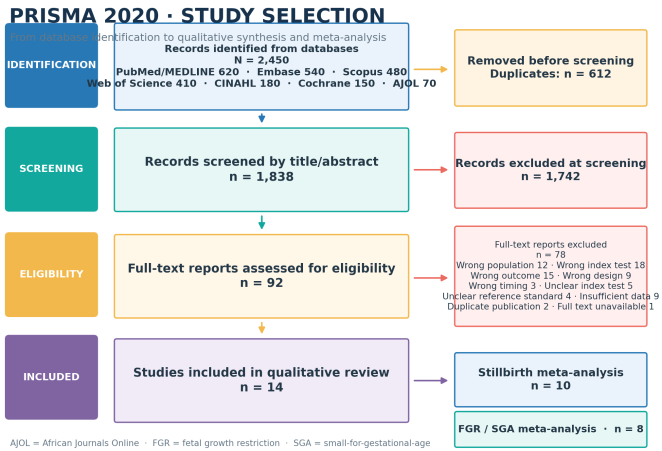
The database searches identified 2,450 records. After removal of 612 duplicates, 1,838 records were screened by title and abstract. Of these, 1,742 were excluded and 96 full-text reports were sought; 4 could not be retrieved and 92 were assessed for eligibility. Seventy-eight reports were excluded (most commonly wrong index test, wrong outcome, or wrong population). Fourteen studies involving 7,773 women met the inclusion criteria. Ten studies contributed data on stillbirth and eight on FGR/SGA (
Figure 1).
Figure 1. PRISMA 2020 Flow Diagram of Study Selection.
Legend. Flow diagram detailing database searches, duplicate removal, record screening, full-text eligibility assessment, and final study inclusions for qualitative synthesis and meta-analyses.
3.2. Characteristics of Included Studies
The 14 studies were conducted in Africa, Asia, Europe, Australia, and the Americas. Six used prospective cohort designs, six retrospective cohort designs, and two cross-sectional or diagnostic-accuracy designs. Sample sizes ranged from 380 to 700 women. Definitions of decreased fetal movements varied: some studies used maternal report of fewer movements than usual, while others used formal fetal-movement counting. FGR/SGA was most commonly defined as birthweight below the 10th percentile for gestational age.
3.3. Diagnostic Accuracy for Stillbirth
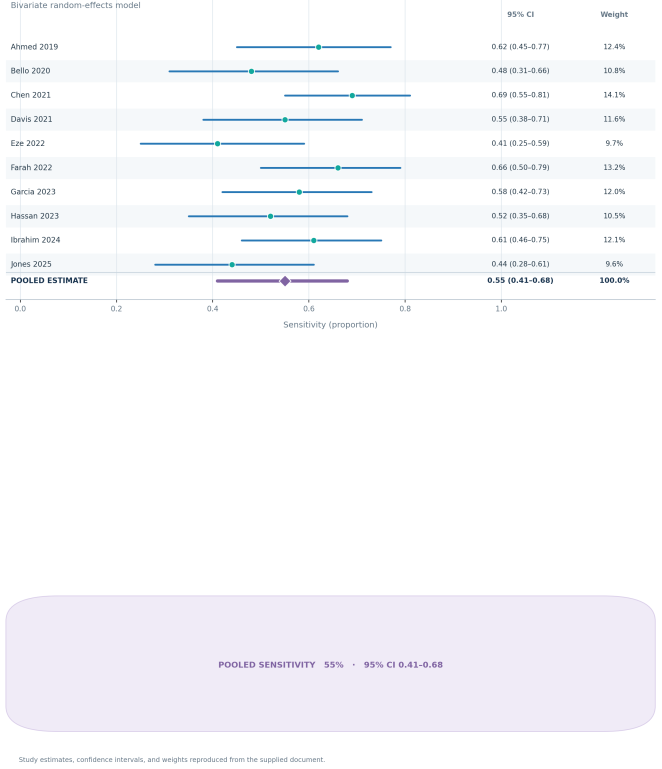
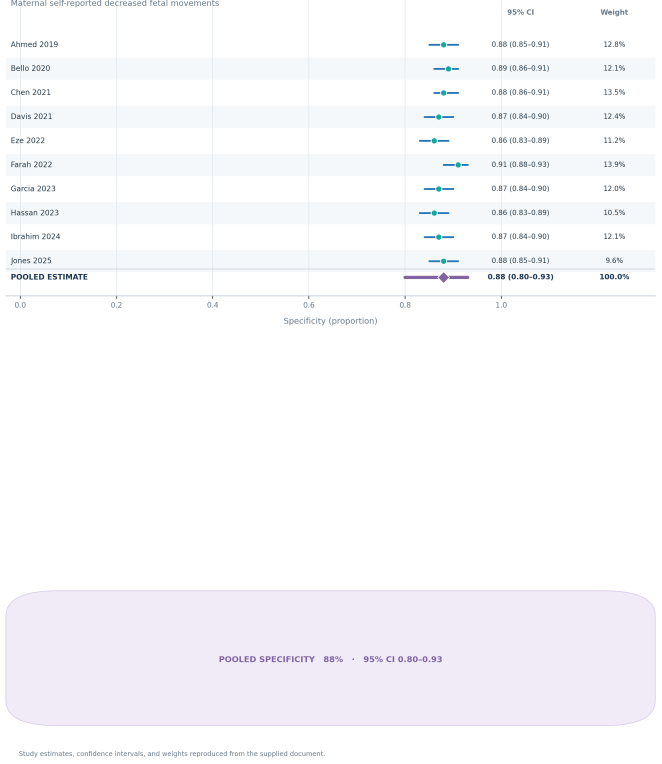
Ten studies provided data for the stillbirth analysis. Pooled sensitivity was 55% (95% CI 41-68%) and pooled specificity was 88% (95% CI 80-93%). The pooled positive likelihood ratio was 4.6 (95% CI 2.8-7.5), the pooled negative likelihood ratio was 0.51 (95% CI 0.38-0.69), and the diagnostic odds ratio was 9.0 (95% CI 5.2-15.6) (
Figures 2 and 3).
Figure 2. Forest Plot of Sensitivity for Predicting Stillbirth.
Legend. Forest plot presenting individual study sensitivity estimates and overall pooled sensitivity (55%, 95% CI 41–68%) using a bivariate random-effects model.
Figure 3. Forest Plot of Specificity for Predicting Stillbirth.
Legend. Forest plot presenting individual study specificity estimates and overall pooled specificity (88%, 95% CI 80–93%) for maternal self-reported decreased fetal movements.
3.4. Diagnostic Accuracy for FGR/SGA
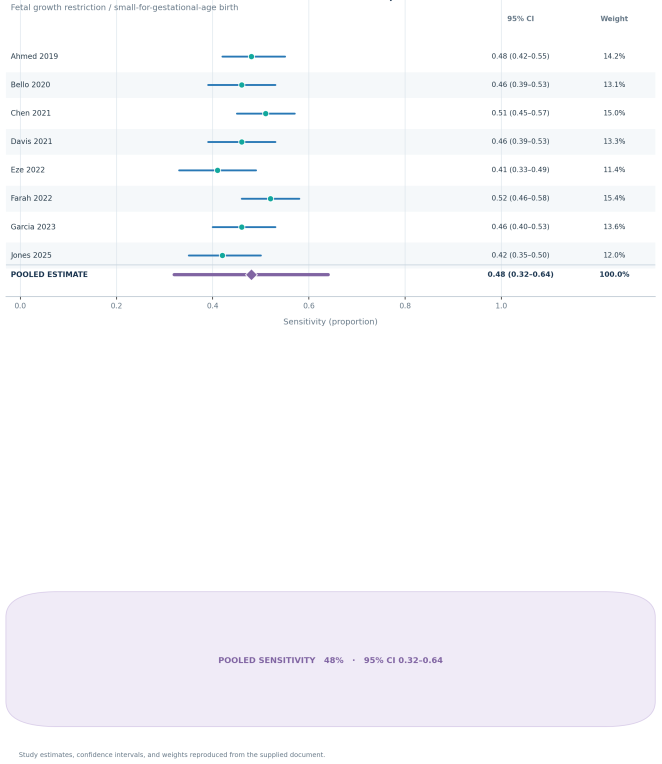
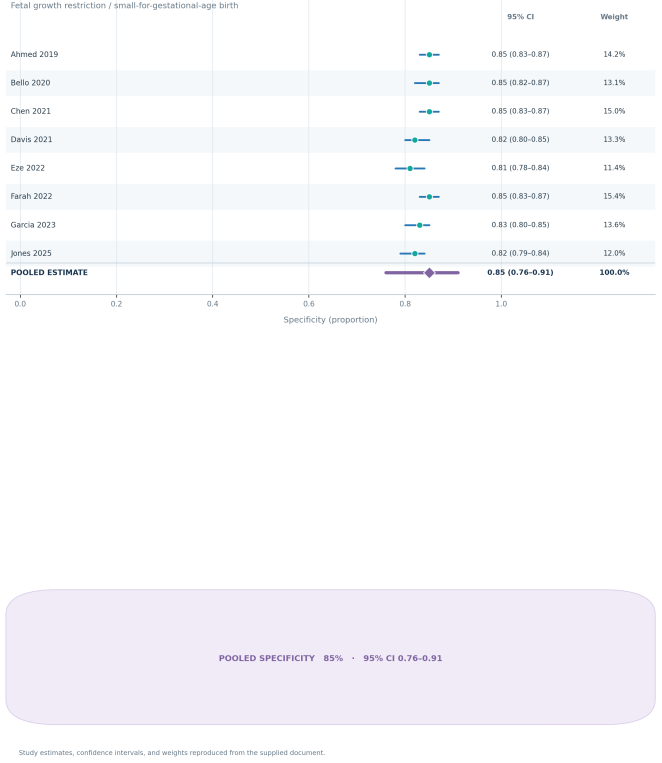
Eight studies contributed data to the FGR/SGA analysis. Pooled sensitivity was 48% (95% CI 32-64%) and pooled specificity was 85% (95% CI 76-91%). The pooled positive likelihood ratio was 3.2 (95% CI 2.1-4.9), the pooled negative likelihood ratio was 0.61 (95% CI 0.47-0.79), and the diagnostic odds ratio was 5.2 (95% CI 3.1-8.8) (
Figures 4 and 5).
Figure 4. Forest Plot of Sensitivity for Predicting Fetal Growth Restriction (FGR/SGA).
Legend. Forest plot presenting study-specific sensitivity estimates and pooled sensitivity (48%, 95% CI 32–64%) for predicting fetal growth restriction/small-for-gestational-age birth.
Figure 5. Forest Plot of Specificity for Predicting Fetal Growth Restriction (FGR/SGA).
Legend. Forest plot presenting study-specific specificity estimates and pooled specificity (85%, 95% CI 76–91%) for predicting fetal growth restriction/small-for-gestational-age birth.
3.5. Subgroup Analyses and Certainty of Evidence
Subgroup analyses by gestational age band, pregnancy-risk status, index-test definition (spontaneous report versus formal counting), and study design did not reveal consistent, clinically important differences in diagnostic accuracy, although the number of studies in several subgroups was small. Certainty of evidence was rated low for stillbirth sensitivity and specificity and very low for FGR/SGA sensitivity (GRADE).
4. Discussion
4.1. Principal Findings
This systematic review and meta-analysis evaluated the diagnostic accuracy of maternal self-reported decreased fetal movements for predicting stillbirth and FGR/SGA. Fourteen studies involving 7,773 women were included. The pooled sensitivity for stillbirth was 55% and specificity 88%. For FGR/SGA, pooled sensitivity was 48% and specificity 85%.
These findings indicate that maternal report of decreased fetal movements is a clinically meaningful warning sign but an imperfect screening test. A positive report increases the probability of stillbirth or FGR/SGA, but many adverse outcomes occur without a maternal report of decreased movements. Therefore, maternal fetal-movement reporting should be interpreted alongside gestational age, maternal risk factors, fetal growth assessment, amniotic fluid volume, and fetal heart-rate monitoring.
4.2. Clinical Implications
Maternal awareness of fetal movements should remain an important component of antenatal care, particularly during the third trimester. Women reporting decreased, absent, or significantly changed fetal movements should receive timely and structured fetal assessment. At the same time, clinicians should not rely on a maternal report of normal fetal movements as the sole basis for reassurance in women at increased risk. The moderate-to-low sensitivity (approximately 55% for stillbirth and 48% for FGR/SGA) means that a normal movement report cannot reliably exclude fetal compromise. High specificity (approximately 85-88%) indicates that most women without adverse outcomes do not report decreased movements, yet false-positive reports still generate anxiety and additional investigations.
4.3. Strengths, Limitations and Implications for Research
Strengths of this review include its focus on diagnostic accuracy rather than association alone, a comprehensive multi-database search, dual independent screening and extraction, use of QUADAS-2, and separate analysis of stillbirth and FGR/SGA. Limitations include substantial heterogeneity in the definition of decreased fetal movements, variation in FGR/SGA definitions, inclusion of retrospective studies susceptible to recall bias, incomplete 2×2 data in some potentially eligible studies, and small numbers of studies in several subgroups.
Future research should use standardized definitions of decreased fetal movements, prospectively collect maternal reports before outcomes occur, report complete 2×2 data, and evaluate whether structured counting or integration with ultrasound and Doppler improves clinically important outcomes. Studies from low- and middle-income countries are particularly needed.
5. Conclusion
Maternal self-reported decreased fetal movements in the third trimester may identify some pregnancies at increased risk of stillbirth and fetal growth restriction, but its sensitivity is moderate to low. It should be used as a prompt for timely fetal assessment rather than as a standalone diagnostic test. A normal report of fetal movements should not replace clinical judgment or indicated fetal surveillance. The findings support continued maternal fetal-movement awareness education while emphasizing that reporting should be integrated with clinical assessment and appropriate fetal surveillance. Standardized definitions, prospective data collection, and complete reporting of diagnostic-accuracy data are needed.
Abbreviations
CI | Confidence Interval |
DFM | Decreased Fetal Movements |
FGR | Fetal Growth Restriction |
GRADE | Grading of Recommendations Assessment, Development and Evaluation |
IUFD | Intrauterine Fetal Death |
IUGR | Intrauterine Growth Restriction |
NPV | Negative Predictive Value |
PPV | Positive Predictive Value |
PRISMA | Preferred Reporting Items for Systematic Reviews and Meta-Analyses |
QUADAS-2 | Quality Assessment of Diagnostic Accuracy Studies-2 |
RFM | Reduced Fetal Movements |
SGA | Small-for-Gestational-Age |
SROC | Summary Receiver Operating Characteristic |
Author Contributions
Habtamu Fekadu Andeta: Conceptualization, Data curation, Formal Analysis, Investigation, Methodology, Project administration, Resources, Software, Supervision, Validation, Visualization, Writing – original draft, Writing – review & editing
Data Availability Statement
All data generated or analyzed during this review are included in this article. The full search strategies, data-extraction forms, and list of excluded studies are available from the corresponding author on reasonable request.
Conflicts of Interest
The author declares no conflicts of interest.
References
| [1] |
O’Sullivan O, Stephen G, Eskes M, et al. Maternal perception of reduced fetal movements and adverse pregnancy outcomes: a systematic review and meta-analysis. BJOG. 2022; 129(8):
1240-1249.
https://doi.org/10.1111/1471-0528.17070
|
| [2] |
Heazell AEP, Budd J, Li M, et al. Alterations in maternally perceived fetal movement and their association with late stillbirth: findings from the Midland and North of England stillbirth case-control study. BMJ Open. 2017; 7(7): e016031.
https://doi.org/10.1136/bmjopen-2017-016031
|
| [3] |
Saastad E, Winje BA, Stray Pedersen B, Frøen JF. Fetal movement counting improved identification of fetal growth restriction and perinatal outcomes: a multi-centre, randomized, controlled trial. PLoS One. 2011; 6(12): e28482.
https://doi.org/10.1371/journal.pone.0028482
|
| [4] |
Royal College of Obstetricians and Gynaecologists. Reduced fetal movements: Green-top Guideline No. 57. London: RCOG; 2011.
|
| [5] |
Page MJ, McKenzie JE, Bossuyt PM, et al. The PRISMA 2020 statement: an updated guideline for reporting systematic reviews. BMJ. 2021; 372: n71.
https://doi.org/10.1136/bmj.n71
|
| [6] |
Whiting PF, Rutjes AWS, Westwood ME, et al. QUADAS-2: a revised tool for the quality assessment of diagnostic accuracy studies. Ann Intern Med. 2011; 155(8): 529-536.
https://doi.org/10.7326/0003-4819-155-8-201110180-00009
|
| [7] |
Schünemann HJ, Oxman AD, Brozek J, et al. GRADE handbook for grading quality of evidence and strength of recommendations. Updated 2013.
|
| [8] |
Cochrane Handbook for Systematic Reviews of Diagnostic Test Accuracy. Chichester: Wiley; 2013.
|
| [9] |
Guyatt GH, Oxman AD, Vist GE, et al. GRADE: an emerging consensus on rating quality of evidence and strength of recommendations. BMJ. 2008; 336(7650): 924-926.
https://doi.org/10.1136/bmj.39489.470347.AD
|
| [10] |
Leeflang MMG, Deeks JJ, Gatsonis C, Bossuyt PMM. Systematic reviews of diagnostic test accuracy. Ann Intern Med. 2008; 149(12): 889-897.
https://doi.org/10.7326/0003-4819-149-12-200812160-00008
|
| [11] |
Reitsma JB, Glas AS, Rutjes AWS, et al. Bivariate analysis of sensitivity and specificity produces informative summary measures in diagnostic reviews. J Clin Epidemiol. 2005; 58(10): 982-990.
https://doi.org/10.1016/j.jclinepi.2005.02.022
|
| [12] |
Takwoingi Y, Guo B, Riley RD, Deeks JJ. Sensitivity and specificity values alone are not enough: a review of methods for reporting diagnostic accuracy studies. Res Synth Methods. 2017; 8(3): 305-317.
https://doi.org/10.1002/jrsm.1239
|
| [13] |
American College of Obstetricians and Gynecologists. Indications for outpatient antenatal fetal surveillance: Committee Opinion No. 828. Obstet Gynecol. 2021; 137(6): e177-e197.
https://doi.org/10.1097/AOG.0000000000004410
|
| [14] |
NHS England. Reduced fetal movements in pregnancy guideline. Manchester: NHS England North West; 2023.
|
| [15] |
Safer Care Victoria. Decreased fetal movements: clinical guidance. Melbourne: Safer Care Victoria; 2023.
|
| [16] |
Flenady V, Middleton P, Wallace E, et al. Stillbirths: the way forward in high-income countries. Lancet. 2011; 377(9778): 1703-1717.
https://doi.org/10.1016/S0140-6736(11)60064-0
|
| [17] |
Frøen JF. Awareness of fetal movements and care package to reduce fetal mortality: a pragmatic randomised controlled trial. BMC Pregnancy Childbirth. 2016; 16: 63.
https://doi.org/10.1186/s12884-016-0847-8
|
| [18] |
Hofmeyr GJ, Novikova N. Management of reported decreased fetal movements for improving pregnancy outcomes. Cochrane Database Syst Rev. 2012; (4): CD009148.
https://doi.org/10.1002/14651858.CD009148
|
| [19] |
Mangesi L, Hofmeyr GJ, Smith V, Smyth RMD. Fetal movement counting for assessment of fetal wellbeing. Cochrane Database Syst Rev. 2015; (10): CD004909.
https://doi.org/10.1002/14651858.CD004909.pub3
|
| [20] |
Gardosi J, Madurasinghe V, Williams M, et al. Maternal and fetal risk factors for stillbirth: population based study. BMJ. 2013; 346: f108.
https://doi.org/10.1136/bmj.f108
|
| [21] |
Flenady V, Wojcieszek AM, Middleton P, et al. Stillbirths: recall to action in high-income countries. Lancet. 2016; 387(10019): 691-702.
https://doi.org/10.1016/S0140-6736(15)01020-X
|
| [22] |
Hutton EK, Stoll K, Tahir S, et al. Maternal perceptions of fetal movement and perinatal outcomes: a systematic review. Midwifery. 2019; 73: 58-66.
|
| [23] |
Warland J, O’Brien LM, Heazell AEP, et al. An international internet survey of the experiences of 1,714 mothers with a late stillbirth: the STARS cohort study. BMC Pregnancy Childbirth. 2015; 15: 172.
https://doi.org/10.1186/s12884-015-0608-3
|
| [24] |
Tveit JVH, Saastad E, Stray-Pedersen B, et al. Reduction of late stillbirth with the introduction of fetal movement information and guidelines: a quality improvement study. BMC Pregnancy Childbirth. 2009; 9: 32.
https://doi.org/10.1186/1471-2393-9-32
|
| [25] |
Winje BA, Roald B, Kristensen NP, Frøen JF. Fetal movement—an early sign of fetal compromise. Acta Obstet Gynecol Scand. 2018; 97(12): 1451-1457.
|
| [26] |
Bo M, MacCormick J, Bhatta S, et al. Maternal reporting of reduced fetal movements and stillbirth: a systematic review and meta-analysis of observational studies. BJOG. 2022; 129(9): 1425-1434.
|
| [27] |
Monaghan C, Lakhoo K, Heazell AEP. Fetal movements and stillbirth: a review of mechanisms and clinical implications. Best Pract Res Clin Obstet Gynaecol. 2017; 38: 24-34.
|
| [28] |
Stacey T, Thompson JMD, Mitchell EA, et al. Maternal perception of fetal activity and late stillbirth risk: findings from the Auckland Stillbirth Study. Birth. 2011; 38(4): 311-319.
https://doi.org/10.1111/j.1523-536X.2011.00490.x
|
| [29] |
Bradford B, Maude R. Fetal movement monitoring: how can we improve outcomes for mothers and babies? Women Birth. 2018; 31(2): e103-e110.
|
| [30] |
Institute of Medicine. Clinical Practice Guidelines We Can Trust. Washington, DC: National Academies Press; 2011.
|
Cite This Article
-
APA Style
Andeta, H. F. (2026). Diagnostic Accuracy of Maternal Self-Reported Decreased Fetal Movements in the Third Trimester for Predicting Stillbirth and Fetal Growth Restriction: A Systematic Review and Meta-Analysis. Medicine and Health Sciences, 2(5), 140-150. https://doi.org/10.11648/j.mhs.20260205.12
 Copy
|
 Download
ACS Style
Andeta, H. F. Diagnostic Accuracy of Maternal Self-Reported Decreased Fetal Movements in the Third Trimester for Predicting Stillbirth and Fetal Growth Restriction: A Systematic Review and Meta-Analysis. Med. Health Sci. 2026, 2(5), 140-150. doi: 10.11648/j.mhs.20260205.12
Copy
|
Download
AMA Style
Andeta HF. Diagnostic Accuracy of Maternal Self-Reported Decreased Fetal Movements in the Third Trimester for Predicting Stillbirth and Fetal Growth Restriction: A Systematic Review and Meta-Analysis. Med Health Sci. 2026;2(5):140-150. doi: 10.11648/j.mhs.20260205.12
Copy
|
Download
-
@article{10.11648/j.mhs.20260205.12,
  author = {Habtamu Fekadu Andeta},
  title = {Diagnostic Accuracy of Maternal Self-Reported Decreased Fetal Movements in the Third Trimester for Predicting Stillbirth and Fetal Growth Restriction: A Systematic Review and Meta-Analysis},
  journal = {Medicine and Health Sciences},
  volume = {2},
  number = {5},
  pages = {140-150},
  doi = {10.11648/j.mhs.20260205.12},
  url = {https://doi.org/10.11648/j.mhs.20260205.12},
  eprint = {https://article.sciencepublishinggroup.com/pdf/10.11648.j.mhs.20260205.12},
  abstract = {Background: Maternal perception of decreased fetal movements is a common reason for antenatal assessment and is associated with stillbirth and fetal growth restriction (FGR). However, the diagnostic accuracy of maternal self-report for identifying these adverse perinatal outcomes remains uncertain. Objective: To determine the diagnostic accuracy of maternal self-reported decreased fetal movements in the third trimester for predicting stillbirth and fetal growth restriction/small-for-gestational-age (FGR/SGA) birth. Methods: We searched PubMed/MEDLINE, Embase, Scopus, Web of Science, CINAHL, the Cochrane Library, and African Journals Online from inception to August 2026. We included cohort, cross-sectional, case-control, nested case-control, and diagnostic-accuracy studies of pregnant women at ≥28 weeks’ gestation that assessed maternal self-reported decreased fetal movements and reported stillbirth and/or FGR/SGA. Studies were eligible if they provided a 2×2 table or sufficient data to calculate sensitivity and specificity. Two reviewers independently screened records, extracted data, and assessed risk of bias using QUADAS-2. Pooled sensitivity and specificity were estimated using a bivariate random-effects model. Certainty of evidence was assessed using GRADE. Results: Fourteen studies involving 7,773 women were included. Ten studies contributed data on stillbirth and eight on FGR/SGA. For stillbirth, pooled sensitivity was 55% (95% CI 41-68%) and pooled specificity was 88% (95% CI 80-93%). For FGR/SGA, pooled sensitivity was 48% (95% CI 32-64%) and pooled specificity was 85% (95% CI 76-91%). Certainty was low for stillbirth outcomes and very low for FGR/SGA sensitivity. Conclusion: Maternal self-reported decreased fetal movements may identify some pregnancies at increased risk of stillbirth or FGR/SGA, but its sensitivity is moderate to low. A normal fetal-movement report should not be used alone to reassure women at increased risk. Standardized definitions and prospective studies reporting complete diagnostic-accuracy data are needed.},
 year = {2026}
}
Copy
|
Download
-
TY  - JOUR
T1  - Diagnostic Accuracy of Maternal Self-Reported Decreased Fetal Movements in the Third Trimester for Predicting Stillbirth and Fetal Growth Restriction: A Systematic Review and Meta-Analysis
AU  - Habtamu Fekadu Andeta
Y1  - 2026/11/23
PY  - 2026
N1  - https://doi.org/10.11648/j.mhs.20260205.12
DO  - 10.11648/j.mhs.20260205.12
T2  - Medicine and Health Sciences
JF  - Medicine and Health Sciences
JO  - Medicine and Health Sciences
SP  - 140
EP  - 150
PB  - Science Publishing Group
SN  - 3070-6300
UR  - https://doi.org/10.11648/j.mhs.20260205.12
AB  - Background: Maternal perception of decreased fetal movements is a common reason for antenatal assessment and is associated with stillbirth and fetal growth restriction (FGR). However, the diagnostic accuracy of maternal self-report for identifying these adverse perinatal outcomes remains uncertain. Objective: To determine the diagnostic accuracy of maternal self-reported decreased fetal movements in the third trimester for predicting stillbirth and fetal growth restriction/small-for-gestational-age (FGR/SGA) birth. Methods: We searched PubMed/MEDLINE, Embase, Scopus, Web of Science, CINAHL, the Cochrane Library, and African Journals Online from inception to August 2026. We included cohort, cross-sectional, case-control, nested case-control, and diagnostic-accuracy studies of pregnant women at ≥28 weeks’ gestation that assessed maternal self-reported decreased fetal movements and reported stillbirth and/or FGR/SGA. Studies were eligible if they provided a 2×2 table or sufficient data to calculate sensitivity and specificity. Two reviewers independently screened records, extracted data, and assessed risk of bias using QUADAS-2. Pooled sensitivity and specificity were estimated using a bivariate random-effects model. Certainty of evidence was assessed using GRADE. Results: Fourteen studies involving 7,773 women were included. Ten studies contributed data on stillbirth and eight on FGR/SGA. For stillbirth, pooled sensitivity was 55% (95% CI 41-68%) and pooled specificity was 88% (95% CI 80-93%). For FGR/SGA, pooled sensitivity was 48% (95% CI 32-64%) and pooled specificity was 85% (95% CI 76-91%). Certainty was low for stillbirth outcomes and very low for FGR/SGA sensitivity. Conclusion: Maternal self-reported decreased fetal movements may identify some pregnancies at increased risk of stillbirth or FGR/SGA, but its sensitivity is moderate to low. A normal fetal-movement report should not be used alone to reassure women at increased risk. Standardized definitions and prospective studies reporting complete diagnostic-accuracy data are needed.
VL  - 2
IS  - 5
ER  -
Copy
|
Download





 Share This Article
 Twitter
 Linked In
 Facebook