Abstract
Wheat is a major staple crop in Ethiopia, but its productivity is severely constrained by yellow rust (Puccinia striiformis f.sp. tritici), the most economically important wheat disease. A rain-fed field experiment was conducted in 2019 in the mid-highlands of East Gojjam (Goncha Siso Enesie district, Enesie Qole Kebele) to evaluate integrated management options combining fungicide application frequency and varietal resistance. Three bread wheat varieties (Tay, Picaflor, and Kubsa) with differing reactions to yellow rust were tested under four Tilt 250 EC (propiconazole) application frequencies (0, 1, 2, and 3) in a randomized complete block design with three replications. Terminal disease severity was recorded at 18.2% for Tay, 23.0% for Picaflor, and 44.0% for Kubsa under untreated conditions. When fungicides were applied three times at 10?day intervals, the highest percent disease control (PDC) achieved was 59.2% in Tay, 52.9% in Picaflor, and 71.9% in Kubsa. Yield and thousand kernel weight increased significantly (p<0.01) with three applications: up to 40.9% and 27.7% in moderately resistant Tay, 48.3% and 55.2% in moderately susceptible Picaflor, and 41.2% and 70.4% in highly susceptible Kubsa. These results demonstrate that combining host resistance with optimal fungicide frequency effectively manages yellow rust in bread wheat. Further research is needed to deploy eco-friendly management strategies.
|
Published in
|
American Journal of Plant Biology (Volume 11, Issue 3)
|
|
DOI
|
10.11648/j.ajpb.20261103.13
|
|
Page(s)
|
56-64 |
|
Creative Commons
|

This is an Open Access article, distributed under the terms of the Creative Commons Attribution 4.0 International License (http://creativecommons.org/licenses/by/4.0/), which permits unrestricted use, distribution and reproduction in any medium or format, provided the original work is properly cited.
|
|
Copyright
|
Copyright © The Author(s), 2026. Published by Science Publishing Group
|
Keywords
Bread Wheat, Fungicide, Management, Yellow Rust
1. Introduction
Wheat (
Triticum aestivum) is one of the most important cereal crops globally, serving as a staple food for more than one-third of the world’s population (FAO, 2018). In Ethiopia, wheat is also a key food crop, yet its average yield in 2018 was only 1.83 t ha
-1 | [2] | Central Statistical Agency (CSA). Agricultural sample survey, 2017/2018: Report on area and production of crops (Private peasant holdings, main season). Addis Ababa: Statistical Authority; 2018. Statistical Bulletin No. 446, Vol. 5. 60 p. |
[2]
, far below the global average of 3.47 t ha
-1 | [1] | FAO, IFAD, UNICEF, WFP, WHO. The state of food security and nutrition in the world 2018: Building climate resilience for food security and nutrition. Rome: FAO; 2018. Licence: CC BY-NC-SA 3.0 IGO. Available from:
https://creativecommons.org/licenses/by-nc-sa/3.0/igo |
[1]
. Despite favorable agro-ecological conditions and the availability of high-yielding varieties, productivity remains low, largely due to the prevalence of wheat diseases, particularly rusts
| [3] | Hailu E, Woldeab G. Survey of rust and Septoria leaf blotch diseases of wheat in Central Ethiopia and virulence diversity of stem rust (Pucciniagraminis f. sp. tritici). Adv Crop Sci Technol. 2015; 3(2): 2–5.
https://doi.org/10.4172/2329-8863.1000169 |
[3]
.
Among the rust diseases, yellow rust (
Puccinia striiformis f.sp. tritici) is the most destructive, especially in cool climates, and is a major constraint to wheat production worldwide
| [4] | Aquino P, Carrion F, Calvo R. Selected wheat statistics. In: Ekboir J, editor. World wheat overview and outlook 2002–2001: Developing no-till packages for small-scale farmers. Mexico DF: CIMMYT; 2002. p. 52–62. |
| [5] | Singh RP, William HM, Huerta-Espino J, Rosewarne G. International surveillance of wheat rust pathogens: progress and challenges. In: Proceedings of the 4th International Crop Science Congress; 2004. |
| [6] | Chen XM. Epidemiology and control of stripe rust (Pucciniastriiformis f. sp. tritici) on wheat. Can J Plant Pathol. 2005; 27(3): 314–37. https://doi.org/10.1080/07060660509507230 |
[4-6]
. In Ethiopia, yellow rust is a serious threat in bread wheat producing areas, including the mid-highlands of
Goncha Siso Enesie, where epidemics can cause yield losses of up to 32%
| [7] | Wendale L, Ayalew H, Woldeab G, Mulugeta G. Yellow rust (Pucciniastriiformis) epidemics and yield loss assessment on wheat and triticale crops in Amhara region, Ethiopia. Afr J Crop Sci. 2016; 4(2): 280–5. |
[7]
. Farmers in these areas commonly rely on fungicides such as Tilt 250 EC and Mancozeb to mitigate losses.
However, the long-term reliance on Tilt 250 EC has raised concerns. Continuous use of the same fungicide has been linked to pathogen resistance
| [8] | International Maize and Wheat Improvement Center (CIMMYT). Sounding the alarm on global stem rust: An assessment of race Ug99 in Kenya and Ethiopia and the potential for impact in neighboring regions and beyond. Mexico DF: CIMMYT; 2005. Expert Panel Report. 26 p. |
[8]
. Similarly, resistant wheat varieties often lose effectiveness due to the emergence of new races or environmental changes
. While resistant varieties are considered the most economical and environmentally friendly option
| [10] | Mitiku M, Bacha N, Abera M. Characterization of slow rusting resistance against stem rust (Pucciniagraminis f. sp. tritici) in selected bread wheat cultivars of Ethiopia. Adv Crop Sci Technol. 2018; 6(5): 389.
https://doi.org/10.4172/2329-8863.1000389 |
[10]
, their durability is limited, and chemical control remains necessary to safeguard food security
.
Despite extensive research, yellow rust continues to be a major production constraint in Ethiopia. The frequent breakdown of varietal resistance, the development of fungicide resistance, and the limited effectiveness of single fungicide applications highlight the need for integrated management strategies. In particular, there is insufficient information on the combined effects of varietal resistance and fungicide application frequency under rain-fed conditions in the mid-highlands of East Gojjam. This study was conducted to develop integrated yellow rust management options by evaluating the interaction between bread wheat varieties and optimal fungicide application frequencies under rain-fed conditions.
2. Materials and Methods
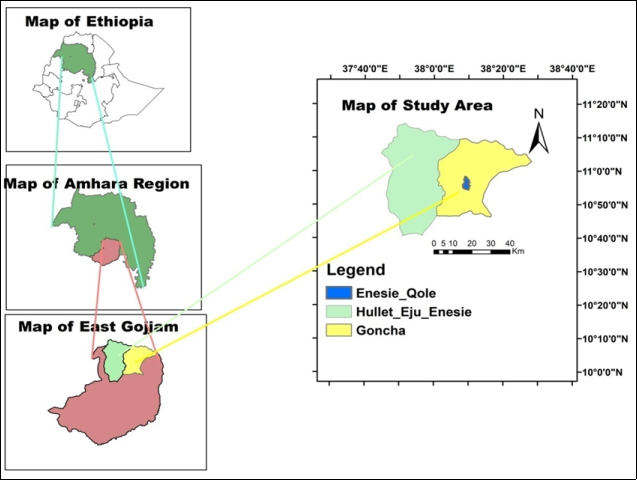
The field experiment was carried out in the 2019 main cropping season at the Farmers Training Center in Enesie Qole Kebele, within the Goncha Siso Enesie district of East Gojjam, Northwestern Ethiopia. The site is situated at 10°55′35″ N and 38°09′32″ E, with an elevation of 2665 meters above sea level. It belongs to the Woyna-Dega agro-ecological zone, which experiences a bimodal rainfall pattern: minor rains occur from March to June, followed by the principal rainy season from July to October. Annual precipitation ranges between 1500 and 1800 mm, while mean temperatures vary from 9°C to 18°C. The soil is classified as clay loam with strong acidity (pH approximately 5.5). The area is widely cultivated with maize (Zea mays), tef (Eragrostis tef), and bread wheat (Triticum aestivum L.), and is notably recognized as a hotspot for yellow rust epidemics in wheat.
Figure 1. Maps the of study area.
Three bread wheat varieties with differing resistance levels to yellow rust were selected: Tay (moderately resistant, MR), Picaflor (moderately susceptible, MS), and Kubsa (highly susceptible, HS) (
Table 1). Tilt 250 EC (propiconazole) was used as the fungicide component. Treatments consisted of 12 combinations: three varieties × four fungicide application frequencies (0, 1, 2, and 3 sprays).
Table 1. Agronomic and pathological characteristics of bread wheat varieties used in the experiment.
Variety | Pedigree | Yield at the time of release (ton ha-1) | Year of release | Releasing Center | Reaction to Yellow Rust |
Research field | Farmers field |
Kubsa | HAR1685 | 5.8-6.3 | 4-4.5 | 1995 | EIAR | HS |
Picaflor | NA | 3-4 | 3.3-5.2 | 2010 | EIAR | MS |
Tay | HAR604 | 2.5-6.1 | 3.4-5.8 | 2005 | AARC | MR |
NA= Not available, MR = moderately resistant, MS = moderately susceptible, HS = highly susceptible, EIAR = Ethiopian Institute of Agricultural Research, AARC = Adet Agricultural Research Center
The experiment was arranged in a randomized complete block design (RCBD) with three replications. Each plot contained 10 rows of 3 m length, giving a gross plot size of 2 m × 3 m (6 m²). The net plot size was the middle six rows (3.6 m²). Row spacing was 0.2 m, with 1 m between plots and 2 m between replications. Seeds were sown manually at a rate of 150 kg ha-1 on July 19, 2019. Fertilizers were applied at planting: NPSB at 100 kg ha-1 and urea at 261 kg ha-1. Weeds were controlled manually twice during the season.
Fungicide application was carried out using a manual knapsack sprayer at the manufacturer’s recommended rate of 0.5 L ha-1. Sprays were applied at 10-day intervals, beginning at the first appearance of yellow rust symptoms. Plastic sheets were used to protect adjacent plots during spraying.
Data were collected from both plot and plant bases. Plot-based data were taken from the six central rows (3.6 m2), while plant-based data were recorded from 10 randomly pre-tagged plants per plot.
Disease incidence was measured from 10 randomly pre-tagged plants in each plot. It was calculated as the proportion of diseased plants, expressed as a percentage, using the following formula:
(1)
The severity of yellow rust was assessed at 10 days interval from the disease appearance until maturity of the crop by using modified Cobb scale by estimating the approximate percentage of leaf area affected from 10 randomly selected plants taken at central rows of each plot
| [12] | Peterson RF, Campbell AB, Hannah AE. A diagrammatic scale for estimating rust intensity of leaves and stem of cereals. Can J Res Sect C. 1948; 26(5): 496–500.
https://doi.org/10.1139/cjr48c-033 |
[12]
.
(2)
The percent rust severity control was calculated by the following formula:
(3)
The Area Under Disease Progress Curve (AUDPC) was calculated using the corrected formula
.
(3)
Where, xi is the cumulative disease severity expressed as a proportion at the ith observation; ti is the time (days after planting) at the ith observation an n is total number of observations.
Infection rate was calculated from the four disease severity observations as a severity of yellow rust infection at the time of rust pustules appearance and every 10 days thereafter. It was estimated using the following formula adopted by
| [14] | Vander Plank JE. Plant disease epidemics and control. New York: Academic Press; 1963. |
[14]
.
(4)
Where x = the percent of severity divided by 100; t = time measured in days.
Yield-related traits, including grain yield (GY), thousand kernel weight (TKW), and aboveground biomass yield (AGBY), were assessed from the six central rows of each plot, with border rows excluded to minimize edge effects. Grain yield and biomass were expressed in tons per hectare, whereas TKW was determined in grams. For TKW, grains were randomly sampled from the total harvest of each plot. Grain moisture content was standardized to 12.5% at harvest. Yield increment (%YI), TKW, and GY for each cultivar were calculated relative to the corresponding protected plots of that variety.
Percent increases in yield and yield components by various treatments were calculated by using the formula:
Where, %YI =Percent yield increment (increment of the parameters grain yield and TKW, Y1 = mean of the respective parameter on protected plots (plots with maximum protection) and Y2=mean of the respective parameter in unprotected plots (i.e. unsprayed plots or sprayed plots with varying level of disease).
All collected data were subjected to analysis of variance (ANOVA) using the General Linear Model (GLM) procedure in SAS software
| [15] | SAS Institute Inc. SAS/STAT® 9.2 User’s Guide. Cary (NC): SAS Institute Inc.; 2008. |
[15]
. When significant differences among treatments were detected, mean separation was performed using the Least Significant Difference (LSD) test at the 5% probability level. This approach allowed for the identification of treatment effects on disease parameters and yield components with appropriate statistical rigor.
3. Results
Analysis revealed that terminal yellow rust severity differed significantly (p < 0.05) among the tested wheat varieties and across fungicide (Tilt 250 EC) application frequencies (
Table 2). In untreated plots, Kubsa exhibited 44.0% severity, Picaflor 23.0%, and Tay 18.06%. Following three fungicide sprays at 10 day intervals, terminal severity was reduced to 7.36% in the moderately resistant variety Tay and 12.3% in the highly susceptible variety Kubsa.
Table 2. Effect of fungicide application frequencies and bread wheat varieties on terminal yellow rust severity and percent disease control.
Variety | Fungicide frequency | TRS% | PDC% |
Tay | N | 18.06 c | 0 |
| 1F | 12.33 d | 31.72 |
| 2F | 8.76 e | 51.49 |
| 3F | 7.36 e | 59.24 |
Picaflor | N | 23.00 b | 0 |
| 1F | 19.00 c | 17.39 |
| 2F | 12.66 d | 44.95 |
| 3F | 10.83 d | 52.91 |
Kubsa | N | 44.00 a | 0 |
| 1F | 24.16 b | 45.09 |
| 2F | 16.83 c | 61.75 |
| 3F | 12.33 d | 71.97 |
CV | | 11.77 | |
LSD(0.01) | | 3.46 | |
TRS= terminal yellow rust severity, PDC= percent disease control, CV = coefficient of infection, LSD= least significance difference, N= nil application of fungicide, N = Nil application of fungicide, 1F = once application of fungicide, 2F = twice application of fungicide, 3F = three times of application of fungicide
Analysis of variance revealed that fungicide application frequency and bread wheat varieties showed significant difference (p < 0.05) in AUDPC of yellow rust (
Table 3).
Table 3.
Effects of fungicide application frequencies and bread wheat varieties to area under disease progress curve. Effects of fungicide application frequencies and bread wheat varieties to area under disease progress curve. Effects of fungicide application frequencies and bread wheat varieties to area under disease progress curve. Variety | Fungicide frequency |
N | 1F | 2F | 3F |
Tay | 359.18 bc | 197.67 ef | 168.17 ef | 156.72 ef |
Picaflor | 365.68 bc | 315.67 cd | 233.67 def | 202.85 ef |
Kubsa | 828.67 a | 455.50 b | 361.83 bc | 279.50 cde |
LSD | 80.22 | | | |
CV | 14.55 | | | |
DAS = Days after sowing, CV = coefficient of infection, LSD= least significance difference, N = Nil application of fungicide, 1F = once application of fungicide, 2F = twice application of fungicide, 3F = three times of application of fungicide
Infection rate was significantly (p < 0.05) affected by treatments and their combinations from initial disease assessment (58 DAS) to each intervals days of assessment (
Table 4).
Table 4. Effects of fungicide application frequencies and bread wheat varieties on infection rate at each interval of days of assessment.
Variety | FF | Intervals of Days of Assessments |
68DAS | 78DAS | 88DAS |
Tay | N | 0.17585ab | 0.137374bc | 0.097648bc |
| 1F | 0.08713c | 0.068367f | 0.055589hi |
| 2F | 0.08176cd | 0.063766f | 0.045640h |
| 3F | 0.05292d | 0.041491g | 0.031433j |
Picaflor | N | 0.16453 b | 0.13972ab | 0.112121a |
| 1F | 0.16543b | 0.122463bc | 0.103424ab |
| 2F | 0.16607b | 0.1028858e | 0.086027de |
| 3F | 0.16543b | 0.098796e | 0.079581ef |
Kubsa | N | 0.20118a | 0.153833a | 0.103841ab |
| 1F | 0.19660ab | 0.144248ab | 0.092308cd |
| 2F | 0.18561ab | 0.124042cd | 0.071482fg |
| 3F | 0.18413ab | 0.1187573d | 0.064996gh |
| LSD | 0.038 | 0.0145 | 0.0107 |
| CV | 12.86 | 7.84 | 8.08 |
CV = coefficient of infection, LSD= least significance difference, FF= fungicide application frequency, DAS= days after sowing, 1F = once application of fungicide, 2F = twice application of fungicide, 3F = three times of application of fungicide
The analysis revealed that the interaction effect of fungicide application frequency and bread wheat varieties significantly (P < 0.05) affected grain yield (
Table 5).
Table 5. Effects of fungicide application frequencies and bread wheat varieties on grain yield.
Treatment | GY (ton ha-1) | Incr (%) |
Variety | Fungicide frequency |
Tay | N | 3.02c | 0 |
| 1F | 3.24b | 10.59 |
| 2F | 3.31b | 9.60 |
| 3F | 3.49a | 15.56 |
Picaflor | N | 2.76d | 0 |
| 1F | 3.16b | 14.49 |
| 2F | 3.56a | 28.29 |
| 3F | 3.67a | 32.97 |
Kubsa | N | 2.10e | 0 |
| 1F | 2.78d | 32.38 |
| 2F | 3.31a | 57.61 |
| 3F | 3.41a | 62.38 |
GY= grain yield, Incr = Increment, 1F = once application of fungicide, 2F = twice application of fungicide, 3F = three times of application of fungicide
The analysis of variance revealed that the interaction effect of fungicide spraying frequency and variety had very high significant (p<0.05) effect on TKW (
Table 6).
Table 6. Effects of fungicide application frequencies and bread wheat varieties on thousand kernels weight.
Treatment | TKW (gm) | Inc (%) |
Variety | Fungicide frequency |
Tay | N | 32.07 e | 0 |
| 1F | 36.77 cd | 14.65 |
| 2F | 39.08 bc | 21.85 |
| 3F | 40.96 b | 27.72 |
Picaflor | N | 31.08 e | 0 |
| 1F | 40.63 b | 51.5 |
| 2F | 47.23 a | 51.9 |
| 3F | 48.24 a | 55.2 |
Kubsa | N | 24.18 f | 0 |
| 1F | 32.01 e | 32.38 |
| 2F | 34.4 de | 42.26 |
| 3F | 41.22 b | 70.47 |
TKW= thousand kernel weight, 1F = once application of fungicide, 2F = twice application of fungicide, 3F = three times of application of fungicide
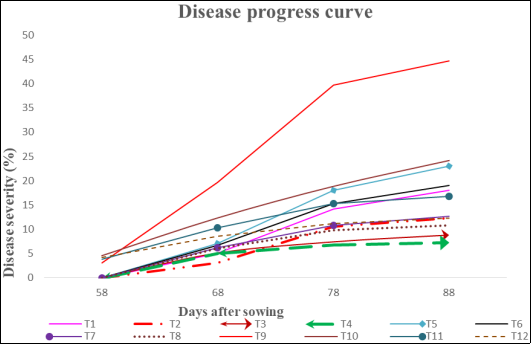
Yellow rust was progressed from booting to maturity on Kubsa and Tay variety and from heading to maturity on Picaflor. On Kubsa the yellow rust severity was reached above 19.6% with a few days after the occurrence of the disease (
Figure 2), but on Tay, it was below 18.06% until the maturity of the crops. The Application of Tilt 250EC at 10 days interval lowered the progress of the rust on each variety. The progress of the disease was lower on variety Tay that received three times application of Tilt 250 EC followed by Tay treated with twice application of Tilt 250 EC while the highest was recorded on untreated Kubsa.
Figure 2. Disease progress curve of yellow rust under foliar application of Tilt 250 EC in intervals.
Note: T1 = Tay with nil application of fungicide, T2 = Tay with once application of fungicide, T3 = Tay with twice times application of fungicide, T4 = Tay with three times application of fungicide, T5 =Picaflor with nil application of fungicide, T6 =Picaflor with once application of fungicide, T7 = Picaflor with twice application of fungicide T8= Picaflor with three times application of fungicide T9= Kubsa with nil application of fungicide T10= Kubsa with once application of fungicide, T11= Kubsa with twice application of fungicide, T12= Kubsa with three times application of fungicide
4. Discussion
The present study demonstrated that fungicide application significantly reduced yellow rust severity, with three sprays of Tilt 250 EC providing the highest level of control (52.9–71.9%) across varieties. This superior performance of three applications compared to one or two is consistent with the principle that repeated fungicide use maintains protective coverage during critical growth stages. Yellow rust is polycyclic, producing multiple infection cycles within a season; therefore, less frequent sprays allow disease to re-establish between applications, particularly in susceptible varieties. Similar findings were reported by
| [16] | Ayele A, Chala A, Shikur E. Effect of varieties, fungicides and application frequencies to wheat yellow rust disease (Pucciniastriiformis f. sp. tritici) management in Arsi Highlands of Ethiopia. Am J Biosci. 2019; 7(6): 113–22.
https://doi.org/10.11648/j.ajbio.20190706.15 |
[16]
in the Bale highlands, where increased spray frequency improved disease control across resistant and susceptible varieties. Other study by
| [17] | Ahmed AU, Bakr MA, Chowdhury JA, Sarkar MA. Efficacy of six fungicides in controlling rust (Uromycesfabae) disease of lentil (Lens culinaris). Bangladesh J Plant Pathol. 2006; 22: 39–40. |
[17]
also confirmed that repeated fungicide applications enhance rust suppression compared to untreated controls.
Varietal differences in disease severity and AUDPC values highlight the role of host resistance. The moderately resistant variety Tay consistently showed lower severity and AUDPC values compared to Picaflor (MS) and Kubsa (HS). This aligns with earlier reports
| [18] | Hailu D, Fininsa C. Relationship between stripe rust (Pucciniastriiformis) and grain quality of bread wheat (Triticumaestivum) in the highlands of Bale, South Eastern Ethiopia. Int J Food Agric Environ. 2007; 5: 24–30. |
| [19] | Viljanen-Rollinson SLH, Parkes RA, Armour T, Cromey MG. Fungicide control of stripe rust in wheat: protection or eradication? N Z Plant Prot. 2002; 55: 336–40. |
[18, 19]
that resistant cultivars exhibit slower disease progress and reduced epidemic development. In the current study, Kubsa, being highly susceptible, required more intensive fungicide protection, yet still recorded higher AUDPC values than Tay under similar spray regimes. This suggests that varietal resistance remains a critical factor in integrated management, reducing reliance on chemical control.
The observed differences in infection rates further support this interpretation. Untreated Kubsa showed the highest infection rates, while Tay with three fungicide applications had the lowest. The decline in infection rate after repeated sprays reflects both the preventive effect of fungicides and the limited capacity of Tilt 250 EC for curative action. As
| [20] | Buchenauer H. Modern selective fungicides: properties, application, mechanism of action. Jena (GDR): VEB Gustav Fischer Verlag; 1987. Chapter 6, Mechanism of action of triazolyl fungicides and related compounds. p. 205–32. |
[20]
noted, Tilt exhibits minimal symplastic movement, restricting its ability to control established infections. Thus, early and repeated applications are essential to suppress new infections before they become systemic
| [21] | Beard C, Jayasena K, Thomas G, Loughman R. Managing stem rust of wheat. Farmnote 73. Perth: Government of Western Australia; 2004. |
[21]
.
Yield responses mirrored disease control outcomes. Grain yield and thousand kernel weight (TKW) increased significantly with fungicide application, particularly in Picaflor, which showed the highest yield gains under three sprays. This suggests that moderately susceptible varieties can benefit most from fungicide protection, as they combine relatively high yield potential with partial resistance. Similar yield improvements have been documented in Ethiopia
| [16] | Ayele A, Chala A, Shikur E. Effect of varieties, fungicides and application frequencies to wheat yellow rust disease (Pucciniastriiformis f. sp. tritici) management in Arsi Highlands of Ethiopia. Am J Biosci. 2019; 7(6): 113–22.
https://doi.org/10.11648/j.ajbio.20190706.15 |
[16]
and internationally
, where fungicide use prevented yield losses of up to 42% and increased winter wheat yields by 77%. Physiologically, fungicide protection prolongs green leaf area, delays chlorophyll degradation, and enhances assimilate translocation during grain filling
| [24] | Zheng W, Huang L, Huang J, Wang X, Chen X, Zhao J, Guo J, Zhuang H, Qiu C, Liu J. High genome heterozygosity and endemic genetic recombination in the wheat stripe rust fungus. Nat Commun. 2013; 4: 2673.
https://doi.org/10.1038/ncomms3673 |
| [25] | Rosenqvist H. The economics of fungicide use in winter wheat in southern Sweden. Crop Prot. 2010; 29(1): 11–9.
https://doi.org/10.1016/j.cropro.2009.08.005 |
[24, 25]
, thereby stabilizing yield under disease pressure.
The increases in TKW across varieties further illustrate the link between disease suppression and assimilate availability. Leaves with fewer pustules maintain photosynthetic capacity, ensuring higher assimilate supply per grain. In contrast, heavily infected leaves suffer reduced photosynthesis and impaired translocation
| [26] | Rodrigo S, Cuello-Hormigo B, Gomes C, Santamaria O, Costa R, Poblaciones MJ. Influence of fungicide treatments on disease severity caused by Zymoseptoriatritici, grain yield and quality parameters of bread-making wheat under Mediterranean conditions. Eur J Plant Pathol. 2015; 141(1): 99–109.
https://doi.org/10.1007/s10658-014-0526-7 |
[26]
, leading to smaller kernels and lower yield. The superior TKW observed in Picaflor under three sprays reflects effective disease control and the variety’s responsiveness to fungicide protection.
Overall, the findings confirm that integrated management—combining varietal resistance with optimal fungicide frequency—is essential for effective yellow rust control. Resistant varieties reduce epidemic intensity, while fungicide applications protect susceptible and moderately susceptible varieties from severe yield losses. However, reliance on fungicides alone is unsustainable due to pathogen resistance risks
| [8] | International Maize and Wheat Improvement Center (CIMMYT). Sounding the alarm on global stem rust: An assessment of race Ug99 in Kenya and Ethiopia and the potential for impact in neighboring regions and beyond. Mexico DF: CIMMYT; 2005. Expert Panel Report. 26 p. |
[8]
. Future research should therefore focus on refining integrated strategies, including rotation of fungicides, deployment of durable resistant varieties, and consideration of agro-ecological variability to ensure cost-effective and sustainable management of yellow rust in Ethiopia.
5. Conclusion
The study demonstrated that both varietal resistance and fungicide application frequency play crucial roles in managing yellow rust in bread wheat under Ethiopian highland conditions. Among the tested varieties, Tay (moderately resistant) and Picaflor (moderately susceptible) showed lower disease severity compared to Kubsa (highly susceptible). However, unsprayed plots still suffered significant yield losses, highlighting the economic importance of yellow rust. Three applications of Tilt 250 EC at 10-day intervals provided the most effective disease control, reducing severity by more than 50% and significantly increasing grain yield and thousand kernel weight across all varieties. This confirms that integrating host resistance with optimal fungicide use can substantially mitigate yield losses caused by yellow rust.
Abbreviations
PDC | Percent Disease Control |
MR | Moderately Resistant |
MS | Moderately susceptible |
HS | Highly susceptible |
NPSB | Nitrogen-Phosphorus-Sulphur-Boron blended fertilizer |
TRS | Terminal yellow rust severity |
DAS | Days After Sowing |
Author Contributions
Workineh Fenta: Conceptualization, Data Curation, Formal Analysis, Methodology, Software, Writing – original draft
Conflicts of Interest
The authors declare no conflicts of interest.
References
| [1] |
FAO, IFAD, UNICEF, WFP, WHO. The state of food security and nutrition in the world 2018: Building climate resilience for food security and nutrition. Rome: FAO; 2018. Licence: CC BY-NC-SA 3.0 IGO. Available from:
https://creativecommons.org/licenses/by-nc-sa/3.0/igo
|
| [2] |
Central Statistical Agency (CSA). Agricultural sample survey, 2017/2018: Report on area and production of crops (Private peasant holdings, main season). Addis Ababa: Statistical Authority; 2018. Statistical Bulletin No. 446, Vol. 5. 60 p.
|
| [3] |
Hailu E, Woldeab G. Survey of rust and Septoria leaf blotch diseases of wheat in Central Ethiopia and virulence diversity of stem rust (Pucciniagraminis f. sp. tritici). Adv Crop Sci Technol. 2015; 3(2): 2–5.
https://doi.org/10.4172/2329-8863.1000169
|
| [4] |
Aquino P, Carrion F, Calvo R. Selected wheat statistics. In: Ekboir J, editor. World wheat overview and outlook 2002–2001: Developing no-till packages for small-scale farmers. Mexico DF: CIMMYT; 2002. p. 52–62.
|
| [5] |
Singh RP, William HM, Huerta-Espino J, Rosewarne G. International surveillance of wheat rust pathogens: progress and challenges. In: Proceedings of the 4th International Crop Science Congress; 2004.
|
| [6] |
Chen XM. Epidemiology and control of stripe rust (Pucciniastriiformis f. sp. tritici) on wheat. Can J Plant Pathol. 2005; 27(3): 314–37.
https://doi.org/10.1080/07060660509507230
|
| [7] |
Wendale L, Ayalew H, Woldeab G, Mulugeta G. Yellow rust (Pucciniastriiformis) epidemics and yield loss assessment on wheat and triticale crops in Amhara region, Ethiopia. Afr J Crop Sci. 2016; 4(2): 280–5.
|
| [8] |
International Maize and Wheat Improvement Center (CIMMYT). Sounding the alarm on global stem rust: An assessment of race Ug99 in Kenya and Ethiopia and the potential for impact in neighboring regions and beyond. Mexico DF: CIMMYT; 2005. Expert Panel Report. 26 p.
|
| [9] |
Alemu W, Fininsa C. Effects of environment on wheat varieties’ yellow rust resistance, yield and yield related traits in South-Eastern Ethiopia. Plant. 2016; 4(3): 14–22.
https://doi.org/10.11648/j.plant.20160403.11
|
| [10] |
Mitiku M, Bacha N, Abera M. Characterization of slow rusting resistance against stem rust (Pucciniagraminis f. sp. tritici) in selected bread wheat cultivars of Ethiopia. Adv Crop Sci Technol. 2018; 6(5): 389.
https://doi.org/10.4172/2329-8863.1000389
|
| [11] |
Cooper J, Dobson H. The benefits of pesticides to mankind and the environment. Crop Prot. 2007; 26(9): 1337–48.
https://doi.org/10.1016/j.cropro.2007.03.022
|
| [12] |
Peterson RF, Campbell AB, Hannah AE. A diagrammatic scale for estimating rust intensity of leaves and stem of cereals. Can J Res Sect C. 1948; 26(5): 496–500.
https://doi.org/10.1139/cjr48c-033
|
| [13] |
Wilcoxson RD, Skovmand B, Atif AH. Evaluation of wheat cultivars ability to retard the development of stem rust. Ann Appl Biol. 1975; 80(3): 275–81.
https://doi.org/10.1111/j.1744-7348.1975.tb01633.x
|
| [14] |
Vander Plank JE. Plant disease epidemics and control. New York: Academic Press; 1963.
|
| [15] |
SAS Institute Inc. SAS/STAT® 9.2 User’s Guide. Cary (NC): SAS Institute Inc.; 2008.
|
| [16] |
Ayele A, Chala A, Shikur E. Effect of varieties, fungicides and application frequencies to wheat yellow rust disease (Pucciniastriiformis f. sp. tritici) management in Arsi Highlands of Ethiopia. Am J Biosci. 2019; 7(6): 113–22.
https://doi.org/10.11648/j.ajbio.20190706.15
|
| [17] |
Ahmed AU, Bakr MA, Chowdhury JA, Sarkar MA. Efficacy of six fungicides in controlling rust (Uromycesfabae) disease of lentil (Lens culinaris). Bangladesh J Plant Pathol. 2006; 22: 39–40.
|
| [18] |
Hailu D, Fininsa C. Relationship between stripe rust (Pucciniastriiformis) and grain quality of bread wheat (Triticumaestivum) in the highlands of Bale, South Eastern Ethiopia. Int J Food Agric Environ. 2007; 5: 24–30.
|
| [19] |
Viljanen-Rollinson SLH, Parkes RA, Armour T, Cromey MG. Fungicide control of stripe rust in wheat: protection or eradication? N Z Plant Prot. 2002; 55: 336–40.
|
| [20] |
Buchenauer H. Modern selective fungicides: properties, application, mechanism of action. Jena (GDR): VEB Gustav Fischer Verlag; 1987. Chapter 6, Mechanism of action of triazolyl fungicides and related compounds. p. 205–32.
|
| [21] |
Beard C, Jayasena K, Thomas G, Loughman R. Managing stem rust of wheat. Farmnote 73. Perth: Government of Western Australia; 2004.
|
| [22] |
Kelley KW. Planting date and foliar fungicide effects on yield components and grain traits of winter wheat. Agron J. 2001; 93(2): 380–9.
https://doi.org/10.2134/agronj2001.932380x
|
| [23] |
Wegulo SN, Breathnach JA, Baenziger PS. Effect of growth stage on the relationship between tan spot and spot blotch severity and yield in winter wheat. Crop Prot. 2009; 28(8): 696–702.
https://doi.org/10.1016/j.cropro.2009.04.004
|
| [24] |
Zheng W, Huang L, Huang J, Wang X, Chen X, Zhao J, Guo J, Zhuang H, Qiu C, Liu J. High genome heterozygosity and endemic genetic recombination in the wheat stripe rust fungus. Nat Commun. 2013; 4: 2673.
https://doi.org/10.1038/ncomms3673
|
| [25] |
Rosenqvist H. The economics of fungicide use in winter wheat in southern Sweden. Crop Prot. 2010; 29(1): 11–9.
https://doi.org/10.1016/j.cropro.2009.08.005
|
| [26] |
Rodrigo S, Cuello-Hormigo B, Gomes C, Santamaria O, Costa R, Poblaciones MJ. Influence of fungicide treatments on disease severity caused by Zymoseptoriatritici, grain yield and quality parameters of bread-making wheat under Mediterranean conditions. Eur J Plant Pathol. 2015; 141(1): 99–109.
https://doi.org/10.1007/s10658-014-0526-7
|
Cite This Article
-
APA Style
Fenta, W. (2026). Fungicide Application Frequency and Wheat Varietal Response to Yellow Rust (Puccinia Striiformis f.sp. tritici) Disease in Western Amhara, Ethiopia. American Journal of Plant Biology, 11(3), 56-64. https://doi.org/10.11648/j.ajpb.20261103.13
 Copy
|
Copy
|
 Download
ACS Style
Fenta, W. Fungicide Application Frequency and Wheat Varietal Response to Yellow Rust (Puccinia Striiformis f.sp. tritici) Disease in Western Amhara, Ethiopia. Am. J. Plant Biol. 2026, 11(3), 56-64. doi: 10.11648/j.ajpb.20261103.13
Copy
|
Download
AMA Style
Fenta W. Fungicide Application Frequency and Wheat Varietal Response to Yellow Rust (Puccinia Striiformis f.sp. tritici) Disease in Western Amhara, Ethiopia. Am J Plant Biol. 2026;11(3):56-64. doi: 10.11648/j.ajpb.20261103.13
Copy
|
Download
-
@article{10.11648/j.ajpb.20261103.13,
  author = {Workineh Fenta},
  title = {Fungicide Application Frequency and Wheat Varietal Response to Yellow Rust (Puccinia Striiformis f.sp. tritici) Disease in Western Amhara, Ethiopia},
  journal = {American Journal of Plant Biology},
  volume = {11},
  number = {3},
  pages = {56-64},
  doi = {10.11648/j.ajpb.20261103.13},
  url = {https://doi.org/10.11648/j.ajpb.20261103.13},
  eprint = {https://article.sciencepublishinggroup.com/pdf/10.11648.j.ajpb.20261103.13},
  abstract = {Wheat is a major staple crop in Ethiopia, but its productivity is severely constrained by yellow rust (Puccinia striiformis f.sp. tritici), the most economically important wheat disease. A rain-fed field experiment was conducted in 2019 in the mid-highlands of East Gojjam (Goncha Siso Enesie district, Enesie Qole Kebele) to evaluate integrated management options combining fungicide application frequency and varietal resistance. Three bread wheat varieties (Tay, Picaflor, and Kubsa) with differing reactions to yellow rust were tested under four Tilt 250 EC (propiconazole) application frequencies (0, 1, 2, and 3) in a randomized complete block design with three replications. Terminal disease severity was recorded at 18.2% for Tay, 23.0% for Picaflor, and 44.0% for Kubsa under untreated conditions. When fungicides were applied three times at 10?day intervals, the highest percent disease control (PDC) achieved was 59.2% in Tay, 52.9% in Picaflor, and 71.9% in Kubsa. Yield and thousand kernel weight increased significantly (p<0.01) with three applications: up to 40.9% and 27.7% in moderately resistant Tay, 48.3% and 55.2% in moderately susceptible Picaflor, and 41.2% and 70.4% in highly susceptible Kubsa. These results demonstrate that combining host resistance with optimal fungicide frequency effectively manages yellow rust in bread wheat. Further research is needed to deploy eco-friendly management strategies.},
 year = {2026}
}
Copy
|
Download
-
TY  - JOUR
T1  - Fungicide Application Frequency and Wheat Varietal Response to Yellow Rust (Puccinia Striiformis f.sp. tritici) Disease in Western Amhara, Ethiopia
AU  - Workineh Fenta
Y1  - 2026/07/24
PY  - 2026
N1  - https://doi.org/10.11648/j.ajpb.20261103.13
DO  - 10.11648/j.ajpb.20261103.13
T2  - American Journal of Plant Biology
JF  - American Journal of Plant Biology
JO  - American Journal of Plant Biology
SP  - 56
EP  - 64
PB  - Science Publishing Group
SN  - 2578-8337
UR  - https://doi.org/10.11648/j.ajpb.20261103.13
AB  - Wheat is a major staple crop in Ethiopia, but its productivity is severely constrained by yellow rust (Puccinia striiformis f.sp. tritici), the most economically important wheat disease. A rain-fed field experiment was conducted in 2019 in the mid-highlands of East Gojjam (Goncha Siso Enesie district, Enesie Qole Kebele) to evaluate integrated management options combining fungicide application frequency and varietal resistance. Three bread wheat varieties (Tay, Picaflor, and Kubsa) with differing reactions to yellow rust were tested under four Tilt 250 EC (propiconazole) application frequencies (0, 1, 2, and 3) in a randomized complete block design with three replications. Terminal disease severity was recorded at 18.2% for Tay, 23.0% for Picaflor, and 44.0% for Kubsa under untreated conditions. When fungicides were applied three times at 10?day intervals, the highest percent disease control (PDC) achieved was 59.2% in Tay, 52.9% in Picaflor, and 71.9% in Kubsa. Yield and thousand kernel weight increased significantly (p<0.01) with three applications: up to 40.9% and 27.7% in moderately resistant Tay, 48.3% and 55.2% in moderately susceptible Picaflor, and 41.2% and 70.4% in highly susceptible Kubsa. These results demonstrate that combining host resistance with optimal fungicide frequency effectively manages yellow rust in bread wheat. Further research is needed to deploy eco-friendly management strategies.
VL  - 11
IS  - 3
ER  -
Copy
|
Download





 Share This Article
 Twitter
 Linked In
 Facebook