Abstract
Sorghum (Sorghum bicolor (L.) Moench) is a key cereal crop in the arid and semi-arid lowlands of Ethiopia, where it contributes significantly to food security, livestock feed, and household income. However, its productivity remains low due to declining soil fertility, limited use of improved varieties, and inadequate fertilizer management. A field experiment was conducted during the 2023/24 main cropping season in Dassenech district, Southern Ethiopia, to evaluate the growth and yield performance of sorghum varieties under different rates of NPSZn blended fertilizer and to determine the optimum fertilizer rate for the study area. The experiment consisted of five sorghum varieties (Dhekeba, ESH-4, ESH-5, Melkam, and a local check) and four NPSZn fertilizer rates (0, 50, 100, and 150 kg ha⁻1) arranged in a factorial combination using a randomized complete block design with three replications. Data on phenology, growth, yield, and yield components were analyzed using SAS software. The results indicated that both main and interaction effects of variety and fertilizer rate significantly (P < 0.05) influenced most measured parameters, including days to flowering, maturity, plant height, panicle length, grain yield, straw yield, and biomass yield. The Melkam variety consistently outperformed other varieties, producing the highest grain yield (4.28 t ha⁻1), while the local check yielded the least (2.74 t ha⁻1). Grain yield increased with increasing fertilizer rates, with the highest mean yield recorded at 150 kg NPSZn ha⁻1, although yields at 100 and 150 kg ha⁻1 were statistically comparable. The highest combined yield (4.97 t ha⁻1) was obtained from Melkam fertilized with 150 kg NPSZn ha⁻1. Based on agronomic performance and economic considerations, Melkam variety with 100 kg NPSZn ha⁻1 is recommended for sorghum production in the study area. Further multi-location and multi-season studies are recommended to confirm the findings.
|
Published in
|
American Journal of Plant Biology (Volume 11, Issue 3)
|
|
DOI
|
10.11648/j.ajpb.20261103.14
|
|
Page(s)
|
65-73 |
|
Creative Commons
|

This is an Open Access article, distributed under the terms of the Creative Commons Attribution 4.0 International License (http://creativecommons.org/licenses/by/4.0/), which permits unrestricted use, distribution and reproduction in any medium or format, provided the original work is properly cited.
|
|
Copyright
|
Copyright © The Author(s), 2026. Published by Science Publishing Group
|
Keywords
Blended Fertilizer, Grain Yield, Growth Performance, Nutrient Management, Variety Response, Yield Improvement
1. Introduction
Sorghum (
Sorghum bicolor (L.) Moench) is one of the world’s most important cereal crops and serves as a staple food for millions of people living in arid and semi-arid regions of Africa and Asia. The crop is highly valued for its remarkable tolerance to drought, high temperature, and poor soil fertility conditions, making it an important component of climate-resilient agricultural systems. Globally, sorghum ranks fifth among cereal crops after maize, rice, wheat, and barley in terms of production and cultivated area. Besides its role in human nutrition, sorghum is widely utilized as livestock feed, forage, biofuel feedstock, and raw material for various industrial products
| [1] | Hariprasanna, K., & Patil, J. V. (2015). Sorghum: Origin, classification, biology and improvement. In R. Madhusudhana, P. Rajendrakumar, & J. V. Patil (Eds.), Sorghum molecular breeding (pp. 3-20). Springer, New Delhi.
https://doi.org/10.1007/978-81-322-2422-8_1 |
| [2] | FAO. (2023). FAOSTAT statistical database. Food and Agriculture Organization of the United Nations. |
[1, 2]
.
Ethiopia is recognized as one of the major centers of origin and diversity of sorghum and possesses extensive genetic resources adapted to diverse agroecological conditions. The crop is cultivated across a wide range of environments, from lowland moisture-stressed areas to relatively high-rainfall regions. According to national agricultural statistics, sorghum is among the most widely grown cereal crops in Ethiopia and plays a crucial role in ensuring food security, particularly in drought-prone areas
| [3] | CSA (Central Statistical Agency). (2024). Agricultural sample survey report on area and production of major crops. Addis Ababa, Ethiopia. |
[3]
. The grain is commonly used for traditional foods and beverages, while the stalks provide feed, fuel, fencing materials, and construction resources for rural households
| [4] | Degefa, K., Abebe, G., & Biru, G. (2023). Factors affecting sorghum production in western Ethiopia: Evidence from smallholder farmers. International Journal on Food, Agriculture and Natural Resources, 4(2), 1-12.
https://doi.org/10.21608/ijfanr.2023.109 |
[4]
.
Despite its importance, the productivity of sorghum in Ethiopia remains low compared to its yield potential. The national average yield is constrained by several interacting factors, including declining soil fertility, erratic rainfall distribution, insect pests, diseases, limited access to improved varieties, and poor agronomic management practices
| [5] | Amelework Assefa, Shimelis, H., & Tongoona, P. (2016). Sorghum production systems and constraints, and coping strategies under drought-prone agro-ecologies of Ethiopia. South African Journal of Plant and Soil, 33(3), 207-217.
https://doi.org/10.1080/02571862.2016.1143043 |
[5]
. Among these constraints, soil fertility depletion is considered one of the most critical limiting factors. Continuous cultivation without adequate nutrient replenishment has led to widespread deficiencies of essential plant nutrients, thereby reducing crop productivity and sustainability
.
Balanced fertilizer application plays a vital role in improving sorghum yield under nutrient-limited conditions. Nitrogen is essential for vegetative growth, chlorophyll formation, and protein synthesis, while phosphorus enhances root development, energy transfer, and grain formation. Zinc, as a micronutrient, is involved in enzyme activation, hormonal regulation, and photosynthetic efficiency. Deficiencies of these nutrients can severely limit crop performance and grain yield
| [7] | Havlin, J. L., Tisdale, S. L., Nelson, W. L., & Beaton, J. D. (2014). Soil fertility and fertilizers: An introduction to nutrient management (8th ed.). Pearson Education, Upper Saddle River, NJ, USA. |
[7]
. In response to these challenges, the use of blended fertilizers such as NPSZn has been promoted in Ethiopia to supply multiple essential nutrients simultaneously and improve soil fertility status
| [8] | EthioSIS (Ethiopian Soil Information System). (2015). Fertilizer recommendation atlas of Ethiopia. Ministry of Agriculture. |
[8]
.
In addition to soil fertility management, varietal selection significantly influences sorghum productivity. Improved sorghum varieties differ in their nutrient use efficiency, growth behavior, adaptability, and yield potential under different environmental conditions. The interaction between genotype and fertilizer application is therefore critical in determining final yield performance. Several studies conducted in Ethiopia have reported significant yield improvements when improved sorghum varieties are combined with balanced fertilizer application, indicating the importance of integrated nutrient and varietal management strategies
| [9] | Redai Weldegebriel, Tesfay Araya, & Yemane G. Egziabher (2020). Effect of blended fertilizer application on yield, nutrient and protein content of sorghum (Sorghum bicolor L. Moench) varieties under rainfed condition in north western Tigray, Ethiopia. International Journal of Life Sciences, 8(1), 51-58. |
| [10] | Regassa, T. (2005). Performance of sorghum varieties under different management practices. Ethiopian Journal of Agricultural Sciences.
https://doi.org/10.11648/j.ijfsb.20240904.15 |
[9, 10]
.
However, fertilizer recommendations and varietal performances are highly site-specific and influenced by soil type, climate, and management practices. Thus, technologies developed in one agroecological zone may not perform similarly in another. Dassenech District, located in Southern Ethiopia, is characterized by arid and semi-arid climatic conditions with low and erratic rainfall, high temperatures, and predominantly low-input agricultural systems. These conditions, coupled with declining soil fertility, contribute to low sorghum productivity in the area
| [11] | Daniel, A. (2025). Biotic Constraints to Crop Production and Food Security in Southern Ethiopia: A Review of Diseases, Pests, and Weeds in Ari, South Omo, and Konso. International Journal of Food Science and Agriculture, 9(4), 283-289.
https://doi.org/10.26855/ijfsa.2025.12.004 |
[11]
.
Although sorghum is a major staple crop in Dassenech District, farmers still rely on local varieties with limited fertilizer input, resulting in suboptimal yields. Therefore, generating location-specific information on improved sorghum varieties and appropriate fertilizer rates is essential to enhance productivity and ensure food security in the region. In this context, the present study was conducted with the following objectives: (i) to evaluate the growth and yield response of selected sorghum varieties to different rates of NPSZn blended fertilizer, (ii) to identify the most productive and adaptable sorghum variety for the study area, and (iii) to determine the optimum NPSZn fertilizer rate for improved sorghum production in Dassenech District, Southern Ethiopia.
2. Methods
2.1. Study Location
The field experiment was conducted during the 2023/2024 main cropping season at Dassenech District, South Omo Zone, Southern Ethiopia. The district is located approximately 860 km southwest of Addis Ababa at 4°49′59″ N latitude and 36°06′00″ E longitude, with an average altitude of about 373 m above sea level. The area is characterized by a lowland agroecology with a hot and semi-arid climate. The mean annual temperature is approximately 34.5°C, while the average annual rainfall is about 350 mm. Rainfall distribution is bimodal, with the main rainy periods occurring from April to May and September to November. The farming system of the area is predominantly agropastoral, where crop production and livestock rearing serve as major livelihood activities.
2.2. Experimental Materials
Four improved lowland sorghum varieties, namely Melkam, Dhekeba, ESH-4, and ESH-5, together with a local farmer cultivar used as a check, were evaluated in this study. The improved varieties were obtained from Melkassa Agricultural Research Center and are recommended for lowland agroecologies. NPSZn blended fertilizer was used as the source of nutrients.
Table 1. Description of sorghum varieties used in the experiment.
Variety | Year of release | Released RC | Required agro-ecology |
Dhekeba | 2013 | Melkasa Agricultural Research Center | Lowland |
ESH4 | 2016 | Melkasa Agricultural Research Center | Lowland |
ESH5 | 2016 | Melkasa Agricultural Research Center | Lowland |
Melkam | 2009 | Melkasa Agricultural Research Center | Lowland |
Local | - | From the community | Lowland |
2.3. Treatments and Experimental Design
The experiment consisted of a factorial combination of five sorghum varieties and four NPSZn fertilizer rates (0, 50, 100, and 150 kg ha⁻1). The treatments were arranged in a Randomized Complete Block Design (RCBD) with three replications. The experimental plot measured 3.75 m × 2.25 m (8.44 m2), consisting of seven rows spaced 75 cm apart. Plants within rows were spaced at 15 cm. The net plot size used for data collection was 6.3 m2. A spacing of 1 m and 2 m was maintained between adjacent plots and blocks, respectively.
2.4. Field Management Practices
The experimental field was prepared using conventional tillage practices. Sorghum seeds were planted manually at the recommended seed rate using a row spacing of 75 cm and plant spacing of 15 cm. Two seeds were sown per hill and later thinned to one healthy plant after emergence. NPSZn fertilizer was applied according to treatment specifications at planting. All other agronomic practices, including weeding, thinning, and field management operations, were carried out uniformly across all treatments following local recommendations for sorghum production.
2.5. Soil Sampling and Analysis
Prior to planting, composite soil samples were collected from the experimental field at a depth of 0-30 cm using a soil auger. Ten subsamples were collected randomly across the field and combined to form a representative composite sample. The soil samples were air-dried, ground, and passed through a 2-mm sieve before laboratory analysis. Soil pH was determined using a soil-to-water ratio of 1: 2.5. Soil texture, organic carbon, total nitrogen, available phosphorus, and cation exchange capacity (CEC) were analyzed using standard laboratory procedures.
2.6. Data Collection
Phenological, growth, and yield parameters were recorded following standard agronomic procedures. Phenological data included days to flowering and days to physiological maturity. Days to flowering was defined as the number of days from planting until 50% of plants in each plot had flowered, while days to physiological maturity was recorded as the number of days from planting until 90% of the plants reached physiological maturity.
Growth parameters comprised plant height and panicle length. Plant height (cm) was measured from the soil surface to the tip of the panicle at maturity using five randomly selected plants per plot. Panicle length (cm) was measured from the base to the tip of the panicle from the same representative plants used for height measurement.
Yield and yield component data included panicle weight, grain yield, straw yield, biomass yield, and harvest index. Panicle weight (kg) was determined by weighing harvested panicles from the net plot area. Grain yield (t ha⁻1) was obtained from grain harvested from the net plot area, adjusted to 12.5% moisture content, and converted to a hectare basis. Straw yield (t ha⁻1) was calculated from the dry weight of crop residues after threshing. Biomass yield (t ha⁻1) was computed as the sum of grain and straw yields.
2.7. Statistical Analysis
All collected data were subjected to analysis of variance (ANOVA) using the General Linear Model (GLM) procedure of SAS statistical software version 9.1. Treatment means were separated using the Least Significant Difference (LSD) test at the 5% probability level whenever significant differences were detected. Statistical significance was declared at P ≤ 0.05.
3. Results
3.1. Soil Physicochemical Properties of the Experimental Site
The physicochemical characteristics of the experimental soil before planting are presented in
Table 2. The soil contained 55% clay, 33% silt, and 12% sand, indicating a clay textural class. The soil pH was 6.24, which falls within the suitable range for sorghum production. Organic carbon (1.69%), organic matter (2.91%), total nitrogen (0.1456%), and cation exchange capacity (11 meq 100 g⁻
1 soil) were generally low, suggesting limited nutrient availability. Available phosphorus was 15.95 ppm, indicating a medium phosphorus status.
Table 2. Physico-chemical properties of the study area soil.
Parameter | Mean test result | Remark |
PH | 6.24 | Suitable |
%OC | 1.69 | Low |
%OM | 2.9113 | Low |
%TN | 0.1456 | Low |
AP (PPM) | 15.954 | Medium |
CEC (meq/100g soil) | 11 | Low |
Soil texture |
% sand | % clay | % silt | Textural class |
12 | 55 | 33 | Clay |
%OC: percent organic carbon of soil, CEC: meq/100g soil, cation exchange capacity of soil in mill equivalent of hundred gram of soil, AP (ppm): available phosphors by parts per million,%TN: percent total nitrogen of soil.
3.2. Days to Flowering and Physiological Maturity
Analysis of variance revealed that days to flowering and days to maturity were significantly (P < 0.001) affected by sorghum varieties, NPSZn fertilizer rates, and their interaction. Among the tested varieties, Dhekeba required the longest period to flowering (67.92 days), whereas ESH-5 flowered earliest (57.83 days) (
Table 3). Similarly, the local variety exhibited the longest maturity period (136.92 days), while ESH-5 matured earliest (123.58 days). Increasing fertilizer rates significantly prolonged both flowering and maturity periods. The highest fertilizer rate (150 kg NPSZn ha⁻
1) resulted in the longest flowering (68.20 days) and maturity (137.33 days) periods, while the control treatment recorded the shortest values. The interaction effect indicated that the local variety supplied with 150 kg NPSZn ha⁻
1 required the longest time to flower and mature, whereas ESH-5 grown without fertilizer flowered and matured earliest.
Table 3. Main effect of NPSZn fertilizer rate and sorghum variety on days to flowering and maturity.
Name of variety | Mean | Rate of fertilizer | Mean |
Days to flowering |
Dhekeba | 67.917a | 0 | 60.533d |
Local variety | 67.417a | 50 | 62.933c |
Melkam | 65.833b | 100 | 64.400b |
ESH-4 | 61.083c | 150 | 68.200a |
ESH-5 | 57.833d | LSD (%) | 1.0522 |
LSD (%) | 1.2537 | | |
Days to maturity |
Local variety | 136.92a | 0 | 123.87c |
ESH-4 | 128.58b | 50 | 125.33c |
Melkam | 128.17b | 100 | 129.67b |
Dhekeba | 128.00b | 150 | 137.33a |
ESH-5 | 123.58c | LSD (%) | 1.7800 |
LSD (%) | 2.1209 | | |
Means of similar parameter within columns denoted by the same letter are not significantly different at 5% level of significance, LSD=Least significant difference
3.3. Plant Height
The results of the study showed that both panicle length and plant height were significantly affected by the main effects of sorghum variety and NPSZn fertilizer rate. Plant height was also highly significantly influenced by the interaction between variety and fertilizer rate (P < 0.001), while panicle length was significantly affected by the interaction effect at P < 0.01. The highest mean plant height (219.27 cm) was recorded from the local variety, followed by Dhekeba (177.77 cm), Melkam (173.87 cm), and ESH-5 (170.45 cm), while the lowest plant height (144.12 cm) was obtained from ESH-4 (
Table 4). Regarding fertilizer rate, plant height increased with increasing NPSZn application, with the maximum value (192.17 cm) recorded at 150 kg ha⁻
1 and the minimum (161.16 cm) at the control treatment (0 kg ha⁻
1).
Table 4. Main effect of NPSZn fertilizer rate and sorghum variety on panicle length and plant height.
Parameter | Name of variety | Mean | Rate of fertilizer | Mean |
Plant height | Local variety | 219.27a | 0 | 161.16d |
Dhekeba | 177.77b | 50 | 174.03c |
Melkam | 173.87bc | 100 | 181.03b |
ESH-5 | 170.45c | 150 | 192.17a |
ESH-4 | 144.12d | LSD (%) | 5.8231 |
LSD (%) | 6.9385 | | |
Means within columns followed by the same letter are not significantly different at 5% level of significance. LSD = Least Significant Difference.
3.4. Panicle Weight and Grain Yield
The results revealed that both panicle weight and grain yield were highly significantly affected (P < 0.01) by the main and interaction effects of sorghum variety and NPSZn blended fertilizer rates.
Grain Yield
Among the tested varieties, Melkam recorded the highest grain yield (4.2775 t ha⁻
1), followed by ESH-5, Dhekeba, and ESH-4, while the local variety produced the lowest yield (2.7383 t ha⁻
1). Regarding fertilizer application, the highest grain yield was obtained at the highest NPSZn rate (150 kg ha⁻
1), whereas the lowest yield was recorded from the unfertilized control (0 kg ha⁻
1). However, there was no significant difference between the grain yields obtained from ESH-4, ESH-5, and Dhekeba varieties, indicating statistical similarity among these improved varieties (
Table 5).
Panicle Weight
Panicle weight followed a similar trend to grain yield. The Melkam variety produced the highest panicle weight, while no significant difference was observed among ESH-4, ESH-5, and Dhekeba varieties. In contrast, the local variety recorded the lowest panicle weight (1.705 kg), indicating inferior performance compared to the improved varieties (
Table 5). In addition, increasing NPSZn fertilizer rate significantly increased panicle weight, with the highest values recorded at higher fertilizer levels. The lowest panicle weight was obtained from the unfertilized treatment (0 kg ha⁻
1). As with grain yield, the interaction effect of variety and fertilizer rate significantly influenced both traits, confirming that varietal response depended on fertilizer application levels.
Table 5. Main effect of NPSZn fertilizer and sorghum variety on panicle weight and grain yield.
Parameter | Name of variety | Mean | Rate of fertilizer | Mean |
Grain Yield (t/ha) | Melkam | 4.2775a | 0 | 2.4940d |
ESH-5 | 3.3008a | 50 | 3.1560c |
Dhekeba | 3.2933b | 100 | 3.7607b |
ESH-4 | 3.2092b | 150 | 4.0447a |
Local Var | 2.7383c | LSD (%) | 0.1922 |
LSD (%) | 0.2290 | | |
Panicle weight (kg) | Melkam | 3.7517a | 0 | 2.3205c |
Dhekeba | 3.0583b | 50 | 2.6080b |
ESH-4 | 2.9892b | 100 | 3.2533a |
ESH-5 | 2.9507b | 150 | 3.3820a |
Local Var | 1.7050c | LSD (%) | 0.2009 |
LSD (%) | 0.2394 | | |
Means of similar parameter within columns denoted by the same letter are not significantly different at 5% level of significance, LSD=Least significant difference.
3.5. Straw and Biomass Yield
Analysis of variance revealed that straw yield and biomass yield were highly significantly affected (P < 0.001) by the main and interaction effects of sorghum variety and NPSZn blended fertilizer rates (
Table 6).
Straw Yield
The highest straw yield (3.2775 t ha⁻
1) was recorded from the Melkam variety, while the lowest straw yield (1.7967 t ha⁻
1) was obtained from the local variety. The improved varieties ESH-4, ESH-5, and Dhekeba showed no significant difference among themselves in straw yield (
Table 6).
Regarding fertilizer application, straw yield increased with increasing NPSZn rates. The highest straw yield (3.6947 t ha⁻
1) was recorded at 150 kg ha⁻
1, whereas the lowest straw yield (1.1440 t ha⁻
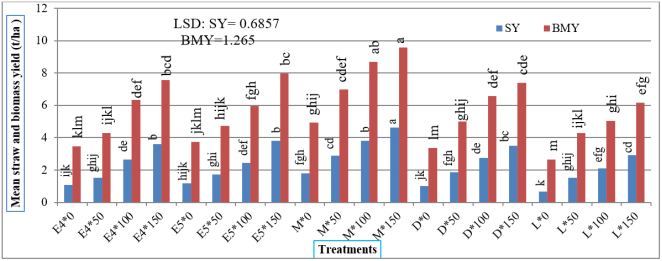
1) was obtained from the unfertilized control treatment. The interaction effect further showed that the highest straw yield (4.62 t ha⁻
1) was obtained from the Melkam variety supplied with 150 kg ha⁻
1 NPSZn fertilizer. In contrast, the lowest straw yield (0.6533 t ha⁻
1) was recorded from the local variety under no fertilizer application, which was statistically similar to ESH-4, ESH-5, and Dhekeba under the same condition (
Table 6).
Biomass Yield
Biomass yield followed a similar trend to straw yield. The highest biomass yield (7.5550 t ha⁻
1) was obtained from the Melkam variety, whereas the lowest biomass yield (4.5350 t ha⁻
1) was recorded from the local variety. No significant differences were observed among ESH-4, ESH-5, and Dhekeba varieties. Increasing NPSZn fertilizer rates significantly improved biomass yield, with the highest value (7.7393 t ha⁻
1) recorded at 150 kg ha⁻
1 and the lowest (3.6380 t ha⁻
1) obtained from the control treatment (
Table 6).
Table 6. Means straw and Biomass yield as affected by sorghum variety and rates of NPSZn fertilizer.
Parameter | Name of variety | Mean | Rate of fertilizer | Mean |
Straw yield (t/ha) | Melkam | 3.2775a | 0 | 1.1440d |
ESH-5 | 2.3008b | 50 | 1.9060c |
Dhekeba | 2.2933b | 100 | 2.7573b |
ESH-4 | 2.2092b | 150 | 3.6947a |
Local Var | 1.7967c | LSD (%) | 0.2169 |
LSD (%) | 0.2585 | | |
Biomass yield (kg) | Melkam | 7.5550a | 0 | 3.6380d |
ESH-5 | 5.6017b | 50 | 5.0620c |
Dhekeba | 5.5867b | 100 | 6.5180b |
ESH-4 | 5.4183b | 150 | 7.7393a |
Local Var | 4.5350c | LSD (%) | 0.4002 |
LSD (%) | 0.4769 | | |
Means of similar parameter within columns denoted by the same letter are not significantly different at 5% level of significance, LSD=Least significant difference.
The interaction effect indicated that the highest biomass yield (9.59 t ha⁻
1) was produced by the Melkam variety at 150 kg ha⁻
1 NPSZn fertilizer, while the lowest biomass yield was recorded from the local variety under no fertilizer application, showing statistical similarity with ESH-4, ESH-5, and Dhekeba under the same condition. Overall, all varieties showed an increasing trend in biomass yield with increasing NPSZn fertilizer application (
Figure 1).
Figure 1. Interaction effect of NPSZn fertilizer rate and sorghum variety on straw and biomass yield.
Means of similar parameter denoted by the same letter are not significantly different at 5% level of significance, LSD=Least significant difference. E4: ESH-4, E5: ESH-5, M: Melkam, D: Dhekeba, L: Local variety.
4. Discussion
The present study showed that NPSZn fertilizer application significantly influenced the phenological development of sorghum varieties. Increasing fertilizer rates progressively delayed both days to flowering and physiological maturity. The longest duration to flowering and maturity was recorded at 150 kg NPSZn ha⁻
1, while the shortest was observed in the control treatment. This delay is likely associated with enhanced vegetative growth induced by higher nutrient availability, particularly nitrogen, which tends to prolong the vegetative phase before the onset of reproductive development. Similar findings were reported by Merdikios et al.
| [13] | Merdikios Malla, Genanaw Tesema, & Yenesew Animaw (2022). Teff growth and yield response to blended fertilizer type and rate in Debub Ari and Bena Tsemay Districts, Southwestern Ethiopia. International Journal of Agricultural Research, Innovation and Technology, 12(1), 145-154.
https://doi.org/10.3329/ijarit.v12i1.61045 |
[13]
, who observed delayed phenological stages in cereal crops with increasing blended fertilizer application. In addition, Balemi et al.
| [14] | Balemi, T., Rurinda, J., Kebede, M., Mutegi, J., Hailu, G., Tufa, T., Abera, T., & Sida, T. S. (2019). Yield response and nutrient use efficiencies under different fertilizer applications in maize (Zea mays L.) in contrasting agro-ecosystems. International Journal of Plant & Soil Science, 29(3), 1-19.
https://doi.org/10.9734/IJPSS/2019/v29i33014 |
[14]
also reported that improved nutrient supply extends crop growth duration due to sustained physiological activity and delayed senescence.
Plant height and panicle length were significantly affected by the interaction of sorghum variety and NPSZn fertilizer rates. The tallest plants were recorded from the local variety under 150 kg NPSZn ha⁻
1, whereas the shortest plants were observed in ESH-4 under the control treatment. The increase in plant height with increasing fertilizer rate may be attributed to improved nitrogen availability, which enhances cell division, stem elongation, and overall vegetative growth. This result agrees with the findings of Redai (2020), who reported a significant increase in sorghum plant height with increasing rates of blended fertilizers
| [9] | Redai Weldegebriel, Tesfay Araya, & Yemane G. Egziabher (2020). Effect of blended fertilizer application on yield, nutrient and protein content of sorghum (Sorghum bicolor L. Moench) varieties under rainfed condition in north western Tigray, Ethiopia. International Journal of Life Sciences, 8(1), 51-58. |
[9]
. Similar, Merdikios et al.
| [13] | Merdikios Malla, Genanaw Tesema, & Yenesew Animaw (2022). Teff growth and yield response to blended fertilizer type and rate in Debub Ari and Bena Tsemay Districts, Southwestern Ethiopia. International Journal of Agricultural Research, Innovation and Technology, 12(1), 145-154.
https://doi.org/10.3329/ijarit.v12i1.61045 |
[13]
and Feyisa and Anbesa
| [17] | Feyisa, H., & Anbesa, F. (2025). Grain Yield and Yield‐Related Traits of Sorghum (Sorghum bicolor (L.) Moench) as Influenced by Integrated Application Rates of Inorganic Fertilizer and Farmyard Manure in Oromia, Ethiopia. International Journal of Agronomy, 2025(1), 3206233. |
[17]
found that nutrient application significantly improved vegetative growth in cereals. Panicle length also increased with higher fertilizer rates, which may be associated with better assimilate production and improved translocation of nutrients to reproductive organs.
Grain yield was significantly influenced by both sorghum variety and NPSZn fertilizer rates. Among the tested varieties, Melkam consistently produced the highest grain yield, particularly when combined with 100 and 150 kg NPSZn ha⁻
1. The superior performance of Melkam may be attributed to its better genetic potential, higher nutrient use efficiency, and adaptability to the agroecological conditions of the study area. The increase in grain yield with increasing fertilizer rates highlights the importance of balanced nutrient management in sorghum production. Nitrogen supports vegetative growth and protein synthesis, phosphorus enhances root development and grain formation, while zinc improves enzymatic activity and photosynthetic efficiency. Similar results were reported by some other scholars who observed significant yield improvements in sorghum and other cereal crops under blended fertilizer application
| [9] | Redai Weldegebriel, Tesfay Araya, & Yemane G. Egziabher (2020). Effect of blended fertilizer application on yield, nutrient and protein content of sorghum (Sorghum bicolor L. Moench) varieties under rainfed condition in north western Tigray, Ethiopia. International Journal of Life Sciences, 8(1), 51-58. |
| [10] | Regassa, T. (2005). Performance of sorghum varieties under different management practices. Ethiopian Journal of Agricultural Sciences.
https://doi.org/10.11648/j.ijfsb.20240904.15 |
| [12] | Sime B. Response of Tef [Eragrostis tef (Zucc.) Trotter] Varieties to Different Rates of Nitrogen Fertilizer in East Gojjam, North West Ethiopia. North West Ethiopia (March 24, 2020). 2020 Mar 24. |
| [15] | Bekele, I., Hundessa, M., & Tilahun, B. (2022). Nutrient response functions of sorghum for Miesso District, Central Rift Valley of Ethiopia. Agricultural Sciences, 13, 33-48.
https://doi.org/10.4236/as.2022.131004 |
| [18] | Sairam, M., Maitra, S., Sain, S., Gaikwad, D. J., & Sagar, L. (2024). Dry Matter Accumulation and Physiological Growth Parameters of Maize as Influenced by Different Nutrient Management Practices. Agricultural Science Digest, 44(2). |
[9, 10, 12, 15, 18]
.
Biomass and straw yields were significantly enhanced by increasing NPSZn fertilizer rates. The highest biomass and straw yields were obtained from Melkam variety at 150 kg NPSZn ha⁻
1, whereas the lowest values were recorded from the unfertilized local variety. The increase in biomass production with higher fertilizer rates is likely due to improved nutrient availability, which enhances photosynthetic activity and dry matter accumulation. This finding is consistent with Redai et al.
| [9] | Redai Weldegebriel, Tesfay Araya, & Yemane G. Egziabher (2020). Effect of blended fertilizer application on yield, nutrient and protein content of sorghum (Sorghum bicolor L. Moench) varieties under rainfed condition in north western Tigray, Ethiopia. International Journal of Life Sciences, 8(1), 51-58. |
[9]
, who reported increased biological yield of sorghum with blended fertilizer application. Correspondingly, other researchers also found that balanced nutrient supply significantly improved total dry matter production in cereal crops 1
| [16] | Azrag, A. A. D., Dagash, Y. M. I., & Yagoub, S. O. (2015). Effect of sowing date and nitrogen fertilizer rate on growth, yield components of sorghum (Sorghum bicolor L.) and nitrogen use efficiency. Journal of Progressive Research in Biology, 2(2), 78-87. https://doi.org/10.53555/jprb.v2i2.26 |
| [17] | Feyisa, H., & Anbesa, F. (2025). Grain Yield and Yield‐Related Traits of Sorghum (Sorghum bicolor (L.) Moench) as Influenced by Integrated Application Rates of Inorganic Fertilizer and Farmyard Manure in Oromia, Ethiopia. International Journal of Agronomy, 2025(1), 3206233. |
| [18] | Sairam, M., Maitra, S., Sain, S., Gaikwad, D. J., & Sagar, L. (2024). Dry Matter Accumulation and Physiological Growth Parameters of Maize as Influenced by Different Nutrient Management Practices. Agricultural Science Digest, 44(2). |
[16-18]
.
Overall, the results indicate that sorghum productivity in Dassenech District can be substantially improved through the integrated use of improved varieties and appropriate NPSZn fertilizer management. Among the tested varieties, Melkam demonstrated superior agronomic performance across most measured traits. Although the highest grain yield was obtained at 150 kg NPSZn ha⁻1, the statistically comparable yield at 100 kg NPSZn ha⁻1 suggests that this rate may be more economically viable and recommended for farmers in the study area under similar agroecological conditions.
5. Conclusion
Soil fertility decline remains one of the major constraints to sustainable agricultural production in Ethiopia, driven by continuous nutrient mining, low organic matter input, soil erosion, and limited use of integrated nutrient management practices. The reviewed literature shows that most soils are deficient in essential nutrients such as nitrogen and phosphorus, which significantly limits crop productivity across different agroecologies. Therefore, improving soil fertility in Ethiopia requires a holistic approach that includes strengthening soil testing services, promoting integrated nutrient management, increasing farmer awareness, and ensuring timely access to affordable fertilizers. Sustainable soil management practices are essential to reverse soil fertility decline and ensure long-term food security in the country.
The data collected on different phenological, growth, yield and yield component parameters showed that varieties and rates of blended fertilizer had significant effect on sorghum at Dassenech woreda, and increased in the rates of NPSZn blended fertilizer resulted in enhanced performance of sorghum varieties. From the tested varieties, Melkam variety is identified to be the best variety, while 100 kg/ha NPSZn blended fertilizer application is identified as the economic rate for Melkam variety production in the area even if it is single season result.
This finding has a significant contribution for different scholars, policy makers and other interested bodies on sorghum production. It also puts benchmark for researchers for further study and crop improvements.
Abbreviations
CSA | Central Statistical Agency |
FAO | Food and Agriculture Organization of the United Nations |
GLM | General Linear Model |
HI | Harvest Index |
ISFM | Integrated Soil Fertility Management |
LSD | Least Significant Difference |
NPSZn | Nitrogen, Phosphorus, Sulfur, and Zinc Blended Fertilizer |
OC | Organic Carbon |
OM | Organic Matter |
RCBD | Randomized Complete Block Design |
SAS | Statistical Analysis System |
Acknowledgments
The author would like to express sincere gratitude to Jinka University for providing financial support that made this study possible. The support contributed significantly to the successful completion of data collection, analysis, and preparation of this work. The author also acknowledges all individuals and institutions who contributed directly or indirectly to the successful completion of this research.
Author Contributions
Berihanu Sime: Conceptualization, Data curation, Formal Analysis, Investigation, Methodology, Visualization, Writing – original draft
Daniel Abebe: Conceptualization, Methodology, Project administration, Supervision, Validation, Writing – review & editing
Damtew Atnafu: Formal Analysis, Investigation, Methodology, Validation, Writing – review & editing
Hafiz Adem: Data curation, Investigation, Resources, Visualization, Writing – review & editing
Conflicts of Interest
The authors declare no conflicts of interest.
References
| [1] |
Hariprasanna, K., & Patil, J. V. (2015). Sorghum: Origin, classification, biology and improvement. In R. Madhusudhana, P. Rajendrakumar, & J. V. Patil (Eds.), Sorghum molecular breeding (pp. 3-20). Springer, New Delhi.
https://doi.org/10.1007/978-81-322-2422-8_1
|
| [2] |
FAO. (2023). FAOSTAT statistical database. Food and Agriculture Organization of the United Nations.
|
| [3] |
CSA (Central Statistical Agency). (2024). Agricultural sample survey report on area and production of major crops. Addis Ababa, Ethiopia.
|
| [4] |
Degefa, K., Abebe, G., & Biru, G. (2023). Factors affecting sorghum production in western Ethiopia: Evidence from smallholder farmers. International Journal on Food, Agriculture and Natural Resources, 4(2), 1-12.
https://doi.org/10.21608/ijfanr.2023.109
|
| [5] |
Amelework Assefa, Shimelis, H., & Tongoona, P. (2016). Sorghum production systems and constraints, and coping strategies under drought-prone agro-ecologies of Ethiopia. South African Journal of Plant and Soil, 33(3), 207-217.
https://doi.org/10.1080/02571862.2016.1143043
|
| [6] |
Agegnehu, G., & Amede, T. (2017). Integrated soil fertility and plant nutrient management in tropical agroecosystems: A review. Pedosphere, 27(4), 662-680.
https://doi.org/10.1016/S1002-0160(17)60387-4
|
| [7] |
Havlin, J. L., Tisdale, S. L., Nelson, W. L., & Beaton, J. D. (2014). Soil fertility and fertilizers: An introduction to nutrient management (8th ed.). Pearson Education, Upper Saddle River, NJ, USA.
|
| [8] |
EthioSIS (Ethiopian Soil Information System). (2015). Fertilizer recommendation atlas of Ethiopia. Ministry of Agriculture.
|
| [9] |
Redai Weldegebriel, Tesfay Araya, & Yemane G. Egziabher (2020). Effect of blended fertilizer application on yield, nutrient and protein content of sorghum (Sorghum bicolor L. Moench) varieties under rainfed condition in north western Tigray, Ethiopia. International Journal of Life Sciences, 8(1), 51-58.
|
| [10] |
Regassa, T. (2005). Performance of sorghum varieties under different management practices. Ethiopian Journal of Agricultural Sciences.
https://doi.org/10.11648/j.ijfsb.20240904.15
|
| [11] |
Daniel, A. (2025). Biotic Constraints to Crop Production and Food Security in Southern Ethiopia: A Review of Diseases, Pests, and Weeds in Ari, South Omo, and Konso. International Journal of Food Science and Agriculture, 9(4), 283-289.
https://doi.org/10.26855/ijfsa.2025.12.004
|
| [12] |
Sime B. Response of Tef [Eragrostis tef (Zucc.) Trotter] Varieties to Different Rates of Nitrogen Fertilizer in East Gojjam, North West Ethiopia. North West Ethiopia (March 24, 2020). 2020 Mar 24.
|
| [13] |
Merdikios Malla, Genanaw Tesema, & Yenesew Animaw (2022). Teff growth and yield response to blended fertilizer type and rate in Debub Ari and Bena Tsemay Districts, Southwestern Ethiopia. International Journal of Agricultural Research, Innovation and Technology, 12(1), 145-154.
https://doi.org/10.3329/ijarit.v12i1.61045
|
| [14] |
Balemi, T., Rurinda, J., Kebede, M., Mutegi, J., Hailu, G., Tufa, T., Abera, T., & Sida, T. S. (2019). Yield response and nutrient use efficiencies under different fertilizer applications in maize (Zea mays L.) in contrasting agro-ecosystems. International Journal of Plant & Soil Science, 29(3), 1-19.
https://doi.org/10.9734/IJPSS/2019/v29i33014
|
| [15] |
Bekele, I., Hundessa, M., & Tilahun, B. (2022). Nutrient response functions of sorghum for Miesso District, Central Rift Valley of Ethiopia. Agricultural Sciences, 13, 33-48.
https://doi.org/10.4236/as.2022.131004
|
| [16] |
Azrag, A. A. D., Dagash, Y. M. I., & Yagoub, S. O. (2015). Effect of sowing date and nitrogen fertilizer rate on growth, yield components of sorghum (Sorghum bicolor L.) and nitrogen use efficiency. Journal of Progressive Research in Biology, 2(2), 78-87.
https://doi.org/10.53555/jprb.v2i2.26
|
| [17] |
Feyisa, H., & Anbesa, F. (2025). Grain Yield and Yield‐Related Traits of Sorghum (Sorghum bicolor (L.) Moench) as Influenced by Integrated Application Rates of Inorganic Fertilizer and Farmyard Manure in Oromia, Ethiopia. International Journal of Agronomy, 2025(1), 3206233.
|
| [18] |
Sairam, M., Maitra, S., Sain, S., Gaikwad, D. J., & Sagar, L. (2024). Dry Matter Accumulation and Physiological Growth Parameters of Maize as Influenced by Different Nutrient Management Practices. Agricultural Science Digest, 44(2).
|
Cite This Article
-
APA Style
Sime, B., Abebe, D., Atnafu, D., Adem, H. (2026). Growth and Yield Response of Sorghum (Sorghum Bicolor (L.) Moench) Varieties to Applied Rates of NPSZn Fertilizer at Omorate, Southern Ethiopia. American Journal of Plant Biology, 11(3), 65-73. https://doi.org/10.11648/j.ajpb.20261103.14
 Copy
|
Copy
|
 Download
ACS Style
Sime, B.; Abebe, D.; Atnafu, D.; Adem, H. Growth and Yield Response of Sorghum (Sorghum Bicolor (L.) Moench) Varieties to Applied Rates of NPSZn Fertilizer at Omorate, Southern Ethiopia. Am. J. Plant Biol. 2026, 11(3), 65-73. doi: 10.11648/j.ajpb.20261103.14
Copy
|
Download
AMA Style
Sime B, Abebe D, Atnafu D, Adem H. Growth and Yield Response of Sorghum (Sorghum Bicolor (L.) Moench) Varieties to Applied Rates of NPSZn Fertilizer at Omorate, Southern Ethiopia. Am J Plant Biol. 2026;11(3):65-73. doi: 10.11648/j.ajpb.20261103.14
Copy
|
Download
-
@article{10.11648/j.ajpb.20261103.14,
  author = {Berihanu Sime and Daniel Abebe and Damtew Atnafu and Hafiz Adem},
  title = {Growth and Yield Response of Sorghum (Sorghum Bicolor (L.) Moench) Varieties to Applied Rates of NPSZn Fertilizer at Omorate, Southern Ethiopia},
  journal = {American Journal of Plant Biology},
  volume = {11},
  number = {3},
  pages = {65-73},
  doi = {10.11648/j.ajpb.20261103.14},
  url = {https://doi.org/10.11648/j.ajpb.20261103.14},
  eprint = {https://article.sciencepublishinggroup.com/pdf/10.11648.j.ajpb.20261103.14},
  abstract = {Sorghum (Sorghum bicolor (L.) Moench) is a key cereal crop in the arid and semi-arid lowlands of Ethiopia, where it contributes significantly to food security, livestock feed, and household income. However, its productivity remains low due to declining soil fertility, limited use of improved varieties, and inadequate fertilizer management. A field experiment was conducted during the 2023/24 main cropping season in Dassenech district, Southern Ethiopia, to evaluate the growth and yield performance of sorghum varieties under different rates of NPSZn blended fertilizer and to determine the optimum fertilizer rate for the study area. The experiment consisted of five sorghum varieties (Dhekeba, ESH-4, ESH-5, Melkam, and a local check) and four NPSZn fertilizer rates (0, 50, 100, and 150 kg ha⁻1) arranged in a factorial combination using a randomized complete block design with three replications. Data on phenology, growth, yield, and yield components were analyzed using SAS software. The results indicated that both main and interaction effects of variety and fertilizer rate significantly (P 1), while the local check yielded the least (2.74 t ha⁻1). Grain yield increased with increasing fertilizer rates, with the highest mean yield recorded at 150 kg NPSZn ha⁻1, although yields at 100 and 150 kg ha⁻1 were statistically comparable. The highest combined yield (4.97 t ha⁻1) was obtained from Melkam fertilized with 150 kg NPSZn ha⁻1. Based on agronomic performance and economic considerations, Melkam variety with 100 kg NPSZn ha⁻1 is recommended for sorghum production in the study area. Further multi-location and multi-season studies are recommended to confirm the findings.},
 year = {2026}
}
Copy
|
Download
-
TY  - JOUR
T1  - Growth and Yield Response of Sorghum (Sorghum Bicolor (L.) Moench) Varieties to Applied Rates of NPSZn Fertilizer at Omorate, Southern Ethiopia
AU  - Berihanu Sime
AU  - Daniel Abebe
AU  - Damtew Atnafu
AU  - Hafiz Adem
Y1  - 2026/07/24
PY  - 2026
N1  - https://doi.org/10.11648/j.ajpb.20261103.14
DO  - 10.11648/j.ajpb.20261103.14
T2  - American Journal of Plant Biology
JF  - American Journal of Plant Biology
JO  - American Journal of Plant Biology
SP  - 65
EP  - 73
PB  - Science Publishing Group
SN  - 2578-8337
UR  - https://doi.org/10.11648/j.ajpb.20261103.14
AB  - Sorghum (Sorghum bicolor (L.) Moench) is a key cereal crop in the arid and semi-arid lowlands of Ethiopia, where it contributes significantly to food security, livestock feed, and household income. However, its productivity remains low due to declining soil fertility, limited use of improved varieties, and inadequate fertilizer management. A field experiment was conducted during the 2023/24 main cropping season in Dassenech district, Southern Ethiopia, to evaluate the growth and yield performance of sorghum varieties under different rates of NPSZn blended fertilizer and to determine the optimum fertilizer rate for the study area. The experiment consisted of five sorghum varieties (Dhekeba, ESH-4, ESH-5, Melkam, and a local check) and four NPSZn fertilizer rates (0, 50, 100, and 150 kg ha⁻1) arranged in a factorial combination using a randomized complete block design with three replications. Data on phenology, growth, yield, and yield components were analyzed using SAS software. The results indicated that both main and interaction effects of variety and fertilizer rate significantly (P 1), while the local check yielded the least (2.74 t ha⁻1). Grain yield increased with increasing fertilizer rates, with the highest mean yield recorded at 150 kg NPSZn ha⁻1, although yields at 100 and 150 kg ha⁻1 were statistically comparable. The highest combined yield (4.97 t ha⁻1) was obtained from Melkam fertilized with 150 kg NPSZn ha⁻1. Based on agronomic performance and economic considerations, Melkam variety with 100 kg NPSZn ha⁻1 is recommended for sorghum production in the study area. Further multi-location and multi-season studies are recommended to confirm the findings.
VL  - 11
IS  - 3
ER  -
Copy
|
Download





 Share This Article
 Twitter
 Linked In
 Facebook