
This paper aimed to shed light on the experiences that Wad Medani city, Sudan, went through in the waste transfer project during the first quarter of the current century, The paper evaluates four successive waste management models implemented in the studied area between 2000 and 2025, ranging from local authority control to private sector and corporate management. Criteria such as transport efficiency, cost per ton, and community interaction, management efficiency…etc. were utilized to compare these periods. Performance during these experiments varied between success and failure. These four successive experiments are: the private sector experiment (the Turkish company), Wad Medani City Development and Elegance Corporation, Gezira State Cleaning and Development Authority, and Greater Wad Medani Locality experiment before and after these three experiments. The study concludes that the corporate model was the most effective, whereas recent conflict and lack of budget have led to significant environmental deterioration, the waste transportation experience by corporations is the best, with the percentage of waste transported by the Wad Medani City Development and Elegance Corporation and the Gezira State Cleaning and Development Authority reaching 98% and 67.8%. The paper recommended that, establishment of a special authority for waste management in Wad Medani, along with intensifying community awareness programs, allocating a special site for a waste dump and registering it officially in the land registry, and diversifying the transport fleet are necessary to have and ideal model. It also recommended that it’s prefer to establish a special structure to accommodate male and female cleaning workers in permanent positions.
| Published in | American Journal of Engineering and Technology Management (Volume 11, Issue 3) |
| DOI | 10.11648/j.ajetm.20261103.12 |
| Page(s) | 42-52 |
| Creative Commons |
This is an Open Access article, distributed under the terms of the Creative Commons Attribution 4.0 International License (http://creativecommons.org/licenses/by/4.0/), which permits unrestricted use, distribution and reproduction in any medium or format, provided the original work is properly cited. |
| Copyright |
Copyright © The Author(s), 2026. Published by Science Publishing Group |
Waste Management, Local Authority, Private Sector, Corporation
Daily waste weight in tons | Population (1000 habitants) | Year |
|---|---|---|
220 | 368 | 2008 |
228 | 380 | 2011 |
256 | 427 | 2016 |
280 | 467 | 2020 |
316 | 525 | 2025 |
No. | Responsible party | Period | Stage |
|---|---|---|---|
1 | The experience of transporting waste by the Locality | 2000 – 2005 | First stage |
2 | The experience of transporting waste by the Turkish company Tamika Kamin Tamzlak (TKTC) | 2006 – 2010 | Second stage |
3 | Waste transport experiment by the Wad Medani City Development and Elegancy Corporation (WMDEC) | 2011 – 2015 | Third stage |
4 | Waste transport experiment by the Gezira State Cleaning and Development Authority (GSCDA) | 2016 – 2020 | Fourth stage |
5 | Waste transport experiment Greater Wad Medani Locality (GWML) | 2020 still continued | Fifth stage |
No. | Criteria | Performance | Evaluation |
|---|---|---|---|
1 | Quantity of waste transported and its percentage of the total waste in the area | 10÷239 | 5% |
2 | Transportation mechanism (efficiency, speed, discipline, comprehensiveness, environmental impact | 3 – 4 old trucks | 4% |
3 | Program sustainability and management efficiency and discipline | There was no separated department | 0 |
4 | Community interaction (awareness, conviction, payment of fees) | Weak | Weak |
5 | Environment and general appearance as a result of program effectiveness | Bad | Bad |
6 | Public health (reduced disease rates) | Malaria and typhoid | Bad |
7 | Cost per ton transported (SDG per ton) | Weak | Weak |
8 | Budget availability | Weak | Weak |
No. | Criteria | Performance Per day | Evaluation |
|---|---|---|---|
1 | Quantity of waste transported and its percentage of the total waste in the area | 100 ton | 42% |
2 | Transportation mechanism (efficiency, speed, discipline, comprehensiveness, environmental impact | Low capacities compactors | 40% |
3 | Program sustainability and management efficiency and discipline | There was a separated dept. | 50% |
4 | Community interaction (awareness, conviction, payment of fees) | Fees included in water tariff | Weak |
5 | Environment and general appearance as a result of program effectiveness | Medium | Medium |
6 | Public health (reduced disease rates) | Medium | Medium |
7 | Cost per ton transported (SDG per ton) | 6000 SDG/ Ton | Highly costive |
8 | Budget availability | incurring heavy debts | Weak |
No. | Criteria | Performance | Evaluation |
|---|---|---|---|
1 | Quantity of waste transported and its percentage of the total waste in the area | 250 ton | 98% |
2 | Transportation mechanism (efficiency, speed, discipline, comprehensiveness, environmental impact | 40 kantars + 3compactors | Excellent and comprehensive |
3 | Program sustainability and management efficiency and discipline | Board of Directors + General Administration + Executive manager + Technical Staff | Disciplined and efficient |
4 | Community interaction (awareness, conviction, payment of fees) | Good | Good |
5 | Environment and general appearance as a result of program effectiveness | Excellent | Excellent |
6 | Public health (reduced disease rates) | Good | Good |
7 | Cost per ton transported (SDG per ton) | 1200 SDG TON | SUITABLE |
8 | Budget availability | Available | Available |
No. | Criteria | Performance | Evaluation |
|---|---|---|---|
1 | Quantity of waste transported and its percentage of the total waste in the area | 67.8% | 200 ton |
2 | Transportation mechanism (efficiency, speed, discipline, comprehensiveness, environmental impact | Not including the whole city | Limited capacity - frequently breaks down - only 1-2 floors per day |
3 | Program sustainability and management efficiency and discipline | Disciplined | Disciplined |
4 | Community interaction (awareness, conviction, payment of fees) | Good | Good |
5 | Environment and general appearance as a result of program effectiveness | Good | Good |
6 | Public health (reduced disease rates) | Good | Good |
7 | Cost per ton transported (SDG per ton) | Costive | 4000 SDG per ton |
8 | Budget availability | Available |
No. | Criteria | Performance | Evaluation |
|---|---|---|---|
1 | Quantity of waste transported and its percentage of the total waste in the area | Compressors x 7 tons (18 m3) x 2 floors (56 tons + efforts) | Less than 30% |
2 | Transportation mechanism (efficiency, speed, discipline, comprehensiveness, environmental impact | 7 compressors 2 floors | Good - not comprehensive |
3 | Program sustainability and management efficiency and discipline | Effective and disciplined | Effective and disciplined |
4 | Community interaction (awareness, conviction, payment of fees) | Very good | Very good |
5 | Environment and general appearance as a result of program effectiveness | Fevers, flies mosquitos … etc | Bad |
6 | Public health (reduced disease rates) | Fevers, flies mosquitos … etc | Bad |
7 | Cost per ton transported (SDG per ton) | Unknown | But High |
8 | Budget availability | Partially available | Not available |
The Experiment | GWML the Locality | GSDCA: Gezira Development and Cleaning Authority | WMDEC: Wad Medani Developing and Elegance Corporation | TKTC: Tamika Kamin Tamzlak Co. |
|---|---|---|---|---|
Transported waste to the total % | 30 | 67, 8 | 98 | 42 |
Cost as SDG per Ton | 4000 | 4000 | 1200 | 6000 |
GWML | Greater Wad Medani Locality |
GSDCA | Gezira Development and Cleaning Authority |
WMDEC | Wad Medani Developing and Elegance Corporation |
TKTC | Tamika Kamin Tamzlak Co |
3 Rs | (Reduce, Reuse and Recycle) |
UNEP | United Nations Environment Program |
IPCC | Intergovernmental Panel on Climate Change |
EST | Environmentally Sound Technologies |
IETC | International Environment Technologies Council |
| [1] | Environment Statistics". United Nations Statistics Division. Archived from the original on 17 March 2017. Retrieved 3 March 2017. |
| [2] |
Cardozo International & Comparative Law Review: Escalating Conflict-Related Sexual and Gender Violence in the Ongoing Sudan Conflict. Available from:
https://www.aa.com.tr/en/africa/ (assessed 4 Decmber 2024). |
| [3] | "Wad Madani | Location & Facts". Encyclopedia Britannica. Retrieved 2021-07-05. |
| [4] | United Nations Environment Program (UNEP): The "Global Waste Management Outlook 2024" report provides data and projections on waste, costs, and the benefits of a circular economy. |
| [5] |
International Day of Zero Waste: Visual Identity Guidelines 2025, United Nations Environment Programme. Available from:
https://wedocs.unep.org/items/72186aad-ea99-4e92-a961-53df47cca03b (22 Dec 2025). |
| [6] | World Health Organization (WHO) handbook Safe management of waste from health-care activities 1999 (commonly known as "the Blue Book". |
| [7] | State Council for Environment and Natural Resources Workshop on Sustainable Environmental Sanitation in Gezira State. paper entitled: The Experience of Waste Management in Wad Medani City. July 2025. |
| [8] |
Solid Waste Management: Methods and Benefits. Ion Exchange. Available from
https://ionexchangeglobal.com/solid-waste-management-methods-and-benefits/#Benef (May 16, 2025). |
| [9] | Sustainable Solid Waste Management by Ni-Bin Chang ISBN: 1118964543 Publication Date: 2015. |
| [10] | Solid Wastes Management by Stephen Burnley ISBN: 1118863941 Publication Date: 2014. |
| [11] | Waste and waste management. BBC. Retrieved 27 May 2025. |
| [12] | "Guidelines for National Waste Management Strategies Moving from Challenges to Opportunities (PDF) ". United Nations Environmental Programme. 2013. Archived from the original (PDF) on 4 March 2016. Retrieved 3 May 2014. |
| [13] | "Zero Waste Definition. Zero Waste International Alliance". 7 September 2022 [Original date 24 June 2018]. Retrieved 31 October 2024. |
| [14] |
"Plastic pollution is growing relentlessly as waste management and recycling fall short, says OECD".
www.oecd.org 22 February 2022. Retrieved 2022-10-21. |
| [15] |
Dream flower Housing Project.
https://www.dreamflower.in/blog/waste-management-in-flats-paving-the-path-to-a-greener-tomorrow/2023 |
| [16] |
Pachamama Alliance: Environmental awareness Available from:
https://pachamama.org/environmental-awareness/ (accessed 6 October 2022). |
APA Style
Disogi, N. E. M. A. E., Allah, R. M. D. (2026). The Experience of Waste Management in Wad Medani, the Capital of Gezira State Sudan Between Success and Failure. American Journal of Engineering and Technology Management, 11(3), 42-52. https://doi.org/10.11648/j.ajetm.20261103.12
ACS Style
Disogi, N. E. M. A. E.; Allah, R. M. D. The Experience of Waste Management in Wad Medani, the Capital of Gezira State Sudan Between Success and Failure. Am. J. Eng. Technol. Manag. 2026, 11(3), 42-52. doi: 10.11648/j.ajetm.20261103.12
@article{10.11648/j.ajetm.20261103.12,
  author = {Nagm Eldeen Mubark Ahmed El Disogi and Rihab Muhammad Dafa Allah},
  title = {The Experience of Waste Management in Wad Medani, the Capital of Gezira State Sudan Between Success and Failure},
  journal = {American Journal of Engineering and Technology Management},
  volume = {11},
  number = {3},
  pages = {42-52},
  doi = {10.11648/j.ajetm.20261103.12},
  url = {https://doi.org/10.11648/j.ajetm.20261103.12},
  eprint = {https://article.sciencepublishinggroup.com/pdf/10.11648.j.ajetm.20261103.12},
  abstract = {This paper aimed to shed light on the experiences that Wad Medani city, Sudan, went through in the waste transfer project during the first quarter of the current century, The paper evaluates four successive waste management models implemented in the studied area between 2000 and 2025, ranging from local authority control to private sector and corporate management. Criteria such as transport efficiency, cost per ton, and community interaction, management efficiency…etc. were utilized to compare these periods. Performance during these experiments varied between success and failure. These four successive experiments are: the private sector experiment (the Turkish company), Wad Medani City Development and Elegance Corporation, Gezira State Cleaning and Development Authority, and Greater Wad Medani Locality experiment before and after these three experiments. The study concludes that the corporate model was the most effective, whereas recent conflict and lack of budget have led to significant environmental deterioration, the waste transportation experience by corporations is the best, with the percentage of waste transported by the Wad Medani City Development and Elegance Corporation and the Gezira State Cleaning and Development Authority reaching 98% and 67.8%. The paper recommended that, establishment of a special authority for waste management in Wad Medani, along with intensifying community awareness programs, allocating a special site for a waste dump and registering it officially in the land registry, and diversifying the transport fleet are necessary to have and ideal model. It also recommended that it’s prefer to establish a special structure to accommodate male and female cleaning workers in permanent positions.},
 year = {2026}
}
TY  - JOUR
T1  - The Experience of Waste Management in Wad Medani, the Capital of Gezira State Sudan Between Success and Failure
AU  - Nagm Eldeen Mubark Ahmed El Disogi
AU  - Rihab Muhammad Dafa Allah
Y1  - 2026/07/24
PY  - 2026
N1  - https://doi.org/10.11648/j.ajetm.20261103.12
DO  - 10.11648/j.ajetm.20261103.12
T2  - American Journal of Engineering and Technology Management
JF  - American Journal of Engineering and Technology Management
JO  - American Journal of Engineering and Technology Management
SP  - 42
EP  - 52
PB  - Science Publishing Group
SN  - 2575-1441
UR  - https://doi.org/10.11648/j.ajetm.20261103.12
AB  - This paper aimed to shed light on the experiences that Wad Medani city, Sudan, went through in the waste transfer project during the first quarter of the current century, The paper evaluates four successive waste management models implemented in the studied area between 2000 and 2025, ranging from local authority control to private sector and corporate management. Criteria such as transport efficiency, cost per ton, and community interaction, management efficiency…etc. were utilized to compare these periods. Performance during these experiments varied between success and failure. These four successive experiments are: the private sector experiment (the Turkish company), Wad Medani City Development and Elegance Corporation, Gezira State Cleaning and Development Authority, and Greater Wad Medani Locality experiment before and after these three experiments. The study concludes that the corporate model was the most effective, whereas recent conflict and lack of budget have led to significant environmental deterioration, the waste transportation experience by corporations is the best, with the percentage of waste transported by the Wad Medani City Development and Elegance Corporation and the Gezira State Cleaning and Development Authority reaching 98% and 67.8%. The paper recommended that, establishment of a special authority for waste management in Wad Medani, along with intensifying community awareness programs, allocating a special site for a waste dump and registering it officially in the land registry, and diversifying the transport fleet are necessary to have and ideal model. It also recommended that it’s prefer to establish a special structure to accommodate male and female cleaning workers in permanent positions.
VL  - 11
IS  - 3
ER  -
Earth Science Department, University of Gezira, Wad Medani City, Sudan
Microbiology Department, University of Gezira, Wad Medani City, Sudan
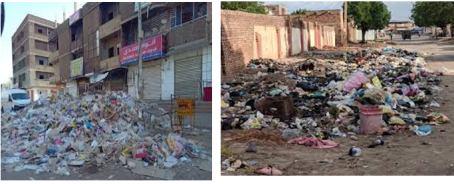
Figure 1. Environental situation of Wad Medani City immediately after the war [7].
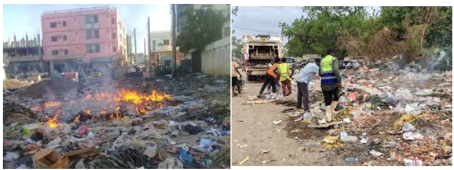
Figure 2. Governmental and nongovernmental organizations in Wad Medani Cy warning immediately after the war.
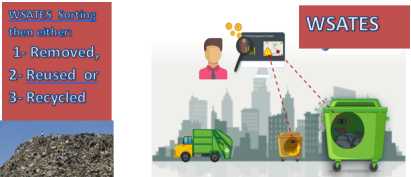
Figure 3. A diagram represents the processes of Waste Management.
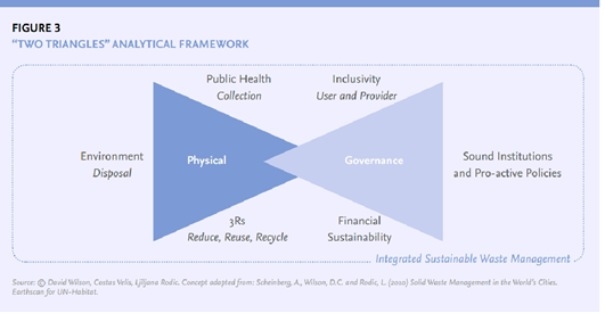
Figure 4. A diagram represents the two triangles analytical framework.
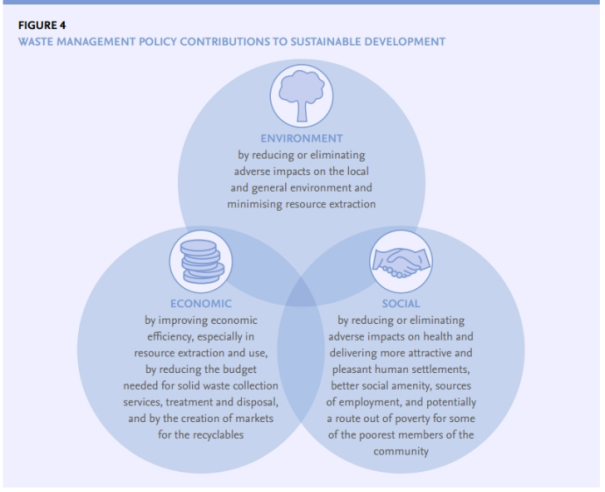
Figure 5. A diagram represents how waste management policy contribute sustainable development [10].

Figure 6. A diagram represents environmental awareness according to Dreamflower [13, 15].
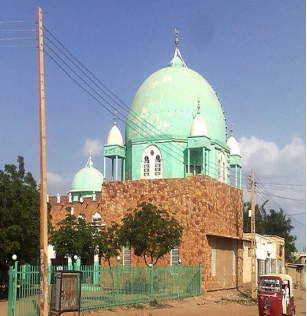
Figure 7. The main feature in Wad Medani City: Qubat AlSunni.
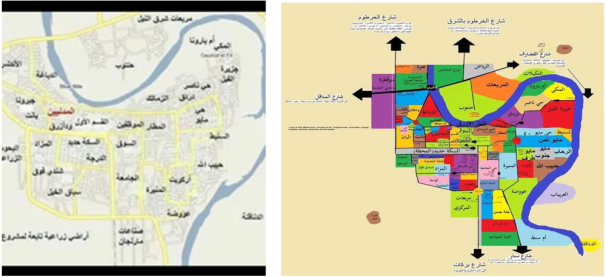
Figure 8. Wad Medani Location Map – Gezira State – Sudan.
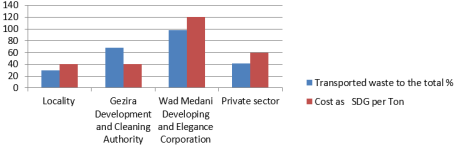
Figure 9. A comparison between the four experiments of waste transportation in the percentage of transported waste to the total and the cost per ton for each.

Information



 Share This Article
 Twitter
 Linked In
 Facebook
 Copy
Copy Download