Abstract
Both the investors and the firms in imperfect markets experience information asymmetry. As a result, they find obtaining full information before making any decisions to be more expensive relative to expected gains. In general, individuals provide finances based on the market price of the common stock, dividend payments, and the ease with which they can liquidate common stock. However, such decisions cannot be explained by a market like mechanism. Similarly, there is no satisfactory behavioral basis to rationalize the choices of the firms and the investors. It is possible to develop AI algorithms since a large amount of data is available on the actual decisions made. The present study postulates a behavioral basis for the observed decisions. In particular, it will be postulated that the financial manager wishes to generate adequate finances to support the capital decisions of the production manager. Similarly, the production manager will consider it necessary to invest in capital stock to avoid losing market share to rival firms. Intuitively, faced with the valuation of many objectives the financial manager attempts to pursue the numerically best objective and utilize the most productive strategy until they find some superior choice. Empirically it was found that in industries like motor vehicles the demand in the long run would be basically for replacement. Financial managers tend to concentrate on the short run objectives. On the other hand, electrical and chemical products do not experience shortage of demand even in the long run. They focus attention on long run objectives. The proposed algorithm accounts for such differences. It was noted that there is a recurrent change in the objectives and strategies of firms. The numerical magnitudes may themselves be inadequate to describe the behavior. Far more detailed data on the relative valuation of objectives and patterns of change over time would be necessary to develop satisfactory predictive algorithms.
|
Published in
|
World Journal of Electronic Commerce (Volume 1, Issue 1)
|
|
DOI
|
10.11648/j.wjec.20260101.13
|
|
Page(s)
|
21-31 |
|
Creative Commons
|

This is an Open Access article, distributed under the terms of the Creative Commons Attribution 4.0 International License (http://creativecommons.org/licenses/by/4.0/), which permits unrestricted use, distribution and reproduction in any medium or format, provided the original work is properly cited.
|
|
Copyright
|
Copyright © The Author(s), 2026. Published by Science Publishing Group
|
Keywords
Strategic Financial Decisions, AI Algorithm, Imperfect Markets
1. The Issues
The financial and product markets of firms in imperfect markets are inherently risky. In financial markets, individuals, who offer finances and firms that seek both long term and short run finances, experience information asymmetry. Firms may offer IPOs (initial public offerings) and sell stocks and shares on the stock market. Firms may also rely on long term financial institutions to acquire long run capital assets. Similarly, firms depend on banking sources for their working capital finance to sustain production (strategic supply based on the capital stock) and conduct sales (resort to selling expenses, advertising and other intangible investments) to match supply. Firms do not have complete information about the total financing available and the quantity they can obtain, since several firms compete in the market. As a result, information asymmetry necessitates making decisions based on incomplete and often probabilistic information.
The shareholders do not have adequate information about the prospects of the firm or its long run stability. As a result, individuals who provide finance operate with incomplete information. They depend on proxies like dividend payments, market price of the common stock, the reputation of the management over time, and the ease with which they can liquidate common stock. The guidelines that economic theory can offer, however extensive they may be, leave some room for risky choices. It is also evident that the market mechanisms to equilibrate such transactions are at best imperfect. Quantitative adjustments by both sides of such markets predominate.
In practice, firms experience external environmental factors, including government policies, that are not under their control. Such factors increase the risks in making financial decisions.
Firms do make such decisions regularly despite the lack of a proper behavioral basis
| [12] | Garg, V., J. Gabaldon, S. Niranjan, amnd T. Hawkins (2025), Impact of strategic performance measures on performance: The role of artificial intelligence and machine learning, Transportation Research: Part E: Logistics and Transportation Review, 198: 104073. https:/10.1016/j.tre.2025.104073 |
| [16] | Kavitha, M., K. Hanumanthu, O. Sai, G. Chandrasekhar, and S. Sugandha (2025), The role of artificial intelligence in financial decision making, Journal of Marketing and Social Research, 21, 189-198. |
[12, 16]
. This generates voluminous data. The purpose of AI algorithms is to investigate the possibility of unravelling regularities in the decision-making process (descriptive AI) or to find ways of prescribing a course of action (prescriptive AI), though, in general, observed decisions embody various types of inefficiencies. Clearly, the AI algorithms should complement behavioral theories rather than supplant them altogether.
One mechanism that firms utilize to overcome information asymmetry is to assign specialized functions such as finance, production, and marketing to different managers. They have the autonomy to make appropriate decisions. The CEO would generally coordinate the activities of the different divisions, with or without an explicit overall objective. Such specialization enables the managers to obtain more relevant information and make appropriate decisions.
However, the emergence of divisions implies that the divisional managers may have different objectives. The emerging multi-objective environment requires additional coordination to synchronize the activities. It can be surmised that a limited hierarchy among the managers emerges. For example, the finance manager has to utilize the networth of the firm and the loyalty of shareholders and financial institutions to identify the supply of external finance. Similarly, the finance manager recognizes a demand from the production manager to maintain a desired level of capital stock and strategic supply. Similar relations exist between the other managers. However, there may not be an equilibrium between supply and demand due to the autonomy of decision-making. The observed external finance for the firm may depend on either of the above. This signals the possibility of information asymmetry between the divisional managers. Whether the limited hierarchy reduces the total effect of information asymmetry on the long run performance of the firm cannot be judged a priori.
Consider the strategic choices of managers in their quest to attain the goals of their respective divisions. The marketing manager indulges in intangible investments in his attempt to create a demand for the products of the firm, to match the strategic supply defined by the production manager. However, consumers will ignore advertisements once they recognize the value of the products. The marketing manager persists with such investments lest the firm should lose its market share vis-a-vis rival firms. This description of the behavior of managers must be incorporated into the AI algorithm.
Another dimension of behavior needs attention. It is necessary to estimate long run consequences whenever a manager attempts to swap the existing strategy with a new one. It is possible to surmise that they will be risk-averse because they will have to bear the costs of failure while returns, based on success, will be much less. In general, they will choose the best objective (numerically, the relative maximum) at each point in time and persist using it until some other objective proves to be superior. Turning to the choice of strategies it can be hypothesized that they will choose the most productive alternative until they find a better one.
One further behavioral consideration needs attention. If a firm finds that its long-run prospects are uncertain, it may concentrate on achieving short run objectives. Similarly, the firm may concentrate on long run objectives if there is no difficulty in achieving short run objectives. Further, the firm may concentrate on long run objectives if there is no information on how short run goals can lead to long term goals. However, it cannot be taken for granted that the pursuit of short run objectives will lead to long term stability. In general, they may include both in their decisions.
It is possible that even if the firm prioritizes one objective, they tend to pursue some others as well. This will be revealed by the percentage choice of objectives.
The present study attempts to develop a descriptive AI algorithm against this backdrop. Essentially, the proposition is that statistical manipulations of data should be undertaken only after accounting for all plausible behavioral information. It should also be noted that the predictions will be based on the most reliable data. The possibility that external environmental shocks will not enable the firm realize its expectations should be acknowledged.
The data of two industries, viz., chemical products and motor vehicles, will be utilized in the empirical part of the study. The data was obtained from the Center for Monitoring the Indian Economy (CMIE) for the years 2001-2023.
The rest of the study is organized as follows. Section 2 provides a brief review of the pertinent literature. Section 3 then details methods of analysis leading to the AI algorithm. Section 4 offers an overview of the data chosen for the study and the definition of the variables used. Section 5 summarizes the empirical experience. Section 6 offers guidelines for future work.
2. A Brief Review of Literature
As of now, there are several studies dealing with various aspects of AI algorithms. Even in the context of finance, the variety of issues considered in these algorithms has not yet reached a steady state. Several partial surveys are available.
In general, algorithms may be descriptive or predictive. However, the available literature has a few studies that deal with the predictive aspect of AI algorithms
| [1] | Agarwal, A., J. Gans, and A. Goldfarb (2022), Prediction Machines: The Simple Economics of Artificial Intelligence (Cambridge: Harvard Business Review Press),
https://doi.org/10.1080/15228053.2019.1673511 |
| [2] | Ahirrao, V., I. Ansari, K. Azim, and K. Bhujel (2025), ASI-Powered financial strategy: Transforming business decision-making through predictive analysis, Emerging Frontiers Library for the American Journal of Engineering and Technology, 7, 126-151. https://taget.org/index.php/ajet/article/view/289 |
| [5] | Chakrabarty, P., and R. Sinha (2025), Predicting the effectiveness of B2B marketing strategies using deep learning: A multi-target regression and classification approach, Data Science and Applications: Proceedings of ICDSA 2025, vol. 1, 1-23.
https://doi.org/10.1007/978-3-032-10753-4-2 |
| [7] | Chen, S., and S. Ren (2025), AI-Powered forecasting, risk assessment, and strategic decision making in finance, Frontiers in Business and Finance, 2, 274-295. |
| [15] | Kabir, R., Y. Guo, and Q. Yang (2025), Transforming linear regression with AI-driven enhancements for superior forecasting robustness and interpretability, International Journal of Information and Communications Technology,
https://www.inderscience.com/ijict |
| [28] | Vudugula, S., S. Chebrolu, M. Bhyiyan, and F. Rozony (2023), Integrating artificial intelligence in strategic decision making: A systematic review of predictive models, International Journal of Scientific Interdisciplinary Research, 4, 1-26. |
[1, 2, 5, 7, 15, 28]
. There is no consistency in the methods adopted. Instead, they are tailored to suit the empirical context.
Turn to the descriptive algorithms. Some studies emphasize the necessity to integrate strategic management literature into model structures. However, its importance was detailed only in
. Most studies refer to only a few pertinent aspects.
A substantial amount of literature deals with the advantages of using AI algorithms. An overview is provided in
| [17] | Khaleel, S., and R. Anan (2023), A Review paper: Optimal test cases for regression testing using artificial intelligence techniques, International Journal of Electrical and Computer Engineering, 13, 180-1816. |
[17]
. Various advantages and drawbacks have been elaborated in
| [23] | Moins, K. G. et al (2025), PROBAST+AI: An updated quality, risk of bias, and applicability tool for predictive models using regression or artificial intelligence methods, Biomedical Journal, http://dx.doi.org/10.1136/bmj-2024-082505 |
[23]
. Such algorithms unravel the mediating mechanisms for making decisions
| [24] | Neiroukh, S., O. Emeagwali, and H. Aljuhmani (2025), Artificial intelligence capability and organizational performance: Unravelling the mediating mechanisms of decision-making processes, Management Decision, 10, 3501-3532.
https://doi.org/10.1108/MD-10-2023-1946 |
[24]
. Improvements in the operational efficiency of firms were the central themes in
. Similarly, the advantages of decision-making skills to stay ahead of competitors was noted in
| [20] | Mandova, V. (2022), Leveraging AI, ML, and DL for innovative business strategies: A comprehensive exploration, International Journal of Modern Computing, 62-72. |
[20]
.
Turn to the methods of analysis. Stepwise regression methods in various forms are the main tools for constructing AI algorithms in
| [13] | Indradevi, R., P. Solomon, and I. Patni (2024), Impact of artificial intelligence in effient knowledge management: An application of stepwise multip.e frgression, in D. Karra (ed.) Advances in Business for Integrating Diversity and Sustainability (London: Taylor and Francis). |
| [22] | Mittal, P., and S. Gautam (2023), Logistic regression and predictive analysis for AI strategies in public services, TEM Journal, 12, 751-756. |
[13, 22]
. A bulk of studies, however, acknowledge non-linearity in regression and interactions within data. The nature of non-linearity by utilizing the logistic regression approach was attempted in
| [22] | Mittal, P., and S. Gautam (2023), Logistic regression and predictive analysis for AI strategies in public services, TEM Journal, 12, 751-756. |
[22]
. Several other methods of approximating the functional forms have been proposed. A comprehensive survey of drawbacks was provided in
| [14] | Joel, M., E. Adaga, and A. Debh (2025), Financial modelling in corporate strategy; A review of AI applications for investment optimization, Account and Financial Management Journal, 10(3). https://doi.org/10.47191/afmj/v1023.01 |
| [23] | Moins, K. G. et al (2025), PROBAST+AI: An updated quality, risk of bias, and applicability tool for predictive models using regression or artificial intelligence methods, Biomedical Journal, http://dx.doi.org/10.1136/bmj-2024-082505 |
| [26] | Siddique, N. (2025), Optimizing business decision-making through AI-enhanced business intelligence systems: A systematic review of data-driven insights in financial and strategic planning, Strategic Data Management and Innovation, 2001, 202-223. |
[14, 23, 26]
.
Several studies acknowledge that non-linearities in regression can be attributed to swaps and switches. Prominent studies include
| [3] | Black, B., and W. Kim (2012), The effects of board structure on firm value: a multiple identification approach using Korean data, Journal of Financial Economics, 104-203-226.
https://doi.org/10.1016/j.jfinew.2011.08.001 |
| [6] | Chatalangia, V., M. Chow, and S. Itra (2025), Swap regression methodology for predicting relationship with historical bivariate data, Journal of Business and Economic Statistics,
http://doi.org/10.48550/arxivb.2508.15479 |
| [10] | Copeland, T., and W. Lee (1991), Exchage offers and stock swaps: New evidence, Financial Management, 20, 34-48.
https://jstor/stablke/3665749 |
| [15] | Kabir, R., Y. Guo, and Q. Yang (2025), Transforming linear regression with AI-driven enhancements for superior forecasting robustness and interpretability, International Journal of Information and Communications Technology,
https://www.inderscience.com/ijict |
[3, 6, 10, 15]
. Moderated polynomial regression and fuzzy regressions that acknowledge changes in strategies and their effects on objectives can be found in
| [8] | Chow, D., E. Ngai, J. Gerow, and J. Tacher (2020), The effects of business-IT strategic alignment and its governance on firm performance: A moderated polynomial regression analysis, MIS quarterly, 44, 1679-1704. |
| [25] | Ozelkan, E., and L. Duckstein (2000), Multi objective fuzzy regression: A general framework, Computers and Operations Research, 27, 635-652.
https://doi.org/10.1016/s0305-0548(99)00110-0 |
[8, 25]
. Another variant of this theme was provided in
| [7] | Chen, S., and S. Ren (2025), AI-Powered forecasting, risk assessment, and strategic decision making in finance, Frontiers in Business and Finance, 2, 274-295. |
[7]
. The empirical methods to identify changes and incorporate them in the regression are quite varied. Support regression methods were advocated in
.
The currently available methods differ with respect to (a) choice of objectives, (b) the strategies available, and (c) the external environment that constrains the choices. The significant variations in each of these dimensions depend on the chosen context and the availability of data. The application under consideration dictates the choices. In general, there is no agreement regarding the relevant choices. The current practice acknowledges that different algorithms will be needed under different conditions, though the segmentation is based on non-overlapping statistical regularities rather than a behavioral basis. ML algorithms that classify the different types of situations in which specific AI algorithms would be usable have not yet come to grips with the practical aspects of decision- making. There is an excessive dependence on statistical methods that may not be suitable in all problem contexts.
3. The Algorithm
The first fundamental behavioral observation is that, confronted with many objectives, the management of the firm would consider the objective that has the largest relative value to begin with. They tend to pursue it until some other objective becomes superior at a future point in time. In a similar vein, note that behavioral rationality demands the use of the most productive strategy while pursuing any specific objective.
The next important step is to define a synthetic objective, preferably incorporating the interrelations between them and the switches and swaps that the managements consider efficient when confronted with a wicked environment. Hence, a synthetic objective was defined with the best objective at every point in time in perspective. It would be realistic to hypothesize that the strategies of the firm will also change, keeping this contingency in perspective.
Identifying the change in the appropriate strategy requires a more detailed analysis. Normally, it should be expected that the firm would pursue a strategy if the expected marginal advantage in its use is the highest at any given point in time.
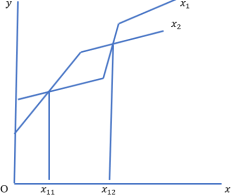
The following method is therefore empirically plausible. Suppose denotes a strategy and represents the value of the objective achieved. However, the relationship varies with the strategy. Figure 1 offers a plausible configuration. Clearly, the firm would pursue the strategy for , strategy for , and switches back to if x > . For all practical purposes, this is an essential aspect of the AI algorithm.
Figure 1. Choice of Objectives and Strategies.
In essence, for any given observation (or the value of the objective), the method detailed above identifies the best objective to be pursued and the most efficient strategy that should be adopted. Even for a given objective, the best strategy may vary over time depending on the cumulative experience of the management. It should be acknowledged that there will be switches and swaps in strategies.
Consider the empirical possibility that a strategy may turn out to be the best for various values of its use. From the viewpoint of prediction, it would be best to consider
where is constructed as the ratio of the average value of the strategy to the average value of the objective.
Another empirical reality should be acknowledged. The same strategy may be applicable for the pursuit of the same objective, depending on the value of the latter. Identifying the range of values of the objective that makes a given strategy efficient can restore the predictive efficiency. For example, referring to
Figure 1 strategy
is the most efficient if 0 ≤ x ≤
and x >
. In the empirical analysis, the average of x =
average of
can be defined as a first approximation. The AI algorithm can be enriched if more detailed data is available.
It is also conceivable that the firm would adopt different strategies to pursue the same objective (e.g., different marketing strategies to improve the market share) depending on the context. Analytically, it may be possible to only specify the probability with which a strategy would be adopted. Detailed data may describe the pursuit of the changes further.
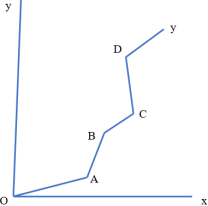
The following simple analogy explains the working of the algorithm. Let y be the destination of the decision maker. It may not be clearly known at the outset. Referring to
Figure 2, the firm begins its operations at O with a target A initially. It may be a short-run goal or a long-run objective. The choice of a strategy could be the one that offers the greatest productivity. As A is approached, the firm may recognize that a better objective at B can be pursued. This may necessitate some changes in strategies as well. Having reached B, or even prior to it in some cases, a new target C may be sighted. The firm will choose strategies that will enable it to reach C in the most efficient manner. The cycle repeats. This description of the intuitively plausible behavior of the management explains the observed nonlinearities most effectively.
Figure 2. Non-Linear Path of Strategies and Objectives. Non-Linear Path of Strategies and Objectives.
The detailed changes can be traced in real time for each of the cases studied. This may be of prohibitive length. Hence, only the characteristics of the broad aggregate results will be presented. Essentially, they will trace the frequency with which objectives and strategies change. Prescribing any change in these aspects over a future date will require further information that can only be guessed or postulated at the present stage of the analysis.
A firm changes its objectives over time depending on its relative position among the objectives. Hence, it is necessary to infer the frequency with which an objective is pursued. Similarly, the choice of the best strategy depends not only on the objective under consideration but also on the relative efficiency of the strategy. As a consequence, it would be useful if the relative frequency of the change in strategies could be noted. Note that the prescription for the strategy to adopt at a point in time depends both on the objective being pursued and the most efficient strategy to cater to that objective.
4. The Data and Variables
The data for several firms in the Chemical Products and Motor Vehicles industries in India constitute the basis on which the analysis was built. The data was obtained from CMIE (Center for Monitoring the Indian Economy) for the years 2001-2023.
The management of firms cannot vary the objectives directly. They will be determined by the strategic choices of the management and environmental variables. The financial implications of three basic functional activities have been considered: Finance, Production, and Marketing.
The following variables were chosen for the analysis.
It was felt that the decision logic of short-run decisions would be different from that of long-run. One of the propositions of this study is that the long- run position of the firm can be sustained only if the short- run activities are efficient. Similarly, the management may concentrate on the long- run objectives if the market for the products is adequate. It is also possible that the firm will concentrate on the short- run objectives if its long- run position is not stable. Hence, three alternatives were considered. Short- run operations, long- run choices, and a combination of both are managed simultaneously.
As such, long-run objectives chosen were external finance 3, and networth 4. The financial manager is responsible for obtaining adequate external finance to acquire the necessary fixed assets. The networth represents the market value of the assets of the firm.
The strategic choices for the long run are fixed assets 7, debt 10, and production expenses 5. Essentially, the acquisition of fixed assets may necessitate the financial manager resorting to debt if equity capital is inadequate.
In the short run, the fixed assets will be utilized in production. This necessitates the acquisition of working capital. The important objectives in the short run will be working capital 8, sales revenue 1, and profit 2. The acknowledgement is that finances incurred in production can be recovered through sales and have implications for the profit of the firm.
For the short-run, the strategic choices will be production 20, selling expenses 6, and inventories 11. Clearly, the fixed assets should be converted to production before realizing any revenue from sales. The only recourse for the firm is to hold inventory if the strategic supply is in excess of the realized sales.
Almost all the data is in financial terms. The CMIE data for many firms is incomplete. Thus, the data for only a few firms could be examined. The original data had to be cleaned up to provide the basis for the analysis. It resulted in the data for 35 firms in the chemical Products industry and 41 firms in the Motor Vehicles industry.
Since some comparisons across variables was necessary each of them has been scaled to add to 100 over the sample.
5. Empirical Experiences
Consider the possibility that firms tend to give priority to long term financial goals. Examine the results at the industry level in the tables that follow. Maintaining the superiority of networth as an objective is evident in the context of chemical products though external finance is very closely of the same frequency. However, for the majority of firms, external finance occupies the dominant role. The only other notable result is that debt financing is an equally important strategy. The demand for finances to acquire capital stock appears to be significant. It can be concluded that in the long-run firms prioritize acquisition of capital stock and, as a result, depend mostly on equity finance. It can be surmised that firms in this industry are not constrained due to lack of demand. They attempt to cater to it using the acquisition of capital assets through external finance.
The motor vehicles industry offers a contrast. Networth has a prominent role at both the industry and firm levels. However, note that firms tend to acquire fixed capital using external finance. The supply of finances to the firms in this industry depends on their ability to demonstrate their long-run viability, though the demand for their products is increasing. The long-run demand will probably stabilize at replacement demand. It should be expected that debt financing may be a priority over equity financing. Note that strategic supply depends on financing production expenses. The fragility of long-run demand suggests that predicting the requirements of long-run finances on the basis of current experiences will be risky.
Consider the question of short-run objectives in relation to the long-run performance. The predominant objectives of the chemical industry are sales revenue and short-run profit. That is, in the short-run, the primary emphasis is on converting strategic supply to realized demand and sales revenue. However, note that most of the firms did not consider production as the most productive strategy to obtain higher levels of profit. Firms depend on working capital financing to maintain their level of production and inventories. The advertising and selling expenses did have a major influence on profit, essentially due to the substantial accumulation of inventories.
The relative ranking of the short-run objectives is similar to that in the chemical industry. Generally, sufficient sales revenue and obtaining short- run profits are the predominant objectives. The priority for the production levels largely determined their demand for working capital. Selling expenses had a significant strategic effect on sales revenue and profit. It can be surmised that shortages of supply of working capital finance is not a constraint. Inventories had a substantial role in determining profit since unplanned inventories add to cost. The positive impact is reflected in the necessity for high levels of strategic supply, and the firms acknowledge that they lose demand if supplies are not available. Even in the context of motor vehicles industry, forecasting the choice of strategies will turn out to be inefficient.
Turn to the possibility of long-run decisions of firms having an impact on short-run choices, or conversely. At the industry level, short-term objectives receive greater importance compared to long-term goals in the context of chemical products industry. Working capital finance had a major role. Though inventories had a significant influence on short-run objectives, taken in isolation, their effect on long-run objectives was prominent when the interaction between long-run and short-run objectives was considered. Acquisition of fixed capital and strategic supply based on it makes working capital finance a dominant objective. In general, short-run strategic choices had very little effect on the long-run objectives and conversely.
The motor vehicles industry offers a contrast in that long-term strategies had a significant impact on the short-run objectives and conversely. The possibility that the acquisition of capital stock and its utilization to create strategic supply without necessarily taking into account the prospects of sales, explains this result.
From the viewpoint of a predictive AI algorithm, it is necessary to consider both the short-run and long-run strategies and objectives together since there are significant interactions between them.
Pronounced fluctuations in the objectives and strategies make it difficult to utilize studies of this nature for predictive AI. More information concerning the factors that influence managers to make switches and swaps will be necessary to make further progress.
Table 1. Chemicals: long run.
industry | | 7 | 10 | 5 |
3 | 47.3141 | 24.4541 | 69.8690 | 5.6769 |
4 | 52.6860 | 26.6667 | 61.1765 | 12.1569 |
3998 | | | | |
3 | | 15.3846 | 76.9231 | 7.6923 |
4 | | 0 | 88.8889 | 11.1111 |
33873 | | | | |
3 | | 14.2857 | 85.7143 | 0. |
4 | | 0. | 75. | 25. |
79484 | | | | |
3 | | 0. | 87.5 | 12.5 |
4 | | 42.8571 | 50. | 7.1429 |
Table 2. Chemicals: short run.
industry | | 20 | 6 | 11 |
8 | 21.4876 | 43.2692 | 31.7308 | 25. |
1 | 38.8430 | 36.1702 | 38.8298 | 25. |
2 | 39.6694 | 0. | 46.8750 | 53.1250 |
3998 | | | | |
8 | | 50. | 25. | 25. |
1 | | 33.3333 | 66.6667 | 0. |
2 | | 0. | 50. | 50. |
33873 | | | | |
8 | | 16.6667 | 33.3333 | 50. |
1 | | 22.2222 | 0. | 77.7778 |
2 | | 0. | 28.5714 | 71.4286 |
79484 | | | | |
8 | | 40. | 40. | 20. |
1 | | 28.5714 | 71.4286 | 0. |
2 | | 0. | 70. | 30. |
Table 3. Chemicals: total.
Industry | | 7 | 10 | 5 | 20 | 6 | 11 |
3 | 13.1818 | 3.4828 | 13.7931 | 25.8621 | 13.7931 | 8.6207 | 34.4828 |
4 | 21.8182 | 10.4167 | 9.3750 | 21.8750 | 9.3750 | 12.5000 | 36.4583 |
8 | 23.1818 | 46.5754 | 13.0137 | 6.1644 | 7.5343 | 15.0685 | 11.6438 |
1 | 17.0455 | 16.0000 | 8.0000 | 20.0000 | 8.0000 | 16.0000 | 32.0000 |
2 | 14.7727 | 13.8462 | 7.6923 | 20.0000 | 16.9231 | 13.8462 | 27.6923 |
3998 | | | | | | | |
3 | | 0. | 0. | 60. | 0. | 20. | 20. |
4 | | 0. | 0. | 66.6667 | 0. | 0. | 33.3333 |
8 | | 40. | 10. | 20. | 10. | 10. | 10. |
1 | | 50. | 0. | 0. | 50. | 0. | 0. |
2 | | 50. | 0. | 0. | 50. | 0. | 0. |
33873 | | | | | | | |
3 | | 0. | 0. | 33.3333 | 33.3333 | 0. | 33.3333 |
4 | | 25. | 0. | 0. | 0. | 12.5 | 62.5 |
8 | | 0. | 28.5714 | 0. | 14.2858 | 0. | 57.1429 |
1 | | 0. | 0. | 0. | 0. | 0. | 100. |
2 | | 33.3333 | 0. | 0. | 0. | 33.3333 | 33.3333 |
79484 | | | | | | | |
3 | | 0. | 0. | 0. | 0. | 0. | 100. |
4 | | 25. | 25. | 0. | 0. | 0. | 50. |
8 | | 75. | 12.5 | 0. | 0. | 0. | 12.5 |
1 | | 0. | 0. | 0. | 0. | 0. | 100. |
2 | | 0. | 33.3333 | 0. | 0. | 0. | 66.6667 |
Table 4. Motor vehicles: long run.
industry | | 7 | 10 | 5 |
3 | 33.2594 | 2. | 57.3333 | 40.6667 |
4 | 66.7406 | 29.2359 | 30.2326 | 40.5316 |
22104 | | | | |
3 | | 0. | 30. | 70. |
4 | | 33.3333 | 13.3333 | 53.3333 |
38309 | | | | |
3 | | 0. | 57.1429 | 42.8572 |
4 | | 33.3333 | 13.3333 | 53.3333 |
96229 | | | | |
3 | | 0. | 62.5 | 37.5 |
4 | | 28.5714 | 14.2857 | 57.1429 |
Table 5. Motor vehicles: short run.
Industry | | 20 | 6 | 11 |
8 | 29.2683 | 45.4546 | 29.5455 | 25. |
1 | 35.9202 | 33.3333 | 42.9012 | 23.7654 |
2 | 34.8115 | 8.9172 | 34.3949 | 56.6879 |
22104 | | | | |
8 | | 66.6667 | 16.6667 | 16.6667 |
1 | | 50. | 50. | 0. |
2 | | 12.5 | 37.5 | 50. |
38309 | | | | |
8 | | 100. | 0. | . |
1 | | 37.5 | 37.5 | 25. |
2 | | 11.1111 | 33.3333 | 55.5556 |
96229 | | | | |
8 | | 80. | 20. | 0. |
1 | | 28.5714 | 71.4286 | 0. |
2 | | 10. | 50. | 40. |
Table 6. Motor Vehicles: total.
Industry | | 7 | 10 | 5 | 20 | 6 | 11 |
3 | 12.3167 | 5.9524 | 14.2857 | 32.1429 | 17.8571 | 17.8571 | 11.9048 |
4 | 23.6070 | 13.0435 | 8.6957 | 30.4378 | 19.2547 | 18.0124 | 10.5590 |
8 | 32.9912 | 27.5556 | 5.7778 | 18.6667 | 8.4444 | 32. | 7.5556 |
1 | 17.1554 | 20.5128 | 16.2393 | 21.3675 | 7.6923 | 21.3675 | 12.8205 |
2 | 13.9296 | 26.3158 | 18.9474 | 24.2105 | 12.6316 | 4.2105 | 13.6842 |
22104 | | | | | | | |
3 | | 0. | 0. | 0. | 100. | 0. | 0. |
4 | | 20. | 0. | 0. | 40. | 20. | 20. |
8 | | 50. | 0. | 0. | 0. | 37.5 | 12.5 |
1 | | 25. | 25. | 50. | 0. | 0. | 0. |
2 | | 50. | 0. | 50. | 0. | 0. | 0. |
38309 | | | | | | | |
3 | | 0. | 0. | 100. | 0. | 0. | 0. |
4 | | 14.2857 | 0. | 28.5714 | 28.5714 | 28.5714 | 0. |
8 | | 16.6667 | 0. | 33.3333 | 0. | 33.3333 | 16.6667 |
1 | | 0. | 0. | 33.3333 | 0. | 33.3333 | 33.3333 |
2 | | 25. | 50. | 0. | 25. | 0. | 0. |
96229 | | | | | | | |
3 | | 0. | 100. | 0. | 0. | 0. | 0. |
0.4 | | 16.6667 | 33.3333 | 16.6667 | 16.6667 | 16.6667 | 0. |
8 | | 33.3333 | 16.6667 | 16.6667 | 0. | 33.3333 | 0. |
1 | | 0. | 20. | 40. | 0. | 20. | 20. |
2 | | 50. | 25. | 25. | 0. | 0. | 0. |
6. Conclusion
The AI algorithm presented in this study has the following advantages.
There is an intuitively obvious behavioral basis for the choice of objectives and strategies of firms as they evolve over time. A satisfactory explanation of the essential non-linearities observed in practice is the highlight of this approach.
The practicing managers can utilize it in real time to systematize their work essentially due to its simplicity in use. In particular, the method integrates the pursuit of short-run and long-run objectives and switches and swaps in the objectives as well as strategies.
When broad trends are considered, it becomes evident that there is no constraint on the demand for the products of firms. Instead, the ability to attract adequate finances, acquire the requisite capital stock, and utilize it in the production process are the real constraints. Advertising and other intangible investments do propel the equilibration of the demand and strategic supply. However, there seems to be more than optimal usage simply to avoid rival firms overtaking the activities of any one firm. It would be worthwhile to improve the algorithm to account for the behavioral responses of rival firms in risky, imperfect markets.
It is always possible that the management makes mistakes in its assessment of the structural changes. They have to be eliminated from the data so that efficient guidance can be provided to the management. Such aberrations can be eliminated sequentially over time. A similar argument holds for the risky changes in the external environment that every firm has to contend with.
The basic conclusions are the following. (a) There is a recurrent swap in the objectives and strategies of every firm. (b) The numerical magnitude of the objectives and strategies is insufficient to attribute priorities to them. A psychometric measure based on the responses of the management becomes essential. Such extensions would be data-intensive and would be contingent on developing appropriate statistical methods.
In general, the experience with this algorithm suggests that its applicability at the industry level is doubtful. It has to be implemented at the firm level, taking the specific conditions of the firm into perspective. Thus, the AI algorithm is useful in providing some guidance.
The frequency distribution for every industry indicates significant swaps in strategies occur even when the same objective is pursued. It is also clear that swaps in objectives are a continuous phenomenon. This occurrence can be noticed even at the firm level. To appreciate why such a change occurs, and to what strategy or objectives the change occurs and identifying the quantum of these changes, will necessarily require a lot more data compared to what is available. The efficiency and cost effectiveness of collecting all such information and prescribing changes efficiently is a question that cannot be answered without further probing.
Abbreviations
CMIE | Center for Monitoring the Indian Economy |
Author Contributions
T.V.S. Ramamohan Rao: Conceptualization, Data curation, Methodology, Resources, Writing – original draft, Writing – review & editing
Conflicts of Interest
The author declares no conflict of interest.
References
| [1] |
Agarwal, A., J. Gans, and A. Goldfarb (2022), Prediction Machines: The Simple Economics of Artificial Intelligence (Cambridge: Harvard Business Review Press),
https://doi.org/10.1080/15228053.2019.1673511
|
| [2] |
Ahirrao, V., I. Ansari, K. Azim, and K. Bhujel (2025), ASI-Powered financial strategy: Transforming business decision-making through predictive analysis, Emerging Frontiers Library for the American Journal of Engineering and Technology, 7, 126-151.
https://taget.org/index.php/ajet/article/view/289
|
| [3] |
Black, B., and W. Kim (2012), The effects of board structure on firm value: a multiple identification approach using Korean data, Journal of Financial Economics, 104-203-226.
https://doi.org/10.1016/j.jfinew.2011.08.001
|
| [4] |
Cao, L. (2003), Support vector machines experts for time series forecasting, Neurocomputing, 51, 321-339.
https://doi.org/10.1016/S0925-2312(02)00577-5
|
| [5] |
Chakrabarty, P., and R. Sinha (2025), Predicting the effectiveness of B2B marketing strategies using deep learning: A multi-target regression and classification approach, Data Science and Applications: Proceedings of ICDSA 2025, vol. 1, 1-23.
https://doi.org/10.1007/978-3-032-10753-4-2
|
| [6] |
Chatalangia, V., M. Chow, and S. Itra (2025), Swap regression methodology for predicting relationship with historical bivariate data, Journal of Business and Economic Statistics,
http://doi.org/10.48550/arxivb.2508.15479
|
| [7] |
Chen, S., and S. Ren (2025), AI-Powered forecasting, risk assessment, and strategic decision making in finance, Frontiers in Business and Finance, 2, 274-295.
|
| [8] |
Chow, D., E. Ngai, J. Gerow, and J. Tacher (2020), The effects of business-IT strategic alignment and its governance on firm performance: A moderated polynomial regression analysis, MIS quarterly, 44, 1679-1704.
|
| [9] |
Chowdhary, R. (2024), AI driven business analytics for operational efficiency, World Journal of Advanced Engineering Technology and Science, 12, 535-543.
https://doi.org/10.30574/wjaets.2024.12.2.0329
|
| [10] |
Copeland, T., and W. Lee (1991), Exchage offers and stock swaps: New evidence, Financial Management, 20, 34-48.
https://jstor/stablke/3665749
|
| [11] |
Crouzet, F., and J. Eberly, A. Eisfeldt, and D. Papanikolaou (2022), The Economics of intangible capital, Journal of Economic Perspectives, 36, 29-52.
https://doi.org/10.1257/jepo.36.3.29
|
| [12] |
Garg, V., J. Gabaldon, S. Niranjan, amnd T. Hawkins (2025), Impact of strategic performance measures on performance: The role of artificial intelligence and machine learning, Transportation Research: Part E: Logistics and Transportation Review, 198: 104073.
https:/10.1016/j.tre.2025.104073
|
| [13] |
Indradevi, R., P. Solomon, and I. Patni (2024), Impact of artificial intelligence in effient knowledge management: An application of stepwise multip.e frgression, in D. Karra (ed.) Advances in Business for Integrating Diversity and Sustainability (London: Taylor and Francis).
|
| [14] |
Joel, M., E. Adaga, and A. Debh (2025), Financial modelling in corporate strategy; A review of AI applications for investment optimization, Account and Financial Management Journal, 10(3).
https://doi.org/10.47191/afmj/v1023.01
|
| [15] |
Kabir, R., Y. Guo, and Q. Yang (2025), Transforming linear regression with AI-driven enhancements for superior forecasting robustness and interpretability, International Journal of Information and Communications Technology,
https://www.inderscience.com/ijict
|
| [16] |
Kavitha, M., K. Hanumanthu, O. Sai, G. Chandrasekhar, and S. Sugandha (2025), The role of artificial intelligence in financial decision making, Journal of Marketing and Social Research, 21, 189-198.
|
| [17] |
Khaleel, S., and R. Anan (2023), A Review paper: Optimal test cases for regression testing using artificial intelligence techniques, International Journal of Electrical and Computer Engineering, 13, 180-1816.
|
| [18] |
Kripalani, G., P. Tolley, R. Gravel, and G. Sexton (1990), Monopoly supply, Atlantic Economic Journal, 18, 32-37.
https://doi.org/10.1007/BF2299016
|
| [19] |
Li, M., and L. Ye (1999), Information technology and firm performance: Linking with environmental, strategic and management contexts, Information and Management, 35, 43-51.
https://doi.org/10.1016/s0378-7206(98)00075-5
|
| [20] |
Mandova, V. (2022), Leveraging AI, ML, and DL for innovative business strategies: A comprehensive exploration, International Journal of Modern Computing, 62-72.
|
| [21] |
Menezes, F., and J. Quiggin (2020), The strategic industry supply curve, Journal of Industrial Economics, 68, 523-555.
https://doi.org/10.1111/joie.12229
|
| [22] |
Mittal, P., and S. Gautam (2023), Logistic regression and predictive analysis for AI strategies in public services, TEM Journal, 12, 751-756.
|
| [23] |
Moins, K. G. et al (2025), PROBAST+AI: An updated quality, risk of bias, and applicability tool for predictive models using regression or artificial intelligence methods, Biomedical Journal,
http://dx.doi.org/10.1136/bmj-2024-082505
|
| [24] |
Neiroukh, S., O. Emeagwali, and H. Aljuhmani (2025), Artificial intelligence capability and organizational performance: Unravelling the mediating mechanisms of decision-making processes, Management Decision, 10, 3501-3532.
https://doi.org/10.1108/MD-10-2023-1946
|
| [25] |
Ozelkan, E., and L. Duckstein (2000), Multi objective fuzzy regression: A general framework, Computers and Operations Research, 27, 635-652.
https://doi.org/10.1016/s0305-0548(99)00110-0
|
| [26] |
Siddique, N. (2025), Optimizing business decision-making through AI-enhanced business intelligence systems: A systematic review of data-driven insights in financial and strategic planning, Strategic Data Management and Innovation, 2001, 202-223.
|
| [27] |
Stiglitz, J. (1989), Imperfect information in the product market, Handbook of Industrial Organization, 1, 769-847.
|
| [28] |
Vudugula, S., S. Chebrolu, M. Bhyiyan, and F. Rozony (2023), Integrating artificial intelligence in strategic decision making: A systematic review of predictive models, International Journal of Scientific Interdisciplinary Research, 4, 1-26.
|
Cite This Article
-
APA Style
Rao, T. R. (2026). An AI Algorithm for Strategic Financial Decisions of Firms in Risky Imperfect Markets. World Journal of Electronic Commerce, 1(1), 21-31. https://doi.org/10.11648/j.wjec.20260101.13
 Copy
|
Copy
|
 Download
ACS Style
Rao, T. R. An AI Algorithm for Strategic Financial Decisions of Firms in Risky Imperfect Markets. World J. Electron. Commer. 2026, 1(1), 21-31. doi: 10.11648/j.wjec.20260101.13
Copy
|
Download
AMA Style
Rao TR. An AI Algorithm for Strategic Financial Decisions of Firms in Risky Imperfect Markets. World J Electron Commer. 2026;1(1):21-31. doi: 10.11648/j.wjec.20260101.13
Copy
|
Download
-
@article{10.11648/j.wjec.20260101.13,
  author = {T.V.S. Ramamohan Rao},
  title = {An AI Algorithm for Strategic Financial Decisions of Firms in Risky Imperfect Markets},
  journal = {World Journal of Electronic Commerce},
  volume = {1},
  number = {1},
  pages = {21-31},
  doi = {10.11648/j.wjec.20260101.13},
  url = {https://doi.org/10.11648/j.wjec.20260101.13},
  eprint = {https://article.sciencepublishinggroup.com/pdf/10.11648.j.wjec.20260101.13},
  abstract = {Both the investors and the firms in imperfect markets experience information asymmetry. As a result, they find obtaining full information before making any decisions to be more expensive relative to expected gains. In general, individuals provide finances based on the market price of the common stock, dividend payments, and the ease with which they can liquidate common stock. However, such decisions cannot be explained by a market like mechanism. Similarly, there is no satisfactory behavioral basis to rationalize the choices of the firms and the investors. It is possible to develop AI algorithms since a large amount of data is available on the actual decisions made. The present study postulates a behavioral basis for the observed decisions. In particular, it will be postulated that the financial manager wishes to generate adequate finances to support the capital decisions of the production manager. Similarly, the production manager will consider it necessary to invest in capital stock to avoid losing market share to rival firms. Intuitively, faced with the valuation of many objectives the financial manager attempts to pursue the numerically best objective and utilize the most productive strategy until they find some superior choice. Empirically it was found that in industries like motor vehicles the demand in the long run would be basically for replacement. Financial managers tend to concentrate on the short run objectives. On the other hand, electrical and chemical products do not experience shortage of demand even in the long run. They focus attention on long run objectives. The proposed algorithm accounts for such differences. It was noted that there is a recurrent change in the objectives and strategies of firms. The numerical magnitudes may themselves be inadequate to describe the behavior. Far more detailed data on the relative valuation of objectives and patterns of change over time would be necessary to develop satisfactory predictive algorithms.},
 year = {2026}
}
Copy
|
Download
-
TY  - JOUR
T1  - An AI Algorithm for Strategic Financial Decisions of Firms in Risky Imperfect Markets
AU  - T.V.S. Ramamohan Rao
Y1  - 2026/10/14
PY  - 2026
N1  - https://doi.org/10.11648/j.wjec.20260101.13
DO  - 10.11648/j.wjec.20260101.13
T2  - World Journal of Electronic Commerce
JF  - World Journal of Electronic Commerce
JO  - World Journal of Electronic Commerce
SP  - 21
EP  - 31
PB  - Science Publishing Group
UR  - https://doi.org/10.11648/j.wjec.20260101.13
AB  - Both the investors and the firms in imperfect markets experience information asymmetry. As a result, they find obtaining full information before making any decisions to be more expensive relative to expected gains. In general, individuals provide finances based on the market price of the common stock, dividend payments, and the ease with which they can liquidate common stock. However, such decisions cannot be explained by a market like mechanism. Similarly, there is no satisfactory behavioral basis to rationalize the choices of the firms and the investors. It is possible to develop AI algorithms since a large amount of data is available on the actual decisions made. The present study postulates a behavioral basis for the observed decisions. In particular, it will be postulated that the financial manager wishes to generate adequate finances to support the capital decisions of the production manager. Similarly, the production manager will consider it necessary to invest in capital stock to avoid losing market share to rival firms. Intuitively, faced with the valuation of many objectives the financial manager attempts to pursue the numerically best objective and utilize the most productive strategy until they find some superior choice. Empirically it was found that in industries like motor vehicles the demand in the long run would be basically for replacement. Financial managers tend to concentrate on the short run objectives. On the other hand, electrical and chemical products do not experience shortage of demand even in the long run. They focus attention on long run objectives. The proposed algorithm accounts for such differences. It was noted that there is a recurrent change in the objectives and strategies of firms. The numerical magnitudes may themselves be inadequate to describe the behavior. Far more detailed data on the relative valuation of objectives and patterns of change over time would be necessary to develop satisfactory predictive algorithms.
VL  - 1
IS  - 1
ER  -
Copy
|
Download





 Share This Article
 Twitter
 Linked In
 Facebook