
Thermal expansion and temperature-dependent elastic properties are important for assessing the stability and performance of nanomaterials in high-temperature applications. The present study investigates the high-temperature thermoelastic properties of selected nanomaterials were investigated using the Murnaghan Equation of State (MEOS) and the Tait Equation of State (TEOS). The normalized volume thermal expansion, bulk modulus, and pressure–volume behavior of Fullerene, 20 nm , nanocrystalline Ag, TiO2, Al, and Cu were evaluated over the temperature range of 300–1000 K. The ambient bulk modulus and its first pressure derivative, obtained from published literature, were used as material-specific parameters for the EOS models. The derived temperature-dependent formulation additionally employs the Anderson–Gruneisen parameter and room-temperature thermal expansion coefficient. The calculated thermal expansion results exhibit excellent agreement with theoretical predictions, demonstrating the validity of the proposed model. The bulk modulus decreases progressively with increasing temperature due to thermal expansion and the weakening of interatomic bonding, Fullerene exhibits the largest temperature-induced variation in bulk modulus, showing the highest temperature sensitivity where as Ni, Ag, TiO2, Al, and Cu show comparatively gradual reductions. Pressure–volume analysis reveals that pressure decreases with increasing volume expansion for all investigated nanomaterials, while TEOS predicts slightly higher tensile pressures than MEOS, particularly at larger volume expansions. Overall, both equations of state successfully describe the thermoelastic response of nanomaterials, and TEOS provides comparatively greater sensitivity for modeling high-temperature behavior. The proposed approach offers a simple, accurate, and computationally efficient method for predicting the thermodynamic and elastic properties of nanomaterials using a limited number of input parameters, making it suitable for the design of materials for high-temperature engineering and nano-device applications. The assumptions regarding temperature-independent reference parameters may, however, limit accuracy at higher temperatures.
| Published in | World Journal of Applied Physics (Volume 11, Issue 4) |
| DOI | 10.11648/j.wjap.20261104.11 |
| Page(s) | 54-64 |
| Creative Commons |
This is an Open Access article, distributed under the terms of the Creative Commons Attribution 4.0 International License (http://creativecommons.org/licenses/by/4.0/), which permits unrestricted use, distribution and reproduction in any medium or format, provided the original work is properly cited. |
| Copyright |
Copyright © The Author(s), 2026. Published by Science Publishing Group |
Temperature Dependence, Fullerene (C60), Nanocrystalline Materials, Volume Thermal Expansivity, Thermoelastic Properties, Pressure–volume Relationship
Materials |
|
|
|
|
|---|---|---|---|---|
Fullerene C60 | 17.27 [18] | 491 [19] | 122 [20] | 300 |
20-nm Ni | 33 [21] | 228 [2 1] | 26.34 [21] | 300 |
nm-Ag | 18 [2 2] | 103.6 [2 3] | 4 [2 3] | 300 |
nm-TiO2 | 15.2 [20] | 243 [2 4] | 4 [2 4] | 300 |
nm-Al | 78 [2 5] | 321 [2 5] | 4 [2 5] | 300 |
Cu | 6.2 [2 2] | 137.8 [2 3] | 4 [2 3] | 300 |
Materials | RMSE |
| Percentage error |
|
|---|---|---|---|---|
Fullerene C60 | 0.0001033 | 0.0000542 | 0.00532% | 0.999792 |
20-nm Ni | 0.0002115 | 0.0001432 | 0.01399 % | 0.999524 |
nm-Ag | 0.00003379 | 0.00002450 | 0.002427 % | 0.999918 |
nm-TiO2 | 0.00002393 | 0.00001750 | 0.001736 % | 0.999942 |
nm-Al | 0.00074706 | 0.00053550 | 0.05131 % | 0.998189 |
Cu | 0.00000391 | 0.00000286 | 0.0002848 % | 0.999990 |
Materials | Volume change |
| TEOS | Mean relative deviation |
|---|---|---|---|---|
Fullerene C60 | 1.00-1.02455 | 0-3.82 | 0-4.78 | 25.74 % |
20-nm Ni | 1.00-1.03211 | 0-4.89 | 0-5.64 | 15.61 % |
nm-Ag | 1.00-1.01206 | 0-1.21 | 0-1.57 | 29.94 % |
nm-TiO2 | 1.00-1.01013 | 0-2.40 | 0-3.05 | 27.36 % |
nm-Al | 1.00-1.0583 | 0-16.27 | 0-20.54 | 26.46 % |
Cu | 1.000-1.00407 | 0-0.56 | 0-0.71 | 28.77 % |
EOS | Equation of State |
TEOS | Tait Equation of State |
MEOS | Murnaghan Equation of State |
AgNPs | Silver Nanoparticles |
| [1] | H. Gleiter, “NANOSTRUCTURED MATERIALS: BASIC CONCEPTS AND MICROSTRUCTURE p.” [Online]. Available: |
| [2] | M. Singh and M. Kao, “Study of Nanomaterials under High Pressure,” Adv. Nanopart., vol. 02, no. 04, pp. 350–357, 2013, |
| [3] | N. P. Shetti, A. Mishra, S. Basu, and T. M. Aminabhavi, “Versatile fullerenes as sensor materials,” Mater. Today Chem., vol. 20, p. 100454, 2021, |
| [4] | X. He, W. Zhong, C. T. Au, and Y. Du, “Size dependence of the magnetic properties of Ni nanoparticles prepared by thermal decomposition method,” Nanoscale Res. Lett., vol. 8, no. 1, 2013, |
| [5] | O. Maťátková, J. Michailidu, A. Miškovská, I. Kolouchová, J. Masák, and A. Čejková, “Antimicrobial properties and applications of metal nanoparticles biosynthesized by green methods,” Biotechnol. Adv., vol. 58, p. 107905, 2022, |
| [6] | S. Nayak, K. B. Manjunatha, L. C. Goveas, C. V. Rao, and S. P. Sajankila, “Investigation of nonlinear optical properties of AgNPs synthesized using Cyclea peltata leaf extract post OVAT optimization,” Bionanoscience, vol. 11, no. 3, pp. 884–892, 2021. |
| [7] | M. Abu-Elghait, M. K. Y. Soliman, M. S. Azab, and S. S. Salem, “Response surface methodology: Optimization of myco-synthesized gold and silver nanoparticles by Trichoderma saturnisporum,” Biomass Convers. Biorefin., vol. 15, no. 3, pp. 4211–4224, Feb. 2025, |
| [8] | X. Chen and A. Selloni, “Introduction: Titanium dioxide (TiO2) nanomaterials,” Oct. 08, 2014, American Chemical Society. |
| [9] | M. Tsega Yihunie, “Effect of Temperature Sintering on Grain Growth and Optical Properties of TiO2 Nanoparticles,” J. Nanomater., vol. 2023, 2023, |
| [10] | F. Czerwinski, “Thermal stability of aluminum alloys,” Aug. 01, 2020, MDPI AG. |
| [11] | V. Molahalli et al., “Properties, Synthesis, and Characterization of Cu-Based Nanomaterials,” in ACS Symposium Series, vol. 1466, American Chemical Society, 2024, pp. 1–33. |
| [12] | N. M. Prakash, “Determination of coefficient of thermal expansion of single-walled carbon nanotubes using molecular dynamics simulation,” The Florida State University, Master of Science Thesis, vol. 54, 2005. |
| [13] |
Q. He and Z. Yan, “Study of temperature dependence of bulk modulus and interatomic separation for ionic solids,” physica status solidi (b), vol. 223, no. 3, pp. 767–771, 2001.
https://doi.org/10.1002/1521-3951(200102)223:3<767::AID-PSSB767>3.0.CO;2-X |
| [14] | O. L. Anderson, “Equation of State of Solids for Geophysics and Ceramic Science,” 1995. |
| [15] | Z.-H. Fang, “Temperature dependence of volume thermal expansion for NaCl and KCl crystals,” Physica B Condens. Matter, vol. 357, no. 3–4, pp. 433–438, 2005. |
| [16] | J. Shanker and M. Kumar, “Thermodynamic Approximations in High-pressure and High-Temperature Physics of Solids,” phys.stat.sol., vol. 179, no. b, p. 351, 1993. |
| [17] | O. L. Anderson, D. Isaak, and H. Oda, “HIGH-TEMPERATURE ELASTIC CONSTANT DATA ON MINERALS RELEVANT TO GEOPHYSICS,” American Geophysical Union, vol. 30, no. 1, pp. 57–90, 1992. |
| [18] | P. Keblinski and P. K. Schelling, “Comment on ‘“Thermal Contraction of Carbon Fullerenes and Nanotubes,” 2004. |
| [19] | N. Dubrovinskaia, L. Dubrovinsky, W. Crichton, F. Langenhorst, and A. Richter, “Aggregated diamond nanorods, the densest and least compressible form of carbon,” Appl. Phys. Lett., vol. 87, no. 8, Aug. 2005, |
| [20] | J. Chandra, D. Kandpal, and B. R. K. Gupta, “Study of thermo-elastic properties of nanomaterials under high temperature,” Physica B Condens. Matter, vol. 404, no. 8, pp. 1087–1091, 2009, |
| [21] | S. Rekhi, S. K. Saxena, R. Ahuja, B. Johansson, and J. Hu, “Experimental and theoretical investigations on the compressibility of nanocrystalline nickel,” J. Mater. Sci., vol. 36, no. 19, pp. 4719–4721, 2001. |
| [22] | M. Singh and M. Singh, “Impact of size and temperature on thermal expansion of nanomaterials,” Pramana - Journal of Physics, vol. 84, no. 4, pp. 609–619, Apr. 2015, |
| [23] | M. Singh, S. Tlali, and H. Narayan, “Pressure Dependent Volume Change in Some Nanomaterials Using an Equation of State,” Nanoscience and Nanotechnology, vol. 2, no. 6, pp. 201–207, Jan. 2013, |
| [24] | V. Swamy et al., “Compression behavior of nanocrystalline anatase TiO 2,” solid state electronics, vol. 125, pp. 111–115, 2003, [Online]. Available: |
| [25] | Z. Wang et al., “Size-induced reduction of transition pressure and enhancement of bulk modulus of AlN nanocrystals,” Journal of Physical Chemistry B, vol. 108, no. 31, pp. 11506–11508, Aug. 2004, |
| [26] | F. D. Murnaghan, “The compressibility of media under extreme pressures,” Proc. Natl. Acad. Sci. U. S. A., vol. 30, no. 9, p. 244, 1944. |
APA Style
Mishra, R. K., Gupta, O. P., Trivedi, S. K. (2026). Equations of State Based Modeling of High-Temperature Thermoelastic Properties of Selected Nanomaterials. World Journal of Applied Physics, 11(4), 54-64. https://doi.org/10.11648/j.wjap.20261104.11
ACS Style
Mishra, R. K.; Gupta, O. P.; Trivedi, S. K. Equations of State Based Modeling of High-Temperature Thermoelastic Properties of Selected Nanomaterials. World J. Appl. Phys. 2026, 11(4), 54-64. doi: 10.11648/j.wjap.20261104.11
@article{10.11648/j.wjap.20261104.11,
  author = {Rajendra Kumar Mishra and Om Prakash Gupta and Sudhir Kumar Trivedi},
  title = {Equations of State Based Modeling of High-Temperature Thermoelastic Properties of Selected Nanomaterials},
  journal = {World Journal of Applied Physics},
  volume = {11},
  number = {4},
  pages = {54-64},
  doi = {10.11648/j.wjap.20261104.11},
  url = {https://doi.org/10.11648/j.wjap.20261104.11},
  eprint = {https://article.sciencepublishinggroup.com/pdf/10.11648.j.wjap.20261104.11},
  abstract = {Thermal expansion and temperature-dependent elastic properties are important for assessing the stability and performance of nanomaterials in high-temperature applications. The present study investigates the high-temperature thermoelastic properties of selected nanomaterials were investigated using the Murnaghan Equation of State (MEOS) and the Tait Equation of State (TEOS). The normalized volume thermal expansion, bulk modulus, and pressure–volume behavior of Fullerene, 20 nm , nanocrystalline Ag, TiO2, Al, and Cu were evaluated over the temperature range of 300–1000 K. The ambient bulk modulus and its first pressure derivative, obtained from published literature, were used as material-specific parameters for the EOS models. The derived temperature-dependent formulation additionally employs the Anderson–Gruneisen parameter and room-temperature thermal expansion coefficient. The calculated thermal expansion results exhibit excellent agreement with theoretical predictions, demonstrating the validity of the proposed model. The bulk modulus decreases progressively with increasing temperature due to thermal expansion and the weakening of interatomic bonding, Fullerene exhibits the largest temperature-induced variation in bulk modulus, showing the highest temperature sensitivity where as Ni, Ag, TiO2, Al, and Cu show comparatively gradual reductions. Pressure–volume analysis reveals that pressure decreases with increasing volume expansion for all investigated nanomaterials, while TEOS predicts slightly higher tensile pressures than MEOS, particularly at larger volume expansions. Overall, both equations of state successfully describe the thermoelastic response of nanomaterials, and TEOS provides comparatively greater sensitivity for modeling high-temperature behavior. The proposed approach offers a simple, accurate, and computationally efficient method for predicting the thermodynamic and elastic properties of nanomaterials using a limited number of input parameters, making it suitable for the design of materials for high-temperature engineering and nano-device applications. The assumptions regarding temperature-independent reference parameters may, however, limit accuracy at higher temperatures.},
 year = {2026}
}
TY  - JOUR
T1  - Equations of State Based Modeling of High-Temperature Thermoelastic Properties of Selected Nanomaterials
AU  - Rajendra Kumar Mishra
AU  - Om Prakash Gupta
AU  - Sudhir Kumar Trivedi
Y1  - 2026/10/14
PY  - 2026
N1  - https://doi.org/10.11648/j.wjap.20261104.11
DO  - 10.11648/j.wjap.20261104.11
T2  - World Journal of Applied Physics
JF  - World Journal of Applied Physics
JO  - World Journal of Applied Physics
SP  - 54
EP  - 64
PB  - Science Publishing Group
SN  - 2637-6008
UR  - https://doi.org/10.11648/j.wjap.20261104.11
AB  - Thermal expansion and temperature-dependent elastic properties are important for assessing the stability and performance of nanomaterials in high-temperature applications. The present study investigates the high-temperature thermoelastic properties of selected nanomaterials were investigated using the Murnaghan Equation of State (MEOS) and the Tait Equation of State (TEOS). The normalized volume thermal expansion, bulk modulus, and pressure–volume behavior of Fullerene, 20 nm , nanocrystalline Ag, TiO2, Al, and Cu were evaluated over the temperature range of 300–1000 K. The ambient bulk modulus and its first pressure derivative, obtained from published literature, were used as material-specific parameters for the EOS models. The derived temperature-dependent formulation additionally employs the Anderson–Gruneisen parameter and room-temperature thermal expansion coefficient. The calculated thermal expansion results exhibit excellent agreement with theoretical predictions, demonstrating the validity of the proposed model. The bulk modulus decreases progressively with increasing temperature due to thermal expansion and the weakening of interatomic bonding, Fullerene exhibits the largest temperature-induced variation in bulk modulus, showing the highest temperature sensitivity where as Ni, Ag, TiO2, Al, and Cu show comparatively gradual reductions. Pressure–volume analysis reveals that pressure decreases with increasing volume expansion for all investigated nanomaterials, while TEOS predicts slightly higher tensile pressures than MEOS, particularly at larger volume expansions. Overall, both equations of state successfully describe the thermoelastic response of nanomaterials, and TEOS provides comparatively greater sensitivity for modeling high-temperature behavior. The proposed approach offers a simple, accurate, and computationally efficient method for predicting the thermodynamic and elastic properties of nanomaterials using a limited number of input parameters, making it suitable for the design of materials for high-temperature engineering and nano-device applications. The assumptions regarding temperature-independent reference parameters may, however, limit accuracy at higher temperatures.
VL  - 11
IS  - 4
ER  -
Department of Physics, Dayanand Brajendra Swarup College, Kanpur, India
Department of Physics, Dayanand Brajendra Swarup College, Kanpur, India
Department of Physics, Dayanand Brajendra Swarup College, Kanpur, India
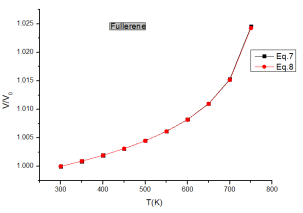
Figure 1. Variation of volume with effect of high temperature in Fullerene (C60) nanomaterial with present (Eq. (7)) and Fang et al. (Eq. (8)).
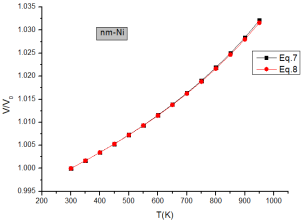
Figure 2. Variation of volume with effect of high temperature in 20nm-Ni nanomaterial with present (Eq. (7)) and Fang et al. (Eq. (8)).
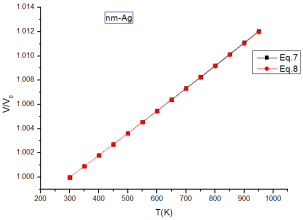
Figure 3. Variation of volume with effect of high temperature in nm-Ag nanomaterial with present (Eq. (7)) and Fang et al. (Eq. (8)).
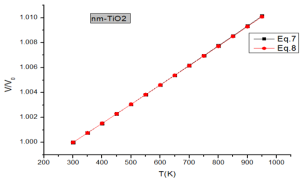
Figure 4. Variation of volume with effect of high temperature in nm-TiO2 nanomaterial with present (Eq. (7)) and Fang et al. (Eq. (8)).
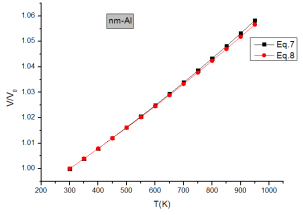
Figure 5. Variation of volume with effect of high temperature in nm-Al nanomaterial with present (Eq. (7)) and Fang et al. (Eq. (8)).
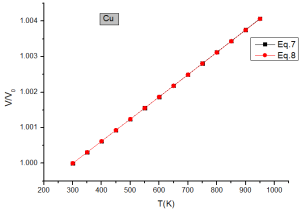
Figure 6. Variation of volume with effect of high temperature in nm-Cu nanomaterial with present (Eq. (7)) and Fang et al. (Eq. (8)).
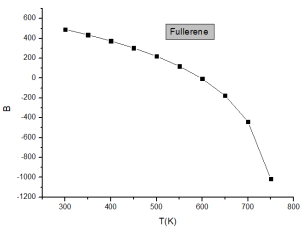
Figure 7. Variation of bulk modulus with effect of high temperature in Fullerene (C60) nanomaterial with present Eq. (13).
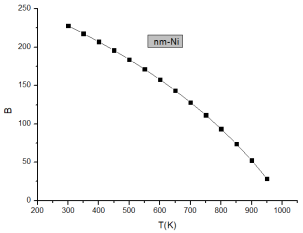
Figure 8. Variation of bulk modulus with effect of high temperature in 20nm-Ni nanomaterial with present Eq. (13).
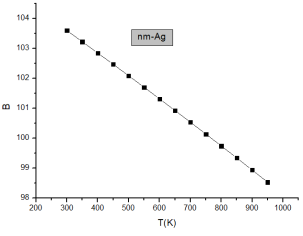
Figure 9. Variation of bulk modulus with effect of high temperature in nm-Ag nanomaterial with present Eq. (13)
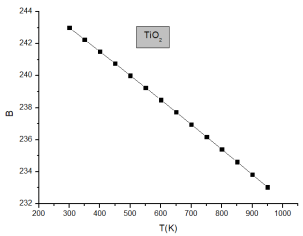
Figure 10. Variation of bulk modulus with effect of high temperature in nm-TiO2 nanomaterial with present Eq. (13).
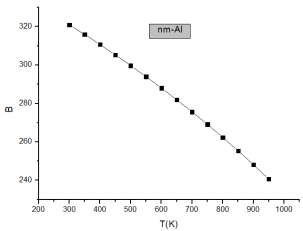
Figure 11. Variation of bulk modulus with effect of high temperature in nm-Al nanomaterial with present Eq. (13).
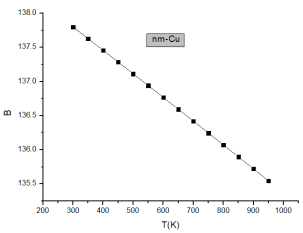
Figure 12. Variation of bulk modulus with effect of high temperature in nm-Cu nanomaterial with present Eq. (13).
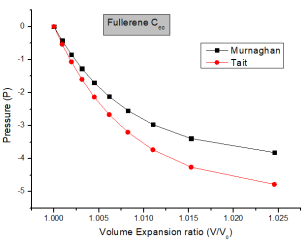
Figure 13. Comparative Variation of pressure with respect to volume expansion ratio in Murnaghan and Tait EOS in Fullerene (C60) nanomaterial.
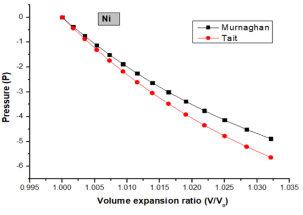
Figure 14. Comparative Variation of pressure with respect to volume expansion ratio in Murnaghan and Tait EOS in nm-Ni nanomaterial.
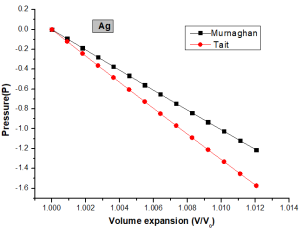
Figure 15. Comparative Variation of pressure with respect to volume expansion ratio in Murnaghan and Tait EOS in nm-Ag nanomaterial.
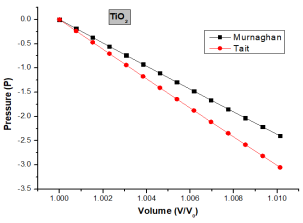
Figure 16. Comparative Variation of pressure with respect to volume expansion ratio in Murnaghan and Tait EOS in nm-TiO2 nanomaterial.
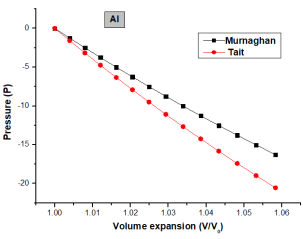
Figure 17. Comparative Variation of pressure with respect to volume expansion ratio in Murnaghan and Tait EOS in nm-Al nanomaterial.
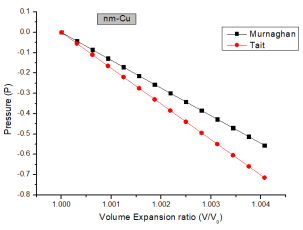
Figure 18. Comparative Variation of pressure with respect to volume expansion ratio in Murnaghan and Tait EOS in nm-Cu nanomaterial.

Information



 Share This Article
 Twitter
 Linked In
 Facebook
 Copy
Copy Download