
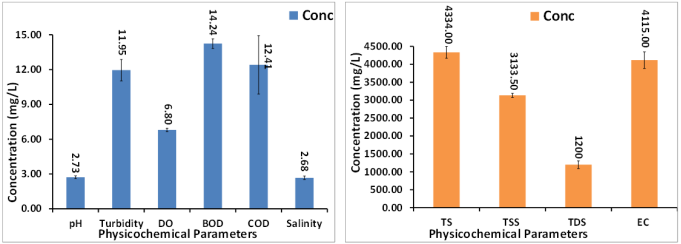
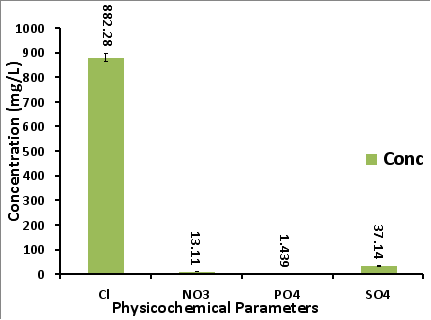
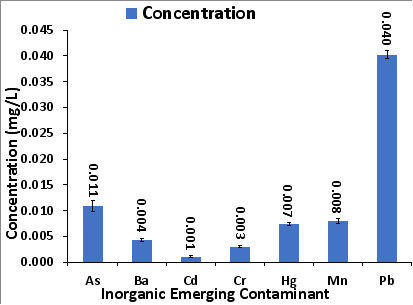
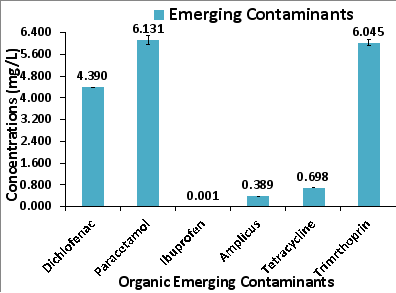
Pharmaceutical wastewater is a major source of emerging contaminants (ECs), which include pharmaceutical residues, personal care products, endocrine-disrupting compounds, and other biologically active substances that are not completely removed by conventional wastewater treatment processes. The continuous discharge of these contaminants into aquatic environments poses significant risks to ecosystems and human health due to their persistence, bioaccumulation potential, and biological activity. This study focused on the identification and quantification of emerging contaminants present in pharmaceutical wastewater collected from a pharmaceutical manufacturing facility. Wastewater samples were collected and subjected to physicochemical characterization prior to contaminant analysis. The identification and quantification of target contaminants were carried out using advanced analytical techniques, Gas Chromatography-Mass Spectrometry (GC-MS) and ICP-OES for Organic and Inorganic emerging contaminants respectively. Common pharmaceutical compounds detected included analgesics, antibiotics, anti-inflammatory drugs, anti-malaria drugs and other active pharmaceutical ingredients. The concentrations of these contaminants varied depending on the nature of the manufacturing processes and wastewater characteristics. The physicochemical results revealed a pH of 2.73, turbidity of 11.95 NTU, dissolved oxygen (DO) of 6.80 mg/L, biochemical oxygen demand (BOD) of 14.24 mg/L, chemical oxygen demand (COD) of 12.41 mg/L, total dissolved solids (TDS) of 1,200 mg/L, chloride (Cl⁻) of 882.28 mg/L, and sulphate (SO42⁻) of 37.14 mg/L. The inorganic contaminants detected include arsenic (As) at 0.011 mg/L, cadmium (Cd) at 0.001 mg/L, mercury (Hg) at 0.007 mg/L, and lead (Pb) at 0.007 mg/L. and organic emerging contaminants are paracetamol (4.390), dichlofenac (6.131), tetracycline (0.698), and ampiclux (0.389). While some contaminants exceeded recommended environmental thresholds, highlighting the inadequacy of conventional treatment systems in completely removing these pollutants. The study provides essential baseline data on the occurrence and levels of emerging contaminants in pharmaceutical wastewater and underscores the need for effective treatment technologies to prevent environmental contamination. The results also support the development of sustainable remediation strategies, including the application of nanoparticle-based adsorption systems for the efficient removal of pharmaceutical pollutants from wastewater.
| Published in | World Journal of Applied Chemistry (Volume 11, Issue 4) |
| DOI | 10.11648/j.wjac.20261104.11 |
| Page(s) | 101-113 |
| Creative Commons |
This is an Open Access article, distributed under the terms of the Creative Commons Attribution 4.0 International License (http://creativecommons.org/licenses/by/4.0/), which permits unrestricted use, distribution and reproduction in any medium or format, provided the original work is properly cited. |
| Copyright |
Copyright © The Author(s), 2026. Published by Science Publishing Group |
Pharmaceutical Wastewater, Emerging Contaminants, Identification, Quantification, GC-MS, Pharmaceutical Residues, Environmental Pollution
PARAMETER | NIS -WHO STANDARD |
|---|---|
pH | 6.5-8.5 |
Turbidity | NTU 30 max |
Dissolved Oxygen (DO) | 15 mg/L max |
Biochemical Oxygen Demand (BOD) | 30 mg/L max |
Chemical Oxygen Demand (COD) | 80 mg/L max |
Salinity | 1000 mg/L (max) |
Total Solid (TS) | 1500 mg/mL (max) |
Total Suspended Solid (TSS) | 2000 mg/L (max) |
Total Dissolved Solids (TDS) | 2000 mg/L (max) |
Conductivity | 2500 µS/cm (max) |
Chloride ion (Cl-) | 250 mg/L (max) |
Nitrate (NO3-) | 45 mg/L (max) |
Phosphate (PO43-) | 4.5 mg/L (max) |
Sulphate (SO32-) | 250 mg/L (max) |
PARAMETERS | WHO Standard permissible limit |
|---|---|
Arsenic (As) | 0.2 |
Barium (Ba) | 5.0 |
Cadmium (Cd) | 0.02 |
Chromium (Cr) | 0.5 |
Mercury (Hg) | 0.01 |
Manganese (Mn) | 0.08 |
Lead (Pb) | 0.1 |
PARAMETERS | WHO Standard permissible limit |
|---|---|
Dichlofenac | 0.0005 |
Paracetamol | 0.0092 |
Ibuprofen | 0.0071 |
Amplicus | 0.6000 |
Tetracycline | 0.0010 |
Trimethropin | 0.0005 |
ECs | Emerging Contaminants |
Cu-Fe NPS | Copper-Iron Nanoparticles Tailing |
IECs | Inorganic Emerging Contaminants |
OECs | Organic Emerging Contaminants |
ICP-OES | Inductively Coupled Plasma–Optical Emission Spectrometry |
GC-MS | Gas Chromatography-Mass Spectrometry |
SPE | Solid Phase Extraction |
HNO3 | Nitric Acid |
HCl | Hydrochloric Acid |
COD | Chemical Oxygen Demand |
BOD | Biochemical Oxygen Demand |
EC | Electrical Conductivity Salinity, |
TDS | Total Dissolved Solids |
DO | Dissolved Oxygen |
| [1] | Adeoye, J. B., Tan, Y. H., Lau, S. Y., Tan, Y. Y., Chiong, T., Mubarak, N. M., & Khalid, M. (2024). Advanced oxidation and biological integrated processes for pharmaceutical wastewater treatment: A review. Journal of Environmental Management, 353, 120170. |
| [2] | Astuti, Y. D., & Nastiti, A. (2024). Occurrence and removal efficiency of active pharmaceutical ingredients (APIs) in wastewater treatment plants: A systematic review from Southeast Asia. ACS ES&T Water, 4(10), 3988-4008. |
| [3] | Srinivasan, K., Hariharapura, R. C., & Mallikarjuna, S. V. (2025). Pharmaceutical waste management through microbial bioremediation. Environmental Monitoring and Assessment, 197(488), 1-26. |
| [4] | Zhang, H., Mu, Y., Li, S., Wang, Y., Ya, T., Chen, C., & Duan, L. (2025). Challenges and future directions of neglected emerging contaminants in wastewater treatment plants. ACS ES&T Water, 5(5), 2005-2008. |
| [5] | Li, Y., Zhang, H., Wang, J., & Chen, X. (2024). Occurrence, risks, and removal methods of antibiotics in urban wastewater treatment systems: A review. Water, 16(23), 3428. |
| [6] | Kanakaraju, D., Glass, B. D., & Goh, P. S. (2025). Advanced oxidation process-mediated removal of pharmaceuticals from water: A review of recent advances. Environmental Science and Pollution Research, 32, 14316-14350. |
| [7] | Sporsho, S. S., Saha, D., Khan, M. H., Rahman, M. S., Rukh, M., Islam, M. R., Chakma, T., Haque, F., Roy, H., Sarkar, D., & Islam, M. S. (2025). Insights into adsorbent-based pharmaceutical wastewater treatment and future developments toward sustainability. RSC Advances, 15, 50597-50632. |
| [8] | Ghosh, S., Das, S., & Sharma, A. (2024). Occurrence, fate, transport, and removal technologies of emerging contaminants: A review on recent advances and future perspectives. CLEAN - Soil, Air, Water, 52(3), e202300259. |
| [9] | Richardson, S. D., & Kimura, S. Y. (2020). Water analysis: Emerging contaminants and current issues. Analytical Chemistry, 92(1), 473-505. |
| [10] |
Garg, S., Sharma, P., Kumar, A., & Singh, R. (2025). Comprehensive insights on the detection, occurrence and modelling of pharmaceuticals in surface water, groundwater, and drinking water treatment plants. Journal of Hazardous Materials Advances, 18, 100707.
https://doi.org/10.1016/j.hazadv.2025.100707 International Journal of Pharmacy Practice, 33(4), 360-373. |
| [11] | Wu, X., Nawaz, S., Li, Y., & Zhang, H. (2024). Environmental health hazards of untreated livestock wastewater: potential risks and future perspectives. Environmental Science and Pollution Research, 31(17), 24745-24767. |
| [12] | Alshammari, A., Alshammari, A. A., Al-Mutairi, K. A., & Alharbi, S. K. (2024). Pharmaceuticals in drinking water: A scoping review to raise pharmacists' public health and environmental awareness on contamination in groundwater, surface water, and other sources. |
| [13] | Liu, T., Aniagor, C. O., Ejimofor, M. I., Menkiti, M. C., Tang, K. H. D., Chin, B. L. F., Chan, Y. H., Yiin, C. L., Cheah, K. W., Chai, Y. H., et al. (2023). Technologies for removing pharmaceuticals and personal care products (PPCPs) from aqueous solutions: Recent advances, performances, challenges and recommendations for improvements. Journal of Molecular Liquids, 374, 121144. |
| [14] | Deblonde, T., Cossu-Leguille, C., & Hartemann, P. (2013). Environmental impact of medical prescriptions: Assessing the risks and hazards of persistence, bioaccumulation and toxicity of pharmaceuticals. Public Health, 127(4), 312-317. |
| [15] | Alqarni, A. M. (2024). Analytical methods for the determination of pharmaceuticals and personal care products in solid and liquid environmental matrices: A review. Molecules, 29(16), 3900. |
| [16] | Jiang, T., Wu, W., Ma, M., Hu, Y., & Li, R. (2024). Occurrence and distribution of emerging contaminants in wastewater treatment plants: A global review over the past two decades. Science of the Total Environment, 951, 175664. |
| [17] | Ågerstrand, M., & Rudén, C. (2010). Evaluation of the accuracy and consistency of the Swedish environmental classification and information system for pharmaceuticals. Science of the Total Environment, 408(11), 2327-2339. |
| [18] | Boll, K., & Hallberg, E. (2023). Self-declarations of environmental classification at Fass. se: Experiences from the reviewing process during 2021 (IVL Report C751). IVL Swedish Environmental Research Institute. |
| [19] | LIF. (2025). Environmental classification of pharmaceuticals at FASS. se. Swedish Association of the Pharmaceutical Industry (LIF), Stockholm, Sweden. |
| [20] | Nworie, F. S., Akinpelu, A. O., & Oladoja, N. A. (2024). A critical review of occurrence, sources, fate, ecological risk, and health effect of emerging contaminants in water and wastewater. Environmental Nanotechnology, Monitoring & Management, 22, 100994. |
| [21] | Patel, M., Kumar, R., Kishor, K., Mlsna, T., Pittman, C. U., Jr., & Mohan, D. (2024). Pharmaceuticals of emerging concern in aquatic systems: Chemistry, occurrence, effects, and removal methods. Chemical Engineering Journal, 496, 153743. |
| [22] | Kümmerer, K. (2022). Pharmaceuticals in the environment: Sources, fate, effects and risks. Environmental Sciences Europe, 34(1), 1-15. |
| [23] | Hernández-Tenorio, A. R., García-Rodríguez, O., Sánchez-Polo, M., & Rivera-Utrilla, J. (2023). Pharmaceutical active compounds at drugs manufacturing wastewater: A review. Environmental Nanotechnology, Monitoring & Management, 20, 100870. |
| [24] | Nguyen, M. K., Nguyen, T. H., Le, T. T., & co-authors. (2024). Occurrence and fate of pharmaceutical pollutants in wastewater: Insights on ecotoxicity, health risk, and state-of-the-art removal. Chemosphere, 354, 141678. |
| [25] | Srivastava, S. K. (2024). Recent advances in removal of pharmaceutical pollutants in wastewater using metal oxides and carbonaceous materials as photocatalysts: A review. RSC Applied Interfaces, 1(3), 340-429. |
| [26] | La Rosa, M. C., Maugeri, A., Favara, G., La Mastra, C., Magnano San Lio, R., Barchitta, M., & Agodi, A. (2025). The impact of wastewater on antimicrobial resistance: A scoping review of transmission pathways and contributing factors. Antibiotics, 14(2), 131. |
| [27] | Wu, J., Han, Z., & Ma, X. (2025). A database on antibiotics and antibiotic resistance in wastewater and solid waste from pharmaceutical industry based on a systematic review. China CDC Weekly, 7(3), 92-100. |
| [28] | Raju, N. P., Dhanorkar, M., & Singh, P. (2025). The interplay between antimicrobial resistance genes and emerging contaminants in wastewater treatment plants: Key players in One Health. Annals of Microbiology, 75, 28. |
| [29] | World Health Organization. (2025). Wastewater and environmental surveillance: Summary for antimicrobial resistance. |
| [30] | Punch, R., Azani, R., Ellison, C., Majury, A., Hynds, P. D., Payne, S. J., & Brown, R. S. (2025). The surveillance of antimicrobial resistance in wastewater from a One Health perspective: A global scoping and temporal review (2014-2024). One Health, 21, 101139. |
| [31] | Meradji, S., Basher, N. S., Sassi, A., Ibrahim, N. A., & Idres, T. (2025). The role of water as a reservoir for antibiotic-resistant bacteria. Antibiotics, 14(8), 763. |
| [32] | Byrnes, N. A., Silvester, R., Cross, G., Weightman, A. J., Jones, D. L., & Kasprzyk-Hordern, B. (2025). Assessing the risk of antimicrobial resistance and potential environmental harm through national-scale surveillance of antimicrobials in hospital and community wastewater. Environment International, 202, 109606. |
| [33] | Ahammad, N. A., Ahmad, M. A., Hameed, B. H., & Din, A. T. M. (2023). A mini review of recent progress in the removal of emerging contaminants from pharmaceutical waste using various adsorbents. Environmental Science and Pollution Research, 30, 124459-124473. |
| [34] | Wada, O. Z., Olawade, D., Afolalu, T., & Alghamdi, A. A. (2025). Recent occurrence of pharmaceuticals in freshwater, emerging treatment technologies, and future considerations: A review. Chemosphere, 374, 144153. |
| [35] | Bano, A., Prasad, B., Kumari, M., Meili, L., & Prasad, K. S. (2025). Pharmaceuticals in water and wastewater: A review on ecological risk and sustainable treatment options. Water, Air, & Soil Pollution, 236(8), 516. |
| [36] | Tapera, M., Chokwe, R. C., Munonde, T. S., Mamba, G., & Madikizela, L. M. (2026). Pharmaceutical pollutants in wastewater treatment plants: A global review of occurrence, treatment efficiency, and implications for receiving water bodies. Next Research, 6(1), 101430. |
| [37] | Uluseker, C., Lofts, S., & Harrison, S. (2025). Advances and challenges in modelling the environmental fate and exposure of pharmaceuticals: A comprehensive review. Environmental Science: Processes & Impacts, 27, 3700-3724. |
| [38] | Silva, M. A., Ferreira, L. C., Gomes, J. F., & Santos, P. S. (2025). Analytical advances for identification and quantification of contaminants of emerging concern in aquatic environments. Journal of Environmental Chemical Engineering, 13(2), 114882. |
| [39] | Lin, X., Shao, B., & Xu, J. (2025). Occurrence, risk assessment, and removal of emerging contaminants in aquatic environment. Water, 17(11), 1657. |
| [40] | Tisler, S., Kilpinen, K., Devers, J., Castro, M., Jørgensen, M. B., Mandava, G., Lundqvist, J., Cedergreen, N., & Christensen, J. H. (2025). Mapping emerging contaminants in wastewater effluents through multichromatographic platform analysis and source correlations. Environmental Science & Technology, 59(11), 5766-5774. |
| [41] | Harish, H., & Jegatheesan, V. (2025). A review of sources, worldwide legislative measures and the factors influencing the treatment technologies for contaminants of emerging concern (CECs). Current Pollution Reports, 11, 44. |
| [42] | Yakamercan, E., Obijianya, C. C., Jayakrishnan, U., Aygun, A., Velluru, S., & Karimi, M. (2025). A critical review of contaminants of emerging concern in reclaimed wastewater: Implications for agricultural irrigation. Water Conservation Science and Engineering, 10(112). |
| [43] | Boahen, E., Owusu, L., & Adjei-Anim, S. O. (2025). A comprehensive review of emerging environmental contaminants of global concern. Discover Environment, 3(144). |
| [44] | Singh, C. K., Sodhi, K. K., Rajagopalan, V., Sharma, S., Kaur, J., & Kumar, Y. (2025). Managing the complexity of emerging contaminants in aquatic environments: Exploring their ecotoxicological impacts, detection techniques, and the use of innovative technologies for their remediation. Discover Catalysis, 2(9). |
| [45] | Mojiri, A., Vakili, M., Aziz, S. Q., Tajuddin, R. M., Farraji, H., & Gholami, A. (2025). Analytical approaches for identification and quantification of contaminants of emerging concern in water and wastewater systems: A comprehensive review. Environmental Research, 267, 120874. |
| [46] | Akinpelu, A., Akinlabi, E., & co-authors. (2024). Occurrence, analysis and removal processes of emerging pharmaceuticals from waters for the protection and preservation of a sustainable environment: A review. Journal of Cleaner Production, 466, 142654. |
| [47] | Kaur, R., Sharma, V., Singh, P., & Kumar, A. (2025). Advanced chromatographic and mass spectrometric techniques for detection of emerging contaminants in wastewater: Recent developments and future perspectives. Journal of Environmental Chemical Engineering, 13(1), 114231. |
| [48] | Berset, J. D., Kienle, C., & Du Pasquier, D. (2024). Recent advances in analytical methods for monitoring contaminants of emerging concern in aquatic environments. TrAC Trends in Analytical Chemistry, 174, 117650. |
| [49] | Sabarinathan, M., Rajendran, S., Ramesh, M., & Govarthanan, M. (2025). Advances in extraction, clean-up, and analytical determination of pharmaceuticals and personal care products in wastewater systems. Microchemical Journal, 210, 111456. |
| [50] | Pérez-Lucas, G., Vela, N., El Aatik, A., & Navarro, S. (2024). Sample preparation strategies for the analysis of emerging contaminants in environmental waters: Current trends and future perspectives. Journal of Chromatography A, 1732, 465051. |
| [51] | Farooq, U., Shahid, M., Ahmad, Z., & Khan, N. A. (2025). Recent advances in sample preparation techniques for trace analysis of contaminants of emerging concern in environmental waters. Environmental Technology & Innovation, 38, 104215. |
| [52] | Mulla, S. I., Bharagava, R. N., Saxena, G., & Kumar, A. (2024). Analytical methodologies for monitoring contaminants of emerging concern in environmental matrices: Challenges and opportunities. Environmental Advances, 15, 100512. |
| [53] | Aziz, K. H. H., Mustafa, F. S., Karim, M. A. H., & Hama, S. (2025). Pharmaceutical pollution in the aquatic environment: Advanced oxidation processes as efficient treatment approaches: A review. Materials Advances, 6, 3433-3454. |
| [54] | Islam, I. U., Hu, X., Shang, J., Ashraf, M. A., Ali, T., Aslam, A. A., Li, S., Li, D., Nazir, M. S., Wang, X., & Yabalak, E. (2025). MOF and MOF-based membranes: Promising solutions for pharmaceutical wastewater treatment. Journal of Materials Science, 60, 3634-3662. |
| [55] | Onotu, O. P., Samuel, H. S., Undie, D. A., Akinpelu, O. O., Ibekwe, F. A., et al. (2025). Nanoparticles for targeted removal of emerging contaminants in wastewater: Mechanisms and sustainable practices. Discover Nano, 20, 191. |
| [56] | Cozzolino, V., Coppola, G., Calabrò, V., Chakraborty, S., Candamano, S., & Algieri, C. (2025). Heterogeneous TiO2 photocatalysis coupled with membrane technology for persistent contaminant degradation: A critical review. Applied Water Science, 15, 243. |
| [57] | Okpala-Chinonso, A. N., Moronkola, B. A., & Alegbe, M. J. (2026). Synthesis of composite copper - iron nanoparticles from Copper Tailings using Sodium Borohydride as Reductant. European Journal of Applied Sciences; Vol. 14 No. 03 (2026), 322-340. |
| [58] | Kundu, S., Singh, P., Sharma, A., & Kumar, V. (2025). Mine tailings as secondary resources for the synthesis of functional nanomaterials: Opportunities for environmental sustainability. Journal of Environmental Management, 372, 124003. |
| [59] | Zhang, Y., Luo, H., Chen, M., & Xu, P. (2024). Recovery of valuable metals from mine tailings and their conversion into functional materials for environmental applications. Minerals Engineering, 218, 108020. |
| [60] | Wang, Q., Zhao, X., Liu, Y., & Sun, J. (2025). Recent advances in copper-based nanomaterials for the removal of pharmaceutical pollutants from water and wastewater. Chemosphere, 376, 145087. |
| [61] | Li, J., Chen, Y., Zhang, X., & Wang, L. (2025). Copper-iron bimetallic nanomaterials for wastewater treatment: Synthesis, mechanisms, and environmental applications. Environmental Technology & Innovation, 38, 104398. |
| [62] | Bian, Z., Wang, H., Zhao, Y., & Liu, S. (2025). Mine tailings valorization for sustainable environmental remediation and resource recovery: Recent advances and future perspectives. Resources, Conservation and Recycling, 214, 108015. |
| [63] | Xiao, Y., Du, Z., Li, Y., Cao, L., & Zhu, B. (2025). A review on the application of biosensors for monitoring emerging contaminants in the water environment. Sensors, 25(16), 4945. |
| [64] |
Zhao, W., Wang, B., & Yu, G. (2025). Addressing the uncertainties in the environmental analysis, modeling, source and risk assessment of emerging contaminants. Water, 17(2), 215.
https://doi.org/10.3390/w17020215 Fdez-Sanromán, A., Bernárdez-Rodas, N., Rosales, E., Pazos, |
| [65] | Mohapatra, S., Jong, M.-C., Mukherji, S., van Lier, J. B., & Spanjers, H. (2025). Liquid crystal monomers (LCMs) of emerging concern: Recent progress and challenges in wastewater treatment. Current Pollution Reports, 11(1), 48. |
| [66] | Fdez-Sanromán, A., Bernárdez-Rodas, N., Rosales, E., Pazos, M., González-Romero, E., & Sanromán, M. Á. (2025). Biosensor technologies for water quality: Detection of emerging contaminants and pathogens. Biosensors, 15(3), 189. |
| [67] | Petrie, B., Barden, R., & Kasprzyk-Hordern, B. (2022). A review on emerging contaminants in wastewaters and the environment: Current knowledge, understudied areas and recommendations for future monitoring. Water Research, 219, 118563. |
| [68] | Alygizakis, N. A., Oswald, P., Thomaidis, N. S., & Aalizadeh, R. (2023). Sampling and preservation strategies for monitoring contaminants of emerging concern in wastewater systems. Science of the Total Environment, 878, 162963. |
| [69] | Paíga, P., Correia-Sá, L., Correia, M., Figueiredo, S., Vieira, J., Jorge, S., Silva, J. G., & Delerue-Matos, C. (2024). Temporal analysis of pharmaceuticals as emerging contaminants in surface water and wastewater samples. Journal of Xenobiotics, 14(3), 48. |
| [70] | American Public Health Association (APHA). (2023). Standard methods for examination of water and wastewater (24th ed.). American Public Health Association |
| [71] | National Environmental Standards and Regulations Enforcement Agency (NESREA). (2009). National Environmental (Chemicals, Pharmaceuticals, Soap and Detergent Manufacturing Industries) Regulations, 2009. Federal Republic of Nigeria Official Gazette, Abuja, Nigeria. |
| [72] | Hossen, M. A., Sattar, G. S., & Mostafa, M. G. (2024). Factors affecting the performance of a pharmaceutical wastewater treatment plant: Characterization of effluent and environmental risk. Heliyon, 10(7), e29165. |
| [73] | Nishmitha, P. S., Akhilghosh, K. A., Aiswriya, V. P., Ramesh, A., Muthuchamy, M., & Muthukumar, A. (2025). Understanding emerging contaminants in water and wastewater: A comprehensive review on detection, impacts, and solutions. Journal of Hazardous Materials Advances, 18, 100755. |
| [74] | Adjei, K. Y., Aliyu, A., Owhe-Ureghe, E., Oriakhi, E. A., Bakare-Abidola, T., Olaoye, J., & Adepoju, Y. O. (2025). Biological treatment of emerging organic micropollutants in wastewater: Recent advances and perspectives. World Journal of Biology Pharmacy and Health Sciences, 21(3), 488-505. |
APA Style
Angela, O., Adekemi, M. B., John, A. M. (2026). Identification and Quantification of Emerging Contaminants in Pharmaceuticals Wastewater. World Journal of Applied Chemistry, 11(4), 101-113. https://doi.org/10.11648/j.wjac.20261104.11
ACS Style
Angela, O.; Adekemi, M. B.; John, A. M. Identification and Quantification of Emerging Contaminants in Pharmaceuticals Wastewater. World J. Appl. Chem. 2026, 11(4), 101-113. doi: 10.11648/j.wjac.20261104.11
@article{10.11648/j.wjac.20261104.11,
  author = {Okpala-Chinonso Angela and Moronkola Bridget Adekemi and Alegbe Monday John},
  title = {Identification and Quantification of Emerging Contaminants in Pharmaceuticals Wastewater},
  journal = {World Journal of Applied Chemistry},
  volume = {11},
  number = {4},
  pages = {101-113},
  doi = {10.11648/j.wjac.20261104.11},
  url = {https://doi.org/10.11648/j.wjac.20261104.11},
  eprint = {https://article.sciencepublishinggroup.com/pdf/10.11648.j.wjac.20261104.11},
  abstract = {Pharmaceutical wastewater is a major source of emerging contaminants (ECs), which include pharmaceutical residues, personal care products, endocrine-disrupting compounds, and other biologically active substances that are not completely removed by conventional wastewater treatment processes. The continuous discharge of these contaminants into aquatic environments poses significant risks to ecosystems and human health due to their persistence, bioaccumulation potential, and biological activity. This study focused on the identification and quantification of emerging contaminants present in pharmaceutical wastewater collected from a pharmaceutical manufacturing facility. Wastewater samples were collected and subjected to physicochemical characterization prior to contaminant analysis. The identification and quantification of target contaminants were carried out using advanced analytical techniques, Gas Chromatography-Mass Spectrometry (GC-MS) and ICP-OES for Organic and Inorganic emerging contaminants respectively. Common pharmaceutical compounds detected included analgesics, antibiotics, anti-inflammatory drugs, anti-malaria drugs and other active pharmaceutical ingredients. The concentrations of these contaminants varied depending on the nature of the manufacturing processes and wastewater characteristics. The physicochemical results revealed a pH of 2.73, turbidity of 11.95 NTU, dissolved oxygen (DO) of 6.80 mg/L, biochemical oxygen demand (BOD) of 14.24 mg/L, chemical oxygen demand (COD) of 12.41 mg/L, total dissolved solids (TDS) of 1,200 mg/L, chloride (Cl⁻) of 882.28 mg/L, and sulphate (SO42⁻) of 37.14 mg/L. The inorganic contaminants detected include arsenic (As) at 0.011 mg/L, cadmium (Cd) at 0.001 mg/L, mercury (Hg) at 0.007 mg/L, and lead (Pb) at 0.007 mg/L. and organic emerging contaminants are paracetamol (4.390), dichlofenac (6.131), tetracycline (0.698), and ampiclux (0.389). While some contaminants exceeded recommended environmental thresholds, highlighting the inadequacy of conventional treatment systems in completely removing these pollutants. The study provides essential baseline data on the occurrence and levels of emerging contaminants in pharmaceutical wastewater and underscores the need for effective treatment technologies to prevent environmental contamination. The results also support the development of sustainable remediation strategies, including the application of nanoparticle-based adsorption systems for the efficient removal of pharmaceutical pollutants from wastewater.},
 year = {2026}
}
TY  - JOUR
T1  - Identification and Quantification of Emerging Contaminants in Pharmaceuticals Wastewater
AU  - Okpala-Chinonso Angela
AU  - Moronkola Bridget Adekemi
AU  - Alegbe Monday John
Y1  - 2026/10/14
PY  - 2026
N1  - https://doi.org/10.11648/j.wjac.20261104.11
DO  - 10.11648/j.wjac.20261104.11
T2  - World Journal of Applied Chemistry
JF  - World Journal of Applied Chemistry
JO  - World Journal of Applied Chemistry
SP  - 101
EP  - 113
PB  - Science Publishing Group
SN  - 2637-5982
UR  - https://doi.org/10.11648/j.wjac.20261104.11
AB  - Pharmaceutical wastewater is a major source of emerging contaminants (ECs), which include pharmaceutical residues, personal care products, endocrine-disrupting compounds, and other biologically active substances that are not completely removed by conventional wastewater treatment processes. The continuous discharge of these contaminants into aquatic environments poses significant risks to ecosystems and human health due to their persistence, bioaccumulation potential, and biological activity. This study focused on the identification and quantification of emerging contaminants present in pharmaceutical wastewater collected from a pharmaceutical manufacturing facility. Wastewater samples were collected and subjected to physicochemical characterization prior to contaminant analysis. The identification and quantification of target contaminants were carried out using advanced analytical techniques, Gas Chromatography-Mass Spectrometry (GC-MS) and ICP-OES for Organic and Inorganic emerging contaminants respectively. Common pharmaceutical compounds detected included analgesics, antibiotics, anti-inflammatory drugs, anti-malaria drugs and other active pharmaceutical ingredients. The concentrations of these contaminants varied depending on the nature of the manufacturing processes and wastewater characteristics. The physicochemical results revealed a pH of 2.73, turbidity of 11.95 NTU, dissolved oxygen (DO) of 6.80 mg/L, biochemical oxygen demand (BOD) of 14.24 mg/L, chemical oxygen demand (COD) of 12.41 mg/L, total dissolved solids (TDS) of 1,200 mg/L, chloride (Cl⁻) of 882.28 mg/L, and sulphate (SO42⁻) of 37.14 mg/L. The inorganic contaminants detected include arsenic (As) at 0.011 mg/L, cadmium (Cd) at 0.001 mg/L, mercury (Hg) at 0.007 mg/L, and lead (Pb) at 0.007 mg/L. and organic emerging contaminants are paracetamol (4.390), dichlofenac (6.131), tetracycline (0.698), and ampiclux (0.389). While some contaminants exceeded recommended environmental thresholds, highlighting the inadequacy of conventional treatment systems in completely removing these pollutants. The study provides essential baseline data on the occurrence and levels of emerging contaminants in pharmaceutical wastewater and underscores the need for effective treatment technologies to prevent environmental contamination. The results also support the development of sustainable remediation strategies, including the application of nanoparticle-based adsorption systems for the efficient removal of pharmaceutical pollutants from wastewater.
VL  - 11
IS  - 4
ER  -
Department of Chemistry, Lagos State University, Lagos State, Nigeria
Department of Chemistry, Lagos State University, Lagos State, Nigeria
Department of Chemistry, Lagos State University, Lagos State, Nigeria

Information



 Share This Article
 Twitter
 Linked In
 Facebook
 Copy
Copy Download