Abstract
Mastectomy with axillary lymph node dissection is the reference operation for locally advanced breast cancer in many low-resource settings, and its wound is frequently complicated. This systematic review aimed to synthesize the published evidence on the wound-healing and anti-infective effects of topical honey in women treated for breast cancer, with particular attention to the surgical wound after mastectomy with axillary dissection. Following the PRISMA 2020 statement, PubMed/MEDLINE, Google Scholar and Semantic Scholar were searched for clinical studies published in English or French between 1 January 2000 and 31 December 2025. Two reviewers independently screened records and full texts; risk of bias was assessed with the Cochrane RoB 2 tool for randomized trials, the Joanna Briggs Institute checklist for case series and the CASP checklist for systematic reviews, and levels of evidence were graded according to the French National Authority for Health. Because of marked heterogeneity, the results were synthesized narratively by wound type. Of 874 records identified, 611 were screened after removal of duplicates, 100 full texts were assessed and 10 reports were included. They corresponded to nine distinct studies with 368 patients in primary studies: six reports of five randomized trials, three case series and one systematic review, published between 2005 and 2021 mainly in high-income countries, with one study from North Africa and none from sub-Saharan Africa. Four studies concerned radiation dermatitis, three malignant fungating wounds, two chronic wounds in breast care and one oncology in general. No study evaluated honey on the surgical wound after mastectomy with axillary dissection, the closest evidence being a single breast surgical dehiscence healed in 35 days. The best-established benefits of honey were symptomatic, namely control of malodour and exudate and improved comfort, whereas in radiation dermatitis results were favourable but mostly non-significant, except when honey was added to pentoxifylline (complete healing at 12 weeks: 74% vs 54% vs 36%). Overall risk of bias was low in two reports, moderate in five and high in three. Honey therefore appears to be a safe, affordable and biologically plausible option for breast cancer-related wounds, but its effect on the post-mastectomy surgical wound has not been evaluated and no study has come from sub-Saharan Africa; well-designed randomized trials with standardized honey and objective, blindly assessed outcomes are required.
|
Published in
|
Science Journal of Clinical Medicine (Volume 15, Issue 4)
|
|
DOI
|
10.11648/j.sjcm.20261504.11
|
|
Page(s)
|
58-67 |
|
Creative Commons
|

This is an Open Access article, distributed under the terms of the Creative Commons Attribution 4.0 International License (http://creativecommons.org/licenses/by/4.0/), which permits unrestricted use, distribution and reproduction in any medium or format, provided the original work is properly cited.
|
|
Copyright
|
Copyright © The Author(s), 2026. Published by Science Publishing Group
|
Keywords
Honey, Breast Cancer, Mastectomy, Axillary Dissection, Wound Healing, Radiation Dermatitis, Malignant Wound,
Systematic Review
1. Introduction
Breast cancer is the most frequently diagnosed cancer and the leading cause of cancer death in women worldwide, with about 2.3 million new cases and more than 670,000 deaths in 2022
| [1] | Bray F, Laversanne M, Sung H, Ferlay J, Siegel RL, Soerjomataram I, et al. Global cancer statistics 2022: GLOBOCAN estimates of incidence and mortality worldwide for 36 cancers in 185 countries. CA Cancer J Clin. 2024; 74(3): 229-63. |
| [2] | World Health Organization. Breast cancer [Internet]. Geneva: WHO; 2024. Available:
https://www.who.int/news-room/fact-sheets/detail/breast-cancer |
[1, 2]
. In sub-Saharan Africa, it affects younger women than in high-income countries, and most patients present at a locally advanced stage, because of the absence of organized screening, socio-economic barriers and limited treatment capacity
| [3] | Jedy-Agba E, McCormack V, Adebamowo C, dos-Santos-Silva I. Stage at diagnosis of breast cancer in sub-Saharan Africa: a systematic review and meta-analysis. Lancet Glob Health. 2016; 4(12): e 923-35. |
| [4] | Ly M, Antoine M, André F, Callard P, Bernaudin JF, Diallo DA. Breast cancer in sub-Saharan African women: current state of knowledge. Bull Cancer. 2011; 98(7): 797-806. |
[3, 4]
. In Burkina Faso, 1,372 new cases and 818 deaths were estimated in 2022, representing 15.3% of cancers in women
| [1] | Bray F, Laversanne M, Sung H, Ferlay J, Siegel RL, Soerjomataram I, et al. Global cancer statistics 2022: GLOBOCAN estimates of incidence and mortality worldwide for 36 cancers in 185 countries. CA Cancer J Clin. 2024; 74(3): 229-63. |
[1]
. More than 60% of patients are diagnosed at stage III or IV, which explains the frequent use of total or modified radical mastectomy with axillary lymph node dissection
| [5] | Zongo N, Millogo-Traoré TFD, Bagré SC, Bagué AH, Ouangré E, Zida M, et al. The role of surgery in the management of breast cancer in women at the Yalgado Ouédraogo University Hospital Center: a study of 81 cases. Pan Afr Med J. 2015; 22: 117. |
| [6] | Crestani A, et al. Prevention of lymphocele or seroma after mastectomy and axillary lymphadenectomy for breast cancer: systematic review and meta-analysis. Sci Rep. 2022; 12(1): 10016. |
[5, 6]
.
Mastectomy with axillary dissection remains the reference procedure for locally advanced tumours, but its wound is frequently complicated by seroma, surgical site infection (SSI), skin flap necrosis, dehiscence and lymphoedema
| [7] | Kuroi K, Shimozuma K, Taguchi T, Imai H, Yamashiro H, Ohsumi S, et al. Evidence-based risk factors for seroma formation in breast surgery. Jpn J Clin Oncol. 2006; 36(4): 197-206. |
| [8] | Cardoso F, Kyriakides S, Ohno S, Penault-Llorca F, Poortmans P, Rubio IT, et al. Early breast cancer: ESMO Clinical Practice Guidelines for diagnosis, treatment and follow-up. Ann Oncol. 2019; 30(8): 1194-220. |
[7, 8]
. These complications prolong hospital stay, delay adjuvant chemotherapy and radiotherapy, and impair the quality of life of patients
| [9] | Molan P, Rhodes T. Honey: a biologic wound dressing. Wounds. 2015; 27(6): 141-51. |
[9]
. In African settings, they are favoured by advanced disease, neoadjuvant chemotherapy, anaemia and undernutrition.
Honey, the natural sweet substance produced by
Apis mellifera bees, has been used empirically as a wound remedy since Antiquity, and modern data provide a solid mechanistic basis for this use
| [10] | Vandamme L, Heyneman A, Hoeksema H, Verbelen J, Monstrey S. Honey in modern wound care: a systematic review. Burns. 2013; 39(8): 1514-25. |
| [11] | Cooper RA, Molan PC, Harding KG. The sensitivity to honey of Gram-positive cocci of clinical significance isolated from wounds. J Appl Microbiol. 2002; 93(5): 857-63. |
[10, 11]
. Its high osmolarity has a debriding and antibacterial effect; its acidic pH, the release of hydrogen peroxide by glucose oxidase and, in Manuka honey (
Leptospermum scoparium), non-peroxide activity due to methylglyoxal make it bactericidal, including against biofilms and methicillin-resistant
Staphylococcus aureus | [12] | Jenkins R, Burton N, Cooper R. Manuka honey inhibits cell division in methicillin-resistant Staphylococcus aureus. J Antimicrob Chemother. 2011; 66(11): 2536-42. |
| [13] | Majtan J. Honey: an immunomodulator in wound healing. Wound Repair Regen. 2014; 22(2): 187-92. |
[12, 13]
. Honey also promotes autolytic debridement, granulation and re-epithelialization and modulates inflammation
| [14] | Tashkandi H. Honey in wound healing: an updated review. Open Life Sci. 2021; 16(1): 1091-100. |
| [15] | Jull AB, Cullum N, Dumville JC, Westby MJ, Deshpande S, Walker N. Honey as a topical treatment for wounds. Cochrane Database Syst Rev. 2015;(3): CD005083. |
[14, 15]
.
Previous systematic reviews have shown the efficacy of honey on wounds in general and on burns
| [11] | Cooper RA, Molan PC, Harding KG. The sensitivity to honey of Gram-positive cocci of clinical significance isolated from wounds. J Appl Microbiol. 2002; 93(5): 857-63. |
| [16] | Ferraz Barbosa B, de Moraes FCA, Araujo Alves da Silva B, Bordignon Barbosa C, Pereira da Silva I, da Silva ER, et al. The use of honey for cicatrization and pain control of obstetric wounds: a systematic review and meta-analysis of randomized controlled trials. Nutrients. 2024; 16(2): 185. |
[11, 16]
, and a recent meta-analysis found improved healing and less pain after episiotomy and caesarean section
| [17] | Page MJ, McKenzie JE, Bossuyt PM, Boutron I, Hoffmann TC, Mulrow CD, et al. The PRISMA 2020 statement: an updated guideline for reporting systematic reviews. BMJ. 2021; 372: n71. |
[17]
. However, no systematic review had specifically analysed its effect on the surgical wound after mastectomy with axillary dissection. This context combines treatment-related immunosuppression, frequent undernutrition and complex bacterial contamination.
The research question of this review was: according to the literature published between 2000 and 2025, what is the effect of topical honey, compared with usual wound care, on healing time and surgical site infection in women with breast cancer treated by mastectomy with axillary dissection? The specific objectives were to identify all studies on topical honey for wounds related to breast cancer treatment, to assess their level of evidence and risk of bias, to compare the effect of honey with that of usual treatments, and to identify research gaps.
2. Methodology
2.1. Protocol and Reporting
This systematic review with narrative thematic synthesis was conducted and reported according to the Preferred Reporting Items for Systematic Reviews and Meta-Analyses (PRISMA) 2020 statement
| [18] | Institute of Medicine (US) Committee on Standards for Systematic Reviews of Comparative Effectiveness Research. Finding what works in health care: standards for systematic reviews. Washington (DC): National Academies Press (US); 2011. |
[18]
and the standards of the Institute of Medicine for systematic reviews
| [19] | Sterne JAC, Savović J, Page MJ, Elbers RG, Blencowe NS, Boutron I, et al. RoB 2: a revised tool for assessing risk of bias in randomised trials. BMJ. 2019; 366: l4898. |
[19]
. It covered studies published from 1 January 2000 to 31 December 2025.
2.2. Eligibility Criteria
Eligibility criteria were defined using the PICOS (Population, Intervention, Comparator, Outcomes, Study design) framework (
Table 1). The primary target population was adult women operated on for histologically proven breast cancer by mastectomy (total, modified radical) or breast-conserving surgery with axillary dissection. Because a preliminary search found no study restricted to this population, studies of topical honey on other wounds related to breast cancer or its treatment (malignant fungating wounds, radiation dermatitis, chronic or dehiscent wounds after breast surgery) were also included, as the closest available evidence.
Table 1. Eligibility criteria (PICOS).
Element | Inclusion criteria | Exclusion criteria |
Population | Women with breast cancer; primary target: surgical wound after mastectomy or breast-conserving surgery with axillary dissection; also malignant, radiation-induced or chronic wounds related to breast cancer | Wounds unrelated to breast cancer (venous ulcers, burns) without a breast cancer subgroup |
Intervention | Topical honey in any form (raw, purified, medical-grade, honey-impregnated dressings such as Medihoney® or L-Mesitran®), alone or combined with other local care | Oral or systemic use of honey |
Comparator | Standard local care (antiseptics, moist dressings, silver, alginate, aqueous cream, placebo), another active treatment, or no comparator | – |
Outcomes | At least one of: healing time, complete healing, infectious complications, pain, odour, exudate, quality of life, tolerance | Studies without extractable clinical outcome |
Study design | Randomized or non-randomized trials, cohort and case–control studies, case series, systematic reviews | Isolated case reports, narrative reviews, editorials, letters, qualitative studies, preclinical studies |
Other | English or French; published 2000–2025; full text available | Full text unavailable |
2.3. Information Sources and Search Strategy
Three databases were searched: PubMed/MEDLINE, Google Scholar and Semantic Scholar, supplemented by grey literature (conference abstracts, theses and trial registries). Keywords combined "honey", "manuka honey", "medical grade honey", "breast cancer", "breast neoplasms", "mastectomy", "axillary dissection", "wound healing", "cicatrization", "surgical wound", "radiation dermatitis" and "malignant wound". The PubMed equation was: (honey OR manuka honey) AND (breast cancer OR breast neoplasms OR mastectomy) AND (wound healing OR radiation dermatitis OR surgical wound). Equivalent equations were adapted to Google Scholar and Semantic Scholar. References were managed with Zotero version 9.0.5.
2.4. Study Selection
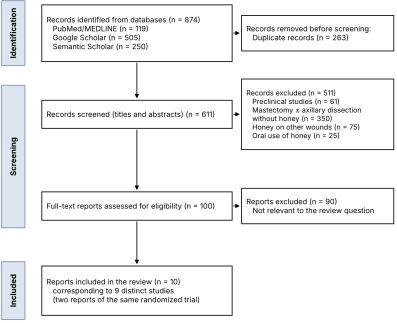
Records retrieved from the three databases and from grey literature were imported into Zotero, and duplicates were removed. Selection was then performed in two stages by two independent reviewers (Djoua Yowel Marilyne Laura Cathérine and Ouattara Adama): first, titles and abstracts were screened against the eligibility criteria; second, the full texts of potentially relevant reports were assessed, and the reason for each exclusion was recorded. Disagreements were resolved by discussion until consensus. The number of records at each stage is shown in the PRISMA flow diagram (
Figure 1). Companion publications of the same study were identified and linked, so that the number of distinct studies and of patients could be reported without double counting.
2.5. Data Extraction
Data were extracted by one reviewer (Djoua Yowel Marilyne Laura Cathérine) into a standardized Excel form, piloted on the first included reports, and checked by a second reviewer (Ouattara Adama). The form recorded: author, year, country and design; participants (age, stage, histological type, prior chemotherapy or radiotherapy, comorbidities, nutritional status); intervention (type and origin of honey, frequency of dressing change, duration); comparator; outcomes (time to complete healing, infection, pain, odour, exudate, quality of life) with their effect measures and p values; and missing data. When data were reported only in abstracts or short reports, this was noted, and no assumption was made about unreported results.
2.6. Risk of Bias and Level of Evidence
Risk of bias was assessed with tools adapted to each design: the Cochrane RoB 2 tool for randomized trials
| [20] | Sterne JA, Hernán MA, Reeves BC, Savović J, Berkman ND, Viswanathan M, et al. ROBINS-I: a tool for assessing risk of bias in non-randomised studies of interventions. BMJ. 2016; 355: i4919. |
[20]
, ROBINS-I for non-randomized comparative studies
| [21] | Munn Z, Barker TH, Moola S, Tufanaru C, Stern C, McArthur A, et al. Methodological quality of case series studies: an introduction to the JBI critical appraisal tool. JBI Evid Synth. 2020; 18(10): 2127-33. |
[21]
, the Joanna Briggs Institute (JBI) checklist for case series
and the Critical Appraisal Skills Programme (CASP) checklist for systematic reviews
| [23] | French National Authority for Health (Haute Autorité de Santé). Levels of evidence and grading of clinical practice guidelines: an overview. Saint-Denis La Plaine: HAS; 2013. |
[23]
. Each domain was rated as low risk, some concerns or high risk. Levels of evidence were assigned according to the classification of the French National Authority for Health (Haute Autorité de Santé, HAS)
| [24] | Lund-Nielsen B, Adamsen L, Gottrup F, Rørth M, Tolver A, Kolmos HJ. Qualitative bacteriology in malignant wounds — a prospective, randomized, clinical study to compare the effect of honey and silver dressings. Ostomy Wound Manage. 2011; 57(7): 28-36. |
[24]
, and overall methodological quality was graded as high, moderate or low.
2.7. Synthesis
Heterogeneity was assessed qualitatively. It was clinical (types of wounds: surgical, malignant fungating, radiation-induced or chronic; populations; honey preparations, doses and frequency of application; comparators), methodological (randomized trials, case series and a systematic review, with different durations of follow-up and risks of bias) and related to outcomes (healing, symptom scores, dermatitis grading scales and bacteriology measured with different instruments). Because of this heterogeneity and the small number of comparable studies, no meta-analysis was performed and no pooled estimate or statistical test of heterogeneity was computed. Results were summarized descriptively (numbers and proportions of studies, without statistical tests) and synthesized narratively by wound type (thematic synthesis), taking into account the design, level of evidence and risk of bias of each study.
2.8. Ethical Considerations
As a review of published data, this study did not require ethical approval or patient consent.
3. Results
3.1. Study Selection
The search identified 874 records (PubMed/MEDLINE 119, Google Scholar 505, Semantic Scholar 250). After removal of 263 duplicates, 611 titles and abstracts were screened and 511 records were excluded: preclinical studies (n = 61), mastectomy with or without axillary dissection without honey (n = 350), honey on other wounds (n = 75) and oral use of honey (n = 25). Of the 100 full-text reports assessed, 90 were excluded as not relevant to the review question. Ten reports were included (
Figure 1). Two of them were companion publications of the same randomized trial by Lund-Nielsen et al., one reporting clinical outcomes and the other bacteriological outcomes
| [25] | Moolenaar M, Poorter RL, van der Toorn PP, Lenderink AW, Poortmans P, Egberts AC. The effect of honey compared to conventional treatment on healing of radiotherapy-induced skin toxicity in breast cancer patients. Acta Oncol. 2006; 45(5): 623-4. |
| [26] | Shoma A, Eldars W, Noman N, Saad M, Elzahaf E, AbdAlla M, et al. Pentoxifylline and local honey for radiation-induced burn following breast conservative surgery. Curr Clin Pharmacol. 2010; 5(4): 251-6. |
[25, 26]
; the ten reports therefore correspond to nine distinct studies.
Figure 1. PRISMA 2020 flow diagram of study selection.
3.2. Characteristics of the Included Studies
The included reports were published between 2005 and 2021, with a peak of three publications in 2011. They comprised six reports of five randomized controlled trials (60% of reports)
| [25] | Moolenaar M, Poorter RL, van der Toorn PP, Lenderink AW, Poortmans P, Egberts AC. The effect of honey compared to conventional treatment on healing of radiotherapy-induced skin toxicity in breast cancer patients. Acta Oncol. 2006; 45(5): 623-4. |
| [26] | Shoma A, Eldars W, Noman N, Saad M, Elzahaf E, AbdAlla M, et al. Pentoxifylline and local honey for radiation-induced burn following breast conservative surgery. Curr Clin Pharmacol. 2010; 5(4): 251-6. |
| [27] | Kwok R, O'Brien S, Lunz L, Morgan M, Frassica DA, Cheston S, et al. Prospective randomized pilot study of standard skin care versus Medihoney in the prophylactic and acute management of radiation dermatitis in patients receiving adjuvant radiation therapy for breast cancer [abstract]. Int J Radiat Oncol Biol Phys. 2015; 93(3 Suppl): E468-9. |
| [28] | Naidoo N, Molan P, Littler R, Mok G, Jameson M, Round G, et al. A phase II randomized controlled trial of Manuka honey as prophylaxis against radiation-induced dermatitis in breast cancer patients [abstract]. Eur J Cancer. 2011; 47(Suppl 1). |
| [29] | Robson V, Martin L, Cooper R. The use of Leptospermum honey on chronic wounds in breast care. Honey: A Modern Wound Management Product. Aberdeen: Wounds UK Publishing; 2005:103-111. |
| [30] | Holubová A, Chlupáčová L, Cetlová L, Cremers NAJ, Pokorná A. Medical-grade honey as an alternative treatment for antibiotics in non-healing wounds — a prospective case series. Antibiotics (Basel). 2021; 10(8): 918. |
[25-30]
, three case series (30%)
and one systematic review (10%)
| [34] | Lund-Nielsen B, Müller K, Adamsen L. Malignant wounds in women with breast cancer: feminine and sexual perspectives. J Clin Nurs. 2005; 14(1): 56-64. |
[34]
. Seven countries were represented: Denmark, the United Kingdom and the United States (two reports each), and the Netherlands, Egypt, the Czech Republic and New Zealand (one each). Europe contributed six reports (60%), North America two (20%), Africa one (Egypt, North Africa; 10%) and Oceania one (10%). No study was conducted in sub-Saharan Africa. The eight primary studies included 368 patients in total, with sample sizes ranging from 2 to 150.
Honey was used alone in nine reports and combined with another active agent (pentoxifylline) in one. Medical-grade honey was used in eight reports, mostly Manuka or
Leptospermum honey (Medihoney®, L-Mesitran®, Honeysoft®), purified honey in one and an unspecified honey in one. Comparators were silver dressings, paraffin or conventional care, aqueous cream, standard skin care (Hydrophor), pentoxifylline, or no comparator. The main characteristics of the included studies are summarized in
Table 2.
Table 2. Characteristics and main results of the included studies.
Study (country) | Design; HAS level; n | Population / wound | Honey vs comparator | Main results |
Lund-Nielsen 2011, clinical report (Denmark) | RCT; level 2; 69 | Malignant wounds, mostly breast | Manuka honey dressings vs silver dressings, 4 weeks | Odour (p = 0.007) and exudate (p < 0.0001) improved in both arms, no difference between them; wound size reduction 15 vs 8 cm² (p = 0.63) |
Lund-Nielsen 2011, bacteriology report (Denmark) | Same RCT; level 2; 69 | Malignant wounds, mostly breast | Manuka honey vs silver dressings | At least one pathogen in almost all wounds; no qualitative difference between arms or over time |
Moolenaar 2006 (Netherlands) | RCT; level 2; 21 patients (24 skin reactions) | Radiation dermatitis, breast cancer | Medical honey (Honeysoft®) vs paraffin | Trend towards faster healing of grade ≥ 3 dermatitis; higher patient satisfaction; underpowered |
Shoma 2010 (Egypt) | RCT, 3 arms; level 2; 150 (3 × 50) | Radiation burn after breast-conserving surgery | A: standard care; B: + pentoxifylline 400 mg twice daily; C: B + topical purified honey | Complete healing at 12 weeks: C 74% vs B 54% vs A 36% (p < 0.0001); marked analgesic effect of honey |
Kwok 2015 (USA) | Pilot RCT (abstract); level 2; 34 | Adjuvant radiotherapy, including after modified radical mastectomy | Medihoney® twice daily vs standard skin care (Hydrophor) | Trend in favour of Medihoney®; full data unpublished |
Naidoo 2011 (New Zealand) | Phase II RCT (abstract); level 2; 81 | Prophylaxis of radiation dermatitis | Manuka honey twice daily vs aqueous cream | Grade ≥ 2 dermatitis 37.2% vs 57.8% (p = 0.08); trend to shorter duration |
Robson 2005 (UK) | Case series; level 4; 2 | Chronic wounds in breast care (dehiscence after breast reduction, post-radiotherapy necrosis) | Leptospermum honey; no comparator | Healing and symptom control; good tolerance |
Holubová 2021 (Czech Republic) | Prospective case series; level 4; 9 (1 breast case) | Non-healing infected wounds, including one breast surgical dehiscence | Medical-grade honey (L-Mesitran®); before–after | Breast dehiscence healed at day 35; pain VAS 2 at day 20; odour and exudate resolved in all cases |
Segovia 2010 (USA) | Case report series (congress, news report); level 4; 2 | Fungating breast tumour wounds | Medihoney® dressings every 3 days; no comparator | Rapid debridement, elimination of malodour; healing from the third dressing change in one case |
Bardy 2008 (UK) | Systematic review; 43 studies | Uses of honey in oncology (wounds, mucositis) | Various | Low overall methodological quality; possible value for fungating and post-excision wounds; insufficient evidence |
RCT: randomized controlled trial; VAS: visual analogue scale. HAS: French National Authority for Health.
3.3. Thematic Synthesis
Malignant fungating breast wounds. In the randomized trial of Lund-Nielsen et al. in Denmark (69 patients with malignant wounds, mostly of breast origin), Manuka honey-coated dressings were compared with silver-coated dressings for four weeks
| [25] | Moolenaar M, Poorter RL, van der Toorn PP, Lenderink AW, Poortmans P, Egberts AC. The effect of honey compared to conventional treatment on healing of radiotherapy-induced skin toxicity in breast cancer patients. Acta Oncol. 2006; 45(5): 623-4. |
[25]
. Odour (p = 0.007) and exudate (p < 0.0001) improved significantly in both arms, without difference between them, and the reduction in wound size was not significant (p = 0.63). The bacteriological report of the same trial found at least one pathogen in almost all wounds, without qualitative difference between dressings or over time; the authors concluded that routine bacteriological sampling was not justified
| [26] | Shoma A, Eldars W, Noman N, Saad M, Elzahaf E, AbdAlla M, et al. Pentoxifylline and local honey for radiation-induced burn following breast conservative surgery. Curr Clin Pharmacol. 2010; 5(4): 251-6. |
[26]
. A congress report described rapid debridement and elimination of malodour with Medihoney® dressings
| [33] | Alexander S. Malignant fungating wounds: managing pain, bleeding and psychosocial issues. J Wound Care. 2009; 18(10): 418-25. |
[33]
. These results matter for women with fungating tumours, for whom malodour, exudate and bleeding cause distress and social isolation
| [35] | Alhabsi AN, Al Lawati A, Al Hashmi L, Al-Isaii F, Alghammari A, Das S, et al. Clinical and postoperative applications of Manuka honey in wound healing: an evidence-based review. Int Wound J. 2026; 23: e70939. |
| [36] | Ouédraogo I. Honey in the management of malignant breast tumours: a systematic review of the literature from 2001 to 2025. [Master's thesis No. 344]. Ouagadougou: Joseph KI-ZERBO University; 2026. |
[35, 36]
.
Radiation dermatitis. The three-arm randomized trial of Shoma et al. in Egypt (150 women after breast-conserving surgery) evaluated pentoxifylline alone and combined with topical purified honey for radiation-induced burns
| [28] | Naidoo N, Molan P, Littler R, Mok G, Jameson M, Round G, et al. A phase II randomized controlled trial of Manuka honey as prophylaxis against radiation-induced dermatitis in breast cancer patients [abstract]. Eur J Cancer. 2011; 47(Suppl 1). |
[28]
. Complete healing at 12 weeks was highest when honey was added (74% vs 54% with pentoxifylline alone and 36% with standard care), with a marked analgesic effect. In the phase II trial of Naidoo et al., grade ≥ 2 radiation dermatitis occurred in 37.2% of women using Manuka honey and 57.8% of those using aqueous cream, a clinically notable but non-significant difference (p = 0.08)
| [30] | Holubová A, Chlupáčová L, Cetlová L, Cremers NAJ, Pokorná A. Medical-grade honey as an alternative treatment for antibiotics in non-healing wounds — a prospective case series. Antibiotics (Basel). 2021; 10(8): 918. |
[30]
. The randomized trial of Moolenaar et al. (21 patients)
| [27] | Kwok R, O'Brien S, Lunz L, Morgan M, Frassica DA, Cheston S, et al. Prospective randomized pilot study of standard skin care versus Medihoney in the prophylactic and acute management of radiation dermatitis in patients receiving adjuvant radiation therapy for breast cancer [abstract]. Int J Radiat Oncol Biol Phys. 2015; 93(3 Suppl): E468-9. |
[27]
and the pilot trial of Kwok et al. (34 patients)
| [29] | Robson V, Martin L, Cooper R. The use of Leptospermum honey on chronic wounds in breast care. Honey: A Modern Wound Management Product. Aberdeen: Wounds UK Publishing; 2005:103-111. |
[29]
pointed in the same direction without providing definitive evidence. Several of these trials were available only as abstracts or short reports, which limited their full methodological assessment.
Chronic and surgical wounds in breast care. Robson, Martin and Cooper reported the use of
Leptospermum honey on chronic and radiation-induced wounds in breast care, with complete healing within a few weeks, pain relief and no adverse effects
. In the prospective case series of Holubová et al., one breast surgical wound dehiscence healed in 35 days with medical-grade honey, with resolution of pain, odour and exudate
| [32] | Bardy J, Slevin NJ, Mais KL, Molassiotis A. A systematic review of honey uses and its potential value within oncology care. J Clin Nurs. 2008; 17(19): 2604-23. |
[32]
. This isolated observation is the published evidence closest to the post-mastectomy surgical wound.
Evidence related to breast surgery. No included study evaluated honey on the incision after mastectomy with axillary dissection. Three elements approach this question: the trial of Shoma et al., the only randomized trial whose population was explicitly post-surgical (breast-conserving surgery), although the target wound was a radiation burn
| [28] | Naidoo N, Molan P, Littler R, Mok G, Jameson M, Round G, et al. A phase II randomized controlled trial of Manuka honey as prophylaxis against radiation-induced dermatitis in breast cancer patients [abstract]. Eur J Cancer. 2011; 47(Suppl 1). |
[28]
; the breast surgical dehiscence of Holubová et al.
| [32] | Bardy J, Slevin NJ, Mais KL, Molassiotis A. A systematic review of honey uses and its potential value within oncology care. J Clin Nurs. 2008; 17(19): 2604-23. |
[32]
; and the trial of Moolenaar et al. on radiation-induced lesions of the chest wall in breast cancer patients
| [27] | Kwok R, O'Brien S, Lunz L, Morgan M, Frassica DA, Cheston S, et al. Prospective randomized pilot study of standard skin care versus Medihoney in the prophylactic and acute management of radiation dermatitis in patients receiving adjuvant radiation therapy for breast cancer [abstract]. Int J Radiat Oncol Biol Phys. 2015; 93(3 Suppl): E468-9. |
[27]
. The systematic review of Bardy et al. concluded that the evidence on honey in oncology was of low quality, while suggesting a possible value for fungating and post-excision wounds
| [34] | Lund-Nielsen B, Müller K, Adamsen L. Malignant wounds in women with breast cancer: feminine and sexual perspectives. J Clin Nurs. 2005; 14(1): 56-64. |
[34]
.
3.4. Level of Evidence and Risk of Bias
According to the HAS classification, the six reports of randomized trials were level 2, the three case series level 4, and the systematic review was classified as a level 1 synthesis that concluded that evidence was insufficient. RoB 2 was used for six reports (60%), the JBI checklist for three (30%) and CASP for one (10%) (
Table 3).
Table 3. Risk of bias of the included reports.
Study | Tool | Domain ratings | Overall | Main source of bias |
Lund-Nielsen 2011, clinical | RoB 2 | D1 !, D2 +, D3 +, D4 !, D5 ! | Some concerns | Outcome measurement (D4): subjective outcomes, blinding impossible |
Lund-Nielsen 2011, bacteriology | RoB 2 | D1 !, D2 +, D3 +, D4 !, D5 ! | Some concerns | Outcome measurement (D4): unblinded clinical assessment |
Moolenaar 2006 | RoB 2 | D1 !, D2 !, D3 +, D4 !, D5 ! | Some concerns | D4: unblinded grading; small sample (n = 21) |
Shoma 2010 | RoB 2 | D1 !, D2 +, D3 +, D4 +, D5 + | Low | Randomization (D1) not described; objective primary outcome (burn area) |
Kwok 2015 | RoB 2 | D1 –, D2 !, D3 !, D4 –, D5 – | High | Randomization and blinding not reported (abstract) |
Naidoo 2011 | RoB 2 | D1 !, D2 !, D3 +, D4 !, D5 ! | Some concerns | D4: open-label trial; RTOG grading sensitive to knowledge of treatment |
Robson 2005 | JBI | Q1 !, Q2 +, Q3 !, Q4 –, Q5 – | High | Selection and follow-up: two cases, no standardized follow-up |
Holubová 2021 | JBI | Q1 +, Q2 +, Q3 +, Q4 !, Q5 + | Some concerns | Unblinded assessment of healing |
Segovia 2010 | JBI | Q1 !, Q2 !, Q3 –, Q4 –, Q5 + | High | Incomplete description, no standardized follow-up |
Bardy 2008 | CASP | C1 +, C2 +, C3 !, C4 +, C5 ! | Low | Low quality of the primary studies available |
+ low risk; ! some concerns; – high risk. RoB 2 domains: D1 randomization; D2 deviations from intended interventions; D3 missing outcome data; D4 measurement of the outcome; D5 selection of the reported result. JBI items: Q1 clear inclusion criteria; Q2 valid measurement of the condition and intervention; Q3 complete and consecutive inclusion; Q4 complete follow-up; Q5 clear reporting of results.
Overall, two reports were at low risk of bias (20%: Shoma, Bardy), five raised some concerns (50%: both Lund-Nielsen reports, Moolenaar, Naidoo, Holubová) and three were at high risk (30%: Robson, Kwok, Segovia). The most frequent main source of bias was the measurement of the outcome (D4), present in five reports. It stems from a single, irreducible cause, the impossibility of blinding honey (colour, smell, texture), combined with subjective outcomes such as odour, pain, exudate and dermatitis grade. The trial of Shoma et al. avoided this bias by using an objective primary outcome (burn surface area).
4. Discussion
4.1. Summary of the Evidence
This review, conducted according to PRISMA 2020 and including ten reports published between 2005 and 2021, is to our knowledge the first to synthesize specifically the evidence on the wound-healing effect of honey in breast cancer while addressing the post-mastectomy wound. It reveals a gap between a solid biological rationale and limited clinical evidence
| [12] | Jenkins R, Burton N, Cooper R. Manuka honey inhibits cell division in methicillin-resistant Staphylococcus aureus. J Antimicrob Chemother. 2011; 66(11): 2536-42. |
| [14] | Tashkandi H. Honey in wound healing: an updated review. Open Life Sci. 2021; 16(1): 1091-100. |
| [37] | Erejuwa OO, Sulaiman SA, Wahab MSA. Effects of honey and its mechanisms of action on the development and progression of cancer. Molecules. 2014; 19(2): 2497-522. |
[12, 14, 37]
. The best-documented benefit of honey is symptomatic: control of malodour, inflammation and exudate in fungating tumour wounds
| [25] | Moolenaar M, Poorter RL, van der Toorn PP, Lenderink AW, Poortmans P, Egberts AC. The effect of honey compared to conventional treatment on healing of radiotherapy-induced skin toxicity in breast cancer patients. Acta Oncol. 2006; 45(5): 623-4. |
| [33] | Alexander S. Malignant fungating wounds: managing pain, bleeding and psychosocial issues. J Wound Care. 2009; 18(10): 418-25. |
[25, 33]
, which is often the legitimate goal of care in palliative situations
| [35] | Alhabsi AN, Al Lawati A, Al Hashmi L, Al-Isaii F, Alghammari A, Das S, et al. Clinical and postoperative applications of Manuka honey in wound healing: an evidence-based review. Int Wound J. 2026; 23: e70939. |
[35]
. For objective healing outcomes and the prevention of radiation dermatitis, results are heterogeneous and, when formally tested, mostly non-significant
| [27] | Kwok R, O'Brien S, Lunz L, Morgan M, Frassica DA, Cheston S, et al. Prospective randomized pilot study of standard skin care versus Medihoney in the prophylactic and acute management of radiation dermatitis in patients receiving adjuvant radiation therapy for breast cancer [abstract]. Int J Radiat Oncol Biol Phys. 2015; 93(3 Suppl): E468-9. |
| [30] | Holubová A, Chlupáčová L, Cetlová L, Cremers NAJ, Pokorná A. Medical-grade honey as an alternative treatment for antibiotics in non-healing wounds — a prospective case series. Antibiotics (Basel). 2021; 10(8): 918. |
[27, 30]
. The positive result of Shoma et al. concerns honey combined with pentoxifylline, and its own contribution cannot be fully separated from that of the drug
| [28] | Naidoo N, Molan P, Littler R, Mok G, Jameson M, Round G, et al. A phase II randomized controlled trial of Manuka honey as prophylaxis against radiation-induced dermatitis in breast cancer patients [abstract]. Eur J Cancer. 2011; 47(Suppl 1). |
[28]
. Honey should therefore be regarded as a promising, safe but insufficiently evaluated option rather than a proven treatment.
4.2. Complementarity with the Antitumour Data
A companion systematic review conducted in our department examined the antitumour and systemic effects of honey in malignant breast tumours
| [38] | Xiong X, Ou X, Wang L, Zheng X. Efficacy and safety of methylprednisolone in the prevention of seroma formation after mastectomy: systematic review and meta-analysis. Medicine (Baltimore). 2025; 104: e45353. |
[38]
. Mostly preclinical data showed inhibition of cell proliferation, induction of apoptosis and reduced migration and invasion, together with adjuvant benefits on mucositis, fatigue and quality of life during chemotherapy and radiotherapy
| [38] | Xiong X, Ou X, Wang L, Zheng X. Efficacy and safety of methylprednisolone in the prevention of seroma formation after mastectomy: systematic review and meta-analysis. Medicine (Baltimore). 2025; 104: e45353. |
| [39] | Bocoum A, van Riel SJJM, Traoré SO, Ngo Oum II EF, Traoré Y, Thera AT, et al. Medical-grade honey enhances the healing of caesarean section wounds and is similarly effective to antibiotics combined with povidone-iodine in the prevention of infections — a prospective cohort study. Antibiotics (Basel). 2023; 12(1): 92. |
[38, 39]
. The present review complements that work: the antitumour effect concerns honey mostly given orally, whereas this review documents its local wound-healing action. These are two distinct but complementary dimensions of the same natural resource.
4.3. Honey Compared with Conventional Care
Conventional care of the post-mastectomy wound relies on asepsis, drainage and standard dressings (povidone-iodine and other antiseptics, saline, alginate, hydrocolloids), whereas the prevention of seroma and flap necrosis relies on quilting sutures, flap fixation or corticosteroids, with inconsistent efficacy
| [7] | Kuroi K, Shimozuma K, Taguchi T, Imai H, Yamashiro H, Ohsumi S, et al. Evidence-based risk factors for seroma formation in breast surgery. Jpn J Clin Oncol. 2006; 36(4): 197-206. |
| [40] | Mossel DA. Honey for necrotic breast ulcers. Lancet. 1980; 2(8203): 1091. |
[7, 40]
. None of these studies evaluated honey. Honey combines a broad antibacterial and antibiofilm activity, including against methicillin-resistant Staphylococcus aureus (MRSA)
| [12] | Jenkins R, Burton N, Cooper R. Manuka honey inhibits cell division in methicillin-resistant Staphylococcus aureus. J Antimicrob Chemother. 2011; 66(11): 2536-42. |
| [13] | Majtan J. Honey: an immunomodulator in wound healing. Wound Repair Regen. 2014; 22(2): 187-92. |
[12, 13]
; an anti-inflammatory action through inhibition of the release of tumour necrosis factor alpha (TNF-α), interleukin-1 beta (IL-1β) and interleukin-6 (IL-6) and stimulation of fibroblasts
| [14] | Tashkandi H. Honey in wound healing: an updated review. Open Life Sci. 2021; 16(1): 1091-100. |
[14]
; stimulation of angiogenesis and re-epithelialization; and maintenance of a moist environment that favours cell migration and autolytic debridement
| [10] | Vandamme L, Heyneman A, Hoeksema H, Verbelen J, Monstrey S. Honey in modern wound care: a systematic review. Burns. 2013; 39(8): 1514-25. |
| [15] | Jull AB, Cullum N, Dumville JC, Westby MJ, Deshpande S, Walker N. Honey as a topical treatment for wounds. Cochrane Database Syst Rev. 2015;(3): CD005083. |
[10, 15]
. These properties target precisely the main mechanisms of post-mastectomy wound complications: infection, often superimposed on seroma, is the main pathway to dehiscence and flap necrosis
| [7] | Kuroi K, Shimozuma K, Taguchi T, Imai H, Yamashiro H, Ohsumi S, et al. Evidence-based risk factors for seroma formation in breast surgery. Jpn J Clin Oncol. 2006; 36(4): 197-206. |
| [8] | Cardoso F, Kyriakides S, Ohno S, Penault-Llorca F, Poortmans P, Rubio IT, et al. Early breast cancer: ESMO Clinical Practice Guidelines for diagnosis, treatment and follow-up. Ann Oncol. 2019; 30(8): 1194-220. |
[7, 8]
.
This coherence is consistent with observations in other surgical settings. A meta-analysis of randomized trials showed that topical honey improves healing and reduces pain after episiotomy and caesarean section
| [17] | Page MJ, McKenzie JE, Bossuyt PM, Boutron I, Hoffmann TC, Mulrow CD, et al. The PRISMA 2020 statement: an updated guideline for reporting systematic reviews. BMJ. 2021; 372: n71. |
[17]
, a cohort of 766 women in Mali found faster healing of caesarean wounds with medical-grade honey
| [41] | Codex Alimentarius Commission (FAO/WHO). Standard for honey (CXS 12-1981, revised 2001). Rome: FAO/WHO; 2001. |
[41]
, and the Cochrane review of Jull et al. concluded that honey heals infected postoperative wounds faster than antiseptics and gauze
| [16] | Ferraz Barbosa B, de Moraes FCA, Araujo Alves da Silva B, Bordignon Barbosa C, Pereira da Silva I, da Silva ER, et al. The use of honey for cicatrization and pain control of obstetric wounds: a systematic review and meta-analysis of randomized controlled trials. Nutrients. 2024; 16(2): 185. |
[16]
. These data are transferable but indirect: they strengthen the plausibility of a benefit on the breast surgical wound without demonstrating it.
The safety of honey depends on its quality. Manuka honey owes its antiseptic properties to its high methylglyoxal content, and caution has been suggested regarding chronic exposure to very high doses
| [37] | Erejuwa OO, Sulaiman SA, Wahab MSA. Effects of honey and its mechanisms of action on the development and progression of cancer. Molecules. 2014; 19(2): 2497-522. |
[37]
. As early as 1980, a letter in the Lancet warned of the microbiological risk of non-sterilized honey applied to breast ulcers
| [3] | Jedy-Agba E, McCormack V, Adebamowo C, dos-Santos-Silva I. Stage at diagnosis of breast cancer in sub-Saharan Africa: a systematic review and meta-analysis. Lancet Glob Health. 2016; 4(12): e 923-35. |
[3]
. Honey for clinical use must therefore be standardized, microbiologically controlled, compliant with the Codex Alimentarius and preferably gamma-sterilized; its enzymatic activity is degraded by heat and prolonged storage
| [10] | Vandamme L, Heyneman A, Hoeksema H, Verbelen J, Monstrey S. Honey in modern wound care: a systematic review. Burns. 2013; 39(8): 1514-25. |
| [41] | Codex Alimentarius Commission (FAO/WHO). Standard for honey (CXS 12-1981, revised 2001). Rome: FAO/WHO; 2001. |
[10, 41]
.
4.4. Relevance to the Post-Mastectomy Wound and the African Context
The central result of this review is negative: none of the included studies evaluated honey on the incision after mastectomy with axillary dissection, although this surgery is common in our context because of late diagnosis and carries high wound morbidity
| [5] | Zongo N, Millogo-Traoré TFD, Bagré SC, Bagué AH, Ouangré E, Zida M, et al. The role of surgery in the management of breast cancer in women at the Yalgado Ouédraogo University Hospital Center: a study of 81 cases. Pan Afr Med J. 2015; 22: 117. |
| [7] | Kuroi K, Shimozuma K, Taguchi T, Imai H, Yamashiro H, Ohsumi S, et al. Evidence-based risk factors for seroma formation in breast surgery. Jpn J Clin Oncol. 2006; 36(4): 197-206. |
[5, 7]
. The single breast surgical dehiscence healed with honey only illustrates plausibility
| [32] | Bardy J, Slevin NJ, Mais KL, Molassiotis A. A systematic review of honey uses and its potential value within oncology care. J Clin Nurs. 2008; 17(19): 2604-23. |
[32]
. A second gap adds to the first: no study was conducted in sub-Saharan Africa and none used local honey, although this region combines a high frequency of locally advanced breast cancer
| [3] | Jedy-Agba E, McCormack V, Adebamowo C, dos-Santos-Silva I. Stage at diagnosis of breast cancer in sub-Saharan Africa: a systematic review and meta-analysis. Lancet Glob Health. 2016; 4(12): e 923-35. |
| [4] | Ly M, Antoine M, André F, Callard P, Bernaudin JF, Diallo DA. Breast cancer in sub-Saharan African women: current state of knowledge. Bull Cancer. 2011; 98(7): 797-806. |
[3, 4]
with immediate availability of honey. This double gap justifies a randomized trial in Burkina Faso comparing a standardized local honey with conventional care, with healing time as the primary outcome and 30-day SSI, seroma, dehiscence, pain and cost as secondary outcomes, assessed by an independent, blinded evaluator.
4.5. Strengths and Limitations
The strengths of this review are its explicit question, its adherence to PRISMA 2020, double independent selection, and the use of design-specific risk-of-bias tools.
It also has limitations. First, the heterogeneity of designs, honey preparations and outcomes precluded meta-analysis and limits the strength of conclusions. Second, the absence of any trial on the post-mastectomy surgical wound is the main gap, and the included evidence is therefore indirect. Third, several trials were available only as abstracts or short reports, with incomplete data. Fourth, sample sizes were small and follow-up often short. Fifth, the search was limited to three databases (without Embase, CINAHL or the Cochrane Library) and to English and French, and Google Scholar searches are not fully reproducible; relevant studies may have been missed. Sixth, the protocol was not registered, and two reports of the same trial and a non-peer-reviewed congress report were counted among the ten included reports. Finally, the certainty of the evidence was graded with the HAS classification rather than with the GRADE approach, publication bias could not be assessed formally because of the small number of studies, and some of the included evidence (case series and reports of only two patients) carries a high risk of selection bias.
4.6. Implications and Research Agenda
In the current state of knowledge, honey cannot be formally recommended as the reference treatment for breast oncological wounds. It nevertheless has real logistical and economic advantages: it is locally produced, abundant, cheap, easy to obtain, culturally accepted and safe. Its integration into practice requires standardization and clinical validation. Priorities are: (i) randomized trials with standardized honey and objective outcomes assessed blindly by a third party (microbiologically defined SSI at 30 days, seroma volume, wound area measured by planimetry on photographs); (ii) harmonized designs and outcomes to allow future meta-analyses; (iii) galenic development and stability testing of quality-controlled local medical-grade honey; and (iv) pharmacovigilance in African settings.
5. Conclusion
This systematic review of ten reports shows that honey has a coherent therapeutic profile and excellent tolerance in breast cancer-related wounds. Its best-established benefit is symptomatic, with control of malodour, inflammation and exudate in fungating tumour wounds; in radiation dermatitis, results are encouraging but mostly non-significant. No study evaluated honey on the surgical wound after mastectomy with axillary dissection, and none came from sub-Saharan Africa. The current evidence, dominated by low-level studies, does not support grade A recommendations. Given the low cost, availability, acceptability and safety of honey, its rigorous evaluation with standardized preparations and relevant comparators in sub-Saharan Africa is an original, relevant and feasible research priority.
Abbreviations
CASP | Critical Appraisal Skills Programme |
HAS | Haute Autorite de Sante (French National Authority for Health) |
IL-1β | Interleukin-1 Beta |
IL-6 | Interleukin-6 |
JBI | Joanna Briggs Institute |
MRSA | Methicillin-Resistant Staphylococcus Aureus |
PICOS | Population, Intervention, Comparator, Outcomes, Study design |
PRISMA | Preferred Reporting Items for Systematic Reviews and Meta-Analyses |
RCT | Randomized Controlled Trial |
RoB 2 | Cochrane Risk of Bias 2 tool |
ROBINS-I | Risk Of Bias In Non-randomised Studies of Interventions |
RTOG | Radiation Therapy Oncology Group |
SSI | Surgical Site Infection |
TNF-α | Tumour Necrosis Factor Alpha |
VAS | Visual Analogue Scale |
Author Contributions
Ouattara Adama: Conceptualization, Investigation, Methodology, Supervision, Validation, Writing – review & editing
Djoua Yowel Marilyne Laura Cathérine: Data curation, Formal Analysis, Investigation, Methodology, Visualization, Writing – original draft
Ouedraogo Charlemagne: Formal Analysis, Validation, Writing – review & editing
Conflicts of Interest
The authors declare no conflicts of interest.
References
| [1] |
Bray F, Laversanne M, Sung H, Ferlay J, Siegel RL, Soerjomataram I, et al. Global cancer statistics 2022: GLOBOCAN estimates of incidence and mortality worldwide for 36 cancers in 185 countries. CA Cancer J Clin. 2024; 74(3): 229-63.
|
| [2] |
World Health Organization. Breast cancer [Internet]. Geneva: WHO; 2024. Available:
https://www.who.int/news-room/fact-sheets/detail/breast-cancer
|
| [3] |
Jedy-Agba E, McCormack V, Adebamowo C, dos-Santos-Silva I. Stage at diagnosis of breast cancer in sub-Saharan Africa: a systematic review and meta-analysis. Lancet Glob Health. 2016; 4(12): e 923-35.
|
| [4] |
Ly M, Antoine M, André F, Callard P, Bernaudin JF, Diallo DA. Breast cancer in sub-Saharan African women: current state of knowledge. Bull Cancer. 2011; 98(7): 797-806.
|
| [5] |
Zongo N, Millogo-Traoré TFD, Bagré SC, Bagué AH, Ouangré E, Zida M, et al. The role of surgery in the management of breast cancer in women at the Yalgado Ouédraogo University Hospital Center: a study of 81 cases. Pan Afr Med J. 2015; 22: 117.
|
| [6] |
Crestani A, et al. Prevention of lymphocele or seroma after mastectomy and axillary lymphadenectomy for breast cancer: systematic review and meta-analysis. Sci Rep. 2022; 12(1): 10016.
|
| [7] |
Kuroi K, Shimozuma K, Taguchi T, Imai H, Yamashiro H, Ohsumi S, et al. Evidence-based risk factors for seroma formation in breast surgery. Jpn J Clin Oncol. 2006; 36(4): 197-206.
|
| [8] |
Cardoso F, Kyriakides S, Ohno S, Penault-Llorca F, Poortmans P, Rubio IT, et al. Early breast cancer: ESMO Clinical Practice Guidelines for diagnosis, treatment and follow-up. Ann Oncol. 2019; 30(8): 1194-220.
|
| [9] |
Molan P, Rhodes T. Honey: a biologic wound dressing. Wounds. 2015; 27(6): 141-51.
|
| [10] |
Vandamme L, Heyneman A, Hoeksema H, Verbelen J, Monstrey S. Honey in modern wound care: a systematic review. Burns. 2013; 39(8): 1514-25.
|
| [11] |
Cooper RA, Molan PC, Harding KG. The sensitivity to honey of Gram-positive cocci of clinical significance isolated from wounds. J Appl Microbiol. 2002; 93(5): 857-63.
|
| [12] |
Jenkins R, Burton N, Cooper R. Manuka honey inhibits cell division in methicillin-resistant Staphylococcus aureus. J Antimicrob Chemother. 2011; 66(11): 2536-42.
|
| [13] |
Majtan J. Honey: an immunomodulator in wound healing. Wound Repair Regen. 2014; 22(2): 187-92.
|
| [14] |
Tashkandi H. Honey in wound healing: an updated review. Open Life Sci. 2021; 16(1): 1091-100.
|
| [15] |
Jull AB, Cullum N, Dumville JC, Westby MJ, Deshpande S, Walker N. Honey as a topical treatment for wounds. Cochrane Database Syst Rev. 2015;(3): CD005083.
|
| [16] |
Ferraz Barbosa B, de Moraes FCA, Araujo Alves da Silva B, Bordignon Barbosa C, Pereira da Silva I, da Silva ER, et al. The use of honey for cicatrization and pain control of obstetric wounds: a systematic review and meta-analysis of randomized controlled trials. Nutrients. 2024; 16(2): 185.
|
| [17] |
Page MJ, McKenzie JE, Bossuyt PM, Boutron I, Hoffmann TC, Mulrow CD, et al. The PRISMA 2020 statement: an updated guideline for reporting systematic reviews. BMJ. 2021; 372: n71.
|
| [18] |
Institute of Medicine (US) Committee on Standards for Systematic Reviews of Comparative Effectiveness Research. Finding what works in health care: standards for systematic reviews. Washington (DC): National Academies Press (US); 2011.
|
| [19] |
Sterne JAC, Savović J, Page MJ, Elbers RG, Blencowe NS, Boutron I, et al. RoB 2: a revised tool for assessing risk of bias in randomised trials. BMJ. 2019; 366: l4898.
|
| [20] |
Sterne JA, Hernán MA, Reeves BC, Savović J, Berkman ND, Viswanathan M, et al. ROBINS-I: a tool for assessing risk of bias in non-randomised studies of interventions. BMJ. 2016; 355: i4919.
|
| [21] |
Munn Z, Barker TH, Moola S, Tufanaru C, Stern C, McArthur A, et al. Methodological quality of case series studies: an introduction to the JBI critical appraisal tool. JBI Evid Synth. 2020; 18(10): 2127-33.
|
| [22] |
Critical Appraisal Skills Programme. CASP Systematic Review Checklist [Internet]. Oxford: CASP; 2018. Available:
https://casp-uk.net/casp-tools-checklists/
|
| [23] |
French National Authority for Health (Haute Autorité de Santé). Levels of evidence and grading of clinical practice guidelines: an overview. Saint-Denis La Plaine: HAS; 2013.
|
| [24] |
Lund-Nielsen B, Adamsen L, Gottrup F, Rørth M, Tolver A, Kolmos HJ. Qualitative bacteriology in malignant wounds — a prospective, randomized, clinical study to compare the effect of honey and silver dressings. Ostomy Wound Manage. 2011; 57(7): 28-36.
|
| [25] |
Moolenaar M, Poorter RL, van der Toorn PP, Lenderink AW, Poortmans P, Egberts AC. The effect of honey compared to conventional treatment on healing of radiotherapy-induced skin toxicity in breast cancer patients. Acta Oncol. 2006; 45(5): 623-4.
|
| [26] |
Shoma A, Eldars W, Noman N, Saad M, Elzahaf E, AbdAlla M, et al. Pentoxifylline and local honey for radiation-induced burn following breast conservative surgery. Curr Clin Pharmacol. 2010; 5(4): 251-6.
|
| [27] |
Kwok R, O'Brien S, Lunz L, Morgan M, Frassica DA, Cheston S, et al. Prospective randomized pilot study of standard skin care versus Medihoney in the prophylactic and acute management of radiation dermatitis in patients receiving adjuvant radiation therapy for breast cancer [abstract]. Int J Radiat Oncol Biol Phys. 2015; 93(3 Suppl): E468-9.
|
| [28] |
Naidoo N, Molan P, Littler R, Mok G, Jameson M, Round G, et al. A phase II randomized controlled trial of Manuka honey as prophylaxis against radiation-induced dermatitis in breast cancer patients [abstract]. Eur J Cancer. 2011; 47(Suppl 1).
|
| [29] |
Robson V, Martin L, Cooper R. The use of Leptospermum honey on chronic wounds in breast care. Honey: A Modern Wound Management Product. Aberdeen: Wounds UK Publishing; 2005:103-111.
|
| [30] |
Holubová A, Chlupáčová L, Cetlová L, Cremers NAJ, Pokorná A. Medical-grade honey as an alternative treatment for antibiotics in non-healing wounds — a prospective case series. Antibiotics (Basel). 2021; 10(8): 918.
|
| [31] |
Segovia D. Honey beneficial for treatment of fungating tumor wounds [Internet]. News-Medical; 2010 Apr 17. Available:
https://www.news-medical.net/news/20100417/Honey-beneficial-for-treatment-of-fungating-tumor-wounds.aspx
|
| [32] |
Bardy J, Slevin NJ, Mais KL, Molassiotis A. A systematic review of honey uses and its potential value within oncology care. J Clin Nurs. 2008; 17(19): 2604-23.
|
| [33] |
Alexander S. Malignant fungating wounds: managing pain, bleeding and psychosocial issues. J Wound Care. 2009; 18(10): 418-25.
|
| [34] |
Lund-Nielsen B, Müller K, Adamsen L. Malignant wounds in women with breast cancer: feminine and sexual perspectives. J Clin Nurs. 2005; 14(1): 56-64.
|
| [35] |
Alhabsi AN, Al Lawati A, Al Hashmi L, Al-Isaii F, Alghammari A, Das S, et al. Clinical and postoperative applications of Manuka honey in wound healing: an evidence-based review. Int Wound J. 2026; 23: e70939.
|
| [36] |
Ouédraogo I. Honey in the management of malignant breast tumours: a systematic review of the literature from 2001 to 2025. [Master's thesis No. 344]. Ouagadougou: Joseph KI-ZERBO University; 2026.
|
| [37] |
Erejuwa OO, Sulaiman SA, Wahab MSA. Effects of honey and its mechanisms of action on the development and progression of cancer. Molecules. 2014; 19(2): 2497-522.
|
| [38] |
Xiong X, Ou X, Wang L, Zheng X. Efficacy and safety of methylprednisolone in the prevention of seroma formation after mastectomy: systematic review and meta-analysis. Medicine (Baltimore). 2025; 104: e45353.
|
| [39] |
Bocoum A, van Riel SJJM, Traoré SO, Ngo Oum II EF, Traoré Y, Thera AT, et al. Medical-grade honey enhances the healing of caesarean section wounds and is similarly effective to antibiotics combined with povidone-iodine in the prevention of infections — a prospective cohort study. Antibiotics (Basel). 2023; 12(1): 92.
|
| [40] |
Mossel DA. Honey for necrotic breast ulcers. Lancet. 1980; 2(8203): 1091.
|
| [41] |
Codex Alimentarius Commission (FAO/WHO). Standard for honey (CXS 12-1981, revised 2001). Rome: FAO/WHO; 2001.
|
Cite This Article
-
APA Style
Adama, O., Cathérine, D. Y. M. L., Charlemagne, O. (2026). Topical Honey for Wound Healing in Women Treated for Breast Cancer, with a Focus on the Surgical Wound After Mastectomy with Axillary Dissection: A Systematic Review. Science Journal of Clinical Medicine, 15(4), 58-67. https://doi.org/10.11648/j.sjcm.20261504.11
 Copy
|
 Download
ACS Style
Adama, O.; Cathérine, D. Y. M. L.; Charlemagne, O. Topical Honey for Wound Healing in Women Treated for Breast Cancer, with a Focus on the Surgical Wound After Mastectomy with Axillary Dissection: A Systematic Review. Sci. J. Clin. Med. 2026, 15(4), 58-67. doi: 10.11648/j.sjcm.20261504.11
Copy
|
Download
AMA Style
Adama O, Cathérine DYML, Charlemagne O. Topical Honey for Wound Healing in Women Treated for Breast Cancer, with a Focus on the Surgical Wound After Mastectomy with Axillary Dissection: A Systematic Review. Sci J Clin Med. 2026;15(4):58-67. doi: 10.11648/j.sjcm.20261504.11
Copy
|
Download
-
@article{10.11648/j.sjcm.20261504.11,
  author = {Ouattara Adama and Djoua Yowel Marilyne Laura Cathérine and Ouedraogo Charlemagne},
  title = {Topical Honey for Wound Healing in Women Treated for Breast Cancer, with a Focus on the Surgical Wound After Mastectomy with Axillary Dissection: A Systematic Review},
  journal = {Science Journal of Clinical Medicine},
  volume = {15},
  number = {4},
  pages = {58-67},
  doi = {10.11648/j.sjcm.20261504.11},
  url = {https://doi.org/10.11648/j.sjcm.20261504.11},
  eprint = {https://article.sciencepublishinggroup.com/pdf/10.11648.j.sjcm.20261504.11},
  abstract = {Mastectomy with axillary lymph node dissection is the reference operation for locally advanced breast cancer in many low-resource settings, and its wound is frequently complicated. This systematic review aimed to synthesize the published evidence on the wound-healing and anti-infective effects of topical honey in women treated for breast cancer, with particular attention to the surgical wound after mastectomy with axillary dissection. Following the PRISMA 2020 statement, PubMed/MEDLINE, Google Scholar and Semantic Scholar were searched for clinical studies published in English or French between 1 January 2000 and 31 December 2025. Two reviewers independently screened records and full texts; risk of bias was assessed with the Cochrane RoB 2 tool for randomized trials, the Joanna Briggs Institute checklist for case series and the CASP checklist for systematic reviews, and levels of evidence were graded according to the French National Authority for Health. Because of marked heterogeneity, the results were synthesized narratively by wound type. Of 874 records identified, 611 were screened after removal of duplicates, 100 full texts were assessed and 10 reports were included. They corresponded to nine distinct studies with 368 patients in primary studies: six reports of five randomized trials, three case series and one systematic review, published between 2005 and 2021 mainly in high-income countries, with one study from North Africa and none from sub-Saharan Africa. Four studies concerned radiation dermatitis, three malignant fungating wounds, two chronic wounds in breast care and one oncology in general. No study evaluated honey on the surgical wound after mastectomy with axillary dissection, the closest evidence being a single breast surgical dehiscence healed in 35 days. The best-established benefits of honey were symptomatic, namely control of malodour and exudate and improved comfort, whereas in radiation dermatitis results were favourable but mostly non-significant, except when honey was added to pentoxifylline (complete healing at 12 weeks: 74% vs 54% vs 36%). Overall risk of bias was low in two reports, moderate in five and high in three. Honey therefore appears to be a safe, affordable and biologically plausible option for breast cancer-related wounds, but its effect on the post-mastectomy surgical wound has not been evaluated and no study has come from sub-Saharan Africa; well-designed randomized trials with standardized honey and objective, blindly assessed outcomes are required.},
 year = {2026}
}
Copy
|
Download
-
TY  - JOUR
T1  - Topical Honey for Wound Healing in Women Treated for Breast Cancer, with a Focus on the Surgical Wound After Mastectomy with Axillary Dissection: A Systematic Review
AU  - Ouattara Adama
AU  - Djoua Yowel Marilyne Laura Cathérine
AU  - Ouedraogo Charlemagne
Y1  - 2026/11/23
PY  - 2026
N1  - https://doi.org/10.11648/j.sjcm.20261504.11
DO  - 10.11648/j.sjcm.20261504.11
T2  - Science Journal of Clinical Medicine
JF  - Science Journal of Clinical Medicine
JO  - Science Journal of Clinical Medicine
SP  - 58
EP  - 67
PB  - Science Publishing Group
SN  - 2327-2732
UR  - https://doi.org/10.11648/j.sjcm.20261504.11
AB  - Mastectomy with axillary lymph node dissection is the reference operation for locally advanced breast cancer in many low-resource settings, and its wound is frequently complicated. This systematic review aimed to synthesize the published evidence on the wound-healing and anti-infective effects of topical honey in women treated for breast cancer, with particular attention to the surgical wound after mastectomy with axillary dissection. Following the PRISMA 2020 statement, PubMed/MEDLINE, Google Scholar and Semantic Scholar were searched for clinical studies published in English or French between 1 January 2000 and 31 December 2025. Two reviewers independently screened records and full texts; risk of bias was assessed with the Cochrane RoB 2 tool for randomized trials, the Joanna Briggs Institute checklist for case series and the CASP checklist for systematic reviews, and levels of evidence were graded according to the French National Authority for Health. Because of marked heterogeneity, the results were synthesized narratively by wound type. Of 874 records identified, 611 were screened after removal of duplicates, 100 full texts were assessed and 10 reports were included. They corresponded to nine distinct studies with 368 patients in primary studies: six reports of five randomized trials, three case series and one systematic review, published between 2005 and 2021 mainly in high-income countries, with one study from North Africa and none from sub-Saharan Africa. Four studies concerned radiation dermatitis, three malignant fungating wounds, two chronic wounds in breast care and one oncology in general. No study evaluated honey on the surgical wound after mastectomy with axillary dissection, the closest evidence being a single breast surgical dehiscence healed in 35 days. The best-established benefits of honey were symptomatic, namely control of malodour and exudate and improved comfort, whereas in radiation dermatitis results were favourable but mostly non-significant, except when honey was added to pentoxifylline (complete healing at 12 weeks: 74% vs 54% vs 36%). Overall risk of bias was low in two reports, moderate in five and high in three. Honey therefore appears to be a safe, affordable and biologically plausible option for breast cancer-related wounds, but its effect on the post-mastectomy surgical wound has not been evaluated and no study has come from sub-Saharan Africa; well-designed randomized trials with standardized honey and objective, blindly assessed outcomes are required.
VL  - 15
IS  - 4
ER  -
Copy
|
Download





 Share This Article
 Twitter
 Linked In
 Facebook