Research Article | | Peer-Reviewed

Synthesis and Spectrometric Study of New Iron Phthalocyanine Polymers: Influence of Peripheral COOH and CN Groups on Vibrational and Electronic Properties

Received: 4 February 2026     Accepted: 14 February 2026     Published: 27 February 2026
Views:       Downloads:
Abstract

We have prepared and isolated in solid form two types of polymers formed between iron (II) complexes ([FePc(COOH)8] and [FePc(CN)8]) and two bidentate ligands [trans-1,2-bis (4-pyridyl) ethylene (bpe); trans-1,2-bis (4-pyridyl) ethane (bpa)]. The electronic and vibrational absorption spectra of these complexes are discussed in comparison with those of previous work on [FePcL2]n polymers with the same ligands. Infrared spectrometry shows a modulation in the intensities of certain characteristic bands of the complexes, reflecting a reorganization of the structure of these compounds through the formation of polymers and, above all, the emergence of new vibration bands attributable to the ligands. In electron absorption spectrometry, our results confirm those already available in the literature with the [FePcL2]n series. The presence of the bpa ligand causes each macrocycle of the polymer to behave independently. In contrast, the bpe ligand induces a perfect linear connection between the macrocycles due to its alkene function, which allows electrons to move easily along the polymer chain. The presence of peripheral groups (COOH and CN) provides a novel result because they strongly influence not only the energy of the π→π* band, but especially that of the central metal-axial ligand charge transfer band (CT Fe→L). These charge transfers are responsible for the conductive properties of these compounds.

Published in Science Journal of Chemistry (Volume 14, Issue 1)
DOI 10.11648/j.sjc.20261401.13
Page(s) 25-37
Creative Commons

This is an Open Access article, distributed under the terms of the Creative Commons Attribution 4.0 International License (http://creativecommons.org/licenses/by/4.0/), which permits unrestricted use, distribution and reproduction in any medium or format, provided the original work is properly cited.

Copyright

Copyright © The Author(s), 2026. Published by Science Publishing Group

Keywords

Iron Phthalocyanine, Bpe, Bpa, UV-Visible, IR

1. Introduction
Over the last decade, the search for conductors made of polymers composed of stacked planar organic or organometallic units has intensified due to the enormous potential this approach offers for the development of molecular materials, superconductors, and molecular devices . Studies have shown that the nature of the molecular stacking within these polymers has a direct impact on their electrical and optical properties.
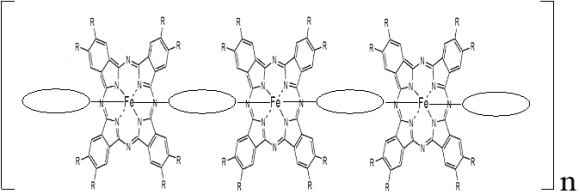
Thus, various current research projects are focused on networks of compounds that possess an extended π electron system with a near one-dimensional stacking . Systems composed of metallophthalocyanines (MPcs) associated with bidentate ligands such as pyridine derivatives are therefore of particular interest (Figure 1). This type of stacking occurs when the central atom (transition metal) of the macrocycle is biaxially connected to the bidentate ligands. F. Mendizabal et al. obtained improved conductivities when studying polymers composed of iron [FePc] and ruthenium [RuPc] phthalocyanines bonded to the bidentate ligand bipyridine ethylene (byet). Furthermore, the results were better with the [FePc(byet)]n polymers because the gap between the frontier crystalline orbitals was 0.430 eV, whereas it was 0.640 eV for the [RuPc(byet)]n polymer.
Recently, numerous articles have reported on linear [FePc] polymers, in which iron atoms are axially linked by bidentate ligands containing π electrons . The main objective is to create conductive materials based on a linear arrangement of transition metal chains.
Soo et al. studied polymers composed of a chain of [FePc(CN)8] groups linked together by the bipyridine ligand. They reported that the presence of cyano groups not only improved the solubility of these materials but also that they exhibited high conductivity (106 - 107 S cm–1) without doping.
Several studies have shown that the synthesis of octacyanated metallophthalocyanines [MPc(CN)8] with tetracyanobenzene as a precursor leads primarily to mixtures of monomers and polymers . In contrast, our previous work allowed us to isolate the [FePc(COOH)8] complex with improved solubility and high purity .
To provide more information on the spectral properties obtained with [FePc] polymers, Karifa et al. investigated a series of [FePcL] complexes, where L = bpe, bpa. They highlighted the nature of charge transfers in the new compounds they obtained by comparing them with the UV-Visible spectra of FePc, [FePc(Py)2] and [FePc(4CNPy)2] reported in the literature.
In connection with this work, we set out to modulate the electronic structure of [FePc] by first introducing equatorial substituents (-COOH) and (-CN) and then attaching axial bidentate ligands.
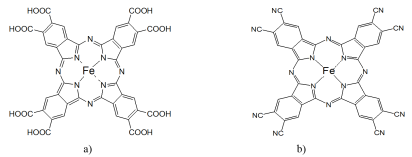
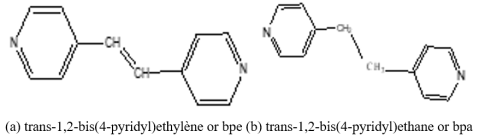
In this article, we prepared and studied, using electron and vibrational spectroscopy, a series of octacarboxylated and octacyanated iron phthalocyanine complexes (Figure 2) bearing the bidentate pyridine ligands [trans-1,2-bis (4-pyridyl) ethylene (bpe); trans-1,2-bis (4-pyridyl) ethane (bpa), pyridine (Py), 4-cyanopyridine (4CNPy)] in the axial position. The spectroscopic properties of these complexes were discussed in comparison with those of [FePc] complexes bearing the same axial ligands.
Elucidating the electronic structure of these complexes through the exploitation of our results could allow us to propose these compounds as candidates for the design of molecular materials because of the ease with which electrons would move along the molecular chain.
Figure 1. Representation of polymer iron phthalocyanine with R = COOH or CN and.
Figure 2. (a) Iron octacarboxylate phthalocyanine [FePc(COOH)8] and (b) iron octacyanine phthalocyanine [FePc(CN)8].
2. Materials and Methods
2.1. Products and Procedure
Pyromellitic dianhydride (97%), phthalic anhydride (97%), iron(II) sulfate heptahydrate (>99%), urea (>99%), ammonium heptamolybdate tetrahydrate (>99%), ethanol (>99.8%), methanol (>99.8%), acetone (>99.8%), sodium hydroxide (>98%), nitrobenzene (>99%), tetracyanobenzene (97%), acetonitrile (>99.8%), benzene (97%), hydrochloric acid (>37%) and DMSO (>99.9%) were obtained from Aldrich, as were pyridine (≥99%), 4-cyanopyridine, trans-1,2-bis(4-pyridyl)ethane (99%), and trans-1,2-bis(4-pyridyl)ethylene (97%) were received from Alfa Aesar.
Unless otherwise stated, all reagents and solvents were used without further purification.
2.2. Preparation of Compounds
2.2.1. Preparation of Iron Phthalocyanine
The complex [FePc] is obtained by adopting the previous work described in the literature. As described in previous work .
2.2.2. Iron Phthalocyanine Preparations Bearing Axial Ligands
The complex bearing the Py ligand
The complex bearing the Py ligand was obtained by refluxing 20 mg (3.52 × 10⁻⁵ mol) of [FePc] and an excess of the corresponding ligand in acetonitrile. After three hours of heating, a green product was isolated and washed with ethanol.
Figure 3. Structure of pyridine.
The complexes bearing the bpe and bpa ligands
Complexes bearing the bpe and bpa ligands were obtained by refluxing 20 mg (3.52 × 10⁻⁵ mol) of [FePc] and an excess of the corresponding ligand in acetonitrile. After one week of heating, a green product was isolated and washed with ethanol.
Figure 4. Structure of (a) bpe and (b) bpa.
Complexes bearing 4CNPy ligands
The reaction product of [FePc] with the ligand 4CNPy was obtained by bringing the two compounds into contact, 20 mg (3.52 × 10⁻⁵ mol) of [FePc] and an excess of 4CNPy, in benzene. The mixture was refluxed for four days. The isolated solid was washed with ethanol and then dried.
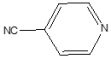
Figure 5. Structure of 4-CNpyridine.
2.2.3. Preparation of [FePc(COOH)8] and [FePc(CN)8] Complexes
We prepared and purified the [FePc(COOH)8] and [FePc(CN)8] complexes as described in the literature .
Preparations of octacarboxylated and octacyanated iron phthalocyanine complexes bearing pyridine axial ligands and derivatives.
A mixture of 15 mg (≈ 1.1 × 10⁻⁴ mol) of [FePc(COOH)₈] or [FePc(CN)₈] and an excess amount of the corresponding ligand is brought to reflux in the appropriate solvent in a 100 cm³ single-necked flask. The products isolated in solid form were all purified in the same way as before.
2.3. Equipmen
2.3.1. Optical Absorption Spectroscopy
UV-visible spectra were recorded using a 190 DES Double Energy System spectrometer in the 350 nm and 800 nm range from compounds dissolved in dimethyl sulfoxide (DMSO) in the presence of an excess of ligand for compounds bearing axial ligands.
2.3.2. Vibrational Infrared Spectroscopy
The IR spectra were recorded in the frequency range of 400 cm–1 to 3000 cm–1 using a Bruker TENSOR 27 spectrometer, diamond ATR, from the powders of the samples.
3. Results and Discussion
3.1. Optical Absorption Spectrometry
The wavelengths of the absorption maxima between 350 nm and 800 nm are grouped in Tables 1, 2, 3 and 4.
3.1.1. The Basic Complexes [FePc], [FePc(COOH)8], and [FePc(CN)8]
Table 1. Wavelengths of absorption maxima in nm of UV-visible spectra of [FePc], [FePc(COOH)8] and [FePc(CN)8] in solution in DMSO.

Compounds

ππ*

FeLax

LaxPc

[FePc]

649

-

-

[FePc(COOH)8]

682

-

-

[FePc(CN)8]

686

-

-

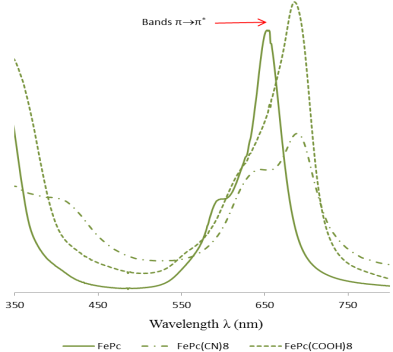
Figure 6. UV-visible spectra of FePc, [FePc(COOH)8] and [FePc(CN)8] in DMSO solution.
Comparing the electronic absorption spectra of the [FePc], [FePc(COOH)8], and [FePc(CN)8] complexes to Figure 6, we observed a significant modification of the electronic properties of the [FePc] macrocycle due to the introduction of the carboxyl and cyano groups at its periphery. The entire system shifted towards longer wavelengths. inter- and intramolecular interactions resulted in a dominant electron-donating effect, which is consistent with findings in the literature . These displacements can be attributed to dipolar interaction phenomena or those resulting from the formation of hydrogen bonds which stabilize the electron density around the macrocycle, thus weakening the energy required for electronic transitions in the case of the [FePc(COOH)8] complex and to a "π stacking" phenomenon in the case of the [FePc(CN)8] complex .
3.1.2. [FePc] Complexes Bearing the Ligands Py, 4CNPy, Bpe and Bpa
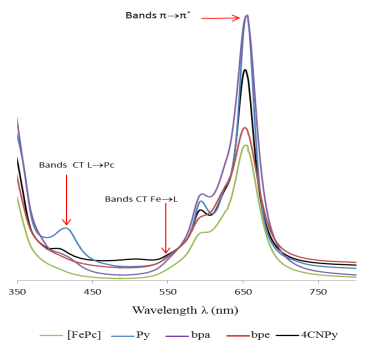
The [FePc] complexes and ligands used are hexacoordinated in the form of FePcL2, in which the ligands are located on either side of the macrocycle plane. Indeed, a splitting of the π→π* band is observed with the [FePc] series when the resulting complexes are pentacoordinated, i.e., with an axial ligand on the central iron metal .
Table 2. Wavelengths of the absorption maxima in nm of the UV-visible spectra of [FePc] and reaction compounds of [FePc] with pyridine and its derivatives in solution in DMSO.

Compounds

ππ*

FeLax

LaxPc

[FePc]

649

-

-

[FePc(Py)2]

653

-

406

[FePc(4CNPy)2]

649

497

397

[FePc(bpa)2]n

652

-

405

[FePc(bpe)2]n

649

575

400

Figure 7. UV-visible spectra of FePc and the reaction compounds of [FePc] with pyridine and its derivatives (bpa, bpe, 4CNPy) in solution in DMSO.
The formation of polymers with these pyridine ligands, as well as their presence in an axial position on the iron metal of the [FePc] complex, leads to the appearance of an axial ligand-iron metal charge transfer band (CT L→Pc bands) around 400 nm and an axial iron metal-ligand charge transfer band around 550 nm (CT Fe→L bands) (Table 2 and Figure 7). The results obtained with the [FePc] series are consistent with those previously published in the literature .
3.1.3. The [FePc(COOH)8] Complexes Bearing the Ligands Py, 4CNPy, Bpe and Bpa
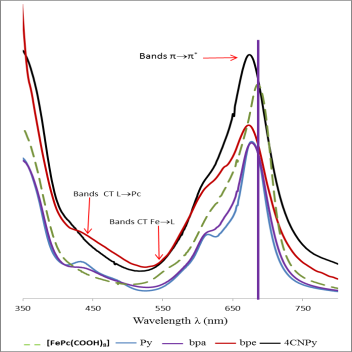
The appearance of the π → π* transition band in the spectra of the prepared complexes (Figure 8) could indicate that we have hexacoordinated complexes [FePc(COOH)8L2].
Table 3. Wavelengths of absorption maxima in nm of the UV-visible spectra of [FePc(COOH)8] and the reaction compounds of [FePc(COOH)8] with pyridine and its derivatives in DMSO solution.

Compounds

ππ*

FeLax

LaxPc

[FePc(COOH)8]

682

-

-

[FePc(COOH)8(Py)2]

673

-

424

[FePc(COOH)8(4CNPy)2]

673

540e

418

[FePc(COOH)8(bpa)2]n

672

-

425

[FePc(COOH)8(bpe)2]n

671

552

425

Figure 8. UV-visible spectra of [FePc(COOH)8] and the reaction compounds of [FePc(COOH)8] with pyridine and its derivatives (bpa, bpe, 4CNPy) in DMSO solution.
A similar phenomenon, observed in our previous work with a series of monodentate pyridine ligands, appears in the spectra of the reaction compounds of [FePc(COOH)8] with axial ligands. The introduction of axial ligands causes a significant increase in the main π → π* band transition energies. It is highly likely that the phenomena underlying the electron-donating effect resulting from the introduction of -COOH groups, as discussed in section 2.1.1, are significantly attenuated by the binding of these types of axial ligands.
A new transition band, absent in the spectrum of [FePc(COOH)8], appears around 425 nm (Table 3) in all spectra of the compounds obtained. This transition is attributed to a charge transfer from the axial ligand to the macrocycle (CT L→Pc) by analogy with the results obtained with the [FePcL2] series . Furthermore, the band at 540 nm, appearing as a shoulder in the spectrum of the [FePc(COOH)8(4CNPy)2] complex, is attributable to a charge-transfer transition from the central metal to the axial ligand (CT Fe→L), by analogy with the results of the [FePc] series (Table 2). Indeed, in the [FePcL2] series, this band is observed when the pyridine carries an electron-withdrawing group such as -CN . Previous work by Karifa et al. showed that the presence of this band justified the formation of the [FePc(bpe)2]n polymer because the different macrocycles of the polymer would all be linked with perfect conjugation. The ability of electrons to move along the chain induces macrocycle-dependent behavior in the polymer. Each macrocycle behaves as an electron-withdrawer for its neighbors; this phenomenon is identical to that observed with the 4CNPy ligand.
In our study, the appearance of the (CT Fe→L) band at 552 nm, supported the formation of the polymer [FePc(COOH)8(bpe)2]n. The energy of this band in the polymer is low compared to that of the monomer complex [FePc(COOH)8(4CNPy)2]. This difference could be explained by the conjugation of macrocycles in the polymer structure, which would facilitate electronic transitions along the chain. The absence of the charge transfer band from the central metal to the axial ligand (CT Fe→L) in the spectrum of the polymer [FePc(COOH)8(bpa)2]n could be justified by the independent behavior of each macrocycle in the polymer, given the absence of conjugation of the bipyridine ethane ligand.
3.1.4. The [FePc(CN)8] Complexes Bearing the Ligands Py, 4CNPy, Bpe and Bpa
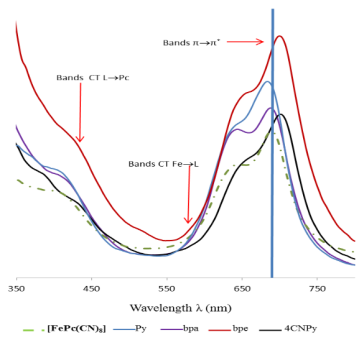
As in the first two series, the π→π* band is not split (Figure 9), suggesting that we have hexacoordinated [FePc(CN)8L2] compounds.
Table 4. Wavelengths of absorption maxima in nm of the UV-visible spectra of [FePc(CN)8] solutions and the reaction compounds of [FePc(CN)8] with pyridine and its derivatives in DMSO solution.

Compounds

ππ*

FeLax

LaxPc

[FePc(CN)8]

684

-

-

[FePc(CN)8(Py)2]

678

-

417

[FePc(CN)8(4CNPy)2]

697

557

426

[FePc(CN)8(bpa)2]n

683

-

415

[FePc(CN)8(bpe)2]n

694

567

423 e

Figure 9. UV-visible spectra of [FePc(CN)8] and the reaction compounds of [FePc(CN)8] with pyridine and its derivatives (bpa, bpe, 4CNPy) in solution in DMSO.
In this series of [FePc(CN)8L2] complexes, the energy of the main π→π* transition band is influenced by the presence of certain ligands. Indeed, the presence of the axial ligands 4CNPy and bpe causes a bathochromic shift of this band by approximately 10 nm. Furthermore, charge-transferring transition bands (CT L→Pc) were observed throughout the series. In contrast, the CT Fe→L bands are only evident with the two ligands 4CNPy and bpe (Table 4 and Figure 9). Their nature could explain this result. The energy evolution of this band is consistent with previous results and confirms the formation of the polymer [FePc(CN)8(bpe)2]n.
If in the series [FePc(COOH)8L2], the π→π* band undergoes an overall bathochromic shift, a new result is observed with the series [FePc(CN)8L2].
Indeed, when the ligand is trans-1,2-bis(4-pyridyl)ethylene, the π→π* band of the polymer complex [FePc(CN)8(bpe)2]n shifts by about 10 nm compared to that of the [FePc(CN)8] complex. The same applies to the monomer complex [FePc(CN)8(4CNPy)2]. This could be explained by the specific nature of the peripheral CN groups. Also, in the previous work of Karifa et al. , the presence of the axial ligand 4CNPy promoted charge transfer from the central iron metal to the axial ligand. He obtained the same result when preparing the polymer [FePc(bpe)2]n and explained it by the presence of the ethylene group of the bpe ligand, which promotes conjugation of the two phthalocyanine macrocycles through the iron metal. This conjugation facilitates electron transfer along the polymer chain, unlike the polymer formed with the bpa ligand, where the lack of unsaturation induces independent behavior for each entity of the [FePc(CN)8(bpa)2]n polymer. Similarly, Schneider et al. showed in their work that the π→π* band of the [FePc(bip)2]n polymer (with bip = bipyridine or pyrazine) shifted by approximately 60 nm relative to that of the [FePc(bip)2] complex, thus justifying the perfect conjugation of the complex rings through the bipyridine.
The differences in behavior between the polymer [FePc(COOH)8(bpe)2]n and the polymer [FePc(CN)8(bpe)2]n could be explained by the nature of the interactions present in these two structures. Furthermore, Fickling et al. showed, through the calculation of the Hammett constants of the CN and COOH groups, that the cyano group was 1.5 times more electron-withdrawing than the carboxyl group.
The weakening of hydrogen bonds could explain the hypsochromic shift of the π→π* band in the [FePc(COOH)8(bpe)2]n polymer. Conversely, this same band shifts towards the red end of the spectrum in the [FePc(CN)8(bpe)2]n polymer. Many studies in the literature have shown that when benzene rings are substituted with electron-withdrawing groups, weak electrostatic interaction occurs between the benzene rings, which would favor a linear, sandwich-like arrangement of the different structures . This type of stacking, which weakens the π→π* band energy, confers excellent superconductivity to the resulting materials . The broadening of the π→π* band in the spectra of the polymers we isolated, is consistent with the results obtained by Soo et al. when they studied polymers formed by the [FePc(CN)8] complex with bypyridine ligands.
3.2. Infrared Absorption Spectrometry
The frequencies of the most notable vibration bands are grouped in Tables 5 and 6.
3.2.1. Octacarboxylated Iron Phthalocyanine Complexes Bearing Axial Ligands
The spectra of octacarboxylated complexes bearing axial ligands (Table 5) differ slightly from that of [FePc(COOH)8]. Most of the [FePc(COOH)8] bands are present, although some vibrational bands have disappeared, appeared, shifted, or their intensity has changed. It might be assumed that the structure of [FePc(COOH)8] is only slightly modified by the presence of ligands, but it is clear that the binding of axial ligands could lead to changes in the stacking pattern. This new stacking pattern could therefore be responsible for the variation in relative intensities and the enhancement of certain vibrational bands in the complexes bearing axial ligands .
Table 5. Notable vibration bands of [FePc(COOH)8] and reaction compounds of [FePc(COOH)8] with pyridine and its derivatives between 400 and 4000 cm–1.

[FePc(COOH)8]

[FePc(COOH)8Py2]

[FePc(COOH)8(bpa)2]n

[FePc(COOH)8(4CNPy)2]

[FePc(COOH)8(bpe)2]n

Attributions

430 f

431 f

440 f

ΦC-C deformation du macrocycle

482 m

458 m

466 f

433 m

452 f

501 m

501 m

506 f

501 f

496 m

543 m

547 m

555 m

538 m

546 m

581 m

632 F

590 m

600 f

599 m

627 m

630 F

632 F

627 F

662 m

667 F

676 m

688 F-697 F

696 m

695 m

732 TF

734 F

732 F

733 TF

731TF

C-H

749 F

750 f

799 m

750 F

749 m

C–H

799 F

801 f

800 m

799 m

825 m

823 m

826 m

824 m

918 F

921 F

916 F

923 F

916 m

M-N

1000 F

1008 F

1006 m

1000 F

1005 m

1090 TF

1090 F

1088 TF

1088 TF

1086 F

βC-H

1143 f

1150 m

1153 m

1151 m

1163 f

-

1155 m

1180 f

-

1233 F

1237 m

1236 m

1242 m

1237 m

C-O

1268 F

1272 F

1268 F

1270 F

1264 TF

C-C

1317 m

1319 m

1318 f

1316 m

1317 f

C-N

1369 m

1374 m

1376 F

1369 m

1368 m

1437 m

1452 F

1450 F

1450 m

M-N

1450 m

1498 m

1514 F

1450 F

1515 F

Vibration C=N du cycle

1516 m

1516 m

1582 F

1516 m

1582 F

1586 F

1583 m

1586 m

1628 m

1635 f

1637 F

1703 TF

1705 TF

1703 TF

1704 TF

1697 TF

C=O

2500-3500 l

2500-3500 l

2500-3500 l

2500-3500 l

2500-3500 l

νO-H

Legend: T F = very strong F = strong m = medium f = weak l = wide.
The slight change in the characteristic band frequencies of the phthalocyanine (Pc) macrocycle, despite the coordination of axial ligands, demonstrates the high stability of the C–C, C–N, and C=N bonds of the phthalocyanine macrocycle . Modifications such as the appearance of weak bands at 458 cm–1 and 825 cm–1 in the spectrum of [FePc(COOH)8(Py)2], and at 600 cm–1 and 826 cm–1 in the spectrum of [FePc(COOH)8(4CNPy)2], can be attributed to the presence of pyridine ligands at the axial position of the central metal, as they are absent in the spectrum of [FePc(COOH)8]. Similarly, the increase in intensity and the splitting of the band appearing around 690 cm–1 in the spectra of the reaction compounds is attributable to the presence of pyridine ligands, by analogy with previous studies. Furthermore, recent works carried out on octacarboxylated gold phthalocyanine complexes bearing the same ligands have reported similar results .
As with pyridine ligands, polymer formation through the binding of bipyridine ligands has little effect on the resulting spectra. However, the appearance and modification of the relative intensities of certain bands were observed. Thus, the appearance of bands around 590 cm–1 and 823 cm–1 in the spectra of the polymers [FePc(COOH)8(bpa)2]n and [FePc(COOH)8(bpe)2]n can be attributed to the binding of axial ligands. The bands at 799 cm–1 and 1000 cm–1 in the spectrum of [FePc(COOH)8] decreased in intensity in the spectra of the complexes containing the bpa and bpe ligands.
The vibration band of the –CH2 or –CH groups of the bpa and bpe ligands is not evident in the spectra of the complexes containing these ligands. It is likely that it is masked or coupled with the O-H vibration band, which also appears in the same region . The weak invariance of the band at 918 cm–1, associated with the various movements of the metal in the plane of the phthalocyanine macrocycle despite substitution in the axial position, shows that the symmetry around the metal has not changed. These observations support the formation of hexacoordinated complexes, as in the case of complexes obtained by binding axial ligands to [FePc(L2)].
3.2.2. Octacyanated Iron Phthalocyanine Complexes with Axial Ligands
In general, the frequencies of the characteristic bands of the phthalocyanine (Pc) macrocycle have been observed to be only slightly modified despite the binding of axial ligands. Similar phenomena have been observed compared to those already observed in the spectra of [FePc(COOH)8] complexes. Indeed, studies carried out on octacyanated gold phthalocyanine complexes bearing pyridine and substituted pyridine axial ligands on the one hand, and on axially substituted iron phthalocyanine complexes [(CH3)8PcFeL2], [X16PcFeL2] (X= Cl, Br), [(CO2Na)4PcFeL2] (L = Py, 3OHPy, 4OHPy, 4ClPy, 4CNPy, 4CHOPy) on the other hand, have highlighted these phenomena .
Table 6. Notable vibration bands of [FePc(CN)8] and the reaction compounds of [FePc(CN)8] with pyridine and its derivatives between 400 and 4000 cm–1.

[FePc(CN)8]

[FePc(CN)8Py2]

[FePc(CN)8(bpa)2]n]n

[FePc(CN)8(4CNPy)2]

[FePc(CN)8(bpe)2]n

Attributions

480 f

-

477 f

-

533 F

ΦC-C deformatio n du macrocycle

529 TF

-

529 TF

-

613 m

-

-

-

-

-

636 f

-

637 f

-

684 f

-

684 f

672 f

704 f

-

702 f

-

705 m

721 F

724 TF

721 F

734 TF

721 m

νC–H

759 F

-

757 F

-

761 F

C–H

800 F

808 m

800 F

818 F

800 F

C–H

872 m

-

872 m

-

-

915 m

923 m

920 F

933 F

909 f

M-N

1028 F

1038 m

1028 F

1047 f

1051 m

1096 TF

1112 TF

1096 TF

1121 TF

1106 TF

βC-H

1164 m

1173 f

1164 m

1182 f

1142 m

1268 F

1276 TF

1269 F

1276 TF

1267 m

C-C

1310 TF

1309 TF

1310 TF

1318 TF

1318 F

C-N

1412 m

-

1412 m

-

1415 m

M-N Cycle vibration C=N

1443 m

1452 m

1445 m

1465 F

1443 f

1519 F

1518 f

1519 F

1529 m

1515 F

-

1549 f

-

1560 f

1569 f

1573 m

-

1571 m

-

-

-

1620 f

-

1628 f

-

-

1659 f

-

1667 f

-

1715 m

1725 m

1710 m

1736 m

1724 f

C=N bonded

2223 F

2226 F

2223 F

2236 TF

2226 F

νC≡N

-

-

2900-2987 m

2900-2990 m

νCH2; νCH

Legend: TF = very strong, F = strong, m = medium, f = weak
The new bands appearing in the spectra of [FePc(CN)8] reaction compounds with ligands originate primarily from ligand vibrations and/or structural changes. Thus, the increase in band intensity around 720 cm–1 and 1230 cm–1 in the spectra of [FePc(CN)8] complexes bearing the axial ligands Py and 4CNPy is attributable to the vibrational bands of these ligands. The new bands observed, on the one hand at 1549 cm–1, 1620 cm–1, and 1659 cm–1 in the spectrum of [FePc(CN)8(Py)2] and, on the other hand, at 1560 cm–1, 1628 cm–1, and 1667 cm–1 in the spectrum of [FePc(CN)8(4CNPy)2], can also be attributed to the vibrations of the said ligands as they are absent in the spectrum of [FePc(CN)8] (Table 6). The increased intensity of the band at 2236 cm–1 of the [FePc(CN)8(4CNPy)2] complex can be attributed to the superposition of CN bands originating from the 4CNPy ligand and the peripheral cyano groups. Indeed, the CN vibrational band of the 4CNPy ligand was observed at 2230 cm–1 in the spectrum of the free ligand . The binding of bipyridine ligands has very little effect on the spectra obtained. Most of the [FePc(CN)8] vibrational bands are found in the spectra of the prepared compounds, although some bands exhibit a relative variation in intensity. The major change in the spectra of these complexes is the appearance of the new band between 2900 cm–1 and 3000 cm–1. In the case of [FePc(CN)8(bpa)2]n, this band can be attributed to the vibration of the two –CH2 groups linking the two pyridine rings and in the case of [FePc(CN)8(bpe)2]n to the two –CH groups also linking the two pyridine rings, thus accounting for their binding to [FePc(CN)8]. In the infrared spectra of the free ligands, these different bands are found at the same vibration frequencies . The slight invariance of the band around 920 cm–1, associated with the various movements of the metal in the plane of the phthalocyanine macrocycle despite substitution at the axial position, shows that the symmetry around the metal has not changed. These findings, which are consistent with previous work, support the formation of the new compounds .
4. Conclusion
The results of spectrometric studies of polymer compounds [FePc(COOH)8(bpa)2]n, [FePc(COOH)8(bpe)2]n, [FePc(CN)8(bpa)2]n, and [FePc(CN)8(bpe)2]n synthesized and isolated in the solid state are reported for the first time in this work. The number of entities n per polymer could not be determined.
Vibrational spectrometry results show a modulation of the intensities of the characteristic bands of the complexes, which is explained by a structural reorganization of the compounds. We were also able to identify new vibrational bands, such as those at 590 cm-1, 690 cm-1, and 823 cm-1, attributable to the vibrational bands of the ligands in the spectra of the polymer compounds.
Overall, the π→π* band of the [FePc] complex undergoes a bathochromic shift in electron absorption spectrometry with the presence of peripheral groups (-COOH and –CN) as described in the literature.
On the one hand, polymer formation resulted in a redshift of approximately 45 nm in the π→π* band in the case of the [FePc(CN)8(bpe)2]n polymer compared to its monomeric counterpart [FePc(bpe)2]n. On the other hand, polymer formation is supported by the decrease in the energy of the Fe→L CT band.
The results showed that the bpa ligand induced independent behavior for each macrocycle of the resulting polymer. In contrast, the bpe ligand promoted linear conjugation of the different macrocycles of the polymer formed. We hypothesized that polymers obtained with the bpe ligand possess electronic properties that can be exploited in the design of superconducting materials.
Abbreviations

Bpe

Trans-1,2-bis (4-pyridyl) Ethylene

Bpa

Trans-1,2-bis (4-pyridyl) Ethane

IR

Infrared

DMSO

Dimethyl Sulfoxide

Py

Pyridine

4CNPy

4-CNpyridine

ATR

Attenuated Total Reflectance

CT

Charge Transfert

Acknowledgments
We thank all the technicians who assisted us during the collection of spectrometric measurement data.
Author Contributions
Lassane Tarpaga: Conceptualization, Methodology, Writing – review & editing
Wend-Kuny Guy Aristide Nitiema: Data curation
Seydou Ouedraogo: Investigation, Methodology
Bertrand Ouemega: Investigation, Methodology
Bintou Sessouma: Investigation, Methodology
Mabinty Bayo-Bangoura: Conceptualization, Methodology
Karifa Bayo: Writing – review & editing, Supervision
Conflicts of Interest
The authors declare that there is no conflicts of interest for this article.
References
[1] Karifa, B., Guy, V. O., Georges, T., David, B. UV-VISIBLE AND IR spectra of iron(II) phthalocyanine polymer complexes linked by bis-pyridinato ligands. Polyhedron. 1990, 9(8), 1087-1090.
[2] Soo, J. K., Michiko, M., Kiyotaka, S. Synthesis and electrical properties of one-dimensional octacyanometallophtalocyanine (M= Fe, Co) polymers. Journal of the Porphyrins and Phthalocyanines. 2000, 4(1), 136-144.
[3] Leonardo, A., Chiara, T., Brian, S., Alberto, C. Molecular devices based on the mechanical bond: recent advances. Coordination Chemistry Reviews. 2006, 553, 217583.
[4] Michael, H., Uwe, K., Hans-joachim, S. Iodine-doped bridged phthalocyaninatoiron (II) And-ruthenium(II) Compounds. Synthetic Metals. 1987, 20(3), 347-356.
[5] Sami, A., Néji, B., Bassem,: Phthalocyanines: Syntheses and Proprietes. Moroccan Journal of Heterocyclic Chemistry. 2021, 20(1), 1-14.
[6] Mendizabal, F., Olea-Azar, C., Zapata-Torres, G., Eisner, F. Metallomacrocycle complex bridged polymers: electronic structures of–[MacM (L)]n. Journal of Molecular Structure THEOCHEM. 2001, 543(1-3), 23-37.
[7] Schick, G. A., Bocian, D. F. Resonance Raman studies of bis (pyridine) adducts of iron (II), ruthenium (II), and osmium (II) octaethylporphyrins. Effects of heavy-metal substitution on porphyrin and axial-ligand vibrational and electronic properties. Journal of the American Chemical Society. 1984, 106(6), 1682-1694.
[8] Schneider, O., Hanack, M. Phthalocyanine iron with pyrazine as a bidentate bridging ligand. Angewandte Chemie. 1980, 92(5), 391-393.
[9] Danilo D, Michael H. Phthalocyanines as materials for advanced technologies: some examples. Journal of the Porphyrins and Phthalocyanines. 2004, 8(7), 915-933.
[10] Nakagawa, M., Rikukawa, M., Sanui, K., Ogata, N. Synthesis, electrochemical, and electrical properties of (phthalocyaninato) iron complexes with azopyridines. Synthetic metals. 1997, 84(1-3), 391-392.
[11] Victor, N. N., Evgeny, A. L. Synthesis of substituted phthalocyanines. ARKIVOC. 2010, (2010) 1, 136-208.
[12] Nitiema, W. K. G. A., Lassane, T., Bertrand, O., Bayo-Bangoura, M., Holade, Y., Bayo, K. Preparation, vibrational and electronic studies of octasubstituted gold phthalocyanine complexes and their derivatives bearing axial pyridine and substituted pyridine ligands. Journal of the West African Society of ChemistryPreparation, vibrational and electronic studies of octasubstituted gold phthalocyanine complexes and their derivatives bearing axial pyridine and substituted pyridine ligands. Journal of the West African Society of Chemistry. 2024, 53, 74-84.
[13] Tarpaga, L., Bayo-Bangoura, M., Ouédraogo, S., Bayo, K. Preparation, vibrational and electronic studies of hexacoordinated complexes of iron octocarboxyphthalocyanine with pyridine axial ligands and substituted pyridines, phosphine and phosphites. Asian Journal of Science and Technology. 2018, 9(5), 8185-8192.
[14] Zanguina, A., Bayo, K., Bayo-Bangoura, M., Ouédraogo, G. V. IR and UV-visible spectra of iron (II) phthalocyanine complexes with phosphine or phosphite. Bulletin of the Chemical Society of Ethiopia. 2002, 16(1), 73-79.
[15] Sakamoto, K., Ohno-okumura, E. Syntheses and functional properties of phthalocyanines. Materials. 2009, 2(3), 1127-1179.
[16] Xuezheng, Y., Shoujuan, L., Shishan, X., Shuai, C., Xiaoli, Z., Xilin, S., Tianrong, Z., Xiaoliang, Z., Dongjiang, Y. Coupling of iron phthalocyanine at carbon defect site via π-π stacking for enhanced oxygen reduction reaction. Applied Catalysis B: Environment and Energy. 2021, 280, 119437.
[17] Jinping, W., Xiaoming, Z., Yi, Z., Zhen, P., Chunzhen, Z., Fenglian, Z. Structural design of porous organic polymers to mitigate π-stacking-induced quenching in porphyrin/phthalocyanine photosensitizers for enhanced antibacterial activity. RSC Advances. 2025, 15(7), 48604-48627.
[18] Ouedraogo, G. V., More, C., Richard, Y., Benlian, D. Charge-transfer and Moessbauer spectra of axially substituted iron (II) phthalocyanines. Inorganic Chemistry. 1981, 20(12), 4387-4393.
[19] Dustin, E. N, Laura, S. F., Briana, R. S., Victor, N. N. Charge-Transfer Spectroscopy of Bisaxially Coordinated Iron(II) Phthalocyanines through the Prism of the Lever’s EL Parameters Scale, MCD Spectroscopy, and TDDFT Calculations. Inorganic Chemistry. 2022, 61(21), 8250-8266.
[20] Fierro, C., Anderson, A. B., Scherson, D. A. Electron donor-acceptor properties of porphyrins, phtalocyanines, and related ring chelates: a molecular orbital study. Journal of Physical and. Chemistry. 1988, 92(24), 6902-6907.
[21] Fickling, M. M., Fischer, A., Mann, B. R., Packer, J., Vaughan, J. Hammett substituent constants for electron-withdrawing substituents: Dissociation of phenols, anilinium ions and dimethylanilinium ions. Journal of the American Chemical Society. 1959, 81(16), 4226-4230.
[22] Kadish, K. M., Smith, K. M., Guilard, R. Structure-Property Relationships in Porphyrin Systems. The Porphyrin Handbook: Multporphyrins, Multiphthalocyanines and Arrays. 2012. 19(1), 1-354.
[23] Benjamin, W. G., Mehul, P., Xiaowen, X. A Threshold for Charge Transfer in Aromatic Interactions? A Quantitative Study of π-Stacking Interactions. Journal of Organic Chemistry. 2005, 70(25), 10532-10537.
[24] Inabe, T., Tajima, H. Phthalocyanines versatile components of molecular conductors. Chemical Reviews. 2004, 104(11), 5503-5534.
[25] Sanda-Bawa, A., Bayo-Bangoura, M., Ouemega, B., Bayo, K. Preparation and vibrational and electronic studies of gold phthalocyanine complexes with axial pyridine and substituted pyridine ligands. International Journal of biological and chemical sciences. 2018, 12(3), 1516-1527.
[26] Emmanuël, L. Spectrometric identification of organic compounds: translation of the 5th American edition. Paris: Deboeck Université 2004, 142 p.
[27] Richard, N. A. 2001. Interpreting infrared, raman, and nuclear magnetic resonance spectra. Elsevier; 2001, 1.
[28] Socrates, G. Infrared and Raman Characteristic Group Frequencies: Tables and Charts, 3rd edition. Wiley; 2004, 368 p.
[29] Barbara, H. S. Infrared spectroscopy: fundamentals and applications. John Wiley & Sons, Ltd; 2004; 231 p.
Cite This Article
  • APA Style

    Tarpaga, L., Nitiema, W. G. A., Ouedraogo, S., Ouemega, B., Sessouma, B., et al. (2026). Synthesis and Spectrometric Study of New Iron Phthalocyanine Polymers: Influence of Peripheral COOH and CN Groups on Vibrational and Electronic Properties. Science Journal of Chemistry, 14(1), 25-37. https://doi.org/10.11648/j.sjc.20261401.13

    Copy | Download

    ACS Style

    Tarpaga, L.; Nitiema, W. G. A.; Ouedraogo, S.; Ouemega, B.; Sessouma, B., et al. Synthesis and Spectrometric Study of New Iron Phthalocyanine Polymers: Influence of Peripheral COOH and CN Groups on Vibrational and Electronic Properties. Sci. J. Chem. 2026, 14(1), 25-37. doi: 10.11648/j.sjc.20261401.13

    Copy | Download

    AMA Style

    Tarpaga L, Nitiema WGA, Ouedraogo S, Ouemega B, Sessouma B, et al. Synthesis and Spectrometric Study of New Iron Phthalocyanine Polymers: Influence of Peripheral COOH and CN Groups on Vibrational and Electronic Properties. Sci J Chem. 2026;14(1):25-37. doi: 10.11648/j.sjc.20261401.13

    Copy | Download

  • @article{10.11648/j.sjc.20261401.13,
      author = {Lassane Tarpaga and Wend-Kuny Guy Aristide Nitiema and Seydou Ouedraogo and Bertrand Ouemega and Bintou Sessouma and Mabinty Bayo-Bangoura and Karifa Bayo},
      title = {Synthesis and Spectrometric Study of New Iron Phthalocyanine Polymers: Influence of Peripheral COOH and CN Groups on Vibrational and Electronic Properties},
      journal = {Science Journal of Chemistry},
      volume = {14},
      number = {1},
      pages = {25-37},
      doi = {10.11648/j.sjc.20261401.13},
      url = {https://doi.org/10.11648/j.sjc.20261401.13},
      eprint = {https://article.sciencepublishinggroup.com/pdf/10.11648.j.sjc.20261401.13},
      abstract = {We have prepared and isolated in solid form two types of polymers formed between iron (II) complexes ([FePc(COOH)8] and [FePc(CN)8]) and two bidentate ligands [trans-1,2-bis (4-pyridyl) ethylene (bpe); trans-1,2-bis (4-pyridyl) ethane (bpa)]. The electronic and vibrational absorption spectra of these complexes are discussed in comparison with those of previous work on [FePcL2]n polymers with the same ligands. Infrared spectrometry shows a modulation in the intensities of certain characteristic bands of the complexes, reflecting a reorganization of the structure of these compounds through the formation of polymers and, above all, the emergence of new vibration bands attributable to the ligands. In electron absorption spectrometry, our results confirm those already available in the literature with the [FePcL2]n series. The presence of the bpa ligand causes each macrocycle of the polymer to behave independently. In contrast, the bpe ligand induces a perfect linear connection between the macrocycles due to its alkene function, which allows electrons to move easily along the polymer chain. The presence of peripheral groups (COOH and CN) provides a novel result because they strongly influence not only the energy of the π→π* band, but especially that of the central metal-axial ligand charge transfer band (CT Fe→L). These charge transfers are responsible for the conductive properties of these compounds.},
     year = {2026}
    }
    

    Copy | Download

  • TY  - JOUR
    T1  - Synthesis and Spectrometric Study of New Iron Phthalocyanine Polymers: Influence of Peripheral COOH and CN Groups on Vibrational and Electronic Properties
    AU  - Lassane Tarpaga
    AU  - Wend-Kuny Guy Aristide Nitiema
    AU  - Seydou Ouedraogo
    AU  - Bertrand Ouemega
    AU  - Bintou Sessouma
    AU  - Mabinty Bayo-Bangoura
    AU  - Karifa Bayo
    Y1  - 2026/02/27
    PY  - 2026
    N1  - https://doi.org/10.11648/j.sjc.20261401.13
    DO  - 10.11648/j.sjc.20261401.13
    T2  - Science Journal of Chemistry
    JF  - Science Journal of Chemistry
    JO  - Science Journal of Chemistry
    SP  - 25
    EP  - 37
    PB  - Science Publishing Group
    SN  - 2330-099X
    UR  - https://doi.org/10.11648/j.sjc.20261401.13
    AB  - We have prepared and isolated in solid form two types of polymers formed between iron (II) complexes ([FePc(COOH)8] and [FePc(CN)8]) and two bidentate ligands [trans-1,2-bis (4-pyridyl) ethylene (bpe); trans-1,2-bis (4-pyridyl) ethane (bpa)]. The electronic and vibrational absorption spectra of these complexes are discussed in comparison with those of previous work on [FePcL2]n polymers with the same ligands. Infrared spectrometry shows a modulation in the intensities of certain characteristic bands of the complexes, reflecting a reorganization of the structure of these compounds through the formation of polymers and, above all, the emergence of new vibration bands attributable to the ligands. In electron absorption spectrometry, our results confirm those already available in the literature with the [FePcL2]n series. The presence of the bpa ligand causes each macrocycle of the polymer to behave independently. In contrast, the bpe ligand induces a perfect linear connection between the macrocycles due to its alkene function, which allows electrons to move easily along the polymer chain. The presence of peripheral groups (COOH and CN) provides a novel result because they strongly influence not only the energy of the π→π* band, but especially that of the central metal-axial ligand charge transfer band (CT Fe→L). These charge transfers are responsible for the conductive properties of these compounds.
    VL  - 14
    IS  - 1
    ER  - 

    Copy | Download

Author Information
  • Laboratory of Molecular Chemistry and Materials, Joseph KI-ZERBO University, Ouagadougou, Burkina Faso
  • Laboratory of Molecular Chemistry and Materials, Joseph KI-ZERBO University, Ouagadougou, Burkina Faso

  • Laboratory of Molecular Chemistry and Materials, Joseph KI-ZERBO University, Ouagadougou, Burkina Faso

  • Laboratory of Molecular Chemistry and Materials, Joseph KI-ZERBO University, Ouagadougou, Burkina Faso

  • Laboratory of Molecular Chemistry and Materials, Joseph KI-ZERBO University, Ouagadougou, Burkina Faso

  • Laboratory of Molecular Chemistry and Materials, Joseph KI-ZERBO University, Ouagadougou, Burkina Faso

  • Laboratory of Molecular Chemistry and Materials, Joseph KI-ZERBO University, Ouagadougou, Burkina Faso