Research Article | | Peer-Reviewed

Evaluation of Some Approximations of the Temperature Integral Used in Kinetic Analysis of Solid-state Reactions

Received: 25 December 2025     Accepted: 15 January 2026     Published: 12 June 2026
Views:       Downloads:
Abstract

In general, thermal analysis is a very convenient way to study the kinetics of thermally activated solid reactions, and experiments involving thermally activated solid reactions typically occur under nonisothermal conditions. The experimental data analysis obtained under non-isothermal conditions includes a temperature integral, also called the Arrhenius integral, which is one of the integrals that belong to many interesting integrals that are important in engineering and have no analytical solution. There are many different approximations that can be applied to the processing of thermogravimetric analysis data, since there is no standard way to calculate the temperature integral. Many approximations of the temperature integral that are important to use determine the kinetic parameters, especially the activation energy, which are typically divided into two categories: exponential and rational approximations. In order to evaluate the accuracy of various approximations of the temperature integral, we consider several certain continuous intervals. When choosing an approximation of the temperature integral needed to analyze the experimental data, it is necessary to analyze the accuracy at different temperature intervals of the approximation and use the appropriate one. We present new rational, irrational and continued fractional approximations together with approximations of the temperature integral presented in several literatures and calculate the relative errors of their activation energies.

Published in Science Journal of Applied Mathematics and Statistics (Volume 14, Issue 3)
DOI 10.11648/j.sjams.20261403.11
Page(s) 71-78
Creative Commons

This is an Open Access article, distributed under the terms of the Creative Commons Attribution 4.0 International License (http://creativecommons.org/licenses/by/4.0/), which permits unrestricted use, distribution and reproduction in any medium or format, provided the original work is properly cited.

Copyright

Copyright © The Author(s), 2026. Published by Science Publishing Group

Keywords

Temperature Integral, Solid-state Reactions, Nonisothermal Conditions, Approximation, Activation Energy
1. Introduction
In general, thermal analysis is a convenient method to study the kinetics of thermally activated solid-state reactions. Experiments where these reactions occur are usually performed under nonisothermal conditions. Most of the part analysis of thermogravimetric data is an active research area and new methods have emerged after ICTAC publication . In addition, some aspects of TGA data analysis, such as thermal inertia, are still under development and the use of logistic equations has been evaluated . Integral methods have the advantage of analyzing experimental kinetic data. Hence, nonisothermal calculations include the temperature integral, also called the Arrhenius function, which has no exact analytical solutions as integral exponential function. Mathematica technique is used for calculations for temperature integration . Many approximations to the temperature integral have been proposed. In this paper, we consider new approximations while discussing the approximations presented in several literatures, which include rational, irrational and continued fractional approximations. In order to analyze the experimental data, when choosing an approximation, it is necessary to use a suitable one considering the accuracy in different temperature intervals of approximations. Interesting approximation techniques related to special functions such as mathematical constants, including Napier constants, or gamma functions have been found . In , deviations of approximations in several intervals or points in [5, 100] were considered. The evaluation method presented here does not indicate the overall behavior of approximations in the given interval. A general consideration is needed to evaluate the accuracy of various approximations of the temperature integral in different intervals. Starting from the classical kinetic equation of nonisothermal kinetics, many mathematical models have been developed to estimate the values of the kinetic triplet, that is, activation energy, pre-exponential factor and reaction mechanism, to fully describe the thermal activation process . The procedure for kinematic analysis can be classified into differential and integral methods, and mathematical analysis can be done by model-free method and model fitting methods, and the model-free method is divided into the linear or nonlinear methods, and linear methods can be easily obtained from the log form of some approximations to temperature integration . Some linear methods are obtained by some approximations, which result in high errors in certain temperature ranges, especially in special cases with low activation energies, whose range exceeds the application limit . The model-free method is used to determine the value of activation energy, and the model fitting method can be used to determine the reaction mechanisms for solid reactions . The reaction mechanisms commonly used in nonisothermal reaction kinetics have been cited . It is practical to find a mechanism corresponding to maximum R2 to select the most probable reaction mechanism . In this paper, we evaluate the approximations presented in the literature and new approximations using the relative errors of activation energies.
2. Theoretical Considerations Related to the Temperature Integration and Its Approximation
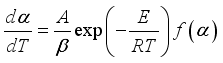
The mathematical model of the process of nonisothermal solid decomposition is given by the following differential equation:
(1)
where (0 < <1) is the fractional conversion, (K/min) the heating rate, E (kJ/mol) the activation energy, A (min-1) the preexponential factor, R the gas constant, T (K) the absolute temperature, specific form of represents the hypothesized model of the reaction mechanism.
In some works, the Simpson rule-based integral calculation method is used to generate the normalized temperature integral references .
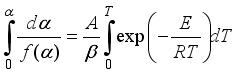
Integrating after separating the variables to solve this differential equation, Eq. (1) becomes
(2)
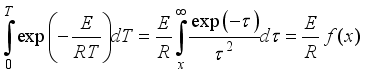
The integral on the right-hand side in Eq. (2) is called the temperature integral or Arrhenius integral. Using the substitution x=E/(RT), the temperature integral from the substitution integral formula is transformed as follows:
(3)
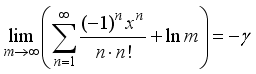
If E/(RT) is very small, i.e., E/(RT)<1, then using power series expansion exp-x=n=1-xnn! and the formula
the Arrhenius integral can be expressed as
(4)
where γ=0.577215664 is the Euler-Mascheroni constant.
The method using power series is not suitable for use in general cases because of the constraint on temperature.
Hence, several approximations other than the power series approximation are used.
In general, approximations to the temperature integral f(x) are classified into two types: one is exponential approximation and the other is rational approximation.
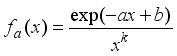
The form of exponential approximation is
(5)
which is usually expressed as follows:
(6)
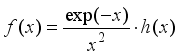
The form of rational approximation is
(7)
Rational approximation is a method of approximating a function by a ratio of two algebraic polynomials, in which the degree of the rational approximation is defined as the degree of the highest degree polynomial. The rational approximation is often used since this can be used for any temperature. It is important to evaluate the accuracy of approximations of the temperature integral within a certain range. x in [9, 100] or [15, 60] is of practical significance. In practice, many reactions occur within this range.
To evaluate the accuracy of the approximation of the temperature integral, the following equations are used:
(8)
(9)
(10)
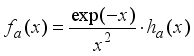
where fa(x), ha(x) are approximations of the temperature integral from Eq. (7).
In , they evaluated the accuracy of two groups of approximations: exponential and rational approximations. shows that exponential approximation has a worse approximation than rational approximation as a whole.
In the case of exponential approximation, when x∈[5, 100], Cai-Liu's approximation () has excellent accuracy and Doyle's approximation has the worst accuracy. When x∈[15, 60], the approximation of TLZW () has excellent accuracy.(see Table 1).
Table 1. Exponential approximations for the temperature integral.

Name

lnpa(x)

ε1

ε2

b

K

a

Doyle

-5.3308

0

1.0516

15.39

0.91

TLZW

-0.37773896

1.8946610

1.00145033

1.6910-2

3.6010-5

Cai–Liu

-0.460120828342246

1.86847901883656

1.00174866236974

4.6110-3

1.5510-3

In the case of rational approximation, the approximation () ha(x)=1 has the worst accuracy, and the approximation of Coats and Redfern takes the next place.
Cai's approximation is of simple form (N=2, n=1), but has higher accuracy than the same complexity approximations (N=2, n=1 or N=2, n=2) ().
Among the approximations with N=3, the best approximation for [5, 100] is Urbanovici–Segal’s approximation and for [15, 60], the best approximation is Senum–Yang 's approximation. In the case of N=4, the best approximation is Ji's approximation.
Deng. et. al.showed that the best approximation in [5, 100] is the Órfão's approximation, and the best approximation in [15, 60] is the Senum-Yang’s approximation.
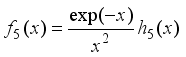
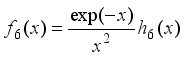
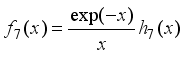
We introduce here new rational approximations as follows:
(11)
(12)
(13)
where
The accuracies of Eqs.(11), (12) and (13) are evaluated in Table 2.
Table 2. Rational approximations for the temperature integral.

Name

Approximation

N

n

ε1

ε2

FJG

19]

1

0

0

0.65

0.19

Coats–Redfern

x-2x

1

1

6.5110-2

2.9610-3

Cai

x+0.66691x+2.64943

2

1

3.9210-6

6.1710-7

Urbanovici–Segal II

x2+3.5xx2+5.5x+5

3

2

1.6010-7

2.7110-8

Senum–Yang I

x2+4xx2+6x+6

3

2

6.4010-6

2.5210-8

Ji

x2+4.45239x+0.76927x2+6.45218x+7.69430

4

2

5.2010-11

1.0910-11

Senum-Yang III

x4+18x3+86x2+96xx4+20x3+120x2+240x+120

7

4

5.9410-10

1.2210-14

Órfão III

0.9999936x4+7.5739391x3+12.4648922x2+3.6907232xx4+9.5733223x3+25.6329561x2+21.0996531x+3.9584969

8

4

7.0710-11

5.8210-12

h5

x5+28x4+246x3+756x2+600xx5+30x4+300x3+1200x2+180x+720

9

5

1.2110-11

2.3810-17

h6

x6+40x5+552x4+3168x3+7092x2+4320xx6+42x5+630x4+4200x3+12600x2+15120x+5040

11

6

3.4310-13

7.3510-20

h7

x7+54x6+1070x5+9720x4+41112x3+71856x2+35280xx7+56x6+1176x5+11760x4+58800x3+141120x2+141120x+40320

13

7

1.2510-14

3.2910-22

It can be seen from the Table 2 that the higher the order of the rational approximation, the higher the accuracy.
The newly proposed approximations h5, h6, and h7 are much more accurate than the previous results for any x.
In addition, there are many approximations of the temperature integral. Table 3 shows some irrational approximations.
We compare here with the new irrational approximations.
Table 3. Irrational approximations for the temperature integral.

Name

Approximation

ε1

ε2

Balarin

xx+4

9.0710-5

1.5710-6

hr2

x2+6.5x-2x2+10.5x+24

2.6610-9

2.8410-11

hr5

x5+29.4265x4+258.3529x3+666.8235x2x5+33.4265x4+376.0588x3+1708.2353x2+2850.7059x+920.6471

1.8510-11

9.3110-17

As shown in Table 3, our new approximations have much higher accuracy compared to others.
In this paper, we introduce a new type of approximation, i.e., the approximations of the temperature integral by the continued fraction.
Table 4. Continued fractional approximations for the temperature integral.

Name

Approximation

ε1

ε2

hc1

x+1x+2+x+3x+1

2.0810-3

2.0510-4

hc2

x2+0.5xx2+2.5x+x2+0.5xx2+1.5x

2.4710-3

2.1710-4

3. Determination of Activation Energy Using the Approximations of Temperature Integrals
There are model fitting methods and model-free methods for determining activation energy. Generally, rational approximations can be used in both the methods, and exponential approximations are used in model-free methods.
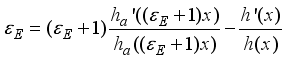
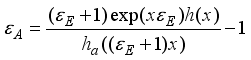
The aforementioned approximations are used to calculate the activation energy. Equations for determining εE and εA are given by
,(14)
and
.(15)
Obviously, εE and εA are dependent on the x and the approximation and not on the reaction model.
Table 5. The value of εE(%) of the approximations at different x.

x

FJG

19]

Coats–Redfern

Cai

Urbanovici–Segal II

Senum–Yang I

Ji

Senum-Yang III

Orfao III

0.5

-1.28102

-2.69102

-7.81102

1.09101

1.31101

-3.15101

4.74

6.6110-2

2

-1.97101

6.15101

-3.62

8.7110-1

1.34

-3.6610-1

1.3910-1

-1.0310-5

5

-4.76

7.15

-1.8610-1

4.3310-2

1.1410-1

-2.4010-3

2.7110-3

1.4910-6

10

-1.47

9.9910-1

-4.7010-4

1.4010-4

1.0310-2

4.6810-5

5.3910-5

-1.7310-6

15

-1.7310-1

3.0910-1

4.1910-3

-6.8010-4

2.1010-3

-2.9710-5

3.8310-6

7.0010-6

20

-4.2110-1

1.3410-1

2.7410-3

-4.1310-4

6.3510-4

-1.4710-5

5.1010-7

5.5010-6

25

-2.7810-1

6.9810-2

1.6110-3

-2.3610-4

2.4310-4

-3.3010-6

9.9310-8

2.1910-6

30

-1.9710-1

4.0910-2

9.4810-4

-1.4010-4

1.0910-4

1.7010-6

2.5010-8

-4.5210-7

40

-1.1410-1

1.7610-2

3.2810-4

-5.7010-5

2.9610-5

3.7610-6

2.6510-9

-3.2410-6

45

-9.0910-2

1.2410-2

1.8610-4

-3.9010-5

1.7210-5

3.5110-6

1.0310-9

-3.8110-6

50

-7.4210-2

9.1010-3

9.7010-5

-2.7010-5

1.0610-5

3.0810-6

4.4310-10

-4.0810-6

55

-6.1710-2

6.8710-3

4.0310-5

-1.9510-5

6.7810-6

2.6110-6

2.0410-10

-4.1710-6

60

-5.2210-2

5.3110-3

3.7010-6

-1.4310-5

4.5110-6

2.1810-6

9.9910-11

-4.1310-6

80

-2.9810-2

2.2610-3

-5.0610-5

-5.1210-6

1.1510-6

9.8710-7

9.1110-12

-3.5410-6

100

-1.9210-2

1.6710-3

-5.5710-5

-2.2510-6

3.9610-8

4.0910-7

1.3810-12

-2.8610-6

Table 6. The value of εE(%) of the approximations at different x.

x

Balarin

h5

h6

h7

hr2

hr5

hc1

hc2

0.5

-3.60101

1.35101

1.96

1.30

3.38101

2.39

-1.52101

2

-2.89

-1.4510-1

1.8810-2

7.5310-3

4.3910-1

4.3310-2

-1.0610-1

2.34

5

-3.1110-1

-3.14

-1.0610-4

2.4110-5

2.7110-3

5.6710-4

5.5210-1

7.3210-1

10

-4.0810-2

-4.7410-1

5.7010-7

7.1310-8

-3.7110-4

7.5110-4

1.5810-1

1.7610-1

15

-1.0910-2

-1.2510-1

1.5910-8

1.2910-9

-7.7810-5

2.8410-7

6.2710-2

6.6910-2

20

-4.1010-3

-4.4210-3

1.0210-9

5.8410-11

-2.2910-5

-7.1110-8

3.0710-2

3.2210-2

25

-1.8710-3

-1.8810-2

1.0710-10

4.6110-12

-8.1410-6

-8.5910-8

1.7310-2

1.7910-2

30

-9.2310-4

-9.0710-3

1.5910-11

5.3310-13

-3.3510-6

-7.1610-8

1.0610-2

1.0910-2

40

-3.3910-4

-2.7410-3

7.0110-13

1.5510-14

-7.7910-7

-4.5310-8

4.8610-3

4.9610-3

45

-2.1910-4

-1.6610-3

1.8910-13

3.4810-15

-4.2010-7

-3.6310-8

3.5110-3

3.5710-3

50

-1.4710-4

-1.0510-3

5.7310-14

8.9810-16

-2.4010-7

-2.9410-8

2.6210-3

2.6610-3

55

-1.0310-4

-6.8910-4

1.9310-14

2.6010-16

-1.4410-7

-2.4110-8

2.010-3

2.0310-3

60

-7.4310-5

-4.6810-4

7.0510-15

8.2610-17

-9.010-8

-2.010-8

1.5610-3

1.5810-3

80

-2.4810-5

-1.2710-4

2.4010-16

1.7410-18

-1.8410-8

-1.0310-8

6.8710-4

6.9410-4

100

-1.0510-5

-4.5310-5

1.6510-17

8.1510-20

-5.2610-9

-5.9810-9

3.6110-4

3.6410-4

Table 7. The value of εA(%) of the approximations at different x.

x

FJG

19]

Coats–Redfern

Cai

Urbanovici–Segal II

Senum–Yang I

Ji

Senum-Yang III

Orfao III

0.5

-1.04102

-1.04102

-1.01102

1.73101

2.23101

-3.45101

6.26

6.4710-2

2

-7.0101

7.05102

-1.22101

3.14

5.3

-1.17

4.610-1

-3.0510-5

5

-4.45101

8.08101

-1.25

2.9210-1

8.9810-1

-1.4610-2

1.8710-2

-2.3710-6

10

-2.82101

1.74101

4.1710-2

-8.3710-3

1.4710-1

3.7210-4

6.8510-4

-3.0710-6

15

-2.08101

7.60

9.6510-2

-1.7910-2

4.3210-2

-5.5310-4

7.0510-5

1.1310-4

20

-1.64101

4.28

6.9610-2

-1.3010-2 

1.7010-2

-2.7310-4

1.2310-5

8.3210-5

25

-1.36101

2.75

4.3510-2

-8.8710-3

8.0310-3

-9.0710-6

2.9510-6

6.1110-6

30

-1.16101

1.91

2.4710-2

-6.1710-3

4.2710-3

1.3110-4

8.8510-7

-6.8410-5

40

-9.01

1.08

2.9410-3

-3.2510-3

1.5410-3

2.0010-4

1.2410-7

-1.6610-4

45

-8.10

8.5910-1

-3.2010-3

-2.4610-3

1.0010-3

1.9010-4

5.4210-8

-1.9110-4

50

-7.35

6.9810-1

-7.5010-3

-1.9010-3

6.8110-4

1.6810-4

2.5710-8

-2.0410-4

55

-6.73

5.7810-1

-1.0510-2

-1.5010-3

4.7910-4

1.4410-4

1.3010-8

-2.0810-4

60

-6.21

4.8710-1

-1.2710-2

-1.2010-3

3.4710-4

1.8410-4

6.9110-9

-2.0610-4

80

-4.74

2.7510-1

-1.6410-2

-5.6410-4

1.1810-4

3.5010-5

8.3710-10

-1.6310-4

100

-3.83

1.7710-1

-1.6810-2

-3.0810-4

5.0210-5 

-1. 6810-5

1.6210-10

-1.0210-4

Table 8. The value of εA(%) of the approximations at different x.

x

Balarin

h5

h6

h7

hr2

hr5

hc1

hc2

0.5

-4.71101

-3.44101

2.33

1.49

4.31101

2.98

-7.12101

2

-1.11101

-5.25101

5.8910-2

2.3110-2

1.40

1.4010-1

4.49

1.44101

5

-2.56

-2.38101

7.010-4

1.5710-4

1.4010-2

3.8510-3

6.0

7.52

10

-6.1710-1

-6.87

2.8210-7

8.5710-7

-4.6410-3

8.9910-5

2.85

3.12

15

-2.4010-1

-2.63

2.3510-8

2.2610-8

-1.5810-3

1.8710-6

1.59

1.64

20

-1.1710-1

-1.21

3.0610-9

1.3310-9

-6.010-4

-4.2910-6 

1.01

1.05

25

-6.6110-2

-6.3510-1

5.4210-10

1.3010-10

-2.6210-4

-4.6210-6 

6.9710-1

7.1810-1

30

-4.0910-2

-3.6410-1

3.1510-11

1.8910-11

-1.2810-4

-4.2010-6 

5.0910-1

5.2210-1

40

-1.8810-2

-1.4510-1

1.1010-11

1.1310-12

-3.9110-5

-3.2710-6 

3.0510-1

3.1110-1

45

-1.3610-2

-9.7710-2

2.9110-12

1.4710-12

-2.3610-5

-2.8810-6 

2.4710-1

2.5110-1

50

-1.0110-2

-6.8310-2

2.2210-13

-2.8910-13

-1.4910-5

-2.5410-6 

2.0310-1

2.0610-1

55

-7.7810-3

-4.9210-2

-3.4210-12

-6.2210-13

-9.8210-6

-2.2610-6 

1.7010-1

1.7310-1

60

-6.0910-3

-3.6410-2

-3.6410-2

-4.1710-12

-6.6710-6

-2.0210-6

1.4510-1

1.4710-1

80

-2.6910-3

-1.3110-2

1.8010-12

1.8010-12

-1.8110-7

-1.3510-6 

8.4410-2 

8.5110-2

100

-1.4210-3

-5.8010-3

4.0910-12

4.0910-12

-6.4310-7

-9.6110-7 

5.5110-2

5.5510-2

Among the approximations presented in the previous works, the approximations of E and A determined by Senum-Yang have the best accuracy. Also, given x for each approximation, we can see that the value of εA is greater than that of εE.
4. Conclusions
By numerical methods with rapidly increasing computational capabilities, temperature integration can be determined, but when enough accuracy is required, the importance of approximations cannot be neglected.
Using efficient approximations, the analytical procedure may be simplified. In addition, suitable approximations may reduce computation time.
We have considered approximations of known or newly constructed temperature integrals.
In general, the rational approximation has better accuracy than the exponential approximation. Rational approximations have better accuracy as the order increases. Efficient selection of approximations requires detailed consideration, such as its complexity, accuracy, and the range of x.
Abbreviations

TGA

Thermogravimetric Analysis

Acknowledgments
It is also the result of collaborative research with State Academy of Sciences.
Author Contributions
Kim Hyon Chol: Conceptualization, Investigation, Visualization, Writing – original draft, Writing – review & editing
Ri Kwang Il: Conceptualization, Validation, Writing – review & editing, Supervision
Funding
This work was partially supported by State Academy of Sciences.
Conflicts of Interest
The authors declare no conflicts of interest.
References
[1] Hammam, M., Abdel-Rahim, M. Hafiz, M., Abu-Sekly A., New combination of noil-isothermal kinetics-revealing methods. J Therm Anal Calorim [Internet]. 2017, 128(3), 1391-405.
[2] Sstk, J., Are nonisotkermal kinetics fearing historical Newton’s cooling law, or are just afraid of inbuilt complications due to undesirable thermal inertial. J Therm Anal Calorim. 2018, 134(3), 1385-93.
[3] Burnham, A. K., Use and misuse of logistic equations for modeling chemical kinetics. J Therm Anal Calorim. 2017, 127(1), 1107-16. Available from:
[4] Cai, J., Wu, W., Liu R., Isoconversional kinetic analysis of complex solid-state processes: Parallel and successive reactions. Ind Eng Chem Res [Internet]. 2012, 51(49), 16157-61.
[5] Mortici, C., A continued fraction approximation of the gamma function. J. Math. Anal. Appl. 402(2013), 405–410.
[6] Chen, C.-P., A more accurate approximation for the gamma function. J. Num. The. 164(2016) 417–428.
[7] Nemes, G., Approximations for the higher order coefficients in an asymptotic expansion for the Gamma function. J. Math. Anal. Appl. 396 (2012), 417–424.
[8] Prez-Maqueda, L. A., Criado, J. M., J. Therm. Anal. Calorim. 60(2000), 909.
[9] Zhang, X., Applications of Kinetic Methods in Thermal Analysis: A Review. Eng. Sci., 2021, 14, 1–13.
[10] Budrugeac, P., An iterative model-free method to determine the activation energy of non-isothermal heterogeneous processes. Thermochimica Acta, 2010, 511, 8–16.
[11] Mu, X., Xuanjun W., Xiangxuan L., Youzhi Z., Thermal Decomposition Performance of Unsymmetrical Dimethylhydrazine (UDMH) Oxalate. PEP, 2012, 37, 316-319.
[12] Chen, N. H., Jin, S., Li, S., Jing, L., Jiang, B., Ji, Z., Qinghai, J. S., Thermolysis, nonisothermal decomposition kinetics, calculated detonation velocity and safety assessment of dihydroxylammonium 5, 5′-bistetrazole-1, 1′-diolate. J. Therm Anal Calorim, 2016, 126, 473–480.
[13] Yi, J. H., Zhao, F. Q., Hong, W. L., Xu, S. Y., Hu, R. Z. Chen, Z. Q. Zhang, L. Y., Effects of Bi-NTO complex on thermal behaviors, nonisothermal reaction kinetics and burning rates of NG/TEGDN/NC propellant. Journal of Hazardous Materials, 2010, 176, 257–261.
[14] Chen, R. Y., Li, Q. W., Xu, X. K. Zhang, D. D., Hao, R. L., Combustion characteristics, kinetics and thermodynamics of Pinus Sylvestris pine needle via non-isothermal thermogravimetry coupled with model-free and model-ftting methods. Case Studies in Thermal Engineering, 2020, 22, 100756.
[15] Yasnó, J. P., Conconi, S., Visintin, A., Suárez, G., Non-isothermal reaction mechanism and kinetic analysis for the synthesis of monoclinic lithium zirconate (m-Li2ZrO3) during solid-state reaction. Journal of Analytical Science and Technology. 2021, 12-15.
[16] Carrero-Mantilla, J. I., Rojas-Gouzlez, A. F., Calculation of the temperature integrals used in the processing of thermogravimetric analysis data, 2019, Vol. 21 No. 2.
[17] Deng., C., Cai., J., Liu, R., Kinetic analysis of solid-state reactions: Evaluation of approximations to temperature integral and their applications. Solid State Sciences 11(2009) 1375–1379.
[18] Tang, W., Liu, Y., Zhang, H., Wang, C., Thermochim. Acta 408(2003) 39.
[19] Ernesto Fischer, P., Chon Shin J., Shyam, S., Gokalgandhi, Ind. Eng. Chem. Res. 26(1987) 1037.
Cite This Article
  • APA Style

    Chol, K. H., Il, R. K. (2026). Evaluation of Some Approximations of the Temperature Integral Used in Kinetic Analysis of Solid-state Reactions. Science Journal of Applied Mathematics and Statistics, 14(3), 71-78. https://doi.org/10.11648/j.sjams.20261403.11

    Copy | Download

    ACS Style

    Chol, K. H.; Il, R. K. Evaluation of Some Approximations of the Temperature Integral Used in Kinetic Analysis of Solid-state Reactions. Sci. J. Appl. Math. Stat. 2026, 14(3), 71-78. doi: 10.11648/j.sjams.20261403.11

    Copy | Download

    AMA Style

    Chol KH, Il RK. Evaluation of Some Approximations of the Temperature Integral Used in Kinetic Analysis of Solid-state Reactions. Sci J Appl Math Stat. 2026;14(3):71-78. doi: 10.11648/j.sjams.20261403.11

    Copy | Download

  • @article{10.11648/j.sjams.20261403.11,
      author = {Kim Hyon Chol and Ri Kwang Il},
      title = {Evaluation of Some Approximations of the Temperature Integral Used in Kinetic Analysis of Solid-state Reactions},
      journal = {Science Journal of Applied Mathematics and Statistics},
      volume = {14},
      number = {3},
      pages = {71-78},
      doi = {10.11648/j.sjams.20261403.11},
      url = {https://doi.org/10.11648/j.sjams.20261403.11},
      eprint = {https://article.sciencepublishinggroup.com/pdf/10.11648.j.sjams.20261403.11},
      abstract = {In general, thermal analysis is a very convenient way to study the kinetics of thermally activated solid reactions, and experiments involving thermally activated solid reactions typically occur under nonisothermal conditions. The experimental data analysis obtained under non-isothermal conditions includes a temperature integral, also called the Arrhenius integral, which is one of the integrals that belong to many interesting integrals that are important in engineering and have no analytical solution. There are many different approximations that can be applied to the processing of thermogravimetric analysis data, since there is no standard way to calculate the temperature integral. Many approximations of the temperature integral that are important to use determine the kinetic parameters, especially the activation energy, which are typically divided into two categories: exponential and rational approximations. In order to evaluate the accuracy of various approximations of the temperature integral, we consider several certain continuous intervals. When choosing an approximation of the temperature integral needed to analyze the experimental data, it is necessary to analyze the accuracy at different temperature intervals of the approximation and use the appropriate one. We present new rational, irrational and continued fractional approximations together with approximations of the temperature integral presented in several literatures and calculate the relative errors of their activation energies.},
     year = {2026}
    }
    

    Copy | Download

  • TY  - JOUR
    T1  - Evaluation of Some Approximations of the Temperature Integral Used in Kinetic Analysis of Solid-state Reactions
    AU  - Kim Hyon Chol
    AU  - Ri Kwang Il
    Y1  - 2026/06/12
    PY  - 2026
    N1  - https://doi.org/10.11648/j.sjams.20261403.11
    DO  - 10.11648/j.sjams.20261403.11
    T2  - Science Journal of Applied Mathematics and Statistics
    JF  - Science Journal of Applied Mathematics and Statistics
    JO  - Science Journal of Applied Mathematics and Statistics
    SP  - 71
    EP  - 78
    PB  - Science Publishing Group
    SN  - 2376-9513
    UR  - https://doi.org/10.11648/j.sjams.20261403.11
    AB  - In general, thermal analysis is a very convenient way to study the kinetics of thermally activated solid reactions, and experiments involving thermally activated solid reactions typically occur under nonisothermal conditions. The experimental data analysis obtained under non-isothermal conditions includes a temperature integral, also called the Arrhenius integral, which is one of the integrals that belong to many interesting integrals that are important in engineering and have no analytical solution. There are many different approximations that can be applied to the processing of thermogravimetric analysis data, since there is no standard way to calculate the temperature integral. Many approximations of the temperature integral that are important to use determine the kinetic parameters, especially the activation energy, which are typically divided into two categories: exponential and rational approximations. In order to evaluate the accuracy of various approximations of the temperature integral, we consider several certain continuous intervals. When choosing an approximation of the temperature integral needed to analyze the experimental data, it is necessary to analyze the accuracy at different temperature intervals of the approximation and use the appropriate one. We present new rational, irrational and continued fractional approximations together with approximations of the temperature integral presented in several literatures and calculate the relative errors of their activation energies.
    VL  - 14
    IS  - 3
    ER  - 

    Copy | Download

Author Information