1. Introduction
The chicken egg is a biological structure proposed by nature for reproduction and providing a complete diet for the developing embryo
| [20] | Shi, S. R., Wang, K. H., Dou, T. C. and Yang, H. M. Egg weight affects some quality traits of chicken eggs, J. Food Agr. Environ. 2009, 7, 432-434. |
[20]
. On the other hand, it is one of poultry product used to reduce animal protein deficiency in the nutrition of smallholder farmers. Therefore it quality parameters were very important hatching better quality chicks and human consumption. Quality of eggs and preserving that quality is a function of physical structure and chemical composition. The quality of an egg ascertains the success of a poultry business because it is associated with the acceptability among the consumers
| [18] | Rajkumar, U., Sharma, R. P., Rajaravindra, K. S., Niranjan. M., Reddy, B. L. N., Bhattacharya, T. K. and Chatterjee, R. N. Effect of genotype and age on egg qualityt in naked neck chicken under tropical climate from India, International Journal Poultry. 2009, 8. 1151-1155. |
[18]
. Egg quality traits are foremost selection standard in poultry. The egg quality is one of most important economic factor in poultry industry for both hatching and table eggs
| [13] | Kocevski, D. The influence of strain and age on some egg quality parameters of commercial laying hens, Biotechnology of Animal Husbandry. 2011, 27, 1649–1658. |
[13]
. Egg quality is a factor that contributes to the better economic price of fertile and table eggs. Smallholders’ farmers in village keep chicken for different purpose and the main purpose and objective was for egg production to sell in local market
| [23] | Usman Abdulkadir, Yosef Taddesse and Teddele Dessie. Breeding Objectives and Farmers Trait Preferences of Village Chicken in East Shewa Zone of Oromia Region Ethiopia, East African Journal of Veterinary and Animal Sciences. 2021, 5(2), 75-80. |
[23]
. Therefore it crucial to evaluate its external and internal quality parameters of egg. The quality of egg determined based on both external and internal quality parameters. The external and internal egg quality traits were influenced by factors such as agro-ecology, breeding, and their interaction
| [19] | Serkalem Assefa, Belete Kuraz Abebe, Ahmed Hussen Gbena. A study on egg quality and hatching traits of indigenous and exotic chickens reared in Silte zone, Southern Ethiopia, Heliyon 9, 2023, 9(8).
https://doi.org/10.1016/j.heliyon.2023.e19126 |
[19]
. External and internal egg quality traits are the determinant factors for the embryonic development of an egg and latter for the viability of the new hatched chick
| [17] | Onagbesan O., Bruggeman V., Desmit L., Debonne M., Witters A., Tona K., Everaert N. and Decuypere E. Gas exchange during storage and incubation of avian eggs: effects on embryogenesis, hatchability, chick quality and post-hatch growth. World's Poultry Science. 2007, 63, 557-573. |
[17]
. The external quality of the egg is determined by features such as the egg weight and shape of the egg, shell thickness, and strength of the shell
| [5] | Bain, M. Recent advances in the assessment of eggshell quality and their future application. World. Poultry Science Journal, 2005, 61, 268-277. |
[5]
. Egg weight is also one of the important phenotypic traits that affects egg quality and reproductive fitness of the chicken
| [12] | Islam, A. M., Bulbul, S. A., Seeland, G., & Islam, A. B. Egg quality of different chicken genotypes in summer and winter. Park Journal of Biological Science. 2001, 4, 1411-1414. |
[12]
. Egg shape index is defined as the ratio of width to length of the egg, and it is an important criterion in determining egg quality. The shell thickness measure shell strength mainly for reduce egg shell breakages
| [3] | Alewi M, Melesse A, Teklegiorgis Y. Crossbreeding Effect on Egg Quality Traits of Local Chickens and Their F1 Crosses with Rhode Island Red and Fayoumi Chicken Breeds Under Farmers’ Management Conditions, Journal of Animal Science Advances. 2012, 2(8), 697-705. |
| [6] | Bekele F, Gjoen HM, Kathle J, Adnoy T, Abebe G. Genotype X environment interaction in two breeds of chickens kept under two management systems in Southern Ethiopia, Tropical Animal Health and Production. 2009, (41), 1101-1114.
https://doi.org/10.1007/s11250-008-9290-7 |
[3, 6]
. The internal quality is measured based various internal components such as weight of yolk, albumen weight and its contents ratio and yolk color. As regards the internal egg quality characteristics, thick albumen is quite an important measure for the freshness of an egg
| [27] | Yonas Kejela, Sandip Banerjee and Mestawet Taye. Some internal and external egg quality characteristics of local and exotic chickens reared in Yirgalem and Hawassa towns, Ethiopia, International Journal of Livestock Production. 2019, 10(5), 135-142. https://doi.org/10.5897/IJLP2018.0547 |
[27]
. The albumen weight was influenced by the agro-ecological variation
| [8] | Berhanu Bekele, Aberra Melesse, Wodmeneh Esatu and Tadelle Dessie. Production performance and egg quality evaluation of indigenous chickens across different agro-ecologies of Southern Ethiopia, Veterinary Integrative Sciences. 2022, 20(1): 133 - 145. https://doi.org/10.12982/VIS.2022.012 |
[8]
. Haugh unit is one internal egg quality that was considered as a typical measure of albumen quality. Haugh unit is also dependent on management system of birds, quality and quantity of feed, production environment and also storage condition of the eggs
| [2] | Aberra, M., Zemene, W., & Yoseph, T. Assessment of prevailing handling and egg quality from scavenging local chickens reared in different agro ecological zones of Ethiopia, Research Journal of Poultry Science. 2012, (5), 64-70. |
[2]
. With current increasing human population of Ethiopia, the poultry products particularly egg was considered as future food concerns, due short generation and high reproductive rate of chickens. Furthermore, in the market consumers prefer indigenous chicken’s eggs over eggs from exotic chicken. The market value of eggs from indigenous chicken is also relatively higher even its size is smaller than exotic chicken’s eggs. Understanding the quality of eggs laid by chickens is essential as it serves as an indicator of productivity, overall chicken care, business success and embryonic development. However, there was no research work on identifying of egg quality parameters of indigenous chicken egg in this area. Therefore, it was conducted to identify egg quality parameters of indigenous chicken ecotype for genetic improvement of chicken genetic resources on sustainable basis for smallholder village poultry producers.
2. Materials and Methods
2.1. Description of the Study Area
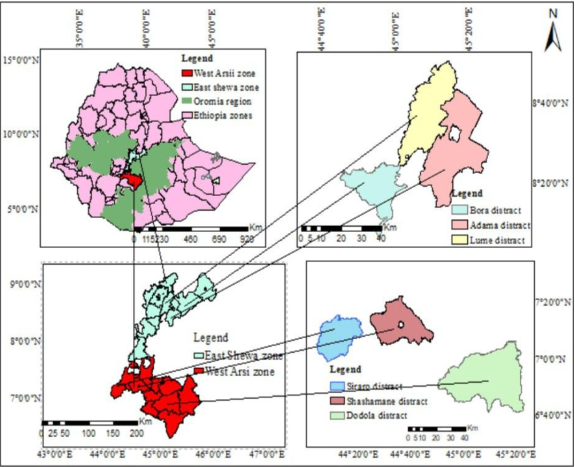
The study was conducted in Bora, Adama and Lume districts from East Shewa zone and Siraro, Shashemene, Dodola and districts from West Arsi zone.
Bora district: The Bora district is located in the East Shewa Zone of the Oromia Region in Ethiopia within the Great Rift Valley. Its administrative center is the town of Bote. Its coordinates are roughly 8.30°N latitude and 38.95°E longitude. It is located about 238 kilometers South of Addis Ababa. Its features was a semi-arid climate and experiences warm, dry conditions with average daytime temperatures of 25°C to 27°C. The district receives an average annual rainfall of 700 mm to 800 mm and one main rainy season between June and September. The altitude of district generally ranges from 1,611 to 2,000 masl.
Adama district: The Adama district is found East Shewa Zone of the Oromia Region in Ethiopia. The administrative town, Adama is located 99 km southeast of the capital, Addis Ababa. The district features altitude ranges from 1,415 to 2,505 masl. The districts lies 8°14' N to 8°40' N and a longitude of 39°4' to 39°29' E. The Annual temperatures generally range from 15°C to 28°C. The weather is mostly hot and dry during the winter, and warm and sunny during the summer. The area receives an average of 700 to 800 mm of rain annually.
Lume district: The Lume district is located in the East Shewa Zone of the Oromia Region in Ethiopia. It is Located about 70 km southeast of Addis Ababa. Its latitude between 8°24' and 8°50' North and a longitude of 39°01' to 39°28' East. Its altitude ranges from 1,500 to 2,300 masl. The district is generally warm, with average highs usually ranging between 23°C and 28°C throughout the year. The hottest months are typically from April to June. The annual rainfall typically falls between 700 mm and 850 mm. The main wet season (Kiremt) occurs during July and August.
Siraro district: Siraro is a rural district in the West Arsi Zone of Ethiopia's Oromia Region. It is located about 330 km south of Addis Ababa. It lies in the Great Rift Valley, with altitudes ranging from 1,500 to 2,750 masl. The district generally characterized by a semi-arid to sub-humid tropical climate.
Shashemene district: The Shashamane district found in the West Arsi Zone of the Oromia Region, Ethiopia. It located 250 kilometers south of Addis Ababa. Sitting in the Great Rift Valley, its geographic coordinates are 7°14' N latitude and 38°36' E longitude, at an elevation of 2,053 masl. The annual average temperatures of the district is between 20°C and 28°C.
Dodola district: Dodola District is located in the West Arsi Zone of the Oromia Region, southeastern Ethiopia. It sits at latitude and longitude 06° 59' N 39° 11' E and lies at an elevation of 2,362 to 2,493 masl. Dodola district experiences a mild highland climate, with average temperatures generally ranging from 9°C to 26°C (48°F to 79°F) year-round. The total rainfall of the district generally ranges between 1,000mm and 1,200mm annually.
Figure 1. Map of study area.
2.2. Sampling and Data Collection
The egg quality parameters evaluation were taken from a total of 1200 (200 eggs purchased from six districts). A total of eight (12) Kebeles, (2) Kebeles per district were selected purposively based on potentiality of indigenous chicken population and accessibility to main road for ease data collection. The fresh eggs were purchased from village households. The households were previously informed to prepare eggs laid within few days. Then eggs were purchased and transported to Adami Tullu Agricultural Research Center for taking egg quality parameters. At time of purchasing external cleanness and surface breakage of the egg was observed before purchased. Additionally, the freshness of eggs was also checked through pointing to sun light and observation physical feature.
2.3. Egg Quality Trait Measurement
The weight of egg was measured using digital balance. The egg width and length was measured using digital caliper. For internal egg quality measurement traits, egg was gentle broken on flat plate and albumen and yolk was carefully separated. The albumen weight and yolk weight were measured using sensitive balance. Shell thickness was measured using digital caliper after removal of the inner shell membrane. The egg shell thickness was measured on eggs taken from middle and both end points. The averages of the three points were used as the thickness of the egg. Albumen height and yolk height was determined using tripod micrometer. Yolk color was recorded from Roche fan color (1–15) levels. Haugh unit was computed from Haugh unit calculate Table by considering albumen height (mm) and egg weight (g). The egg shape index, egg shell ratio, yolk ratio and albumen ratio were calculated using the following formulae.
2.4. Statistical Analysis
The data collected from egg quality parameters were analyzed using GLM procedures (SAS, 2012 version 9.3) by adjusting zones as independent variables. The parameters expressed in terms of ratio or percentage was first converted to target parameters using Microsoft Excel 2010.
3. Results and Discussion
3.1. External Egg Quality Parameters
3.1.1. Egg Weight
The results of current study revealed that the overall mean of egg weight in the study area was 41.28±3.4 (
Table 1). This result was similar with
| [11] | Getachew Bekele Fereja, Bikila Nagari, Mengistu Urge and Negassi Ameha. The study of egg quality on the chicken village in Cheliya district of western Shoa, Ethiopia, International Journal Research- Granthaalayah. 2016, 4(2), 46-51. |
| [28] | Zare Yacouba, Gnanda B. Isidore, Traore Boureima, Kere Michel, Houaga Isidore, Rekaya Romdhane, Nianogo A. Joseph and Belem A. M. Gaston. Relationships between body weight and egg characteristics for Konde chicken ecotype in Centre-East and Sahel ecotype in Burkina Faso. International Journal of Biosciences | IJB. 2024, 24(2), 40-50. |
[11, 28]
who reported average egg weight of 41.13±1.26g and 41.89 ±3.98g respectively. On contrary, egg weight value of present study was lower than findings of
| [14] | Legesse Tunsisa & Sunkurta Digesa. Egg Quality Parameters Evaluation of Indigenous and Sasso Chicken in Sidama Region, Ethiopia, Middle East Res J. Agri Food Sci. 2024, 4(2): 56-60. https://doi.org/10.36348/merjafs.2024.v04i02.002 |
| [25] | Welelaw Edmew, Aberra Melesse, Mohammed Beyan and Mestawet Taye. Assessing The Performance, Egg Quality, and Carcass Characteristics of Indigenous Chickens Reared Under Traditional Management System. International Journal of Research Studies in Agricultural Sciences. 2018, 4(10), 27-35. http://dx.doi.org/10.20431/ 2454- 6224.04010004 |
[14, 25]
who reported average egg weight of indigenous chicken 43.9 ±4.7g and 49.41±445g in respectively. Similarly,
| [27] | Yonas Kejela, Sandip Banerjee and Mestawet Taye. Some internal and external egg quality characteristics of local and exotic chickens reared in Yirgalem and Hawassa towns, Ethiopia, International Journal of Livestock Production. 2019, 10(5), 135-142. https://doi.org/10.5897/IJLP2018.0547 |
[27]
reported egg weight higher than current study which was of 45.20±5.53g for local chicken in Hawasa town. This difference might be due to management; as chicken reared in town get better management thus laid relatively larger size egg than village chicken. Based on UNESE [2010] standard, the egg less than 53g weight was considered as small size. Based this standard, the egg weight of current study was classified under small size egg.
3.1.2. Egg Length
The egg length in the current study was 51.12±2.5mm (
Table 1). This result was slightly similar with findings of
| [9] | Demissu Hundie and Gemeda Duguma. Evaluation of Egg Quality and Carcass Characteristics of Different Strains of Chickens Produced under Varied Management Systems in Western Oromia, Ethiopia, Journal of Agriculture, Food and Natural Resources. 2024, 2(1): 20-26.
https://doi.org/10.20372/afnr.v2i1.971 |
[9]
who reported mean grand egg length of 51.76±0.21mm in western Oromia, Ethiopia. On the other hand, the result of presented study was slightly higher than findings of
| [26] | Yesuf Kedalla and Kefyalew Berihun. 2024. Production and reproductive performance, and egg quality of indigenous chicken in Siltie Zone, Ethiopia, Journal of Science and Development, 2024, 12(1). |
[26]
who reported egg length of 49.84±2.584mm in Siltie zone, Ethiopia. However, the result of present study was lower than egg length of 53.25±2.80mm reported by
.
3.1.3. Egg Width
The overall egg width in the current study was 37.82±1.6 mm (
Table 1). This result was slightly lower similar with findings of
| [29] | Zeneb Damte, Nebiyu Yemane, Hassanuur Hassan, Andualem Tonamo. Performance and egg quality traits of local chickens across different agro ecologies in the Kewot district, North Shewa zone, Northern Ethiopia, Veterinary and Animal Science. 2024, (24). https://doi.org/10.1016/j.vas.2024.100358 |
[29]
who reported average egg width of 38.24 ± 0.19mm in Northern Ethiopia. On the other hand, the result of current study was slightly higher than egg width value of 36.74±0.14mm reported by
| [9] | Demissu Hundie and Gemeda Duguma. Evaluation of Egg Quality and Carcass Characteristics of Different Strains of Chickens Produced under Varied Management Systems in Western Oromia, Ethiopia, Journal of Agriculture, Food and Natural Resources. 2024, 2(1): 20-26.
https://doi.org/10.20372/afnr.v2i1.971 |
[9]
in Western Oromia, Ethiopia. On contrary, higher than present study result egg width of 40.31±0.12mm was reported by
| [22] | Simushi Liswaniso, Ning Qin, Xuesong Shan, Ignatius Musenge Chimbaka, Xue Sun, Rifu Xu. Quality Characteristics, Phenotypic correlations and Principal Component Analysis of Indigenous Free Range Chicken Eggs in Lusaka, Zambia. International Journal of Environmental & Agriculture Research, 2020, 1(6). |
[22]
for Indigenous Free Range Chicken Eggs in Lusaka, Zambia.
3.1.4. Egg Shape Index
The egg shape index in present study (74.15±3.6%)
(Table 1). This result was similar with findings of
| [24] | Wambui C C, E K Njoroge and C B Wasike. Characterization of physical egg qualities in indigenous chicken under free range system of production in Western Kenya. Livestock Research for rural development. 2018. |
[24]
who reported 74.10 ± 0.45% in Western Kenya. Higher than current study of 75.21±4.276% egg shape index was reported by
| [26] | Yesuf Kedalla and Kefyalew Berihun. 2024. Production and reproductive performance, and egg quality of indigenous chicken in Siltie Zone, Ethiopia, Journal of Science and Development, 2024, 12(1). |
[26]
in Siltie Zone of Ethiopia. On other hand, result of current study was higher than findings of
| [25] | Welelaw Edmew, Aberra Melesse, Mohammed Beyan and Mestawet Taye. Assessing The Performance, Egg Quality, and Carcass Characteristics of Indigenous Chickens Reared Under Traditional Management System. International Journal of Research Studies in Agricultural Sciences. 2018, 4(10), 27-35. http://dx.doi.org/10.20431/ 2454- 6224.04010004 |
[25]
and
who reported of egg shape index 72.2% in Southern Ethiopia and 72.66±4.95 in Sidama region of Ethiopia respectively. Eggs are categorized into three shape groups: Sharp (<72), normal (72-76) and round (>76). Based on this classification, the eggs of indigenous chicken’s current in the study classified as normal shape.
3.1.5. Shell Weight
The mean egg shell weight in present study was 4.8±0.8g (
Table 1). This result was slightly similar with findings of
| [15] | Legesse Yotona Tunsisa and Kefyalew Berihun Reda. Evaluation of fertility, hatchability and egg quality of indigenous chickens in different agro-ecologies of the Sidama Region Ethiopia, Veterinary Integrative Sciences. 2023, 21(1): 201 – 219. https://doi.org/10.12982/VIS.2023.016 |
[15]
who reported egg shell weight of 4.38±0.66g in Sidama region. On the other hand, slightly higher than current result of average shell weight of 5.10 ± 0.06g and 5.33 ± 0.25g were reported by
| [29] | Zeneb Damte, Nebiyu Yemane, Hassanuur Hassan, Andualem Tonamo. Performance and egg quality traits of local chickens across different agro ecologies in the Kewot district, North Shewa zone, Northern Ethiopia, Veterinary and Animal Science. 2024, (24). https://doi.org/10.1016/j.vas.2024.100358 |
[29]
and
| [7] | Bekuma A., Asefa, M and Tassew, G. Evaluation of management system, egg quality traits and farmers perception on exotic and indigenous chickens: The case of Buno Bedele zone. South West Ethiopia, Scientific Journal of Animal science, 2020, 9(9):654-666. |
[7]
) in Northern and southwestern, Ethiopia respectively. On contrary, the result of this study was slightly higher than report of
| [26] | Yesuf Kedalla and Kefyalew Berihun. 2024. Production and reproductive performance, and egg quality of indigenous chicken in Siltie Zone, Ethiopia, Journal of Science and Development, 2024, 12(1). |
[26]
who reported egg shell weight of 3.42±0.567g in Siltie zone, Ethiopia.
3.1.6. Shell Thickness
The egg shell thickness in the present study was 0.3±0.04mm (
Table 1). This result was Similar with
| [19] | Serkalem Assefa, Belete Kuraz Abebe, Ahmed Hussen Gbena. A study on egg quality and hatching traits of indigenous and exotic chickens reared in Silte zone, Southern Ethiopia, Heliyon 9, 2023, 9(8).
https://doi.org/10.1016/j.heliyon.2023.e19126 |
[19]
who was reported average egg shell thickness of 0.31 ± 0.03mm, 0.3 ± 0.02mm and 0.32 ± 0.02mm in Highland, midland and lowland respectively in Silte zone, Southern Ethiopia. On contrary, value higher than current study of 0.36 ± 0.01mm and (0.37 mm) egg shell thickness were reported by
| [29] | Zeneb Damte, Nebiyu Yemane, Hassanuur Hassan, Andualem Tonamo. Performance and egg quality traits of local chickens across different agro ecologies in the Kewot district, North Shewa zone, Northern Ethiopia, Veterinary and Animal Science. 2024, (24). https://doi.org/10.1016/j.vas.2024.100358 |
[29]
and
| [1] | Aberra, M., Maak, S., Lengerken, G. V. Effect of longterm heat stress on egg quality traits of Ethiopian naked neck chickens and their F1 crosses with Lohmann White and New Hampshire chicken breeds, Livestock. Research. Rural. Development. 2010, 22(4): 1-13. |
[1]
in Northern Ethiopia and Ethiopian naked neck chickens reared under improved production system respectively. On other hand, the shell thickness in the present study was slightly higher than findings of
| [10] | Fisseha, M., Aberra, M., Tadelle, D. Assessment of village chicken production system and evaluation of the productive and reproductive performance local chicken ecotype in Bure district, Northwest Ethiopia, Afri. J. Agri. Res. 2010, 5(13): 1739-1748. |
[10]
who reported that 0.26 mm in Northwestern Ethiopia.
3.1.7. Shell Ratio
The overall egg shell ratio in current study was 11.8±2.6% (
Table 1). In normal cases the percentage of yolk ratio of egg was ranges from 8%-12% with average of 11%. Based on standard egg shell ratio indigenous chickens egg in this study area had normal egg shell percentage. The result of present study was slightly higher than egg shell ratio of 10.55% reported by
| [9] | Demissu Hundie and Gemeda Duguma. Evaluation of Egg Quality and Carcass Characteristics of Different Strains of Chickens Produced under Varied Management Systems in Western Oromia, Ethiopia, Journal of Agriculture, Food and Natural Resources. 2024, 2(1): 20-26.
https://doi.org/10.20372/afnr.v2i1.971 |
[9]
in western Oromia, Ethiopia. On contrary, the result of present study was lower than findings of
| [22] | Simushi Liswaniso, Ning Qin, Xuesong Shan, Ignatius Musenge Chimbaka, Xue Sun, Rifu Xu. Quality Characteristics, Phenotypic correlations and Principal Component Analysis of Indigenous Free Range Chicken Eggs in Lusaka, Zambia. International Journal of Environmental & Agriculture Research, 2020, 1(6). |
[22]
who reported mean shell ratio of 12.78±0.06% for free range indigenous chicken in Lusaka, Zambia. On the other hand, the value in the current study was higher than findings of
| [8] | Berhanu Bekele, Aberra Melesse, Wodmeneh Esatu and Tadelle Dessie. Production performance and egg quality evaluation of indigenous chickens across different agro-ecologies of Southern Ethiopia, Veterinary Integrative Sciences. 2022, 20(1): 133 - 145. https://doi.org/10.12982/VIS.2022.012 |
[8]
who reported mean shell ratio of 8.77±1.74%, 8.30±1.20 and 9.15±1.685 in lowland, midland and highland respectively agro ecology in Southern, Ethiopia.
Table 1. External egg quality traits of indigenous chicken in the study area.
Parameters (Mean±SD) | Study zones | Overall |
East Shewa | West Arsi |
Egg weight (g) | 40.96±4.6 | 41.5±5.2 | 41.28±3.4 |
Egg length (mm) | 51.53± 2.6 | 50.64± 2.9 | 51.12±2.5 |
Egg width (mm) | 38.22±1.8 | 37.44±1.6 | 37.82±1.6 |
Shape index (%) | 74.2±3.7 | 73.9±4.1 | 74.15±3.6 |
Shell weight (g) | 5.0±0.02 | 4.4±0.73 | 4.8±0.8 |
Shell thickness (mm) | 0.30±0.04 | 0.31 ±0.04 | 0.31±0.03 |
Shell ratio (%) | 12.4±1.4 | 11.4±1.5 | 11.8±2.6 |
mm=millimeter, g=gram, %, = percent
3.2. Internal Egg Quality Parameters
3.2.1. Yolk Weight
The overall mean yolk weight in present study was 15.1±2.6g (
Table 2). This result was similar with findings of
| [4] | Ali Seid and Abebe Tesfa. Consumers’ preferences, acceptability, and quality traits of eggs from exotic and indigenous chickens raised in free-range management in peri-urban areas of Kutaber district, South Wollo, Ethiopia, Applied Food Research Animal Prod. 2025, 5 (1), 91-106. |
[4]
and
who reported average egg yolk weight of 15.06g and 15.21±0.27g in Kutaber district, South Wollo of Ethiopia and Gena Bossa district of Dawro zone respectively. On the other hand, the result of current study was lower than findings of
| [15] | Legesse Yotona Tunsisa and Kefyalew Berihun Reda. Evaluation of fertility, hatchability and egg quality of indigenous chickens in different agro-ecologies of the Sidama Region Ethiopia, Veterinary Integrative Sciences. 2023, 21(1): 201 – 219. https://doi.org/10.12982/VIS.2023.016 |
[15]
who reported yolk of 17.86±1.96g in Sidama region of Ethiopia. Similarly, higher than current study results of 16.90±2.60g, 16.80±2.00g and 16.40±2.17g yolk weight were reported by
| [8] | Berhanu Bekele, Aberra Melesse, Wodmeneh Esatu and Tadelle Dessie. Production performance and egg quality evaluation of indigenous chickens across different agro-ecologies of Southern Ethiopia, Veterinary Integrative Sciences. 2022, 20(1): 133 - 145. https://doi.org/10.12982/VIS.2022.012 |
[8]
in lowland, midland and highland agroecology of southern Ethiopia respectively.
3.2.2. Yolk Height
The overall yolk height in this study was 14.2 ±1.2mm (
Table 2). This result was slightly similar to finding of
| [26] | Yesuf Kedalla and Kefyalew Berihun. 2024. Production and reproductive performance, and egg quality of indigenous chicken in Siltie Zone, Ethiopia, Journal of Science and Development, 2024, 12(1). |
[26]
who reported yolk height of 14.97±1.169mm in Siltie Zone, Ethiopia. On other hand, the result of this study was lower than mean yolk height of 16.17±2.24mm in lowland, 15.70±1.31mm in midland and 16.80±1.10mm in highland reported by
| [15] | Legesse Yotona Tunsisa and Kefyalew Berihun Reda. Evaluation of fertility, hatchability and egg quality of indigenous chickens in different agro-ecologies of the Sidama Region Ethiopia, Veterinary Integrative Sciences. 2023, 21(1): 201 – 219. https://doi.org/10.12982/VIS.2023.016 |
[15]
in Sidama region, Ethiopia. Similarly, mean yolk height of 15.69±1.31mm was reported by
.
3.2.3. Yolk Ratio
The overall mean yolk ratio in this study was 36.8±5.5 % (
Table 2). In normal cases the percentage of yolk ratio of egg was ranges from 27% -32% with average of 30%. Based on this standard, egg of indigenous chickens in the study had higher egg yolk ratio. The result of present study was similar with findings of
| [15] | Legesse Yotona Tunsisa and Kefyalew Berihun Reda. Evaluation of fertility, hatchability and egg quality of indigenous chickens in different agro-ecologies of the Sidama Region Ethiopia, Veterinary Integrative Sciences. 2023, 21(1): 201 – 219. https://doi.org/10.12982/VIS.2023.016 |
[15]
who reported yolk ratio of 36.17±3.92% in Sidama region, Ethiopia. Similarly,
| [8] | Berhanu Bekele, Aberra Melesse, Wodmeneh Esatu and Tadelle Dessie. Production performance and egg quality evaluation of indigenous chickens across different agro-ecologies of Southern Ethiopia, Veterinary Integrative Sciences. 2022, 20(1): 133 - 145. https://doi.org/10.12982/VIS.2022.012 |
[8]
was reported mean yolk ratio of 36.716.90±2.60 16.80±2.00 16.40±2.170±5.84% and 36.40±4.81% in lowland and highland respectively in southern Ethiopia. The same authors were reported lower present study value of 34.90±4.46% yolk ratio in midland agro ecology. On the other hand, the result of current study was higher than findings of
| [9] | Demissu Hundie and Gemeda Duguma. Evaluation of Egg Quality and Carcass Characteristics of Different Strains of Chickens Produced under Varied Management Systems in Western Oromia, Ethiopia, Journal of Agriculture, Food and Natural Resources. 2024, 2(1): 20-26.
https://doi.org/10.20372/afnr.v2i1.971 |
[9]
who reported yolk ratio of 34.99% in western Oromia, Ethiopia. The result of current study was slightly lower report of
| [26] | Yesuf Kedalla and Kefyalew Berihun. 2024. Production and reproductive performance, and egg quality of indigenous chicken in Siltie Zone, Ethiopia, Journal of Science and Development, 2024, 12(1). |
[26]
who reported egg yolk ratio of 38.96±3.754% in Siltie zone, Ethiopia.
3.2.4. Yolk Color
The overall mean yolk color indigenous chickens in this study were 5.18±1.3 (
Table 2). This result was much lower yolk color of 9.22±0.83 and 8.37 ±0.15 reported by
| [26] | Yesuf Kedalla and Kefyalew Berihun. 2024. Production and reproductive performance, and egg quality of indigenous chicken in Siltie Zone, Ethiopia, Journal of Science and Development, 2024, 12(1). |
[26]
and
) in Siltie Zone, Ethiopia and in Gena Bossa district of Dawro zone, South Ethiopia respectively. The difference in yolk color might be due to availability of green feed as affected by season. In current study, there was higher yolk color value was observed in East Shewa zone than West Arsi zone. This might be due to eggs from East Shewa zone was collected where chickens more access to green feed for scavenging or at time of green feed availability in the study area.
3.2.5. Albumen Weight
The overall mean albumen weight in this study were 20.4± 3.4g (
Table 2). This result was similar with finding of
| [28] | Zare Yacouba, Gnanda B. Isidore, Traore Boureima, Kere Michel, Houaga Isidore, Rekaya Romdhane, Nianogo A. Joseph and Belem A. M. Gaston. Relationships between body weight and egg characteristics for Konde chicken ecotype in Centre-East and Sahel ecotype in Burkina Faso. International Journal of Biosciences | IJB. 2024, 24(2), 40-50. |
[28]
who reported average egg white weight of 21.45 ±1.71g for Konde chicken ecotype in Centre East in Burkina Faso. On contrary, much higher than current of study result of 28.13±0.58g albumen weight was reported by
| [21] | Simran Singh, Raman Kant Taggar, Dibyendu Chakraborty, Arvind Kumar, Nishant Kumar and Dhirendra Kumar. Evaluation of Egg Quality Traits of Indigenous Chicken of India, Haryana Vet. 2020, 59(2), 157-159. |
[21]
from indigenous chicken of India. This difference might be due to ecotype breed difference and others management aspects.
3.2.6. Albumen Height
The average albumen height in this study was 5.24±2.8mm (
Table 2). This results was slightly nearby to the results of
| [3] | Alewi M, Melesse A, Teklegiorgis Y. Crossbreeding Effect on Egg Quality Traits of Local Chickens and Their F1 Crosses with Rhode Island Red and Fayoumi Chicken Breeds Under Farmers’ Management Conditions, Journal of Animal Science Advances. 2012, 2(8), 697-705. |
[3]
who reported (5.79 mm) albumen height for local Kei chicken raised in Guraghe zone. On the other hand,
| [26] | Yesuf Kedalla and Kefyalew Berihun. 2024. Production and reproductive performance, and egg quality of indigenous chicken in Siltie Zone, Ethiopia, Journal of Science and Development, 2024, 12(1). |
[26]
and
| [9] | Demissu Hundie and Gemeda Duguma. Evaluation of Egg Quality and Carcass Characteristics of Different Strains of Chickens Produced under Varied Management Systems in Western Oromia, Ethiopia, Journal of Agriculture, Food and Natural Resources. 2024, 2(1): 20-26.
https://doi.org/10.20372/afnr.v2i1.971 |
[9]
who were reported albumen height of 4.59±0.749mm and 4.48±0.07 mm which was slightly lower than this study in Siltie Zone and western Oromia of Ethiopia respectively. On contrary, the result of current study was lower than albumen height value of 6.26±1.03mm reported by
| [15] | Legesse Yotona Tunsisa and Kefyalew Berihun Reda. Evaluation of fertility, hatchability and egg quality of indigenous chickens in different agro-ecologies of the Sidama Region Ethiopia, Veterinary Integrative Sciences. 2023, 21(1): 201 – 219. https://doi.org/10.12982/VIS.2023.016 |
[15]
in Sidama region, Ethiopia.
3.2.7. Albumen Ratio
The overall mean albumen ratio in this study was 50.25±5.6 % (
Table 2). In normal cases the percentage of albumen ratio of egg was ranges from 51%-61 with average of 58%. Based on this standard, albumen ratio of indigenous chickens egg in present study was below set standard. The result of present study was similar to result of
| [8] | Berhanu Bekele, Aberra Melesse, Wodmeneh Esatu and Tadelle Dessie. Production performance and egg quality evaluation of indigenous chickens across different agro-ecologies of Southern Ethiopia, Veterinary Integrative Sciences. 2022, 20(1): 133 - 145. https://doi.org/10.12982/VIS.2022.012 |
[8]
who reported egg albumen ratio of 50.92±5.74 and 50.60±6.69% in midland and highland of Southern Ethiopia. Similarly,
| [26] | Yesuf Kedalla and Kefyalew Berihun. 2024. Production and reproductive performance, and egg quality of indigenous chicken in Siltie Zone, Ethiopia, Journal of Science and Development, 2024, 12(1). |
[26]
who also reported albumen ratio of 50.06±4.838% in in Siltie Zone, Ethiopia. The result of this study was lower than finding of
| [9] | Demissu Hundie and Gemeda Duguma. Evaluation of Egg Quality and Carcass Characteristics of Different Strains of Chickens Produced under Varied Management Systems in Western Oromia, Ethiopia, Journal of Agriculture, Food and Natural Resources. 2024, 2(1): 20-26.
https://doi.org/10.20372/afnr.v2i1.971 |
[9]
who were reported gran mean albumen ratio of 54.71% for unimproved Horro chicken ecotype in Western Oromia.
3.2.8. Haugh Unit
The overall mean haugh unit this study was 78. The haugh unit value of chickens egg was ranges from 0-130. Furthermore, this value was categorized into four classes as AA, A, B and C with values of 72 and more, 71-60, 59-31 and 30 or less respectively. Based on this classification the haugh unit of indigenous chicken egg in present study was classified as AA. This was indicated a good haugh unit eggs. This result present study was slightly higher than findings of
who reported haugh unit of 71.61±9.85 for indigenous chicken in Sidama region, Ethiopia. On the other hand, overall mean haugh unit of 84.23±6.73, 71.86±9.79 and were 74.44±7.29 were reported by
| [15] | Legesse Yotona Tunsisa and Kefyalew Berihun Reda. Evaluation of fertility, hatchability and egg quality of indigenous chickens in different agro-ecologies of the Sidama Region Ethiopia, Veterinary Integrative Sciences. 2023, 21(1): 201 – 219. https://doi.org/10.12982/VIS.2023.016 |
[15]
from indigenous chicken in highland, midland and lowland respectively in different agro-ecologies of the Sidama Region, Ethiopia. Similarly,
| [27] | Yonas Kejela, Sandip Banerjee and Mestawet Taye. Some internal and external egg quality characteristics of local and exotic chickens reared in Yirgalem and Hawassa towns, Ethiopia, International Journal of Livestock Production. 2019, 10(5), 135-142. https://doi.org/10.5897/IJLP2018.0547 |
[27]
who were reported haugh unit of 74.91±15.78 and 82.55±3.82 in Hawasa and Yirgalem towns respectively.
Table 2. The internal egg quality traits of indigenous chicken in the study area.
Parameters (Mean±SD) | Study zones | Overall |
East Shewa | West Arsi |
Yolk weight (g) | 16.2±2.5 | 15.0±2.8 | 15.4±2.6 |
Yolk height (mm) | 14.0 ±1.2 | 14.4± 1.2 | 14.2 ±1.2 |
Yolk ratio (%) | 39.6±5.5 | 36.5±5.6 | 38.12±5.4 |
Yolk color | 6.4±1.8 | 3.8±1.3 | 5.18±1.3 |
Albumen weight (g) | 19.8±3.9 | 21.6±4.0 | 20.4± 3.4 |
Albumen height (mm) | 5.23±1.24 | 5.18±1.26 | 5.24±2.8 |
Albumen ratio (%) | 48.4±4.3 | 52.1±6.0 | 50.25±5.6 |
Haugh Unit (HU) | 78.2 | 77.8 | 78 |
mm=millimeter, g=gram, %= percent