Abstract
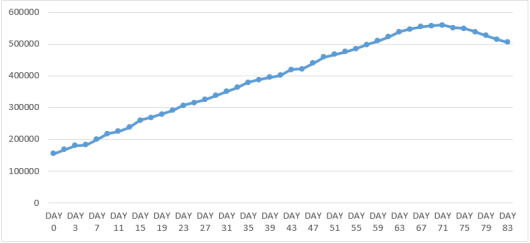
The possible shelf-life of plant tissues after harvest has been demonstrated to be highly correlated with its rate of respiration This study investigated the postharvest changes on the physicochemical, proximate, and vitamin compositions in Cucumber (Cucumis sativus) at ambient temperature from maturity to senescence. The results showed that pH increased gradually from 3.6 on day 0 to 6.6 by day 83, while Total Soluble Solids (TSS) rose from 0.901% to 3.36%, indicating the process of metabolic activity and carbohydrate breakdown. The weight of the fruit initially increased from 306.71 g to 693.64 g before a slight decline, with corresponding rise in volume (154,858 mm³ to 504,858 mm³) and specific gravity (0.999–1.131), which is an indication of structural expansion and water accumulation. Glucose levels rose from 0.194 mg/ml to 0.376 mg/ml, while titratable acidity declined from 0.348% to 0.244%, suggesting a shift toward decreased acidity and enhanced sweetness. Proximate analysis indicated rising moisture (74.49–86.91%), ash (0.72–1.71%), crude fibre (0.93–1.87%), lipids (0.166–0.283%), and protein (1.55–2.86%), concurrent with a decrease in carbohydrate content from 22.14% to 6.37%, expressing metabolic breakdown of stored sugars. Vitamins A, C, and E showed a significant increase (0.151–0.291 mg/100 g, 4.57–6.03 mg/100 g, and 15.45–16.69 mg/100 g, respectively), exhibiting retention and enhancement of antioxidant potential during storage.
1. Introduction
Fruits have played a vital role in the human diet, offering many arrays of quality attributes such as colors, shapes, flavors, aromas, and textures. The nutritional significance of fruits has been thoroughly studied due to growing awareness of food safety
| [1] | Adeeko, A., Yudelevich, F., Raphael, G., Avraham, L., Alon, H., Presman, M. Z., Alkalai-Tuvia, S., Paris, H. S., Fallik, E. and Ziv, C. (2020). Quality and storability of trellised greenhouse-grown, winter-harvested, new sweet acorn squash hybrids. Agronomy, 10: 1443. |
[1]
. Fruit consumption has been linked to a reduced risk of cancer, heart diseases, and other health benefits
| [2] | Paulauskiene, A., Taraseviˇciene, Ž., Žebrauskiene, A. and Pranckietiene, I. (2020). Effect of controlled atmosphere storage conditions on the chemical composition of super hardy kiwifruit. Agronomy, 10: 822. |
[2]
. Fruits have been broadly divided into climacteric and non-climacteric depending on the unique respiratory patterns they exhibit during the ripening process
| [3] | Lichtenthaler, H. K. (2007). Chlorophylls and carotenoids: Pigments of photosynthetic bio membranes. Methods in Enzymology, 148, 350-382. |
[3]
. The presumable shelf-life of plant component after harvest has shown to be highly correlated with its rate of respiration
| [4] | Kader, A. A. (2002). Postharvest technology of horticultural crops. Pp. 55-62, 3th edn. Oakland, CA: University of California, Agricultural and Natural Resources, Publication 3311. |
[4]
. Climacteric fruits are regulated by ethylene production and continue to ripen even after harvested due to an increase in respiration at the beginning of the ripening process
| [5] | Dällenbach, L. J. Eppler, T., Bühlmann-Schütz, S., Kellerhals, M. and Bühlmann, A. (2020). Pre- and Postharvest Factors Control the disease incidence of superficial scald in the new fire blight tolerant apple variety “ladina”. Agronomy, 10: 464. |
[5]
. Also, fruit's ethylene production level and post-harvest deterioration are correlated
| [6] | Nunes, C., Yagiz, Y. and Emond, J. P. (2013). Influence of environmental conditions on the quality attributes and shelf life of ‘Goldfinger’ bananas. Postharvest Biology and Technology, 86, 309-320. |
[6]
. Non-climacteric behavior may be caused by a negative ethylene feedback mechanism, whereas climacteric behavior during ripening may be caused by a positive ethylene feedback mechanism
| [7] | Dita, M., Barquero, M., Heck, D., Mizubuti, E. S. G. and Staver, C. P. (2018). Fusarium Wilt of Banana: Current knowledge on epidemiology and research needs toward sustainable disease management. Frontiers in Plant Science, 9: 1468. |
[7]
. During the process of ripening, fruits usually undergo significant metabolic changes, such as chlorophyll breakdown, cell wall degradation, accumulation of anthocyanin or carotenoid pigments and the synthesis of low-weight metabolites (including sugars, acids, and volatiles), all of which enhance their appeal to seed dispersers
| [8] | Mpai, S., Sivakumar, D. and Chena, Y. (2020). Stimulation of light-emitting diode treatment on defence system and changes in mesocarp metabolites of avocados cultivars (hass and fuerte) during simulated market shelf conditions. Agronomy, 10: 1654. |
[8]
. After fruits have been harvested and before they reach the final consumers, they undergo a stage called postharvest ripening or senescence. The length of this stage varies from days to weeks, and is majorly affected by the fruit's metabolism and ripening stage at the time of harvest
| [9] | Lama, K., Alkalai-Tuvia, S., Chalupowicz, D. And Fallik, E. (2020). Extended storage of yellow pepper fruits at suboptimal temperatures may alter their physical and nutritional quality. Agronomy, 10: 1109. |
[9]
. Preharvest and postharvest changes are known to affect the physiological and morphological attributes of fruit species
| [10] | Yahaya, S. M., Fagwalawa, L. D., Ali, M. U., Lawan, M. and Mahmud, S. (2015). Isolation and identification of pathogenic fungi causing deterioration of lettuce plant (Lactuca sativa): A case study of Yankaba and Sharada vegetables markets. Journal of Plant Science Research 3(1): 1-4. |
[10]
. Main preharvest factors include genetics, environmental conditions (such as climate, cropping conditions, insolation, irrigation, and adequate plant nutrition), the use of agrochemicals, proper pollination, harvest methods, and the condition and physiological age of the fruit at harvest. In contrast, the major postharvest factor is storage, which requires associated physicochemical, biochemical, and microbiological changes
| [1] | Adeeko, A., Yudelevich, F., Raphael, G., Avraham, L., Alon, H., Presman, M. Z., Alkalai-Tuvia, S., Paris, H. S., Fallik, E. and Ziv, C. (2020). Quality and storability of trellised greenhouse-grown, winter-harvested, new sweet acorn squash hybrids. Agronomy, 10: 1443. |
[1]
. Volatiles, which is a complex group of chemical substances including aldehydes, alcohols, ketones, esters, lactones, and terpenes, significantly affect the sensory quality of both harvested and processed fruit products
| [11] | Mustapha, Y. and Yahaya, S. M. (2006). Isolation and identification of post-harvest fungi of Tomato (L. esculentum) and Pepper (Capsicum annum) sample from selected Irrigated sites in Kano. Biological and Environmental Science Journal for the Tropics, 3: 139-141. |
[11]
. The concentration of these volatiles in fruits varies, depending on various preharvest and postharvest factors
| [10] | Yahaya, S. M., Fagwalawa, L. D., Ali, M. U., Lawan, M. and Mahmud, S. (2015). Isolation and identification of pathogenic fungi causing deterioration of lettuce plant (Lactuca sativa): A case study of Yankaba and Sharada vegetables markets. Journal of Plant Science Research 3(1): 1-4. |
[10]
. Cucumbers are known as a vegetable crop because they contain a lot of cucurbitacins and polyphenolics, which are substances with a diverse of biological uses. Ploetz
| [12] | Ploetz, R. C. (2015). Management of Fusarium wilt of banana: A review with special reference to tropical race 4. Crop Protection, 73, 7-15. |
[12]
asserted the activities of cucumbers to include analgesic, diuretic, antibacterial, anti-inflammatory, anti-carcinogenic, anti-hyaluronidase, anti-elastase, antioxidant, and anti-hyperglycemic properties. The aim of the present research is to understudy the effect of postharvest changes on the quality attributes of cucumber from maturity to senescence.
3. Results and Discussion
3.1. Effect of Postharvest Changes on the Physicochemical Properties of Cucumber from Maturity to Senescence
The postharvest changes observed in cucumber fruits stored under ambient conditions, as shown in
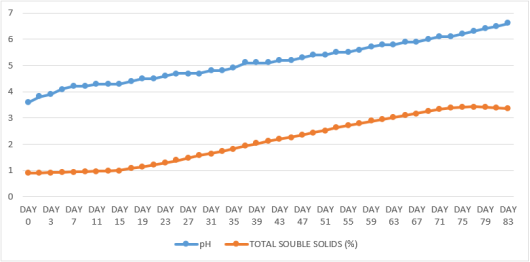
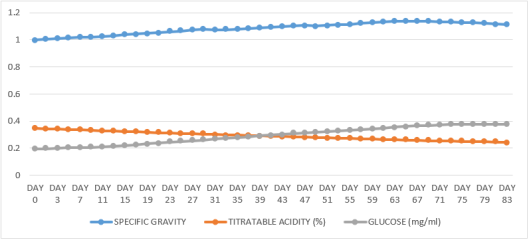
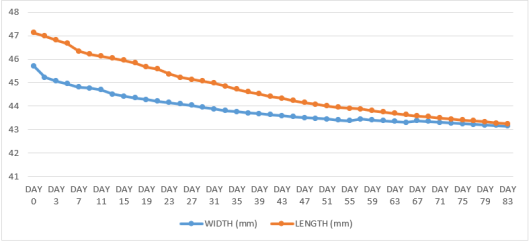
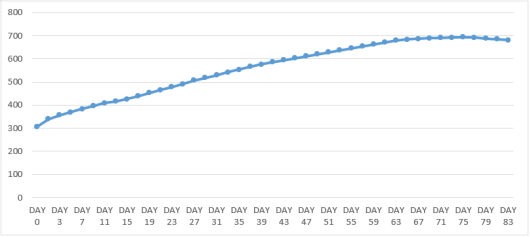
Figures 1 to 5, demonstrated gradual physiological and biochemical changes from maturity to senescence. Throughout the 83-day storage period, parameters such as pH, total soluble solids (TSS), glucose, weight, volume, and specific gravity increased steadily, while titratable acidity (TA), length, and width showed gradual declines. These trends indicate the metabolic changes associated with continous ripening and senescence under ambient conditions, where respiration and enzymatic activity remain high. The significant increase in pH from 3.6 to 6.6, accompanied by a corresponding decrease in titratable acidity from 0.348% to 0.244%, which is an indication of progressive utilization of organic acids as respiratory substrates. Organic acids like citric and malic acid are metabolized through the tricarboxylic acid (TCA) cycle to produce energy for ongoing metabolic processes
| [14] | Kays, S. J., & Paull, R. E. (2004). Postharvest biology. Exon Press. |
[14]
. Similar increases in pH and decreases in acidity during ambient storage have been reported in cucumber
and other non-climacteric fruits such as zucchini and bell pepper
. The decrease in acidity shows the change from synthetic to degradative metabolism as the fruit tilts toward senescence. An increase in Total Soluble Solids (0.90% to 3.36%) and glucose concentration (0.194 to 0.376 mg/ml) further supports enhanced metabolic activity and carbohydrate breakdown. This accumulation of soluble sugars arises from hydrolysis of polysaccharides and structural carbohydrates into simpler sugars during ripening
. Sugars also accumulate due to water loss–induced concentration effects
| [18] | Mahajan, P. V., Caleb, O. J., Singh, Z., Watkins, C. B., & Geyer, M. (2017). Postharvest treatments of fresh produce. Philosophical Transactions of the Royal Society A: Mathematical, Physical and Engineering Sciences, 372(2017), 20130309.
https://doi.org/10.1098/rsta.2013.0309 |
[18]
. Significant increase in Total Soluble Solids and sugar content contribute to the perceived sweetness and are often used as indicators of ripeness and quality in cucumbers and related cucurbits.
Figure 1. Effect of Postharvest Changes on the pH and Total Soluble Solids in Cucumber from Maturity to Senescence.
Figure 2. Effect of Postharvest Changes on the Specific Gravity, Titratable Acidity and Glucose in Cucumber from Maturity to Senescence.
Figure 3. Effect of Postharvest Changes on the Width and Length of Cucumber from Maturity to Senescence.
Figure 4. Effect of Postharvest Changes on the Weight of Cucumber from Maturity to Senescence.
Figure 5. Effect of Postharvest Changes on the Volume of Cucumber from Maturity to Senescence.
Changes in the physical parameters particularly the consistent increase in fruit weight, volume, and specific gravity were notable. The increase in apparent weight and volume could be attributed to water absorption and cell enlargement during the early storage phase, followed by metabolic water production through respiration
| [19] | Wills, R., McGlasson, B., Graham, D., & Joyce, D. (2016). Postharvest: An introduction to the physiology and handling of fruit, vegetables and ornamentals (6th ed.). UNSW Press. |
[19]
. Specific gravity increased from 0.999 to 1.137, reflecting a denser fruit tissue composition, possibly linked to solute accumulation. However, the gradual decrease in width and length toward the later storage period suggests shrinkage and cellular collapse due to moisture loss and cell wall degradation as senescence progressed
| [20] | Vicente, A. R., Saladie, M., Rose, J. K. C., & Labavitch, J. M. (2007). The linkage between cell wall metabolism and fruit softening. Journal of Experimental Botany, 58(14), 3975?3986.
https://doi.org/10.1093/jxb/erm180 |
[20]
. This structural breakdown is typical of tissues undergoing enzymatic softening and loss of turgor pressure. Overall, the trends indicate that cucumbers, when stored at room temperature without postharvest treatments, experience accelerated biochemical and physical changes that compromise long-term quality. The cumulative rise in pH and TSS, coupled with declining acidity and slight morphological shrinkage, are signatures of advanced senescence. These results agree with previous findings that cucumbers are highly perishable and undergo rapid deterioration when stored under non-refrigerated conditions
| [21] | smail, H., Ahmad, S., & Hossain, M. A. (2014). Postharvest changes in cucumber fruits stored at different temperatures. International Food Research Journal, 21(3), 1127?1132. |
| [22] | Kader, A. A. (2013). Postharvest biology and technology: An overview. University of California, Davis. |
[21, 22]
. Postharvest cooling or controlled-atmosphere storage is therefore essential to slow respiration and enzymatic degradation, thereby extending shelf life and maintaining market quality.
In this study, fruit pH increased (from 3.6 to 6.6) while titratable acidity (TA) decreased (0.348% → 0.244%). Concurrently, total soluble solids (TSS) increased (~0.901% → ~3.38%) and glucose concentration rose (~0.194 mg/ml → ~0.369 mg/ml). These patterns suggest active metabolic acid consumption, sugar conversion or concentration effects, and biochemical shifts typical of postharvest physiology. Kays & Paull
| [14] | Kays, S. J., & Paull, R. E. (2004). Postharvest biology. Exon Press. |
[14]
described the mechanism by which harvested fruits consume organic acids via the TCA (tricarboxylic acid) cycle, leading to decreased acidity and raised pH. In the specific case of cucumber, the review by Bao
et al.
underscores that ambient storage accelerates such physicochemical transformations, often compromising quality. The present dataset supports this: the rising TSS and glucose reflect sugar mobilization as carbohydrate reserves are utilized or hydrolysed during storage. For morphological and dimensional changes: the increase in weight, volume and specific gravity during the early to mid storage period in our data may seem counterintuitive, but they align with reports of solute accumulation, moisture redistribution, and respiration derived metabolic water in stored produce
| [24] | Singh, J., Bhatnagar, D., & Sharma, K. (2020). Postharvest biochemical changes in cucurbit vegetables under ambient storage. Journal of Food Biochemistry, 44(5), 13240.
https://doi.org/10.1111/jfbc.13240 |
[24]
. However, the gradual decline in width and length in later days indicates shrinkage and structural collapse, consistent with senescence and moisture loss patterns similar to those observed by Bao
et al.
in greenhouse cultivated cucumbers, where firmness decline and textural disorder emerged 13 days into storage. Thus, the interplay of accumulation and degradation processes is evident in our data and matches established literature.
3.2. Effect of Postharvest Changes on the Proximate Compositions of Cucumber from Maturity to Senescence
Proximate composition analysis, as shown in
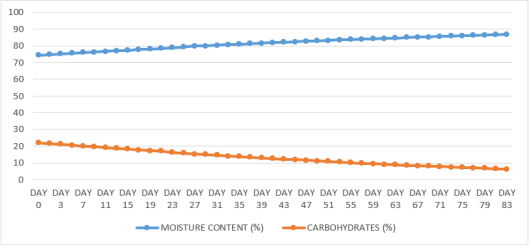
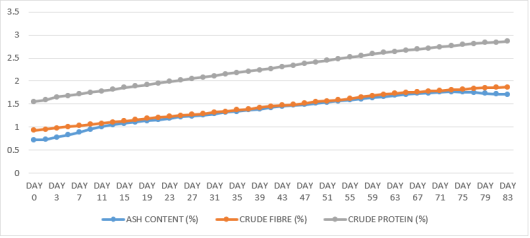
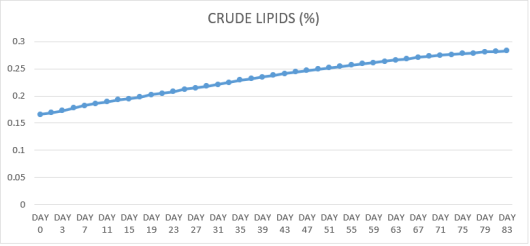
Figures 6 to 8, revealed progressive alterations in the biochemical constituents of cucumber fruits throughout the 83-day storage period. The results demonstrated a continuous increase in moisture, ash, crude fibre, lipids, and protein, while carbohydrate content showed a marked decline. These changes further illustrate the ongoing metabolic processes and compositional shifts occurring during postharvest maturation and senescence under ambient conditions. The steady increase in moisture content from 74.49% to 86.91% may be attributed to metabolic water production during respiration and catabolic reactions
| [24] | Singh, J., Bhatnagar, D., & Sharma, K. (2020). Postharvest biochemical changes in cucurbit vegetables under ambient storage. Journal of Food Biochemistry, 44(5), 13240.
https://doi.org/10.1111/jfbc.13240 |
[24]
. Additionally, ambient humidity can contribute to passive water absorption by cucumber tissues, which are highly permeable and hygroscopic
. However, as senescence advances, this elevated water content may also reflect tissue softening and loss of structural integrity, which reduce the fruit’s ability to regulate internal water balance
| [14] | Kays, S. J., & Paull, R. E. (2004). Postharvest biology. Exon Press. |
[14]
. The observed increase in ash content (0.72% to 1.71%) suggests a relative accumulation of mineral constituents due to the concurrent decline in dry matter, particularly carbohydrates. Similar trends have been reported in other cucurbits such as squash and bottle gourd during postharvest storage
| [25] | Santos, A. A., & Silva, L. R. (2015). Post?harvest carotenoid accumulation and antioxidant activity in cucurbit fruits. Journal of Food Composition and Analysis, 41, 10?16.
https://doi.org/10.1016/j.jfca.2015.01.007 |
[25]
. The rising crude fibre content (0.93% to 1.87%) could be associated with lignification and cell wall modification as tissues age, processes commonly linked to senescence and loss of tenderness
| [20] | Vicente, A. R., Saladie, M., Rose, J. K. C., & Labavitch, J. M. (2007). The linkage between cell wall metabolism and fruit softening. Journal of Experimental Botany, 58(14), 3975?3986.
https://doi.org/10.1093/jxb/erm180 |
[20]
. Enhanced lipid and protein levels may result from the concentration effect due to moisture increase, as well as metabolic changes involving synthesis of stress-related proteins and membrane lipids
| [18] | Mahajan, P. V., Caleb, O. J., Singh, Z., Watkins, C. B., & Geyer, M. (2017). Postharvest treatments of fresh produce. Philosophical Transactions of the Royal Society A: Mathematical, Physical and Engineering Sciences, 372(2017), 20130309.
https://doi.org/10.1098/rsta.2013.0309 |
[18]
. Conversely, carbohydrate content decreased markedly from 22.14% to 6.37%. This sharp decline reflects the consumption of soluble sugars and polysaccharides during respiration and enzymatic degradation, which provide the energy required to sustain postharvest metabolism
| [22] | Kader, A. A. (2013). Postharvest biology and technology: An overview. University of California, Davis. |
[22]
. The depletion of carbohydrates is a key factor driving textural softening and eventual senescence in fresh produce
| [19] | Wills, R., McGlasson, B., Graham, D., & Joyce, D. (2016). Postharvest: An introduction to the physiology and handling of fruit, vegetables and ornamentals (6th ed.). UNSW Press. |
[19]
. Similar carbohydrate reduction trends have been observed in cucumbers stored at room temperature
| [21] | smail, H., Ahmad, S., & Hossain, M. A. (2014). Postharvest changes in cucumber fruits stored at different temperatures. International Food Research Journal, 21(3), 1127?1132. |
[21]
and in other vegetables such as okra and zucchini
. Taken together, the compositional changes recorded during the storage period confirm that cucumbers continue active metabolic and physiological processes after harvest. The increasing moisture, ash, protein, and lipid fractions, coupled with declining carbohydrate reserves, reflect an overall deterioration of nutritive quality as the fruit progresses from maturity to senescence. These findings highlight the perishability of cucumber and emphasize the importance of adopting appropriate postharvest management strategies—particularly refrigeration or modified atmosphere storage—to retard metabolic activity and preserve nutritional quality over time.
Figure 6. Effect of Postharvest Changes on the Moisture Content and Carbohydrates in Cucumber from Maturity to Senescence.
Figure 7. Effect of Postharvest Changes on the Ash Content, Crude Fibre and Crude Protein in Cucumber from Maturity to Senescence.
Figure 8. Effect of Postharvest Changes on the Crude Lipids in Cucumber from Maturity to Senescence.
In this study, there were marked increases in moisture content (74.49% → 86.91%), ash, crude fibre, lipids, and protein, while carbohydrate content declined drastically (22.14% → 6.37%). The increase in moisture content may reflect both passive water uptake under humid ambient conditions and internal water production (via respiration) or relative concentration effects as dry mass is lost. Similar observations of increased moisture—or relative water content—during early postharvest metabolism have been cited in general produce physiology
| [22] | Kader, A. A. (2013). Postharvest biology and technology: An overview. University of California, Davis. |
[22]
. The rise in ash (inorganic content) likely reflects concentration of minerals as other constituents are lost or metabolized; Singh
et al. | [24] | Singh, J., Bhatnagar, D., & Sharma, K. (2020). Postharvest biochemical changes in cucurbit vegetables under ambient storage. Journal of Food Biochemistry, 44(5), 13240.
https://doi.org/10.1111/jfbc.13240 |
[24]
reported rising mineral proportions in cucurbits under prolonged storage. The increase in crude fibre is consistent with cell wall modifications or lignification in senescing tissue
| [20] | Vicente, A. R., Saladie, M., Rose, J. K. C., & Labavitch, J. M. (2007). The linkage between cell wall metabolism and fruit softening. Journal of Experimental Botany, 58(14), 3975?3986.
https://doi.org/10.1093/jxb/erm180 |
[20]
. Meanwhile, the sharp decline in carbohydrates underscores the depletion of reserves as respiration and other metabolic processes continue unabated—a pattern widely reported for vegetables stored at non optimal conditions. For example, Silva
et al.
found significant carbohydrate depletion in zucchini and bell pepper under ambient storage.
3.3. Effect of Postharvest Changes on the Vitamin Composition of Cucumber from Maturity to Senescence
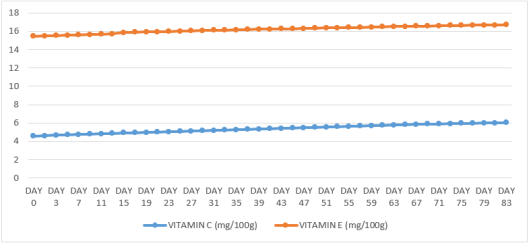
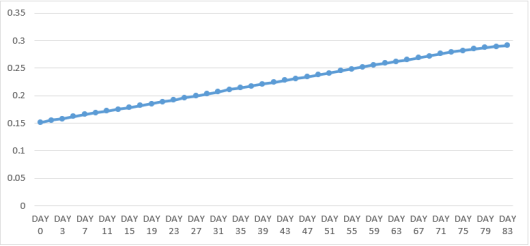
The vitamin composition of cucumber in
Figures 9 and 10 showed a steady and consistent increase in the levels of vitamins A, C, and E throughout the 83-day storage period. Vitamin A content rose from 0.151 mg/100 g to 0.291 mg/100 g, vitamin C from 4.57 mg/100 g to 6.03 mg/100 g, and vitamin E from 15.45 mg/100 g to 16.69 mg/100 g. These gradual increases suggest that, under ambient storage, cucumbers continue to undergo biochemical reactions that enhance antioxidant compound accumulation before senescence sets in. The rise in vitamin A likely results from the ongoing conversion of carotenoid precursors, such as β-carotene, during postharvest ripening. Similar increases in carotenoid content have been reported in cucurbits and other green vegetables as chlorophyll degrades and carotenoid synthesis continues
| [25] | Santos, A. A., & Silva, L. R. (2015). Post?harvest carotenoid accumulation and antioxidant activity in cucurbit fruits. Journal of Food Composition and Analysis, 41, 10?16.
https://doi.org/10.1016/j.jfca.2015.01.007 |
[25]
. Vitamin C (ascorbic acid) is a key antioxidant involved in oxidative stress regulation; its progressive increase may be attributed to enhanced synthesis in response to postharvest oxidative metabolism
| [26] | Lee, S. K., & Kader, A. A. (2000). Preharvest and postharvest factors influencing vitamin C content of horticultural crops. Postharvest Biology and Technology, 20(3), 207?220.
https://doi.org/10.1016/S0925?5214(00)00133?2 |
[26]
. However, while moderate rises are often observed during early storage, extended exposure to room temperature can eventually lead to its degradation—though in this study, the period before decline may not have been reached. The increase in vitamin E (α-tocopherol) suggests an adaptive antioxidative response to elevated reactive oxygen species generated during respiration and senescence
. Tocopherols stabilize membrane lipids and protect cellular integrity, which is crucial in maintaining cucumber tissue viability during storage. This trend aligns with findings by Mahajan
et al.
| [18] | Mahajan, P. V., Caleb, O. J., Singh, Z., Watkins, C. B., & Geyer, M. (2017). Postharvest treatments of fresh produce. Philosophical Transactions of the Royal Society A: Mathematical, Physical and Engineering Sciences, 372(2017), 20130309.
https://doi.org/10.1098/rsta.2013.0309 |
[18]
, who reported similar antioxidant accumulation in fresh produce under ambient stress conditions. Collectively, the progressive enrichment of vitamins A, C, and E underscores the complex balance between degradation and compensatory biosynthetic activity in postharvest cucumbers. Although these increases may temporarily enhance the fruit’s nutritional and antioxidant profile, they occur concurrently with structural softening and compositional deterioration, indicating that biochemical ripening continues despite harvest. Effective storage interventions such as refrigeration or modified-atmosphere packaging would be required to stabilize these nutrients and extend shelf life
| [22] | Kader, A. A. (2013). Postharvest biology and technology: An overview. University of California, Davis. |
| [24] | Singh, J., Bhatnagar, D., & Sharma, K. (2020). Postharvest biochemical changes in cucurbit vegetables under ambient storage. Journal of Food Biochemistry, 44(5), 13240.
https://doi.org/10.1111/jfbc.13240 |
[22, 24]
.
Figure 9. Effect of Postharvest Changes on the Vitamins C and E in Cucumber from Maturity to Senescence.
Figure 10. Effect of Postharvest Changes on the Vitamin A in Cucumber from Maturity to Senescence.
The results showed steady increases in vitamins A (0.151 → 0.291 mg/100 g), C (4.57 → 6.03 mg/100 g) and E (15.45 → 16.69 mg/100 g) during storage. These increasing trends are somewhat unexpected given that many studies report vitamin C and other antioxidants decline with storage time. For instance, in the coating treated cucumber study by Chien
et al.
, ascorbic acid declined under ambient storage. However, the recent review by Bao
et al. observes that cucumber postharvest nutrient dynamics may include initial accumulation of antioxidant compounds as a response to oxidative stress before eventual decline. This suggests that in our samples, antioxidant pathways (for vitamins C and E) may have been up regulated in response to the increasing metabolic/oxidative stress during storage, thus temporarily increasing vitamin levels. The vitamin A increase may reflect conversion of carotenoid precursors as chlorophyll degrades
| [25] | Santos, A. A., & Silva, L. R. (2015). Post?harvest carotenoid accumulation and antioxidant activity in cucurbit fruits. Journal of Food Composition and Analysis, 41, 10?16.
https://doi.org/10.1016/j.jfca.2015.01.007 |
[25]
. While our data do not show a subsequent decline within the 83 day frame, it is plausible that with extended storage or under more stressful conditions (e.g., high temperature, high humidity) vitamin degradation would ensue—a point supported by Lee & Kader
| [26] | Lee, S. K., & Kader, A. A. (2000). Preharvest and postharvest factors influencing vitamin C content of horticultural crops. Postharvest Biology and Technology, 20(3), 207?220.
https://doi.org/10.1016/S0925?5214(00)00133?2 |
[26]
in their work on vitamin C stability in produce storage.





 Share This Article
 Twitter
 Linked In
 Facebook
 Copy
Copy Download