
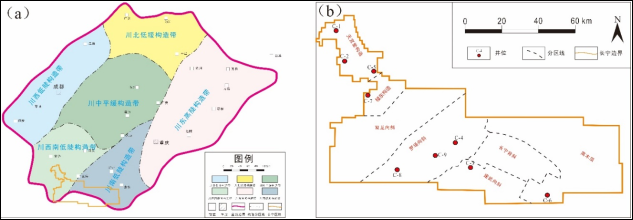
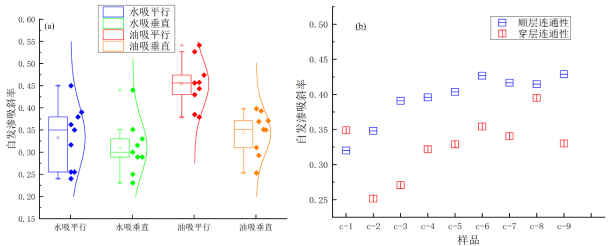
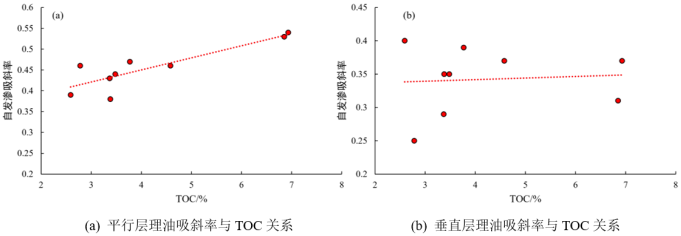
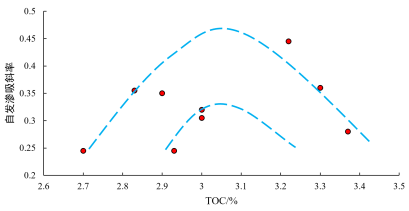
To clarify the differences in pore connectivity in different directions within low-resistivity shale reservoirs, identify factors influencing the connectivity of low-resistivity shale reservoirs, and further discuss the impact of connectivity on rock resistivity, the marine organic-rich low-resistivity shale of the Longmaxi Formation in the Changning area of the Sichuan Basin was selected as the research object. Experiments such as X-ray diffraction mineral composition analysis and spontaneous imbibition were conducted to investigate the differences in pore connectivity of low-resistivity shale. The results indicate that the overall pore connectivity of low-resistivity shale is poor, with better connectivity parallel to the bedding direction than perpendicular to it. Different mineral contents have varying controlling effects on inorganic pore connectivity, with clay minerals playing a significant role in controlling spontaneous imbibition. Organic matter content and maturity have different effects on organic pore connectivity. Higher organic matter content corresponds to better connectivity of organic pores. When maturity is below 3.0%, higher maturity favors improved connectivity, while beyond this threshold, it adversely affects connectivity. Both inorganic and organic pore connectivity exhibit a strong negative correlation with shale resistivity, suggesting that formation water in shale pores can form effective conductive pathways. Formation water content plays a crucial role in controlling resistivity, which is of great significance for further research on the causes of low resistivity in this region.
| Published in | Science Discovery (Volume 14, Issue 2) |
| DOI | 10.11648/j.sd.20261402.14 |
| Page(s) | 44-53 |
| Creative Commons |
This is an Open Access article, distributed under the terms of the Creative Commons Attribution 4.0 International License (http://creativecommons.org/licenses/by/4.0/), which permits unrestricted use, distribution and reproduction in any medium or format, provided the original work is properly cited. |
| Copyright |
Copyright © The Author(s), 2026. Published by Science Publishing Group |
Low-resistivity Shale, Pore Connectivity, Spontaneous Imbibition, Changning Area
井名 | 深度/m | TOC/% | 测井电阻/(Ω·m) | Ro/% |
|---|---|---|---|---|
c-1 | 3506.06 | 2.59 | 19.77 | 3.37 |
c-2 | 3782.43 | 2.78 | 16.38 | 2.70 |
c-3 | 3594.66 | 6.85 | 11.53 | 2.93 |
c-4 | 2344.74 | 3.37 | 9.71 | 2.83 |
c-5 | 3933.41 | 4.58 | 8.21 | 3.00 |
c-6 | 3195.31 | 3.77 | 1.54 | 2.90 |
c-7 | 3639.60 | 3.48 | 1.13 | 3.30 |
c-8 | 3519.33 | 3.38 | 0.39 | 3.22 |
c-9 | 4327.14 | 6.93 | 0.19 | 3.00 |
序号 | 水吸实验(W) | 油吸实验(O) | ||
|---|---|---|---|---|
平行层理(P) | 垂直层理(T) | 平行层理(P) | 垂直层理(T) | |
c-1 | 0.26 | 0.30 | 0.39 | 0.40 |
c-2 | 0.24 | 0.25 | 0.46 | 0.25 |
c-3 | 0.26 | 0.23 | 0.53 | 0.31 |
c-4 | 0.36 | 0.35 | 0.43 | 0.29 |
c-5 | 0.35 | 0.29 | 0.46 | 0.37 |
c-6 | 0.38 | 0.32 | 0.47 | 0.39 |
c-7 | 0.39 | 0.33 | 0.44 | 0.35 |
c-8 | 0.45 | 0.44 | 0.38 | 0.35 |
c-9 | 0.32 | 0.29 | 0.54 | 0.37 |
序号 | 矿物含量/% | |||||
|---|---|---|---|---|---|---|
石英 | 斜长石 | 方解石 | 白云石 | 黄铁矿 | 黏土矿物 | |
c-1 | 69.5 | 2.4 | 7.4 | 3.4 | 3.0 | 14.3 |
c-2 | 41.2 | 8.4 | 8.9 | 5.9 | 3.2 | 32.4 |
c-3 | 43.0 | 4.0 | 23.0 | 20.0 | 2.0 | 8.0 |
c-4 | 43.4 | 1.8 | 21.6 | 16.6 | 2.0 | 14.6 |
c-5 | 51.1 | 2.7 | 21.7 | 11.2 | 2.3 | 11.0 |
c-6 | 38.4 | 3.7 | 27.5 | 13.8 | 2.5 | 14.3 |
c-7 | 40.0 | 4.0 | 30.0 | 10.0 | 6.0 | 10.0 |
c-8 | 61.6 | 6.7 | 7.4 | 4.7 | 5.7 | 13.9 |
c-9 | 64.0 | 5.0 | 6.0 | 8.0 | 3.0 | 14.0 |
| [1] | 邹才能, 赵群, 丛连铸, 等. 中国页岩气开发进展、潜力及前景 [J]. 天然气工业, 2021, 41(1): 1-14. |
| [2] | 姜振学, 李鑫, 王幸蒙, 等. 中国南方典型页岩孔隙特征差异及其控制因素 [J]. 石油与天然气地质, 2021, 42(1): 41-53. |
| [3] | 杨小兵, 张树东, 张志刚, 等. 低阻页岩气储层的测井解释评价 [J]. 成都理工大学学报 (自然科学版), 2015, 42(6): 692-699. |
| [4] | 王玉满, 李新景, 陈波, 等. 海相页岩有机质炭化的热成熟度下限及勘探风险 [J]. 石油勘探与开发, 2018, 45(3): 385-395. |
| [5] | 王滢, 何嘉, 寇一龙, 等. 长宁地区龙马溪组页岩储层低电阻率成因 [J]. 油气地质与采收率, 2022, 29(3): 53-61. |
| [6] | Zixin Xue, Zhenxue Jiang, Xin Wang, et al. Genetic mechanism of low resistivity in high-mature marine shale: Insights from the study on pore structure and organic matter graphitization [J]. Marine and Petroleum Geology, 2022, 144: 105825. |
| [7] | Zhiye Gao, Qinhong Hu. Initial water saturation and imbibition fluid affect spontaneous imbibition into Barnett shale samples [J]. Journal of Natural Gas Science and Engineering, 2016, 34: 541-551. |
| [8] | 郭旭升, 李宇平, 腾格尔, 等. 四川盆地五峰组—龙马溪组深水陆棚相页岩生储机理探讨 [J]. 石油勘探与开发, 2020, 47(1): 193-201. |
| [9] | 李耀华, 宋岩, 徐兴友, 等. 鄂尔多斯盆地延长组7段凝灰质页岩油层的润湿性及自发渗吸特征 [J]. 石油学报, 2020, 41(10): 1229-1237. |
| [10] | 郭建春, 陶亮, 陈迟, 等. 川南龙马溪组页岩储层水相渗吸规律 [J]. 计算物理, 2021, 38(5): 565-572. |
| [11] | 高之业, 熊书苓, 成雨, 等. 川南地区龙马溪组页岩储层水接触角及其稳定性影响因素 [J]. 特种油气藏, 2021, 28(5): 10-16. |
| [12] | 蔡建超. 多孔介质自发渗吸关键问题与思考 [J]. 计算物理, 2021, 38(5): 505-512. |
| [13] | 叶洪涛, 宁正福, 王庆, 等. 页岩储层自发渗吸实验及润湿性研究 [J]. 断块油气田, 2019, 26(01): 84-87. |
| [14] | 黄睿哲, 姜振学, 高之业, 等. 页岩储层组构特征对自发渗吸的影响 [J]. 油气地质与采收率, 2017, 24(1): |
| [15] | Li X, Jiang Z, Wang S, et al. Differences of marine and transitional shales in the case of dominant pore types and exploration strategies, in China [J]. Journal of Natural Gas Science and Engineering, 2022: 104628. |
| [16] | 李军, 金武军, 王亮, 等. 页岩气岩心核磁共振T_2与孔径尺寸定量关系 [J]. 测井技术, 2016, 40(4): 460-464. |
| [17] | 姚艳斌, 刘大锰. 基于核磁共振弛豫谱技术的页岩储层物性与流体特征研究 [J]. 煤炭学报, 2018, 43(1): 181-189. |
| [18] | 王道富, 王玉满, 董大忠, 等. 川南下寒武统筇竹寺组页岩储集空间定量表征 [J]. 天然气工业, 2013, 33(7): 1-10. |
| [19] | Wang X, Jiang Z, Jiang S, et al. Pore Evolution and Formation Mechanism of Organic-Rich Shales in the Whole Process of Hydrocarbon Generation: Study of Artificial and Natural Shale Samples [J]. Energy & Fuels, 2019. |
| [20] | 邹德鹏, 柯式镇, 李君建, 等. 含黏土矿物岩心电频散特性实验研究 [J]. 测井技术, 2018, 42(3): 261-266. |
APA Style
Chen, R., Jiang, Z., Liang, X. (2026). Pore Connectivity of Low-resistivity Shales in the Changning Area and Its Influence on Resistivity. Science Discovery, 14(2), 44-53. https://doi.org/10.11648/j.sd.20261402.14
ACS Style
Chen, R.; Jiang, Z.; Liang, X. Pore Connectivity of Low-resistivity Shales in the Changning Area and Its Influence on Resistivity. Sci. Discov. 2026, 14(2), 44-53. doi: 10.11648/j.sd.20261402.14
@article{10.11648/j.sd.20261402.14,
  author = {Ruihua Chen and Zhenxue Jiang and Xing Liang},
  title = {Pore Connectivity of Low-resistivity Shales in the Changning Area and Its Influence on Resistivity},
  journal = {Science Discovery},
  volume = {14},
  number = {2},
  pages = {44-53},
  doi = {10.11648/j.sd.20261402.14},
  url = {https://doi.org/10.11648/j.sd.20261402.14},
  eprint = {https://article.sciencepublishinggroup.com/pdf/10.11648.j.sd.20261402.14},
  abstract = {To clarify the differences in pore connectivity in different directions within low-resistivity shale reservoirs, identify factors influencing the connectivity of low-resistivity shale reservoirs, and further discuss the impact of connectivity on rock resistivity, the marine organic-rich low-resistivity shale of the Longmaxi Formation in the Changning area of the Sichuan Basin was selected as the research object. Experiments such as X-ray diffraction mineral composition analysis and spontaneous imbibition were conducted to investigate the differences in pore connectivity of low-resistivity shale. The results indicate that the overall pore connectivity of low-resistivity shale is poor, with better connectivity parallel to the bedding direction than perpendicular to it. Different mineral contents have varying controlling effects on inorganic pore connectivity, with clay minerals playing a significant role in controlling spontaneous imbibition. Organic matter content and maturity have different effects on organic pore connectivity. Higher organic matter content corresponds to better connectivity of organic pores. When maturity is below 3.0%, higher maturity favors improved connectivity, while beyond this threshold, it adversely affects connectivity. Both inorganic and organic pore connectivity exhibit a strong negative correlation with shale resistivity, suggesting that formation water in shale pores can form effective conductive pathways. Formation water content plays a crucial role in controlling resistivity, which is of great significance for further research on the causes of low resistivity in this region.},
 year = {2026}
}
TY  - JOUR
T1  - Pore Connectivity of Low-resistivity Shales in the Changning Area and Its Influence on Resistivity
AU  - Ruihua Chen
AU  - Zhenxue Jiang
AU  - Xing Liang
Y1  - 2026/04/30
PY  - 2026
N1  - https://doi.org/10.11648/j.sd.20261402.14
DO  - 10.11648/j.sd.20261402.14
T2  - Science Discovery
JF  - Science Discovery
JO  - Science Discovery
SP  - 44
EP  - 53
PB  - Science Publishing Group
SN  - 2331-0650
UR  - https://doi.org/10.11648/j.sd.20261402.14
AB  - To clarify the differences in pore connectivity in different directions within low-resistivity shale reservoirs, identify factors influencing the connectivity of low-resistivity shale reservoirs, and further discuss the impact of connectivity on rock resistivity, the marine organic-rich low-resistivity shale of the Longmaxi Formation in the Changning area of the Sichuan Basin was selected as the research object. Experiments such as X-ray diffraction mineral composition analysis and spontaneous imbibition were conducted to investigate the differences in pore connectivity of low-resistivity shale. The results indicate that the overall pore connectivity of low-resistivity shale is poor, with better connectivity parallel to the bedding direction than perpendicular to it. Different mineral contents have varying controlling effects on inorganic pore connectivity, with clay minerals playing a significant role in controlling spontaneous imbibition. Organic matter content and maturity have different effects on organic pore connectivity. Higher organic matter content corresponds to better connectivity of organic pores. When maturity is below 3.0%, higher maturity favors improved connectivity, while beyond this threshold, it adversely affects connectivity. Both inorganic and organic pore connectivity exhibit a strong negative correlation with shale resistivity, suggesting that formation water in shale pores can form effective conductive pathways. Formation water content plays a crucial role in controlling resistivity, which is of great significance for further research on the causes of low resistivity in this region.
VL  - 14
IS  - 2
ER  -
State Key Laboratory of Petroleum Resources and Engineering, China University of Petroleum (Beijing), Beijing, China;College of Geosciences, China University of Petroleum (Beijing), Beijing, China
State Key Laboratory of Petroleum Resources and Engineering, China University of Petroleum (Beijing), Beijing, China
Exploration and Development Integration Center, PetroChina Zhejiang Oilfield Company, Hangzhou, China

Information



 Share This Article
 Twitter
 Linked In
 Facebook
 Copy
Copy Download