Abstract
Africa’s democratic systems are increasingly influenced by digital technologies, data infrastructures, social media, and artificial intelligence. These developments provide opportunities to improve electoral administration, evidence-based governance, civic education, and citizen engagement, while also creating risks related to misinformation, exclusion, surveillance, and declining public trust. This study examines how data analytics and Learning Management Systems (LMS) can work together to support electoral integrity and responsible citizenship without replacing established democratic institutions. The study adopts a documentary secondary-data research design, drawing on peer-reviewed studies and authoritative institutional evidence. Selected democratic, digital access, and electoral participation indicators are examined descriptively to identify key democratic pressures and their relationship to potential technological interventions. The findings indicate a significant gap between democratic aspirations and citizens’ experiences. Across 39 African countries, 66% of citizens express a preference for democracy, while 45% describe their countries as mostly or completely democratic and 37% report satisfaction with how democracy works. Although 75% support fair, open, and honest elections, only 39% report trust in their national electoral commission. Internet use in Africa reached 38% in 2024, highlighting both the potential reach and limitations of digital interventions. Electoral participation also varies considerably across selected countries. These findings do not establish a causal relationship between digital learning and electoral participation but demonstrate the importance of context-sensitive approaches. The study therefore proposes the Data-Driven Democratic Resilience Framework (DDDRF), comprising data acquisition, analytics and assurance, LMS-enabled civic learning, citizen feedback, and safeguards relating to privacy, transparency, accessibility, human oversight, and redress. The study contributes an information-systems perspective to research on African democracy by integrating data governance and civic learning within a common framework for strengthening democratic resilience.
|
Published in
|
Research and Innovation (Volume 2, Issue 5)
|
|
DOI
|
10.11648/j.ri.20260205.12
|
|
Page(s)
|
280-294 |
|
Creative Commons
|

This is an Open Access article, distributed under the terms of the Creative Commons Attribution 4.0 International License (http://creativecommons.org/licenses/by/4.0/), which permits unrestricted use, distribution and reproduction in any medium or format, provided the original work is properly cited.
|
|
Copyright
|
Copyright © The Author(s), 2026. Published by Science Publishing Group
|
Keywords
Data Analytics, Democracy, Electoral Integrity, Learning Management Systems, Civic Education, Digital Governance,
Media and Information Literacy, Africa
1. Introduction
Democracy is sustained by more than the periodic act of voting. It depends on credible electoral institutions, access to trustworthy information, opportunities for participation, institutional responsiveness, lawful transfers of authority, and citizens’ capacity to understand and evaluate public information. Across Africa, these conditions increasingly intersect with digital technologies. Electoral registers are digitised; election-management bodies publish information online; political communication occurs through social platforms; public institutions use data systems for monitoring and planning; and citizens increasingly encounter political information through algorithmically mediated environments.
This digital transformation creates a fundamental governance paradox. The same technologies that can increase transparency and participation can also increase uncertainty and distrust. A public dashboard can make information easier to access, yet a dashboard without clear metadata may make a complex process appear deceptively simple. Social media can broaden access to political information, yet the same networks can amplify manipulated content. Artificial intelligence can support classification, translation and anomaly detection, while generative systems can lower the cost of producing convincing synthetic text, images, audio and video. Digital government can improve service delivery, but weak data governance can expose citizens to privacy violations, exclusion and surveillance.
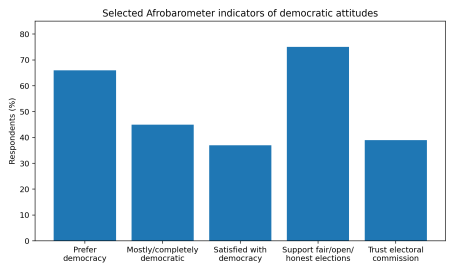
The empirical context is important. Afrobarometer’s 2024 flagship findings show that democratic aspiration remains substantial: 66% of citizens across 39 African countries say they prefer democracy to any other form of government. Yet only 45% consider their countries mostly or completely democratic and 37% are satisfied with the way democracy works. In another indicator, 75% support fair, open and honest elections as the best method for choosing leaders, but only 39% say they trust their national electoral commission somewhat or a lot. These findings indicate a gap between democratic ideals and institutional experience.
The digital divide adds another constraint. ITU
Facts and Figures 2024 estimates that 38% of Africa’s population used the Internet. Digital civic education therefore has substantial potential reach, but it cannot be treated as universally accessible. A web-only civic-learning strategy may exclude people because of connectivity, device availability, affordability, disability, language or digital skills. Democratic technology must consequently be designed as a multimodal ecosystem.
Electoral participation also varies substantially. International IDEA (2023)
| [8] | International IDEA. (2023). Nigeria—February 2023: Elections for President and National Assembly held. Democracy Tracker. |
[8]
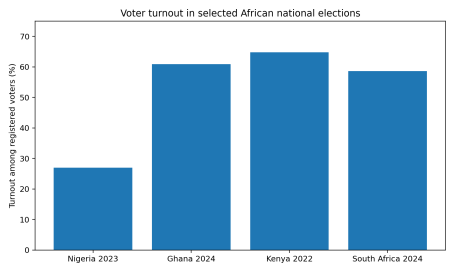
records turnout among registered voters of 27% in Nigeria’s 2023 presidential election, 64.77% in Kenya’s 2022 parliamentary election and 60.88% in Ghana’s 2024 parliamentary election. South Africa’s Electoral Commission reports 58.64% turnout in its 2024 national election. These figures are not directly comparable in every respect because they involve different years, electoral systems and election types. They nevertheless illustrate the scale of participation differences that democratic institutions must understand.
This paper proposes that data analytics and Learning Management Systems can be treated as complementary components of democratic infrastructure. Data analytics can help institutions observe patterns, identify anomalies, monitor public information needs and evaluate interventions. LMS platforms can transform civic information into structured learning experiences with modules, assessments, feedback and learning analytics. Connecting these capabilities can create a feedback loop: institutional data identify information needs; learning content responds to those needs; citizens provide feedback; and institutional responses generate new evidence.
The research has five objectives: first, to examine the role of data analytics in electoral integrity and democratic accountability; second, to assess the potential of LMS platforms for scalable civic and media-information literacy; third, to analyse selected secondary indicators of democratic attitudes, Internet access and electoral participation; fourth, to develop an integrated Data-Driven Democratic Resilience Framework; and fifth, to propose implementation and governance safeguards appropriate to African contexts.
The contribution is intentionally framed as an integrative information-systems contribution rather than a claim that technology alone causes democratic outcomes. Research on electoral technology, misinformation, digital government, data governance and e-learning is substantial, but these domains are frequently studied separately. The present study connects them through a citizen-learning and institutional-feedback architecture. The proposed framework therefore treats the citizen not simply as a data subject or service user but as a participant in a continuous information and learning ecosystem.
2. Conceptual and Theoretical Foundations
2.1. Democratic Resilience
Democratic resilience refers to the ability of democratic systems to withstand, absorb and respond to internal and external pressures without abandoning their core institutional characteristics. Maerz and Lindberg (2021)
conceptualise democratic resilience as a process through which democracies avoid democratic decline or prevent ongoing autocratisation from becoming democratic breakdown. Recent African scholarship similarly emphasises institutionalisation, competitive elections, civil society and mechanisms of accountability as sources of resilience.
This concept is useful for information-systems research because it avoids technological determinism. A technology is not inherently democratic or anti-democratic. Its effects depend on how it is designed, who controls it, what data enter the system, what incentives shape its use, and what rights and remedies exist for affected people. The same analytical infrastructure can be used to improve transparency or to intensify surveillance. The same AI model can support information verification or reproduce bias. Democratic resilience therefore requires technical capacity together with institutional capacity to govern technology.
2.2. Electoral Integrity
Norris (2014)
conceptualises electoral integrity in relation to internationally recognised standards that apply throughout the electoral cycle. This definition is important because technological interventions are often concentrated on election day even though vulnerabilities can occur during registration, campaigning, voter education, polling, counting, result transmission and dispute resolution.
From an information-systems perspective, electoral integrity involves information accuracy, secure record management, accessibility, transparency, auditability and timely communication. Analytics can support these functions but cannot determine legitimacy on its own. Legitimacy remains a product of law, procedure, institutional behaviour, oversight and citizen experience.
2.3. Data-enabled Governance
The World Bank’s World Development Report
| [18] | World Bank. (2021). World Development Report 2021: Data for better lives. World Bank. |
[18]
(2021) treats data as a potential public-good resource while emphasising infrastructure, legal frameworks, institutions and trust. This approach rejects the idea that collecting more data automatically produces better governance. Data have to be governed so that public value can be created while rights and legitimate interests are protected.
OECD (2019)
similarly describes the data-driven public sector as an organisational and institutional transformation rather than an IT procurement exercise. Data must be embedded in policy processes, organisational capabilities, professional skills and governance arrangements. For democratic applications, this means treating data as a chain from collection and quality assurance through analysis, interpretation, communication and feedback.
2.4. Learning Management Systems and Civic Learning
An LMS is normally associated with formal education, but its core capabilities—structured content, assessment, feedback, learner progress and analytics—can also support civic education. Al-Fraihat et al. (2020)
| [3] | Al-Fraihat, D., Joy, M., Masa’deh, R., & Sinclair, J. (2020). Evaluating e-learning systems success: An empirical study. Computers in Human Behavior, 102, 67–86.
https://doi.org/10.1016/j.chb.2019.08.004 |
[3]
found that e-learning success is shaped by system, information, service, educational, support, learner and instructor factors, as well as perceived usefulness, satisfaction and use.
A civic LMS could offer modules on voter registration, electoral rights, result processes, constitutional institutions, source verification, manipulated media, responsible online behaviour and reporting procedures. The democratic value is not persuasion. It is the provision of factual knowledge and critical information skills that help citizens make their own political judgements.
2.5. Technology Acceptance Model
Davis’s (1989)
| [6] | Davis, F. D. (1989). Perceived usefulness, perceived ease of use, and user acceptance of information technology. MIS Quarterly, 13(3), 319–340. |
[6]
Technology Acceptance Model identifies perceived usefulness and perceived ease of use as important determinants of technology acceptance. For civic learning, a system that is technically sophisticated but difficult to use is unlikely to reach citizens effectively. However, acceptance cannot be the only criterion. A system may be easy to use while being intrusive, inaccessible or politically biased. The DDDRF therefore adds privacy, accessibility, transparency and accountability to usability.
2.6. Civic Voluntarism Model
Verba, Schlozman and Brady (1995)
| [5] | Brady, H. E., Verba, S., & Schlozman, K. L. (1995). Beyond SES: A resource model of political participation. American Political Science Review, 89(2), 271–294. |
[5]
emphasise resources, engagement and recruitment in explaining political participation, while Brady, Verba and Schlozman
| [17] | Verba, S., Schlozman, K. L., & Brady, H. E. (1995). Voice and equality: Civic voluntarism in American politics. Harvard University Press. |
[17]
(1995) identify time, money and civic skills as important resources. Civic learning can contribute to the civic-skills component, but it should not be treated as a complete explanation of participation. Institutional trust, security, political competition, cost, social networks and perceived efficacy also matter.
3. Literature Review
3.1. Digital Government and Citizen Engagement
Janowski (2015)
describes digital government as evolving from digitisation and transformation toward engagement and contextualised policy-driven government. This progression is relevant to democratic governance because simply publishing information online is not equivalent to participation. More mature systems provide mechanisms through which citizens interact with institutions, ask questions, provide feedback and observe responses.
Evidence from African settings is nuanced. Research on e-participation in Cameroon found a weak positive association between participation and trust, with the relationship influenced by satisfaction and perceived government performance. This suggests that technology may create channels for participation but cannot substitute for responsive institutions. A civic LMS should therefore be connected to real institutional processes rather than functioning as a public-relations website.
3.2. Electoral Technology and Transparency
Electoral technologies include biometric identification, electronic registers, geographic information systems, result-management platforms and online information portals. Their potential benefits include improved record management, faster reporting and systematic monitoring. Their risks include technical failure, opacity, cybersecurity threats, procurement weaknesses and public mistrust.
Adeleke (2025)
| [1] | Adeleke, F. (2025). Reinstating trust in elections in the era of artificial intelligence and emerging technologies. Data & Policy. Cambridge University Press. |
[1]
argues that emerging technologies in African elections have created both efficiency opportunities and new trust problems. Esiefarienrhe and Maine (2024)
| [7] | Esiefarienrhe, B. M., & Maine, I. M. (2024). Artificial intelligence and the electoral process: The benefits and the challenges. African Journal of Development Studies. |
[7]
similarly identify benefits and challenges associated with AI in electoral processes. The literature supports a governance principle: adoption should be accompanied by transparent procurement, independent testing, public communication, human oversight and mechanisms for contesting errors.
3.3. Misinformation, Disinformation and Synthetic Media
Misinformation and disinformation have become central concerns in electoral information environments. The distinction is useful: misinformation can refer to inaccurate information shared without an intention to deceive, while disinformation generally refers to intentionally deceptive or manipulative information. In practice, the two can interact as content is produced, copied, modified and redistributed.
Recent African scholarship documents the growing relevance of AI-generated propaganda, deepfakes, bots and coordinated content. Mutongoreni and Gwiza (2025)
examine AI-generated propaganda in African elections, while Kirui (2026)
| [11] | Kirui, P. K. (2026). Contesting democracy in the digital age: Disinformation, hate speech, and technology-enabled security threats during Kenya’s 2022 general elections. African Journal of Empirical Research. |
[11]
discusses disinformation and hate speech during Kenya’s 2022 election. Asiedu (2026)
| [4] | Asiedu, M. (2026). The timing trap: Misinformation, disinformation, and the limits of fact-checking in Kenya’s 2022 elections. South African Journal of International Affairs, 33(2), 271–298. https://doi.org/10.1080/10220461.2026.2683199 |
[4]
highlights the timing problem in fact-checking, where corrective information can arrive after a misleading narrative has already spread.
These findings support a preventive learning approach. Citizens can be taught how to inspect sources, distinguish primary from secondary claims, verify images and videos, identify suspicious account behaviour and avoid forwarding unverified content. Analytics can complement learning by identifying emerging information themes, but automated classification should not become an unquestionable verdict.
3.4. Media and Information Literacy
UNESCO describes media and information literacy as a set of capabilities enabling people to engage critically with information and navigate online environments safely. In democratic settings, these capabilities are especially important because citizens make public decisions partly on the basis of information received through media, institutions and social networks.
An LMS is well suited to this form of learning because it can convert abstract principles into scenarios and practice. For example, a learner can be shown an election-result screenshot and asked to identify the original source, date, verification status and evidence required before sharing it. The platform can provide immediate feedback and record which concepts remain difficult.
3.5. Digital Divide and Inclusion
ITU’s 2024 estimate that 38% of Africa’s population used the Internet demonstrates that digital inclusion is a central democratic issue. Access varies by geography, income, gender, age, disability, device ownership and network quality. A digital-only civic programme could therefore widen inequalities rather than reduce them.
The appropriate model is digital-plus rather than digital-only. An LMS can act as a central content and learning-management layer while delivery is extended through mobile-friendly pages, downloadable materials, SMS or USSD where appropriate, radio, community facilitators and physical learning hubs. Accessibility should include captions, transcripts, alternative text, keyboard navigation and local-language adaptation.
3.6. Data Governance and Algorithmic Accountability
The World Bank’s data-governance framework
| [19] | World Bank. (2021). Data governance maturity indicators. World Bank Data Catalog. |
[19]
(2021) identifies infrastructure, laws and regulations, policies and institutions as important components of responsible data use. Democratic applications require additional emphasis on transparency and contestability. Election analytics can be politically sensitive because incorrect classifications may affect perceptions of legitimacy.
An anomaly should therefore be treated as a signal for investigation, not as proof of wrongdoing. Sentiment-analysis systems can misread sarcasm, slang or local languages. Misinformation classifiers can produce false positives. A responsible architecture must document model limitations, measure errors, retain audit trails and require human review for high-impact decisions.
3.7. Research Gap
The literature contains strong research on digital government, electoral technology, misinformation, data governance and e-learning. The gap addressed here is integrative rather than a claim that these technologies have never been linked to democracy. The study asks how data analytics and structured digital learning can be designed as complementary components of democratic resilience.
The DDDRF contributes an information-systems architecture that links institutional data processes to citizen learning and feedback while treating privacy, transparency, accessibility, auditability and redress as system requirements. This moves the discussion from technology as a collection of tools toward technology as an accountable socio-technical system.
4. Methodology
4.1. Research Design
The study adopts a documentary secondary-data design combining structured literature synthesis and descriptive comparative analysis. This design is appropriate because the research question spans multiple countries and institutional domains. A single primary survey would offer valuable local evidence but would not be sufficient for developing a continental framework.
The paper deliberately avoids using simulated observations as empirical evidence. Quantitative figures reported in the results section are taken from identified secondary sources. The analysis remains descriptive because the indicators differ in year, sample, unit of analysis and conceptual meaning.
4.2. Data Sources
Four principal evidence families were used. Afrobarometer (2024)
| [2] | Afrobarometer. (2024). As Africans enter busy political year, scepticism marks weakening support for elections. Afrobarometer Dispatch No. 761. |
[2]
supplied cross-national public-opinion indicators on democratic preference, satisfaction, elections and institutional trust. International IDEA supplied comparable voter-turnout statistics and documents the use of national electoral-management bodies as primary sources. ITU supplied Internet-use estimates. The World Bank, OECD, UNESCO, peer-reviewed journals and national electoral authorities supplied institutional and scholarly evidence on data governance, digital government, e-learning, misinformation and elections.
4.3. Selection and Inclusion Criteria
Sources were included when they met four criteria: authority or peer-review status; direct relevance to democratic governance, data analytics, civic learning or information integrity; a clearly defined population or institutional scope; and sufficient methodological information to interpret the evidence. Official electoral statistics were prioritised for turnout. International organisations were used for cross-national indicators. Peer-reviewed literature was prioritised for theoretical and empirical interpretation.
4.4. Variables and Indicators
The descriptive indicators were democratic preference, perceived democratic performance, satisfaction with democracy, support for fair elections, trust in electoral commissions, Internet use and voter turnout among registered voters. These measures were retained in their original units. No composite democracy-technology index was created because doing so would require assumptions not supported by the available data.
Technology variables were primarily qualitative. The study maps documented capabilities of analytics and LMS platforms to democratic functions rather than inventing an LMS adoption score for African countries.
4.5. Analytical Procedure
Analysis proceeded through four stages. First, relevant indicators were extracted from authoritative sources. Second, descriptive comparisons were produced without ranking countries. Third, the literature was thematically synthesised around electoral integrity, data governance, digital participation, misinformation, media-information literacy and e-learning. Fourth, the findings were translated into the DDDRF architecture.
No inferential regression is reported. Combining voter turnout, Internet access and public-opinion percentages from different years and data-generating processes could create a statistically attractive but substantively invalid model. Measurement validity is prioritised over artificial statistical complexity.
4.6. Reliability and Validity
Reliability is strengthened by using established datasets and official institutional reports. Construct validity is protected by distinguishing concepts that are related but not identical. Voter turnout is not treated as equivalent to civic engagement; Internet access is not treated as digital literacy; trust in an electoral commission is not treated as electoral integrity; and LMS use is not treated as political participation.
The framework’s validity is conceptual and practical rather than experimentally established. Future studies should test the proposed relationships through primary research and implementation pilots.
4.7. Ethics
The study uses publicly available secondary information and collects no personally identifiable participant data. Ethical considerations nevertheless arise in the proposed system. The framework therefore includes data minimisation, purpose limitation, privacy, transparency, accessibility, human oversight, auditability, non-discrimination and redress as core requirements.
5. Results and Secondary-Data Analysis
5.1. Democratic Aspiration Versus Democratic Experience
Afrobarometer’s 2024 flagship report provides the strongest cross-national evidence for the argument. Across 39 African countries, 66% prefer democracy to any other system of government. Yet only 45% describe their countries as mostly or completely democratic and 37% are satisfied with the way democracy works. The pattern indicates that democratic preference remains more resilient than satisfaction with democratic performance.
For this paper, the implication is that civic technology should not focus exclusively on persuading citizens that democracy is valuable. A more useful objective is to improve the information and learning conditions through which citizens understand how democratic institutions operate and hold them accountable.
5.2. Elections and Institutional Trust
Afrobarometer reports that 75% of Africans support fair, open and honest elections as the best method for choosing leaders. At the same time, only 39% report trusting their national electoral commission somewhat or a lot, while 57% express little or no trust. This gap is particularly relevant to data-driven electoral systems because technology is often introduced with the expectation that it will increase trust.
Technology cannot guarantee trust. Trust may increase when processes are understandable, information is timely and errors are acknowledged and corrected. Conversely, opaque systems, unexplained technical failures or inaccessible information may deepen suspicion. The DDDRF therefore treats transparency and explanation as essential system functions.
5.3. Youth Participation
Afrobarometer reports that 64% of Africans aged 18–35 prefer democracy over any other form of government and that 60% of young people are dissatisfied with the way democracy is working. Among citizens old enough to vote in their country’s last election, 63% of youth reported voting compared with 78%–84% among older cohorts.
These data do not establish that youth participation is caused by weak civic education. They do identify a population for whom digital civic learning may be strategically relevant. The appropriate evaluation question is whether learning interventions improve knowledge, verification skills and procedural confidence—not whether they change a person’s political preference.
5.4. Internet Access
ITU estimates Internet use in Africa at 38% in 2024. This is a fundamental design constraint. The connected population is large enough to make digital learning strategically important, but the majority of the population was not online under the indicator used. Civic LMS programmes should therefore be integrated with offline and low-bandwidth channels.
5.5. Electoral Turnout in Selected Countries
International IDEA reports 27% turnout among registered voters in Nigeria’s 2023 presidential election, 64.77% in Kenya’s 2022 parliamentary election and 60.88% in Ghana’s 2024 parliamentary election. South Africa’s Electoral Commission reports 58.64% turnout in the 2024 national election. The figures show variation but should not be interpreted as a ranking or as evidence that one technology environment caused another outcome.
The differences reflect multiple factors including election type, registration practices, political competition, mobilisation, institutional trust, accessibility, security and socioeconomic conditions. Their analytical value lies in showing why a single technological solution cannot be assumed to work uniformly across countries.
5.6. Information Integrity as a Systems Problem
The literature reviewed indicates that misinformation is a systems problem involving creation, amplification, interpretation, correction and institutional response. UNESCO emphasises media and information literacy as a capability for critical engagement with information. Recent studies of African elections identify synthetic media, disinformation and timing as emerging challenges.
Data analytics can contribute by identifying emerging narratives, information gaps and patterns requiring human attention. An LMS can then provide preventive learning. This creates a potentially useful feedback cycle: analytics identifies learning needs; learning improves information evaluation; learner feedback identifies unresolved questions; and institutions update public information.
5.7. Synthesis
Four findings support the framework. First, democratic aspiration remains substantial while satisfaction is lower. Second, support for elections exceeds trust in electoral-management institutions. Third, youth represent an important audience for digital civic learning. Fourth, unequal connectivity limits digital-only approaches. These findings collectively support a socio-technical strategy combining trustworthy data, civic learning and institutional accountability.
Table 1. Selected voter-turnout indicators. Note: figures are descriptive and are not directly comparable as a causal or performance ranking because election years and types differ. Sources: International IDEA; Electoral Commission of South Africa.
Country | Year | Election type | Turnout (%) |
Nigeria | 2023 | Presidential | 27.00 |
Ghana | 2024 | Parliamentary | 60.88 |
Kenya | 2022 | Parliamentary | 64.77 |
South Africa | 2024 | National/Parliamentary | 58.64 |
Figure 1. Voter turnout in selected African national elections. Sources: International IDEA and Electoral Commission of South Africa.
Figure 2. Selected Afrobarometer indicators of democratic attitudes. Source: Afrobarometer 2024.
6. The Data-Driven Democratic Resilience Framework (DDDRF)
6.1. Framework Rationale
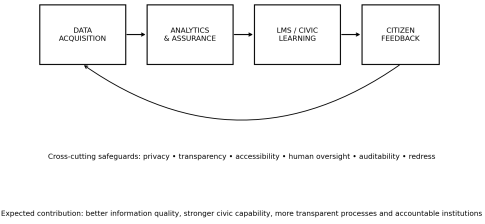
The DDDRF is the principal conceptual contribution of the study. It connects institutional data, analytics, civic learning and citizen feedback while embedding ethical safeguards. The framework rests on five propositions: democratic technology should strengthen institutions rather than replace them; data quality is a prerequisite for trustworthy analytics; civic learning should be continuous; analytics and learning should form a feedback loop; and safeguards should be embedded from the beginning.
The framework is deliberately modular. Institutions can implement the layers incrementally rather than procuring a single monolithic platform. A university may begin with the LMS and learning analytics. An electoral body may begin with public information dashboards. Civil society may begin with media-literacy modules. Over time, interoperable components can be connected.
6.2. Layer 1—Data Acquisition
The first layer gathers legitimate public-interest data such as aggregate voter-registration statistics, polling-station reports, official results, public information requests, civic-learning engagement measures and verified information-integrity reports. Data provenance should identify source, collection date, transformations and limitations.
Data minimisation is essential. An institution does not need to know an individual’s political preference to identify an area where voter-education content is not reaching citizens. Aggregate indicators should be preferred where they are sufficient for the decision.
6.3. Layer 2—Analytics and Assugrance
The second layer uses descriptive analytics, trend analysis, geospatial analysis, anomaly detection and text analysis where appropriate. Descriptive analytics can identify where information is being accessed or where official updates are delayed. Anomaly detection can flag unusual patterns for human investigation. Text analysis can identify recurring information themes.
The word assurance is critical. A model output is evidence, not a verdict. Every high-impact analytical process should have documented validation, error measurement, audit logs, model-version control and human review. This is particularly important where an analytical error could damage an individual’s reputation or confidence in an election.
6.4. Layer 3—LMS-enabled Civic Learning
The LMS should contain short, accessible learning pathways. Suggested modules include: how elections work; voter rights and responsibilities; understanding result collation; verifying political claims; recognising manipulated media; responsible social-media participation; data privacy; reporting electoral concerns; constitutional institutions; and constructive citizen engagement.
Learning should be scenario-based. Instead of asking learners to memorise definitions, the platform can present realistic information problems and require learners to identify the evidence needed before sharing or acting on a claim. Immediate feedback can correct misconceptions, while aggregate learning analytics can identify content requiring revision.
The system should remain politically neutral. It should teach procedures, rights, responsibilities, evidence evaluation and institutional roles rather than promote candidates, parties or ideological positions.
6.5. Layer 4—Citizen Feedback
Citizens should be able to report unclear procedures, request clarification and provide feedback on learning materials. Feedback should be designed around public-interest functions and should not become a mechanism for political surveillance.
Feedback creates a continuous-improvement loop. If many learners misunderstand a particular procedure, content can be revised. If citizens repeatedly ask the same question, institutions can publish clearer explanations. This makes the LMS part of an institutional learning system rather than simply a content repository.
6.6. Cross-cutting Safeguards
Six safeguards run across all layers: privacy, transparency, accessibility, human oversight, auditability and redress. Privacy requires purpose limitation and data minimisation. Transparency requires explanation of data sources and system functions. Accessibility requires attention to disability, language, device and bandwidth. Human oversight prevents automated outputs from becoming unquestionable decisions. Auditability enables independent review. Redress gives citizens a route to challenge errors.
6.7. Expected Outcomes
Immediate outputs include structured civic content, dashboards, information-risk alerts and feedback channels. Intermediate outcomes may include improved procedural knowledge, stronger media-information literacy and faster institutional response to information gaps. Long-term outcomes such as institutional trust and democratic resilience should be measured empirically rather than assumed.
Figure 3. Data-Driven Democratic Resilience Framework. Author’s conceptual synthesis.
6.8. Nigeria-Focused Application
Why Nigeria
Nigeria is a useful application context because of its large electorate, geographic and linguistic diversity, youth population, expanding digital ecosystem and complex electoral environment. International IDEA reports 27% turnout among registered voters in the 2023 presidential election. The election also generated significant public discussion about logistics, results transmission, technology and trust.
The Nigerian case demonstrates why the proposed framework should operate continuously rather than only on election day. A resilient democratic information ecosystem would support citizens before, during and after elections.
Pre-election Phase
Before elections, the LMS could provide modules on registration, voter eligibility, polling procedures, electoral rights, source verification and digital safety. Delivery could occur through universities, schools, civic organisations, community centres and mobile channels.
Analytics could identify aggregate patterns in information requests and learning performance. For example, if a large share of learners repeatedly misunderstands how result collation works, the system could trigger content revision. This approach improves learning without profiling political preferences.
Campaign Phase
During campaigns, information integrity becomes more important. The platform could publish short lessons on verifying claims, identifying manipulated media and locating primary sources. Analytics could help identify recurring public information gaps and direct educators toward them.
Neutrality is essential. A publicly funded civic LMS should not rank candidates or persuade citizens to support or oppose political actors. Its role is procedural and informational.
Election-day Phase
On election day, analytics can support aggregate monitoring of polling-station opening, official announcements, technical incidents and information requests. Public dashboards should clearly distinguish official information from unverified reports and should provide timestamps, source metadata and verification status.
Where an anomaly is detected, the system should trigger human investigation rather than publish an accusation. This protects both institutional credibility and citizens from false conclusions.
Post-election Phase
After an election, the LMS can explain result collation, dispute-resolution procedures and the roles of electoral commissions, courts and legislative bodies. This is important because civic education should not stop after ballots are counted.
Analytics can evaluate which questions remained unresolved and which modules generated persistent misconceptions. The next civic-learning cycle can then be based on evidence rather than assumptions.
Partnerships
Implementation could involve electoral-management bodies, universities, civil-society organisations, media organisations and technology providers. Universities are particularly valuable because they can provide instructional design, data analytics, cybersecurity, independent evaluation and research capacity.
UNESCO
| [16] | UNESCO. (2026). Nigeria to launch International Media and Information Literacy Institute in collaboration with UNESCO. |
[16]
reported in 2026 that Nigeria launched an International Media and Information Literacy Institute in collaboration with UNESCO. This illustrates the growing policy relevance of information literacy and provides a potentially useful ecosystem within which civic-learning research can develop.
7. Discussion
7.1. From Election Technology to Democratic Learning Infrastructure
The central argument is that democratic technology should be understood as an ecosystem rather than a collection of devices. Electoral technologies can improve administrative functions, but citizens also need the knowledge required to interpret what those systems produce. A result-management platform may publish accurate information, yet citizens may remain vulnerable to false counter-narratives if they cannot evaluate competing claims.
Connecting analytics to learning addresses two sides of the information problem: institutional production of trustworthy evidence and citizen capacity to interpret evidence. The proposed architecture therefore moves beyond a one-way information model toward a learning-and-accountability cycle.
7.2. Why an LMS Is Relevant
The use of an LMS for civic education may initially appear unusual because LMS platforms are associated with schools and corporate training. Their underlying capabilities, however, are compatible with continuous civic learning. They provide structured content, assessment, feedback, progress tracking and learning analytics.
There is an important difference between information provision and learning. Posting a voter-education document is information provision. Asking a learner to apply a verification method to a realistic scenario, providing feedback and measuring performance is learning. The latter provides evidence about whether citizens have acquired a specific capability.
7.3. Analytics Are Not Truth Machines
Numerical outputs can appear objective even when they depend on subjective measurement choices. Data reflect decisions about what is collected, how variables are defined and which cases are excluded. Models reflect assumptions and training data. Dashboards reflect decisions about what to display.
In elections, an unusual pattern is not automatically evidence of fraud. A sentiment classifier may misread local language or sarcasm. A misinformation classifier may incorrectly flag legitimate criticism. Consequently, the DDDRF combines analytics with assurance and human review.
7.4. Information Literacy as Democratic Infrastructure
Media and information literacy should be treated as a democratic capability. Citizens should be able to ask who produced a claim, what the original source is, whether the information is current, whether independent evidence exists and whether an image or video shows what it claims to show.
These are learnable competencies. An LMS can provide repeated practice and feedback. This is particularly relevant in environments where citizens receive information from multiple channels with different levels of credibility.
7.5. Inclusion
The 38% Internet-use estimate for Africa makes digital exclusion a central design issue. A democratic LMS should therefore use a digital-plus model. Web learning can be supplemented with low-bandwidth content, mobile access, radio, community facilitators and offline resources.
Inclusion also includes disability and language. Captions, transcripts, alternative text, accessible navigation and local-language content should be treated as requirements rather than optional enhancements.
7.6. Trust as an Outcome
The paper does not claim that technology automatically creates trust. Evidence from Afrobarometer and African e-participation research suggests that trust is shaped by institutional performance and responsiveness. Technology can contribute when it makes processes understandable and institutions responsive, but it can damage trust when it is opaque or unreliable.
Trust should therefore be measured as an outcome. Useful measures include perceived clarity of electoral information, confidence in official sources, satisfaction with institutional communication and the proportion of information queries resolved within defined service standards.
7.7. Information-Systems Contribution
The study contributes to information-systems research by connecting data governance with civic learning, by treating feedback as part of the system architecture, and by embedding ethical safeguards into the design rather than adding them after implementation.
It also demonstrates an application area for data professionals. Skills in data quality, visualisation, machine learning, dashboards, LMS administration and evaluation can be directed toward public-interest information problems.
8. Implementation and Evaluation Roadmap
8.1. Phase 1—Needs Assessment
Implementation should begin with an information-needs assessment rather than technology procurement. Stakeholders should map common citizen questions, information gaps, misinformation patterns, language requirements, accessibility barriers, connectivity constraints and existing civic-education programmes.
A baseline should measure factual knowledge, source-evaluation skills, confidence in navigating electoral procedures and access to reliable information. This creates a basis for later evaluation.
8.2. Phase 2—Content and Platform Design
The LMS should use short learning units with clear objectives, interactive scenarios and knowledge checks. Content should be reviewed by subject-matter experts and independently verified. Version control is necessary because electoral procedures and official information change.
Content should also distinguish between primary sources and commentary. Where possible, modules should link learners to official electoral materials and explain how to recognise outdated or unofficial information.
8.3. Phase 3—Analytics Architecture
Institutions should begin with descriptive analytics before introducing complex predictive models. This allows the data-generating process to be understood and reduces unnecessary risk.
Predictive or machine-learning systems should only be introduced where there is a defined decision problem, adequate data, measurable performance criteria and appropriate human oversight. Models should be tested for false positives and false negatives and documented for independent review.
8.4. Phase 4—Pilot Evaluation
A pilot could use a pre-test/post-test or quasi-experimental design. Participants would complete a baseline assessment, receive civic-learning modules and complete an immediate and delayed assessment. A comparison group could be used where ethically and operationally feasible.
Learning measures could include knowledge gain, verification accuracy, retention and completion. For example, knowledge gain can be represented as post-test score minus pre-test score; verification accuracy as correct verification decisions divided by total tasks; and retention as delayed-test score divided by immediate post-test score.
These measures are preferable to voting-intention measures for a neutral civic-learning intervention because they assess whether the system improves knowledge and information skills rather than attempting to influence political choices.
8.5. Institutional Indicators
Electoral institutions could monitor response time to verified public-information queries, percentage of official updates published within service standards, number of recurring information gaps identified, percentage of public information products with source metadata, number of analytical alerts reviewed by humans and percentage of high-impact outputs subject to documented human review.
8.6. Ethical Evaluation
An intervention should not be declared successful solely because it reaches many users. Ethical performance should be evaluated alongside technical performance. A practical scorecard could cover privacy compliance, accessibility, transparency, model error rates, bias across relevant groups, human-review coverage and availability of correction mechanisms.
8.7. Sustainability
Sustainability requires institutional ownership. Universities and public institutions should develop internal skills in instructional design, data analytics, LMS administration, cybersecurity, governance and project management. Interoperable standards and good documentation can reduce vendor lock-in and preserve institutional memory.
Risks, Limitations and Future Research
8.8. Technological Determinism
The framework does not assume that technology will solve structural democratic problems. Political institutions, socioeconomic conditions, security, corruption, legal frameworks and inequalities remain important. Technology is an enabling infrastructure, not a substitute for institutional reform.
8.8. Data Limitations
The empirical analysis uses sources with different years, samples and definitions. Afrobarometer indicators are survey perceptions; voter turnout is an administrative measure; Internet use is a telecommunications estimate. These indicators should not be combined into a single score without a separate methodological justification.
8.9. No Direct LMS Causal Evidence
There is insufficient cross-national evidence to claim that LMS-based civic education causes higher turnout or greater trust. The paper therefore presents LMS as a theoretically and empirically informed intervention that requires field validation. This distinction is important for peer review because it prevents conceptual propositions from being presented as causal findings.
8.10. Misuse of Analytics
Analytics could be misused for political profiling, surveillance or suppression. The framework responds with purpose limitation, data minimisation, privacy, auditability, human oversight and redress. Future studies should examine whether these safeguards work in practice.
8.11. Language and Cultural Variation
Africa is not a single political, linguistic or technological environment. Civic content must reflect local laws, languages, institutions and information cultures. A module developed for Nigeria cannot simply be transferred to Ghana, Kenya or South Africa without contextual adaptation.
8.12. Future Research Agenda
Four research programmes are especially important. First, multi-country surveys can measure digital civic-literacy levels and examine associations with knowledge and participation while controlling for institutional and socioeconomic factors. Second, experimental studies can test specific LMS modules. Third, machine-learning studies can develop locally validated misinformation-detection models while measuring language bias and false positives. Fourth, implementation studies can examine partnerships among electoral institutions, universities and civil society.
A particularly useful Nigerian study would pilot a multilingual, mobile-first civic LMS and evaluate changes in electoral-procedure knowledge and media-information literacy among young adults. The study could combine learning analytics with independent surveys and qualitative interviews to understand not only whether learning occurred but how participants used the skills outside the platform.
9. Policy and Practical Recommendations
1) Treat civic learning as continuous democratic infrastructure. Civic education should operate year-round rather than only during election periods.
2) Build data-governance safeguards before scaling analytics. Privacy, purpose limitation, access control, model documentation and redress should be designed into systems from the start.
3) Use analytics to support human decision-making. Automated alerts should trigger investigation rather than become automatic accusations or sanctions.
4) Create independent review mechanisms for high-impact electoral technology. Technical, legal and ethical assessments should accompany major deployments.
5) Adopt digital-plus civic education. LMS platforms should be complemented by mobile, low-bandwidth, radio, community and offline channels.
6) Make accessibility a core requirement. Systems should support disability access, multilingual content and different levels of digital literacy.
7) Build university-government partnerships. Universities can contribute instructional design, data analytics, cybersecurity, evaluation and research.
8) Measure learning outcomes. Programmes should assess knowledge gain, verification accuracy, retention and information-seeking behaviour rather than only counting users.
9) Develop AI and information-integrity literacy. Citizens should learn how synthetic media are produced, how to verify claims and how to recognise unreliable sources.
10) Preserve political neutrality in publicly funded civic learning. The objective should be informed citizenship and evidence evaluation, not support for or opposition to particular candidates or parties.
9.1. Institutional Architecture, Financing and Accountability
A framework of this kind requires clear institutional ownership because democratic information systems sit across organisational boundaries. Electoral-management bodies hold authoritative electoral information, universities hold instructional and analytical expertise, civil-society organisations often possess community-level reach, media organisations contribute information-distribution capacity, and technology providers may supply infrastructure. If these actors operate without a defined governance arrangement, responsibilities can become unclear and accountability can weaken. The proposed architecture therefore requires a lead public-interest institution, a technical steering group, an independent oversight function and defined channels for citizen feedback.
The lead institution should be responsible for setting public-interest objectives, approving data-use purposes and publishing accountability reports. A technical steering group can oversee data architecture, interoperability, cybersecurity, analytics quality and LMS operations. Independent oversight should review high-impact analytical uses, privacy compliance, accessibility and political neutrality. Citizen representatives and civil-society organisations should have structured opportunities to review learning content and identify information gaps. The purpose is not to place all democratic information in one institution but to create a transparent governance arrangement for shared infrastructure.
Financing is another practical issue. Civic technology projects frequently begin as donor-funded pilots and later face difficulty when external funding ends. A sustainable model should therefore separate capital costs from recurrent institutional costs. Capital investment may cover platform development, connectivity, security and initial content production. Recurrent funding should cover content updates, system administration, cybersecurity monitoring, accessibility, independent evaluation and staff training. Budgeting for these recurring activities is essential because electoral procedures, public information and technology risks change continuously.
Procurement should also be treated as part of democratic governance. When electoral or civic-learning technology is purchased from external vendors, institutions should require clear technical documentation, data-location information, security controls, interoperability standards and audit rights. Contracts should specify how data are returned or deleted at the end of the engagement and should prevent vendors from using public civic data for unrelated commercial profiling. Where proprietary systems are unavoidable, public institutions should still require sufficient documentation for independent assurance.
Accountability should be visible to citizens. An annual or election-cycle transparency report could disclose the datasets used, categories of analytical models deployed, known limitations, major incidents, accessibility measures, privacy safeguards, system uptime, learning participation and aggregate evaluation results. The report should not reveal sensitive security information or personal data. Its purpose would be to make the operation of the democratic information infrastructure understandable enough for independent scrutiny.
The architecture should also include a clear escalation protocol. A suspected misinformation surge, technical anomaly or data-quality problem should have defined levels of response. Low-risk issues may be handled through routine content updates. Higher-risk issues may require technical investigation, public clarification and independent review. High-impact issues affecting election information should trigger a documented human decision process. Such protocols reduce the temptation to improvise during periods of intense political pressure.
Finally, implementation should recognise that democratic resilience is partly a capacity problem. Institutions require professionals who understand data engineering, analytics, cybersecurity, instructional design, public communication, project management and ethics. Training should therefore be multidisciplinary. A data analyst working on election information should understand the consequences of false positives. An LMS administrator should understand information integrity and accessibility. A communications officer should understand data provenance. A project manager should understand stakeholder accountability. The value of the DDDRF is consequently not only technological; it provides a common language through which different professional communities can coordinate around a shared democratic objective.
9.2. Monitoring, Audit and Continuous Improvement
A mature democratic information system should be evaluated continuously rather than only when an election approaches. Monitoring should cover technical availability, data quality, content accuracy, learning performance, accessibility and governance compliance. A dashboard for institutional managers could distinguish operational indicators from public-facing indicators. Operational indicators might include system uptime, unresolved data-quality exceptions and model performance. Public-facing indicators might include the timeliness of official updates, completion of civic-learning modules and aggregate responses to common information questions.
Audit should occur at several levels. Data audits can test completeness, duplication, provenance and consistency. Model audits can test accuracy, false positives, false negatives and performance across relevant language or demographic groups where lawful and appropriate. Process audits can examine whether human reviewers actually follow documented procedures. Governance audits can test whether data are being used for the purposes communicated to citizens. These different audits are complementary; a technically accurate model can still be deployed through an inappropriate process.
Continuous improvement should be based on evidence rather than assumptions. If a learning module has low completion, the problem may be content length, device compatibility or language rather than lack of interest. If an information alert produces many false positives, the response should involve model refinement and review of the underlying data rather than simply increasing the number of analysts. If citizens repeatedly request clarification about the same procedure, the problem may be institutional communication rather than citizen ignorance. The framework therefore encourages institutions to treat recurring problems as system-design signals.
This approach also creates an opportunity for independent research. Universities can evaluate the system without controlling it, examining whether stated objectives correspond with observed outcomes. Independent evaluation can help prevent institutional enthusiasm from becoming evidence by assertion. It can also identify unintended effects, including exclusion of low-connectivity groups, misunderstanding of automated outputs or excessive collection of personal information. In this sense, evaluation becomes part of democratic accountability rather than merely a project-management requirement.
10. Conclusion
The digital transformation of African societies is changing the conditions under which democratic governance operates. Data systems, social platforms, artificial intelligence and digital learning technologies can improve access to information and institutional responsiveness, but they can also introduce new risks of misinformation, exclusion, surveillance and distrust.
The secondary evidence examined here demonstrates why the problem deserves an information-systems response. Democratic preference remains substantial, yet satisfaction with democratic performance is lower. Support for fair elections remains high, while trust in electoral commissions is weaker. Internet access is expanding but remains uneven. Electoral turnout varies considerably across countries and contexts. None of these observations proves that a particular technology causes a democratic outcome. They instead establish a context in which better information systems and stronger civic capabilities are relevant.
The paper’s principal contribution is the Data-Driven Democratic Resilience Framework. It connects data acquisition, analytics and assurance, LMS-enabled civic learning and citizen feedback while embedding privacy, transparency, accessibility, human oversight, auditability and redress across the system.
The central proposition is therefore not that technology will safeguard democracy by itself. Technology can become part of democratic infrastructure when it is designed around legitimate public purposes, reliable information, informed citizens and accountable institutions. The framework treats citizens as active participants in an information and learning ecosystem rather than merely as data subjects.
For Africa, this creates an opportunity to direct existing expertise in data analytics, information systems, digital learning and project management toward public-interest challenges. Universities, electoral institutions, governments, civil society and technology professionals can collaborate to build civic information systems that help citizens understand procedures, evaluate claims and participate responsibly.
The next step is empirical validation. The DDDRF should be implemented in a bounded pilot, measured using transparent learning and governance indicators, independently evaluated and refined. Such work would move scholarship beyond broad claims about technology and democracy toward evidence about which digital interventions work, for whom, under what conditions and with what safeguards.
Abbreviations
IDEA | Institute for Democracy and Electoral Assistance |
DDDRF | Data-Driven Democratic Resilience Framework |
LMS | Learning Management Systems |
Author Contributions
Philip Okposo: Conceptualization, Data curation, Formal Analysis, Investigation, Methodology, Visualization, Writing – original draft, Writing – review & editing
Data Availability Statement
The study uses publicly available secondary information from Afrobarometer, International IDEA, the International Telecommunication Union (2024)
| [9] | International Telecommunication Union. (2024). Facts and Figures 2024: Internet use. ITU. |
[9]
, the World Bank, UNESCO, OECD and national electoral authorities. No new personally identifiable participant data were collected.
Conflict of Interest
The author declares no conflict of interest.
Appendix
The proposed framework can be evaluated through a structured measurement matrix that separates learning outcomes, information-quality outcomes, institutional-response outcomes and governance safeguards. This distinction is important because democratic resilience is multidimensional and cannot be reduced to a single performance score. The pilot should therefore establish a baseline, implement the civic-learning intervention, conduct immediate post-testing, and conduct a delayed follow-up assessment.
Learning outcomes should measure whether participants can accurately explain basic electoral procedures, distinguish official from unofficial information, identify the original source of a claim, recognise common signs of manipulated media, and identify appropriate channels for reporting electoral concerns. These measures can be captured through scenario-based questions rather than abstract definitions. A scenario might present a fabricated election-result screenshot and ask the participant to identify three steps that should occur before the content is shared.
Information-quality outcomes should assess whether learners increasingly rely on primary and authoritative sources. Indicators may include the proportion of verification tasks in which participants locate an appropriate source, the time required to verify a claim, and the proportion of participants who correctly distinguish a verified result from an unverified social-media claim. The study should avoid measuring partisan agreement because the objective is information competence rather than political persuasion.
Institutional-response outcomes can assess whether public agencies become more responsive to recurring information needs. Possible indicators include median response time to public information queries, the number of recurring questions converted into official explanatory content, the percentage of public information products carrying source and date metadata, and the proportion of high-impact analytical alerts that receive documented human review.
Equity indicators should measure who is reached and who is excluded. These may include completion rates by connectivity category, device type, language, disability-access mode and location where ethically and lawfully collected. The objective is not to profile political preferences but to identify delivery barriers. If completion is substantially lower among low-bandwidth users, for example, the intervention should be redesigned rather than treating those users as uninterested.
Governance indicators should include privacy incidents, data-retention compliance, access-control violations, documented model errors, correction requests, response to correction requests, accessibility compliance and availability of redress. These indicators should be reported alongside technical performance so that efficiency does not become the sole measure of success.
A future empirical study could formulate hypotheses around these measures. For example: H1, participation in a structured civic-LMS intervention is associated with greater improvement in electoral-procedure knowledge than exposure to information-only materials; H2, participants receiving scenario-based media-information literacy modules demonstrate greater verification accuracy than participants receiving text-only materials; H3, improved institutional response to information queries is associated with higher perceived clarity of electoral information; and H4, the effects of the intervention vary according to connectivity and baseline digital literacy. These hypotheses should be tested empirically rather than assumed to be true.
The pilot should also include qualitative interviews or focus groups to understand why participants succeed or fail. Quantitative learning scores may show that a particular module performs poorly, but qualitative evidence can reveal whether the problem is language, terminology, examples, bandwidth, assessment design or lack of prior knowledge. A mixed-method follow-up would therefore complement the secondary-data design of the present paper.
Finally, evaluation should continue after the election cycle. A democratic-learning intervention should be judged partly by whether knowledge and verification behaviours are retained and whether institutions continue to use the evidence generated by the platform. Sustainability, rather than one-off reach, should be treated as a central implementation outcome.
References
| [1] |
Adeleke, F. (2025). Reinstating trust in elections in the era of artificial intelligence and emerging technologies. Data & Policy. Cambridge University Press.
|
| [2] |
Afrobarometer. (2024). As Africans enter busy political year, scepticism marks weakening support for elections. Afrobarometer Dispatch No. 761.
|
| [3] |
Al-Fraihat, D., Joy, M., Masa’deh, R., & Sinclair, J. (2020). Evaluating e-learning systems success: An empirical study. Computers in Human Behavior, 102, 67–86.
https://doi.org/10.1016/j.chb.2019.08.004
|
| [4] |
Asiedu, M. (2026). The timing trap: Misinformation, disinformation, and the limits of fact-checking in Kenya’s 2022 elections. South African Journal of International Affairs, 33(2), 271–298.
https://doi.org/10.1080/10220461.2026.2683199
|
| [5] |
Brady, H. E., Verba, S., & Schlozman, K. L. (1995). Beyond SES: A resource model of political participation. American Political Science Review, 89(2), 271–294.
|
| [6] |
Davis, F. D. (1989). Perceived usefulness, perceived ease of use, and user acceptance of information technology. MIS Quarterly, 13(3), 319–340.
|
| [7] |
Esiefarienrhe, B. M., & Maine, I. M. (2024). Artificial intelligence and the electoral process: The benefits and the challenges. African Journal of Development Studies.
|
| [8] |
International IDEA. (2023). Nigeria—February 2023: Elections for President and National Assembly held. Democracy Tracker.
|
| [9] |
International Telecommunication Union. (2024). Facts and Figures 2024: Internet use. ITU.
|
| [10] |
Janowski, T. (2015). Digital government evolution: From transformation to contextualization. Government Information Quarterly, 32(3), 221–236.
https://doi.org/10.1016/j.giq.2015.07.001
|
| [11] |
Kirui, P. K. (2026). Contesting democracy in the digital age: Disinformation, hate speech, and technology-enabled security threats during Kenya’s 2022 general elections. African Journal of Empirical Research.
|
| [12] |
Maerz, S. F., & Lindberg, S. I. (2021). How democracies prevail: Democratic resilience as a two-stage process. Democratization, 28(5), 885–907.
https://doi.org/10.1080/13510347.2021.1891413
|
| [13] |
Mutongoreni, N. A., & Gwiza, A. (2025). Democracy under siege: AI-generated propaganda in African elections. African Journal of Democracy and Election Research, 5(2), 5–22.
https://doi.org/10.31920/2752-602X/2025/v5n2a1
|
| [14] |
Norris, P. (2014). Why electoral integrity matters. Cambridge University Press.
https://doi.org/10.1017/CBO9781107280861
|
| [15] |
OECD. (2019). The path to becoming a data-driven public sector. OECD Digital Government Studies.
https://doi.org/10.1787/059814a7-en
|
| [16] |
UNESCO. (2026). Nigeria to launch International Media and Information Literacy Institute in collaboration with UNESCO.
|
| [17] |
Verba, S., Schlozman, K. L., & Brady, H. E. (1995). Voice and equality: Civic voluntarism in American politics. Harvard University Press.
|
| [18] |
World Bank. (2021). World Development Report 2021: Data for better lives. World Bank.
|
| [19] |
World Bank. (2021). Data governance maturity indicators. World Bank Data Catalog.
|
Cite This Article
-
APA Style
Okposo, P. (2026). Data-Driven Governance and Digital Learning Systems as Catalysts for Safeguarding Democracy in Africa. Research and Innovation, 2(5), 280-294. https://doi.org/10.11648/j.ri.20260205.12
 Copy
|
Copy
|
 Download
ACS Style
Okposo, P. Data-Driven Governance and Digital Learning Systems as Catalysts for Safeguarding Democracy in Africa. Res. Innovation 2026, 2(5), 280-294. doi: 10.11648/j.ri.20260205.12
Copy
|
Download
AMA Style
Okposo P. Data-Driven Governance and Digital Learning Systems as Catalysts for Safeguarding Democracy in Africa. Res Innovation. 2026;2(5):280-294. doi: 10.11648/j.ri.20260205.12
Copy
|
Download
-
@article{10.11648/j.ri.20260205.12,
  author = {Philip Okposo},
  title = {Data-Driven Governance and Digital Learning Systems as Catalysts for Safeguarding Democracy in Africa},
  journal = {Research and Innovation},
  volume = {2},
  number = {5},
  pages = {280-294},
  doi = {10.11648/j.ri.20260205.12},
  url = {https://doi.org/10.11648/j.ri.20260205.12},
  eprint = {https://article.sciencepublishinggroup.com/pdf/10.11648.j.ri.20260205.12},
  abstract = {Africa’s democratic systems are increasingly influenced by digital technologies, data infrastructures, social media, and artificial intelligence. These developments provide opportunities to improve electoral administration, evidence-based governance, civic education, and citizen engagement, while also creating risks related to misinformation, exclusion, surveillance, and declining public trust. This study examines how data analytics and Learning Management Systems (LMS) can work together to support electoral integrity and responsible citizenship without replacing established democratic institutions. The study adopts a documentary secondary-data research design, drawing on peer-reviewed studies and authoritative institutional evidence. Selected democratic, digital access, and electoral participation indicators are examined descriptively to identify key democratic pressures and their relationship to potential technological interventions. The findings indicate a significant gap between democratic aspirations and citizens’ experiences. Across 39 African countries, 66% of citizens express a preference for democracy, while 45% describe their countries as mostly or completely democratic and 37% report satisfaction with how democracy works. Although 75% support fair, open, and honest elections, only 39% report trust in their national electoral commission. Internet use in Africa reached 38% in 2024, highlighting both the potential reach and limitations of digital interventions. Electoral participation also varies considerably across selected countries. These findings do not establish a causal relationship between digital learning and electoral participation but demonstrate the importance of context-sensitive approaches. The study therefore proposes the Data-Driven Democratic Resilience Framework (DDDRF), comprising data acquisition, analytics and assurance, LMS-enabled civic learning, citizen feedback, and safeguards relating to privacy, transparency, accessibility, human oversight, and redress. The study contributes an information-systems perspective to research on African democracy by integrating data governance and civic learning within a common framework for strengthening democratic resilience.},
 year = {2026}
}
Copy
|
Download
-
TY  - JOUR
T1  - Data-Driven Governance and Digital Learning Systems as Catalysts for Safeguarding Democracy in Africa
AU  - Philip Okposo
Y1  - 2026/10/14
PY  - 2026
N1  - https://doi.org/10.11648/j.ri.20260205.12
DO  - 10.11648/j.ri.20260205.12
T2  - Research and Innovation
JF  - Research and Innovation
JO  - Research and Innovation
SP  - 280
EP  - 294
PB  - Science Publishing Group
SN  - 3070-6297
UR  - https://doi.org/10.11648/j.ri.20260205.12
AB  - Africa’s democratic systems are increasingly influenced by digital technologies, data infrastructures, social media, and artificial intelligence. These developments provide opportunities to improve electoral administration, evidence-based governance, civic education, and citizen engagement, while also creating risks related to misinformation, exclusion, surveillance, and declining public trust. This study examines how data analytics and Learning Management Systems (LMS) can work together to support electoral integrity and responsible citizenship without replacing established democratic institutions. The study adopts a documentary secondary-data research design, drawing on peer-reviewed studies and authoritative institutional evidence. Selected democratic, digital access, and electoral participation indicators are examined descriptively to identify key democratic pressures and their relationship to potential technological interventions. The findings indicate a significant gap between democratic aspirations and citizens’ experiences. Across 39 African countries, 66% of citizens express a preference for democracy, while 45% describe their countries as mostly or completely democratic and 37% report satisfaction with how democracy works. Although 75% support fair, open, and honest elections, only 39% report trust in their national electoral commission. Internet use in Africa reached 38% in 2024, highlighting both the potential reach and limitations of digital interventions. Electoral participation also varies considerably across selected countries. These findings do not establish a causal relationship between digital learning and electoral participation but demonstrate the importance of context-sensitive approaches. The study therefore proposes the Data-Driven Democratic Resilience Framework (DDDRF), comprising data acquisition, analytics and assurance, LMS-enabled civic learning, citizen feedback, and safeguards relating to privacy, transparency, accessibility, human oversight, and redress. The study contributes an information-systems perspective to research on African democracy by integrating data governance and civic learning within a common framework for strengthening democratic resilience.
VL  - 2
IS  - 5
ER  -
Copy
|
Download






 Share This Article
 Twitter
 Linked In
 Facebook