Research Article | | Peer-Reviewed

Modeling of Steady-State Creep Deformation in an Orthotropic Composite Thick-Walled Rotating Cylinder Subjected to a Thermal Gradient

Received: 8 September 2026     Accepted: 20 September 2026     Published: 14 October 2026
Views:       Downloads:
Abstract

The objective of this research is to use Lebesgue strain measure theory and Seth's transition theory to build a mathematical model of steady state creep deformation of an orthotropic thick-walled rotating cylinder subjected to a thermal gradient. Because Seth's theory does not require any assumptions, such as the creep deformation is infinitesimally small, creep strain laws and the associated flow rules, it is crucial for calculating creep stresses based on generalized strain measure theory and asymptotic solution at the turning points of the differential equations defining the deformed field. This theory's consideration of the material's nonlinear character is one of its advantages. The combined effects of temperature and angular speed have been presented numerically and graphically using examples of thick-walled cylinders made of orthotropic, transversely isotropic, and isotropic materials. It is observed that near the cylinder's outer surface, cylinders composed of orthotropic materials (boron-aluminum and graphite-magnesium) have a larger radial creep stress value than those made of titanium and steel. From the inner to the outer surface of the cylinder the tangential creep stress for isotropic material (steel) and transversely isotropic material (titanium) is greater than the tangential creep stress of the cylinder composed of orthotropic boron-aluminum and graphite-magnesium materials. At the outer surface of the cylinder, titanium and steel material has higher axial creep stress value than orthotropic materials. The findings of this paper can be useful in the analysis and design of a cylinder that is exposed to high temperatures, such as high-speed structures involving aerodynamic heating, chemical plants and nuclear plants.

Published in Pure and Applied Mathematics Journal (Volume 15, Issue 3)
DOI 10.11648/j.pamj.20261503.12
Page(s) 45-55
Creative Commons

This is an Open Access article, distributed under the terms of the Creative Commons Attribution 4.0 International License (http://creativecommons.org/licenses/by/4.0/), which permits unrestricted use, distribution and reproduction in any medium or format, provided the original work is properly cited.

Copyright

Copyright © The Author(s), 2026. Published by Science Publishing Group

Keywords

Steady-state Creep, Orthotropic Material, Rotating Cylinder, Stress, Thermal Gradient

1. Introduction
Many engineering structural components are exposed to high temperature for a long period of time changes within the component due a constant stress or load is called creep, which generally occurs at high temperatures (T >(0.3 -0.5) Tm), under a constant load or stress where Tm is a material’s absolute melting temperature and T is thermal creep. In various structural and industrial applications such as aerospace industries, pressure vessels, nuclear reactors, and military applications, piping, turbine blade within a jet engine, steam generator, steel power plants, oil refineries, rubber band, concrete bridge deck etc., the operating temperature is sufficiently high to cause significant creep. Predicting how long a structure will last is one of the most significant uses of creep deformation analysis. The usage of the Larson-Miller parameter is one of several criteria employed in research to estimate life of a structural component Much progress has been made in both theoretical and experimental to describe some aspects of the mechanisms involved in creep . In addition to studying creep behavior on structural components, its behavior also varies based on material properties that form the structures. Material properties such as permeability, creep, stiffness, strength, thermal expansion, and thermal conductivity can vary depending on direction or axis. Creep analysis of orthotropic materials is used to determine the time-dependent deformation of substances that exhibit distinct mechanical properties along three mutually perpendicular axes when subjected to prolonged stress. Examples of orthotropic materials include wood, certain types of plywood, paper, paper laminates, resin laminates reinforced with woven glass fiber (used in aircraft radomes), and most core materials utilized in high-speed aircraft sandwich panels. Proficiency in creep deformation analysis is vital for developing sound structural designs for orthotropic materials operating under high-temperature conditions . This fact is pointed out in 1830’s, the first recorded experiments relating to creep in connection with suspension bridges, steam engines and measuring instruments has been recorded . After a long time in 1910, Andrade used uniaxial creep tests with constant load or stress and got the primary, secondary and tertiary creep. In 1922 Dickenson published his researches on the creep resistance of structural steel and alloy steel members in a furnace and he has given the recognition of the importance of creep to the industrial. James Clerk Maxwell is credited with important foundational work in early mechanics, which is where the study of stress distribution in rotating bodies, especially cylinders and discs, originated. In 1852, the familiar Lamè'sequations provide the solution to the stress and deformation problem of thick-walled tubes under axially symmetric loading within the elastic range. Despite a century of research, Nadai and Hoffman and Sachs treated rotating perfectly plastic cylinders without strain-hardening under the simplifying assumption of incompressibility. Thereafter, Davis and Conelly studied rotating cylinders and tubes of a strain hardening material. Interested primarily in the deformation of a rotating cylinder are Hodge and Balaban but their solution, which includes finite strain, lacks continuity of displacement at the elastic-plastic interface. Recently, the creep behavior of a thick-walled cylinder exposed to thermo-mechanical loads along with internal heat generation were extensively studied by Seddighi et al and their research demonstrated that the effective stress and radial displacement during the creep process can be effectively controlled by optimizing either the external cooling profile or the internal heating profile. Other authors studied the creep behaviors of different structural components using classical treatment which uses the method of superposition and semi-empirical laws such as creep strain laws, the associated flow rule, yield criteria and some simplifying assumptions like incompressibility of material and yield criterion. Seth developed transition theory of creep in which he has defined the measure concept in mechanics in 1966 and creep transition in 1972. Seth has defined the generalized principal strain measure as
eii=∫0eiiA1-2eiiAn2-1deiiA=1n1-(1-2eiiA)n2(1)
where n is the coefficient of strain measure, eiiA is the principal Almansi finite strain component and i=1,2,3. The generalized principal strain components eiim in terms of the principal Almansi strain components eiiA are
eiim=1n1-(1-2eiiA)n2m
The generalized strain measure for uniaxial case, it is given by Seth as
e=1n1-l0lnm
where l0 and l are the initial and strained lengths of the rod respectively and m is the irreversibility index. For n=0,1,2,-1,-2, it gives the Hencky, Swainger, Almansi, Cauchy and Green measures respectively when m=1. Seth has shown that the well-known creep strain laws used in current literature such as Norton’s law, Odqvist law, Kachonov law, Andrade’s law etc. can be derived from the generalized measure. The generalized strain measure not only gives many well-known strain measures for different values of n, but it is also used to find the creep stresses when combined with the transition points of the governing differential equations. Seth has also shown that the transition point analysis does not require any ad-hoc assumptions of incompressibility, creep strain law (or a power relationship between stress and strain) and yield conditions like in classical theory.
Starting from 1972 researchers used to treat problems either using some simplifying assumption (classical) or Seth transition theory (non-classical) approaches. In non-classical approach, the transition function through the combination of principal stresses at the transition points of the differential system describing the deformed medium successfully applied to a more general and wider range of problems . The studies using the non-classical treatment of thick-walled cylindrical structural component are rather limited as compared to classical treatment even though the method neglects the empirical assumptions . For instance, Temesgen et al. studied modeling of creep deformation of a transversely isotropic rotating disc with a shaft having variable density and subjected to a thermal gradient and observed that the value of radial creep stress at the internal surface is maximum for the disc made of steel material in comparison to a disc made of titanium material. They also investigated creep and elastoplastic analysis in functionally graded thick-walled rotating transversely isotropic cylinder under a radial temperature gradient and uniform pressure. Pankaj et al. studied elastic-plastic transition in an orthotropic material disk by using transition theory and concluded that the isotropic material disk at the transition state requires more angular speed to yield at the internal surface in comparison to an orthotropic material disk.
Although heat gradients occur in many rotating engineering structural components made of orthotropic materials, the majority of the studies used generalized measure theory to study creep on isotropic and transversely isotropic materials. No analytical research has been identified to the best of the author's knowledge on creep deformation in an orthotropic composite thick-walled rotating cylinder exposed to a heat gradient under secondary creep conditions using Lebesgue strain measure theory and Seth's transition theory. The main objective of this article is to present an analytical solution for the calculation of creep stress of a rotating thick-walled cylinder subjected to thermal gradient under steady-state creep conditions, taking into account temperature variation in the cylinder and the effect of rotation on the cylinder made of orthotropic materials. Seth's transition theory utilizes the concept of generalized strain measure and asymptotic solution at the turning points or critical points of the governing differential equations defining the deformed field.
2. Non-Linear Differential Equation Governing Transitions
2.1. Mathematical Model
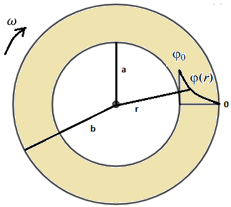
Consider a homogeneous thick-walled cylinder with a central bore of inner radius a and outer radius b made of orthotropic, transversely isotropic, or isotropic material rotates gradually increasing at angular velocity w around an axis perpendicular to its plane and passes through the center, as shown in Figure 1. It is assumed that the thickness of the cylinder is constant and a steady-state temperature φo is applied to the inner surface of the cylinder's center bore.
Figure 1. Cross-Section of a rotating thick-walled cylinder under a radial temperature gradient φ(r).
2.2. Displacement Coordinates and Strain Measures
Because of the cylindrical symmetry of the structure, the displacements are a function of radial r. The physical componentsu, v and w of these displacements in cylindrical coordinates are given by Seth .
u=r1-β,v=0,w=dz(2)
where β is a function ofr=x2+y2 only, d is a constant which is the allowance for uniform
longitudinal extension.
For finite deformation, the Almansi strain measures are given by
errA=∂u∂r-12∂u∂r2+∂v∂r2+∂w∂r2-v2=12[1-β+rβ'2](3)
eθθA=1r∂v∂θ+ur-12r2∂u∂θ2+r2∂v∂θ2+∂w∂θ2-12r2-vr2∂u∂θ+u∂v∂θ-v∂u∂θ+ur2∂v∂θ+u2+r2v2=12[1-β2](4)
ezzA=∂w∂z-12∂u∂z2+r∂v∂z2+∂w∂z2=12[1-(1-d)2](5)
erθA=eθzA=ezrA=0
where errA, eθθA,ezzA, erθAeθzA, ezrA are the components of the strain tensor eijA, the superscript “A” indicates “Almansi” and β'=dβ/dr.Substituting equations (3), (4) and (5) into equation (1), the generalized components of strain are given by:
err=1n[1-β+rβ'n](6)
eθθ=1n[1-βn](7)
ezz=1n[1-(1-d)n](8)
erθ=eθz=ezr=0
2.3. Stress-Strain Relation for Orthotropic Material
The constitutive equations for a linear, thermoelastic, orthotropic material are given by ,
σrrσθθσzzσθzσrzσrθ=C11C12C13000C12C22C23000C13C23C33000000C44000000C55000000C66erreθθezz2eθz2erz2erθ+β11β22β33000φ(9)
or in indicial form byσij=Cijklεkl+βijφwhereβijare called the thermal moduli andβij=-Cijklαklwhereαklare the coefficients of linear thermal expansion and Cijklarestiffness coefficients. Using equations (6), (7), and (8) in equation (9), the thermo-elastic constitutive equations are given by:
σrr=C11n1-β+rβ'n+C12n1-βn+C13n1-1-dn-α1φ=C11n1-βn(1+p)n+C12n1-βn+C13n1-(1-d)n-α1φ(10)
σθθ=C21n1-β+rβ'n+C22n1-βn+C23n1-1-dn-α2φ=C21n1-βn(1+p)n+C22n1-βn+C23n1-1-dn-α2φ(11)
σzz=C31n1-β+rβ'n+C32n1-βn+C33n1-1-dn-α3φ=C31n1-βn1+pn+C32n1-βn+C33n1-1-dn-α3φ(12)
σrθ=σθz=σzr=0
where αii=1, 2, 3 are functions of the coefficient of linear thermal expansion and Cij, rβ'=pβ and φ is the temperature change.
The temperature field satisfying Fourier heat equation ∇2φ=1rddrrdφdr=0with the boundary conditions
φ=φo,at r=a0,at r=b
where φo is a constant, given by Seth. Solving the heat equation using the given boundary conditions, one gets:
φ=φ̅oln⁡(r/b)(13)
whereφ̅o=φoln⁡(a/b)
The stress equations of equilibrium are all satisfied except:
d(rσrr)dr-σθθ+ρω2r2=0(14)
where ρ is the density of the material.
Substituting equations (10), (11) and (13) in equation (14), we get a non-linear differential equation governing transitions in βas:
p1+pn+C12C11p+α1φ̅oC11βn-1nC11βnC11-C211-βn1+pn+C12-C221-βn+C13-C231-1-dn+ (α2-α1nφ̅oln⁡r/b}-ρω2r2C11βn+βp(1+p)n-1dpdβ=0(15)
2.4. Boundary Conditions
Since the cylinder’s internal and external surface are free from mechanical loads. So, the problem’s boundary conditions are set by the boundary conditions on radial stress
σrr=0 at r=a and r=b(16)
the overall equilibrium in the axial direction requires
∫ab2πrσzzdr=0(17)
3. Analytic Solution of the Problem
Seth and other authors showed that the asymptotic solution or the transition function through the principal stress difference leads to creep at the transition point p→-1. We define the transition function ψ to find the creep stresses at the transition point as,
ψ=σrr-σθθ=1nC11-C211-βn1+pn+C12-C221-βn +C13-C231-1-dn+(α2-α1)nφ̅oln⁡(r/b)(18)
Then
ddβln⁡ψ=-βn-1ψC11-C211+pn-1βdpdβ+1+p+C12-C22-(α2-α1)φ̅opβn(19)
from equation (15) substitute the value ofdpdβin equation (19) and then taking the asymptotic value at p→-1, we get
ddβln⁡ψ=nβn-1C12C11-C21-C11C12-C22C11C11-C21+C12-C221-βn+C13-C231-1-dn+α2-α1nφ̅oln⁡rb+φ̅on[α1-α2-α1C11-C21C11]β(C11-C21+C12-C221-βn+(C13-C23)1-1-dn+(α2-α1)nφ̅oln⁡(r/b)]+C11-C21nρω2r2C11βC11-C21+C12-C221-βn+C13-C231-1-dn+α2-α1nφ̅oln⁡rb+C11-C21C11β(20)
As p→-1, the asymptotic value of β is obtained as
β=Dr,(21)
where D is a constant
Using equation (20) and equation (21), we get
ψ=A1ξr(22)
where A1is a constantandξr=r-(C11-C21)C11exp⁡(f1(r)+f2(r)+f3(r))
where
f1(r)=-nDnC11C11-C21C12-C12-C22C11∙∫r-n-1ℏ(r)dr
f2(r)=-nφ̅oα1-α2-α1C11-C21C11∙∫1rℏ(r)dr
f3(r)=-nC11-C21ρω2C11∙∫rℏ(r)dr
where
ℏr=C11-C21+C12-C221-Dnr-n+C13-C231-(1-d)n+α2-α1nφ̅oln⁡(r/b)
Substituting equation (22) in equation (14), we get
σrr=-A1∫ξ(r)rdr-ρω2r22+A2(23)
where A2 is an integration constant.
Substituting the boundary conditions (16) in equation (23), one gets
A1=-(b2-a2)ρω22∫abξ(r)rdr
and
A2=ρω2a22-ρω2(b2-a2)∫0aξ(r)rdr2∫abξ(r)rdr
Using the values of A1andA2 equation (23) becomes
σrr=a2-r2ρω22+ρω2(b2-a2)2∫arξ(r)rdr∫abξ(r)rdr(24)
Using equations (22) and (24), we get
σθθ=σrr+b2-a2ρω2ξ(r)2∫abξ(r)rdr(25)
Using equations (10), (11) and (12), we get
σzz=C32C12+C22σrr+σθθ+φ̅oln⁡(r/b)C32C12+C22(α1+α2)-α3+K1(26)
where
K1=21nC31-C32C11+C21C12+C22+C33-C32C13+C23C12+C22ezz
Using the boundary condition (17) and equation (26), we get
K1=C32ρω22(C32+C32)b2-a2-2C32ρω2(C12+C22)∫abr∫arξ(r)rdr∫abξ(r)rdrdr-C32ρω2(C12+C22)∫abrξ(r)dr∫abξ(r)rdr+φ̅oC32(α1+α2)C12+C22-α3b2-a2+2a2ln⁡(a/b)2(b2-a2)
andnezz=1-(1-d)n=nK12-ζ1ζ2, where ζ1=C31-C32C11+C21C12+C22 and
ζ2=C33-C32C13+C23C12+C22
For appropriate use, we introduce the following non-dimensional quantities,
Ro=ab, R=rb, σr=σrrC33, σθ=σθθC33, σz=σzzC33, 2=ρω2b22C33, βo=φ̅oα3C33
Creep transition stresses (24), (25) and (26) in non-dimensional form become:
σr=-2R2-Ro2+Ω21-Ro2∫RoRξ(R)RdR∫Ro1ξ(R)RdR(27)
σθ=σr+Ω21-Ro2ξ(R)∫Ro1ξ(R)RdR(28)
σz=C32C12+C22σr+σθ+βoα1+α2α3C32C12+C22-1ln⁡R+Ro21-Ro2ln⁡Ro+12-2(1+Ro2)(29)
where
nezz=n2K1-ζ1ζ2
ℏ̌(R)=C11-C21+C13-C23nezz+C12-C221-DbnR-n+α2-α1α3β0C33ln⁡(R)
f1̌(R)=-nC11DbnC11-C21C12-C12-C22C11∙∫R-n-1ℏ̌(R)dR
f2̌(R)=-nβoC33α1-α2α3-α1α3C11-C21C11∙∫1Rℏ̌(R)dR
f3̌(R)=-2nC33Ω2C11-C21C11∙∫Rℏ̌(R)dR
ξ̌R=b-C11-C21C11R-C11-C21C11exp⁡f1̌R+f2̌R+f3̌R=b-(C11-C21)C11ξR
4. Numerical Illustration and Discussion
To illustrate the analysis, the elastic constant values for orthotropic materials (Boron-Aluminum and Graphite-Magnesium), transversely isotropic material (Titanium), and isotropic material (Steel) are taken from the literature and shown in Table 1. The creep stresses of the cylinder are determined using the following values based on the previously described analysis: D/b = 1, α1=α2=α3, and Ω2=10;β0=0.75, n=1/2 (i.e., N = 2 since in the classical theory measure N is equal to 1/n). Simpson's 1/3rd method of numerical integration has been used to approximate the values of the definite integrals in Equations (27) and (28).
Table 1. Elastic stiffness constantsCijused in units of GPa.

Material Symmetry

Materials

Cij

C11

C22

C33

C44 

C55

C66 

C12

C13 

C23 

Orthotropic

Boron-aluminum composite

184

181.7

243.6

54.5

55.2

50.3

74.2

59.7

58.8

Graphite-magnesium composite

28.19

27.08

174.68

17.91

17.70

8.76

10.66

12.41

12.41

Transversely Isotropic

Titanium

162.4

180.7

46.7

92.0

69.0

Isotropic

Steel

2.908

1.27

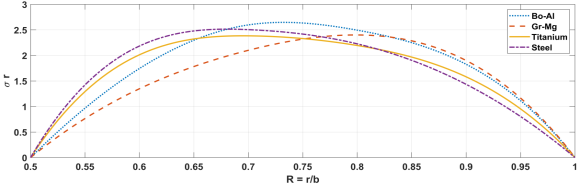
Figure 2. Radial creep stresses in a thick-walled rotating cylinder along radii ratio R. The legend Bo-Al for σrof boron-aluminum, Gr-Mgforσrofgraphite-magnesium, Titanium for σr of titanium and Steel for σr of steel.
In Figure 2, the distribution of radial creep stresses in the steady-state portion of the cylinder composed of steel, titanium, graphite-magnesium, and boron-aluminum materials vs radii ratio is depicted under the influence of angular speed and temperature. When comparing rotating thick cylinders made of boron-aluminum material to those constructed of graphite-magnesium, titanium, and steel, Figure 2 shows that the radial creep stress is highest at the central surface, whereas graphite-magnesium and titanium have the lowest value. Additionally, it can be seen that the transversely isotropic titanium and isotropic steel materials have higher radial creep stress values up to nearly the middlesurface than the orthotropic boron-aluminum and graphite materials. Furthermore, steel materials have higher radial creep stresses than titanium, boron-aluminum, and graphite-magnesium materials close to the cylinder's inner surface, while boron-aluminum materials have higher radial creep stress values than graphite-magnesium materials close to the cylinder's inner surface, with graphite-magnesium material having the lowest value among all other materials. Near the cylinder's outer surface, cylinders composed of orthotropic materials (boron-aluminum and graphite-magnesium) have a larger radial creep stress value than those made of titanium and steel. The radial creep stress of graphite-magnesium materials is higher close to the cylinder's outer surface than that of boron-aluminum materials. Steel cylinders have the lowest radial creep stress value close to the cylinder's outer surface.
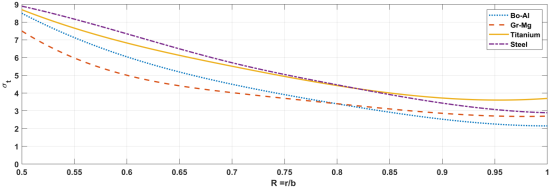
Figure 3. Tangential creep stresses in a thick-walled rotating cylinder along radii ratio R. The legend Bo-Al for σθof boron-aluminum, Gr-Mg for σθ of graphite-magnesium, Titanium for σθ of titanium and Steel for σθ of steel.
Figure 3 shows the distribution of tangential creep stress along with the radii ratio. As the radii ratio rises from the inner to the outer surface of a rotating cylinder, the tangential creep stress falls due to the influence of angular and thermal speed. From the inner to the outer surface of the cylinder, Figure 3 shows that the tangential creep stress for isotropic material (steel) and transversely isotropic material (titanium) is greater than the tangential creep stress of the cylinder composed of orthotropic boron-aluminum and graphite-magnesium materials. However, steel material has a larger tangential creep stress than titanium up to the cylinder's middle surface, whereas titanium has the highest tangential creep stress of all four materials close to its outer surface of the cylinder. Furthermore, up to the cylinder's center surface, tangential creep stress for boron-aluminum is greater than that of graphite-magnesium; nevertheless, near the cylinder's outside surface, the opposite is true.
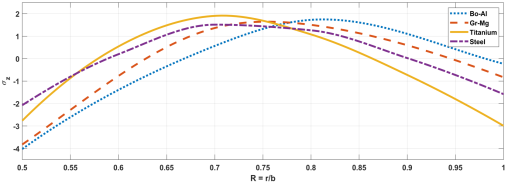
Figure 4. Axial creep stresses in a thick-walled rotating cylinder along radii ratio R. The legend Bo-Al for σz of boron-aluminum, Gr-Mg for σz of graphite-magnesium, Titanium for σz of titanium and Steel for σz of steel.
The axial creep stress along the radii ratio is presented in Figure 4. From the inner surface up to the middle surface of the cylinder, it is evident that the axial creep stress of the rotatingthick-cylinder composed of orthotropic materials: boron-aluminum and graphite-magnesiumis greater than that of the isotropic and transversely isotropic materials: steel and titanium respectively. Boron-aluminum has the highest axial creep stress on the inner surface. On the other hand, the inner surface of a steel cylinder has the least value of axial creep stress. At the outer surface of the cylinder, titanium and steel material has higher axial creep stress value than orthotropic materials. Furthermore, titanium has the highestaxial creep stress at the rotating thick-cylinder's outer surface, while boron-aluminum has the least. Boron-aluminum has the lowest axial creep stress, while titanium has the highest around the center.
5. Conclusions
This article presents the analytic solution of steady-state creep deformation in an orthotropic composite thick-walled rotating cylinder subjected to a thermal gradient using lebesgue strain measure theory and Seth's transition theory. The analytical solution considers only the principal stresses, meaning the transition occurs through the principal stress difference. Consequently, the asymptotic solution describes the onset of creep at a transitional point, governed by the principal stress difference, with a transition function defined to determine the stresses. Significant findings from this study include the following: It is observed that radial creep stress is greater at the center in titanium and steel cylinders, but higher near the outer surface in boron-aluminum and graphite-magnesium cylinders. Steel cylinders show higher tangential creep stress than titanium up to the mid-surface, while titanium surpasses steel, boron-aluminum, and graphite-magnesium near the outer surface. Boron-aluminum shows the highest axial creep stress at the inner surface, while steel has the lowest; at the outer surface, titanium and steel exceed boron-aluminum, and graphite-magnesium.
Abbreviations

a

Inner Radius (m)

Ai

Constants (dimensionless)

b

Outer Radius (m)

Cij

Material Constants (N/m 2)

d

Constants (dimensionless)

D

Constants (dimensionless)

eij

Strain Tensor (dimensionless)

n

Strain Measure Coefficients (dimensionless)

Ro

Radii Ratio at Inner Surface (dimensionless)

u, v, w

Displacement Components (m)

αi

Thermal Expansion Coefficient (1/℉)

βi

Thermalmoduli (𝑁/ 𝑚 2 ℉)

η

Function of 𝑟 Only

σij

Stress Tensor (𝑁/ 𝑚 2)

φ

Temperature (℉)

Φ

Transition Function

ω

Angular Velocity

Author Contributions
Temesgen Alemu Godana: Conceptualization, Investigation, Methodology, Software, Visualization, Writing-original draft, Writing- review & editing
Indu Bala: Writing- review & editing
Conflicts of Interest
The authors declare no conflicts of interest.
References
[1] Dieter, G. E. Jr. Mechanical metallurgy. New York, NY: McGraw-Hill; 1961, pp. 345–350.
[2] Finnie, I., Heller, W. R. Creep of engineering materials. New York, NY: McGraw-Hill; 1959.
[3] Wahl, A. M. A comparative study of elevated temperature creep in long rotatingcylinders based on various flow criteria. In: Proc. Third U.S. National Congress on Appl. Mech, ASME. 1958, 685-691.
[4] Sokolinikoff, I. S. Mathematical theory of elasticity. Second edition. New York, NY: McGraw-Hill; 1950, pp. 70-71.
[5] Timoshenko, S. P., Goodier, J. N. Theory of elasticity. 3rd ed. London: Mc Graw-Hall: 1951.
[6] Hetnarksi, R. B., Ignaczak, J. Mathematical theory of elasticity. New York, NY; Taylor and Francis; 2004, pp. 60.
[7] Parkus, H. Thermo-elasticity. New York, NY; Springer-Verlag Wien; 1976, pp. 30.
[8] Vicat, L. J. Description du pontsuspenduconstruit sur la Dordogne a` Argentat. 1830, pp. 17.
[9] Andrade, E. N. D. C. On the viscous flow in metals, and allied R. Soc. Lond. A, 1910, pp. 84.
[10] Dickenson, J. H. S. The flow of steels at a red heat, Engrn. 1930, 114, pp. 326, pp. 378.
[11] Nadai, A. Theory of flow and fracture of solids. New York, NY; McGraw-Hill; 1950.
[12] Hoffman, O., Sachs, G. Introduction to the theory of plasticity for engineers. New York, NY; McGrawHill; 1953.
[13] Davis, E. A., Connelly, F. M. Stress Distribution and Plastic Deformation in RotatingCylinders of Strain Hardening Material. Journal of Applied Mechanics. 1959, 26, 25-30.
[14] Hodge, P. G. Jr., Balaban, M. Elastic-plastic Analysis of a Rotating Cylinder. International Journal of mechanical sciences. 1962, 4(6), 465-476.
[15] Seddighi, H., Ghannad, M., Loghman, A., Nejad, M. Z. Creep Analysis of a Cylinder Subjectedto 2D Thermo-elasticity Loads and Boundary Conditions with Inner Heat Generation Source. Forces in Mechanics. 2024, 15, 100271.
[16] Singh, T., Gupta, V. K. Modeling Steady-state Creep Behavior of Functionally Graded ThickCylinder in the Presence of Residual Stress. Procedia Engineering. 2013, 55, 760 - 767.
[17] Bhatnagar, N. S., Arya, V. K. Large Strain Creep Analysis of Thick-walled Cylinders.International Journal of Non-Linear Mechanics. 1974, 9(2), 127-140.
[18] Savita, B., Singh, S. B. Investigation of Creep in Anisotropic Cylinder using Plane StressCondition. Structural Integrity and Life. 2025, 25(1), 106-110.
[19] Pushwinder, K., Singh, S.B., Jain, K. S. Creep Behaviour of Isotropic Pressure Vessel with Hemispherical end Subjected to Internal Pressure. Structural Integrity and Life. 2025, 25(1), 111-119.
[20] Seth, B. R. Creep Transition. Journal of Mathematical and Physical Sciences. 1972, 6(2), 1-5.
[21] Seth, B. R. Transition Theory of Creep rupture. MRC Technical Summary Report. 1962, 321.
[22] Seth, B. R. Transition Theory of Elastic-plastic Deformation, Creep and Relaxation. Nature. 1962, 195, 896-897.
[23] Seth, B. R. Elastic-plastic transitions in shells and tubes under pressure. Zamm. 1963, 43(7-8), 345-351.
[24] Seth, B. R. Finite Strain in Elastic Problems. Philos Trans R Soc London, Ser A 1935; 234(738): 231-264.
[25] Seth, B. R. Generalized strain and transition concepts for elastic, plastic deformation, creep and relaxation, in: Proc. XlthInt. Congr. Appl. Mech. Munich., 1964, 383-389.
[26] Seth, B. R. On the Problems of Transition Phenomenon, Bull. Inst. Politec. Roum. 1964, 10, 55-262.
[27] Seth, B. R. Measure-concept in mechanics, Int. J Non-Linear Mech. 1966, 1(1), 35-40.
[28] Sharma, S, Sahay, I, Ravindra, K. Thermo Elastic-plastic Transition of Transversely Isotropic Thick-walled Circular Cylinder under Internal and External Pressure. Multidiscipline Modeling in Materials and Structures. 2014, 10(2), 211-227.
[29] Temesgen, A. G., Singh, S. B., Pankaj, T. Modeling of Creep Deformation in an Internally Pressurized Transversely Isotropic Spherical Shell subjected to a Thermal Gradient. Mechanics of Solids, 2022, 57(4), 937-948.
[30] Gupta, S. K., Shukla, R. K., Elastic-plastic transition in an orthotropic shell under internal pressure. Indian J. pure appl. Math. 1991, 23(3), 243-250.
[31] Pankaj, T., Monika, S. Elastoplastic Deformation in an Orthotropic Spherical Shell Subjected to a Temperature Gradient. Mathematics and mechanics of solids. 2019, 25(1).
[32] Temesgen, A. G., Singh, S. B., Pankaj, T. Modeling of creep deformation of a transversely isotropic rotating disc with a shaft having variable density and subjected to a thermal gradient. Thermal Science and Engineering Progress. 2020, 20, 100745.
[33] Temesgen, A. G., Singh, S. B., Pankaj, T., Elastoplastic analysis in functionally graded thick-walled rotating transversely isotropic cylinder under a radial temperature gradient and uniform pressure. mathematics and mechanics. 2020, 26(1).
[34] Temesgen, A. G., Singh, S. B., Pankaj, T. Creep transition analysis in functionally graded thick-walled rotating transversely isotropic cylinder under a radial temperature gradient and uniform pressure. Structural Integrity and Life. 2020, 20(3), 285-296.
[35] Pankaj, T., Neeru, G., Kanav, G., Monika, S. Elastic-plastic transition in an orthotropic material disc. Structural Integrity and Life. 2020, 20(2), 169-172.
[36] Temesgen, A. G., Singh, S. B., Pankaj, T. Elastoplastic Modeling of an Orthotropic Boron-Aluminum Fiber-Reinforced Composite Thick-Walled Rotating Cylinder Subjected to a Temperature Gradient. Mechatronic Systems Design and Solid Materials: Methods and Practices. Apple Academic Press. 2021, 221-238.
Cite This Article
  • APA Style

    Godana, T. A., Bala, I. (2026). Modeling of Steady-State Creep Deformation in an Orthotropic Composite Thick-Walled Rotating Cylinder Subjected to a Thermal Gradient. Pure and Applied Mathematics Journal, 15(3), 45-55. https://doi.org/10.11648/j.pamj.20261503.12

    Copy | Download

    ACS Style

    Godana, T. A.; Bala, I. Modeling of Steady-State Creep Deformation in an Orthotropic Composite Thick-Walled Rotating Cylinder Subjected to a Thermal Gradient. Pure Appl. Math. J. 2026, 15(3), 45-55. doi: 10.11648/j.pamj.20261503.12

    Copy | Download

    AMA Style

    Godana TA, Bala I. Modeling of Steady-State Creep Deformation in an Orthotropic Composite Thick-Walled Rotating Cylinder Subjected to a Thermal Gradient. Pure Appl Math J. 2026;15(3):45-55. doi: 10.11648/j.pamj.20261503.12

    Copy | Download

  • @article{10.11648/j.pamj.20261503.12,
      author = {Temesgen Alemu Godana and Indu Bala},
      title = {Modeling of Steady-State Creep Deformation in an Orthotropic Composite Thick-Walled Rotating Cylinder Subjected to a Thermal Gradient},
      journal = {Pure and Applied Mathematics Journal},
      volume = {15},
      number = {3},
      pages = {45-55},
      doi = {10.11648/j.pamj.20261503.12},
      url = {https://doi.org/10.11648/j.pamj.20261503.12},
      eprint = {https://article.sciencepublishinggroup.com/pdf/10.11648.j.pamj.20261503.12},
      abstract = {The objective of this research is to use Lebesgue strain measure theory and Seth's transition theory to build a mathematical model of steady state creep deformation of an orthotropic thick-walled rotating cylinder subjected to a thermal gradient. Because Seth's theory does not require any assumptions, such as the creep deformation is infinitesimally small, creep strain laws and the associated flow rules, it is crucial for calculating creep stresses based on generalized strain measure theory and asymptotic solution at the turning points of the differential equations defining the deformed field. This theory's consideration of the material's nonlinear character is one of its advantages. The combined effects of temperature and angular speed have been presented numerically and graphically using examples of thick-walled cylinders made of orthotropic, transversely isotropic, and isotropic materials. It is observed that near the cylinder's outer surface, cylinders composed of orthotropic materials (boron-aluminum and graphite-magnesium) have a larger radial creep stress value than those made of titanium and steel. From the inner to the outer surface of the cylinder the tangential creep stress for isotropic material (steel) and transversely isotropic material (titanium) is greater than the tangential creep stress of the cylinder composed of orthotropic boron-aluminum and graphite-magnesium materials. At the outer surface of the cylinder, titanium and steel material has higher axial creep stress value than orthotropic materials. The findings of this paper can be useful in the analysis and design of a cylinder that is exposed to high temperatures, such as high-speed structures involving aerodynamic heating, chemical plants and nuclear plants.},
     year = {2026}
    }
    

    Copy | Download

  • TY  - JOUR
    T1  - Modeling of Steady-State Creep Deformation in an Orthotropic Composite Thick-Walled Rotating Cylinder Subjected to a Thermal Gradient
    AU  - Temesgen Alemu Godana
    AU  - Indu Bala
    Y1  - 2026/10/14
    PY  - 2026
    N1  - https://doi.org/10.11648/j.pamj.20261503.12
    DO  - 10.11648/j.pamj.20261503.12
    T2  - Pure and Applied Mathematics Journal
    JF  - Pure and Applied Mathematics Journal
    JO  - Pure and Applied Mathematics Journal
    SP  - 45
    EP  - 55
    PB  - Science Publishing Group
    SN  - 2326-9812
    UR  - https://doi.org/10.11648/j.pamj.20261503.12
    AB  - The objective of this research is to use Lebesgue strain measure theory and Seth's transition theory to build a mathematical model of steady state creep deformation of an orthotropic thick-walled rotating cylinder subjected to a thermal gradient. Because Seth's theory does not require any assumptions, such as the creep deformation is infinitesimally small, creep strain laws and the associated flow rules, it is crucial for calculating creep stresses based on generalized strain measure theory and asymptotic solution at the turning points of the differential equations defining the deformed field. This theory's consideration of the material's nonlinear character is one of its advantages. The combined effects of temperature and angular speed have been presented numerically and graphically using examples of thick-walled cylinders made of orthotropic, transversely isotropic, and isotropic materials. It is observed that near the cylinder's outer surface, cylinders composed of orthotropic materials (boron-aluminum and graphite-magnesium) have a larger radial creep stress value than those made of titanium and steel. From the inner to the outer surface of the cylinder the tangential creep stress for isotropic material (steel) and transversely isotropic material (titanium) is greater than the tangential creep stress of the cylinder composed of orthotropic boron-aluminum and graphite-magnesium materials. At the outer surface of the cylinder, titanium and steel material has higher axial creep stress value than orthotropic materials. The findings of this paper can be useful in the analysis and design of a cylinder that is exposed to high temperatures, such as high-speed structures involving aerodynamic heating, chemical plants and nuclear plants.
    VL  - 15
    IS  - 3
    ER  - 

    Copy | Download

Author Information