Research Article | | Peer-Reviewed

Cancer Antigen 15-3 and Carcinoembryonic Antigen Chemotherapeutic Response and Associated Hepato-Renal Toxicity in Cameroonian Cancer Patients

Received: 22 January 2026     Accepted: 2 February 2026     Published: 26 February 2026
Views:       Downloads:
Abstract

Background: Chemotherapy remains central to cancer management in sub-Saharan Africa but is frequently complicated by treatment resistance and cumulative hepato-renal toxicity. Longitudinal biomarker monitoring may improve early detection of subclinical organ dysfunction and therapeutic response. This study evaluated longitudinal changes in hepatic, renal, inflammatory, and tumor-associated biomarkers to elucidate chemotherapy response and resistance patterns among cancer patients receiving systemic therapy in Cameroon. Materials and Methods: A longitudinal observational study was conducted among 120 cancer patients treated at the Cameroon Oncology Centre (February-July 2025). Serum liver enzymes (aspartate aminotransferase (AST), alanine aminotransferase (ALT)), albumin, urea, creatinine-derived estimated glomerular filtration rate (eGFR), C-reactive protein (CRP) measurement was done once at the end of the chemotherapeutic period were measured at baseline and over three follow-up time points at two-month intervals, while cancer biomarkers, namely carcinoembryonic antigen (CEA), and cancer antigen 15-3 (CA15-3) were screened within two interval periods. Non-parametric analyses (Kruskal–Wallis, Friedman tests) assessed group differences and monotonic trends, while Spearman’s correlation evaluated treatment–biomarker associations. Results: Participants were predominantly female (77.5%), with advanced-stage disease (Stage III–IV: 59.2%). Liver enzymes remained largely stable throughout follow-up, indicating preserved hepatocellular integrity. In contrast, albumin exhibited a significant monotonic decline (−1.20%, p = 0.004), reflecting cumulative metabolic and inflammatory stress. Renal function showed a modest but significant decline in eGFR (−3.77%, p = 0.044), particularly among platinum-based regimens, despite stable urea levels. Tumour marker analysis revealed a pronounced and consistent reduction in CA15-3 (−12.98%, p = 0.006), whereas CEA showed no significant longitudinal trend. Drug-specific correlations supported time-dependent renal and hepatic effects, particularly with cisplatin and combination therapies. Conclusion: Longitudinal biomarker profiling reveals subclinical renal stress, systemic metabolic burden, and differential tumour marker responsiveness during chemotherapy. CA15-3 and eGFR emerged as sensitive indicators of treatment response and toxicity, underscoring the value of integrated biomarker monitoring in resource-limited oncology settings.

Published in Journal of Cancer Treatment and Research (Volume 14, Issue 1)
DOI 10.11648/j.jctr.20261401.12
Page(s) 9-27
Creative Commons

This is an Open Access article, distributed under the terms of the Creative Commons Attribution 4.0 International License (http://creativecommons.org/licenses/by/4.0/), which permits unrestricted use, distribution and reproduction in any medium or format, provided the original work is properly cited.

Copyright

Copyright © The Author(s), 2026. Published by Science Publishing Group

Keywords

Biomarkers, Cancer, Chemotherapy, Chemotherapy Resistance, Hepato-Renal Toxicity, CA15-3, CEA

1. Introduction
Cancer remains a leading cause of morbidity and mortality worldwide, with a disproportionate burden observed in low- and middle-income countries, including sub-Saharan Africa . Despite advances in early detection and therapeutic strategies, chemotherapy remains a cornerstone of cancer management, particularly in resource-limited settings where access to targeted therapies and immunotherapy is restricted . However, the clinical efficacy of chemotherapy is frequently compromised by the development of chemotherapy resistance, which represents a major obstacle to successful cancer treatment and long-term survival . Chemotherapy resistance may be intrinsic or acquired and is driven by complex biological mechanisms, including altered drug transport, enhanced DNA repair capacity, dysregulation of apoptosis, tumour microenvironmental adaptations, and systemic metabolic and inflammatory disturbances . Clinically, resistance often manifests as persistent or rising tumour marker levels, disease progression despite treatment, and worsening organ dysfunction, all of which may be detected through routine biochemical monitoring . Tumour markers such as carcinoembryonic antigen (CEA) and cancer antigen 15-3 (CA15-3) are widely used in oncology for monitoring treatment response, detecting recurrence, and assessing disease progression, particularly in breast and gastrointestinal malignancies . Failure of these markers to decline following chemotherapy, or their progressive elevation during treatment has been associated with poor therapeutic response and resistance . Nevertheless, tumour markers alone may not fully capture the systemic biological consequences of chemotherapy resistance, underscoring the need for integrative biomarker approaches.
Chemotherapeutic agents exert cytotoxic effects not only on malignant cells but also on normal tissues, particularly the liver and kidneys, which play central roles in drug metabolism and excretion . Hepatotoxicity and nephrotoxicity are common adverse effects of chemotherapy and may exacerbate treatment resistance by altering drug pharmacokinetics, increasing systemic inflammation, and limiting dose intensification . Biochemical markers such as alanine aminotransferase (ALT), aspartate aminotransferase (AST), albumin, creatinine, urea, and eGFR are therefore essential indicators of organ function during chemotherapy . Emerging evidence suggests that hepato-renal dysfunction is not merely a treatment side effect but may actively contribute to chemotherapy resistance by impairing drug clearance, promoting oxidative stress, and amplifying inflammatory signalling pathways . Inflammatory biomarkers, particularly C-reactive protein (CRP), have also been implicated in cancer progression and treatment resistance through modulation of tumour-host interactions and immune dysregulation . In sub-Saharan Africa, the challenge of chemotherapy resistance is compounded by late-stage presentation, environmental toxicant exposure, limited diagnostic resources, and high prevalence of comorbid conditions that may influence biochemical profiles . Despite this, data integrating tumour markers, inflammatory indices, and hepato-renal biomarkers as indicators of chemotherapy resistance in African cancer populations remains scarce.
Importantly, most studies assess chemotherapy response using cross-sectional designs, which may fail to capture dynamic biochemical changes over time. Longitudinal biomarker monitoring, particularly over clinically relevant intervals such as three months, provides a more robust framework for identifying resistance patterns, treatment-related toxicity, and trace signs of therapeutic failure . Given the multifactorial nature of chemotherapy resistance and the pivotal role of organ function in modulating treatment outcomes, this study was designed to evaluate biochemical signatures of chemotherapy resistance using an integrative panel of tumour markers, inflammatory markers, and hepatic and renal function biomarkers among cancer patients receiving chemotherapy in Cameroon. By adopting a biomarker-driven and longitudinal approach, this study aims to provide clinically relevant insights into chemotherapy resistance in a low-resource oncology setting and to inform improved therapeutic monitoring strategies.
2. Materials and Methods
Study design and period
This study was conducted as a combined cross-sectional and longitudinal observational investigation at the Cameroon Oncology Centre, Bekoko, Douala, Littoral Region of Cameroon, between February and July 2025. For the longitudinal component, biological samples were collected at baseline (Time 0) and at follow-up after an interval of two (2) months, while cancer markers were followed up and collected twice over the 6 months follow up period. The Cameroon Oncology Centre serves as a major referral oncology facility for patients from Douala and surrounding regions. Sample collection was carried out at the clinical collection unit, while all biochemical analytical tests were performed in the hospital laboratory under standardised operating conditions.
Study population and eligibility criteria
Cancer patients aged ≥19 years receiving chemotherapy during the study period were eligible for inclusion. Patients with documented pre-existing liver disease, renal disease, or confirmed hepatitis B or C viral infection were excluded to reduce confounding effects on hepatic and renal biomarkers. Participation was voluntary, and written informed consent was obtained from all participants before enrolment. Participant confidentiality was strictly maintained throughout the study.
Data collection
Data was collected using a well-structured questionnaire administered to each participant. Information obtained included sociodemographic characteristics (age, sex, marital status, educational level, region of origin, and religion), clinical characteristics (type of cancer, cancer stage, and affected organ), and treatment-related variables (chemotherapeutic agents, treatment combinations, and chemotherapy cycles).
Sample size calculation
The estimated sample size that used for this study was calculated according to the Daniel’s formula formula for simple random sampling: (n= (Zα2×p×1-p/L2); where, Zα= 95% confidence interval or limit; P = Approximate prevalence rate; L=Permissible or sampling error (5%). Assuming that about 8.5% of the inhabitants were suffering from cancer, the prevalence rate was equal to 0.085. Therefore, Zα = 0.95; P =0.085 and L= 0.05. Using these values, a minimum sample size (n) of 120 was required for the study.
Ethical considerations
Ethical approval was obtained from Regional Human Health Research Ethics Committee Littoral (N°2025/CE/CRERSH-LITTORAL). Administrative authorisation was granted by the Regional Delegation of Public Health (ref: N°1335/A/MINSANTE/SG/DOSTS/SDOD/SFSP), and the Cameroon Oncology Centre and written informed consent was obtained from all participants before sample collection.
Clinical sample collection
Five millilitres of venous blood were collected aseptically from each participant into plain tubes via venipuncture. Blood samples were centrifuged (5,000 xg, 10 min), and serum was separated and stored at -20°C until analysis. For the longitudinal assessment, repeat blood samples for biochemical analysis were collected from the same participants after a three-month interval, and cancer markers (CEA and CA15-3) were assessed at two time points, each following a three-months interval, after six therapeutic cycles of two weeks each per participants, to determine the resistance pattern.
Biochemical analyses
Biochemical assays
Serum creatinine was quantified using a colorimetric Jaffe reaction , with a commercial creatinine assay kit from Abbott Laboratories (Abbott Ltd, Illinois, USA). Briefly, 100 µL of serum sample was combined with 1 mL of working reagent, homogenized, and absorbance was measured at 505 nm using a biochemical analyser (ChenduEmpsun Medical Co., Ltd, Chengdu, China). The eGFR was calculated using the CKD-EPI equation , incorporating serum creatinine (SCr), age, and gender. The eGFR values were used to stage chronic kidney disease, following established protocols (KDIGO, 2013).
eGFR (mL/min/1.73 m2) =142×minScrκ,1α×maxScrκ,1-1.200×0.993age×1.012 (if female)(1)
Where: eGFR: Estimated Glomerular Filtration Rate, Scr: Serum Creatinine (mg/dL), κ (kappa): 0.7 for females, 0.9 for males, α (Alpha): -0.241 for females, -0.302 for males, min (-1) and max (+1): Functions to adjust based on whether Scr/k is < 1 or > 1.
Serum urea was measured using the enzymatic urease-glutamate dehydrogenase method . Serum urea was determined using a BIOLABO kit (ref No. 02160; BIOLABO, Maizy, France). Briefly, Reagents R1 and R2 from the kit were mixed to prepare the working solution. A 1,000 µL of the reagent mixture was pipetted into a cuvette, followed by the addition of 10 µL of serum. After incubation at 37°C for 5 minutes, 1,000 µL of reagent R3 was added and incubated for an additional 5 minutes. Absorbance was measured at 340 nm against a blank using a Lansio Bio bioanalyzer (L520201075, Lansion Biotechnology Co., Ltd., Nanjing, China). ALT and AST activities were measured using enzymatic kinetic methods . Commercial assay kits from BIOLABO (Maizy, France) were used. For each assay, 800 µL of reagent R1, 200 µL of reagent R2, and 100 µL of serum were mixed and incubated preincubated at room temperature for 5 minutes. Absorbance was measured at 340 nm using the LansioBio L520201075 semi-automated analyser (LansioBio L520201075, Lansion Biotechnology Co., Ltd, Nanjing, Jiangsu Province, China). Serum albumin concentration was measured using the bromocresol green (BCG) dye-binding method, in which albumin binds to BCG at acidic pH to form a coloured complex proportional to albumin concentration . Briefly, a blank solution (1,000 µL reagent + 10 µL distilled water) and a standard solution (1,000 µL reagent + 10 µL standard) were prepared. The sample solution was prepared following the same protocol and incubated for minutes. After incubation for 5 minutes, absorbance was read at 500 nm using the Lansio Bioanalyzer.
Tumour marker assessment and chemotherapy resistance
The study utilized Cancer Antigen 15-3 (CA15-3) and Carcinoembryonic Antigen (CEA) to track disease burden and therapeutic efficacy. These biomarkers are established tools for identifying treatment response and the emergence of drug resistance in solid malignancies. The combined use of CA15-3 and CEA allows complementary assessment of tumor dynamics across a heterogeneous cancer population, enhancing sensitivity for detecting differential treatment responses and resistance patterns over time .
Metastatic cells marker for breast, ovarian, lung and prostate Cancer Antigen 15-3 (CA15-3) was measured using a commercially available sandwich enzyme-linked immunosorbent assay (MBS701293, MyBioSource, Inc, California, US). Briefly, 25 µL of diluted serum (dilution factor of 0.3) and 100 µL of biotin-labelled antibody were added to microplate wells and incubated for 60 minutes. Wells were washed three times, followed by the addition of enzyme conjugate and further incubation. A 100 µL substrate solution was added and incubated for 20 minutes, after which the reaction was stopped, and absorbance read at 450nm. The CA15-3 levels in samples were determined using a standard curve prepared alongside serum samples analysis. Metastatic cells marker for (colorectal, breast, lung and ovarian cancer) Carcinoembryonic Antigen (CEA) concentration was determined using a fluorescence immunoassay, based on the formation of antigen–antibody complexes detected by fluorescence emission intensity . Determination of CEA levels were measured using commercially available RDT kit (Accu-Tell CEA Rapid Test Cassette, AccuBioTech, China). Briefly, 100 µL of serum was mixed with 300 µL of sample diluent, and 100 µL of the mixture was applied to the test well of the assay card. The card was inserted into a dry fluoroimmunoassay analyzer (Getein 1160 Quantitative Immunoassay Analyser, Wuhan Aliroad Medical Equipments Co., Ltd, China), and results were read after 10 minutes.
Systemic inflammation
The systemic inflammation was assessed by C-Reactive Proteins (CRP) using thelatex agglutination method, allowing semi-quantitative estimation . Briefly, Serial dilutions of serum were prepared using saline. Fifty microliters of latex reagent was added to each reaction circle, mixed gently, and observed for visible agglutination. CRP was assessed semi quantitatively at the end of the treatment period to determine the level of inflammation linked to the treatment outcome at the end of the study period.
Statistical analysis
Data were entered into Microsoft Excel and analysed using SPSS v25. Descriptive statistics summarized demographic, clinical, and biochemical variables. Data was tested for normality using skewness and Kurtosis (-2 to +2). Continuous variables were expressed as medians and interquartile ranges using the Kruskal-Wallis test, while categorical variables were presented as frequencies and percentages. Group comparisons were performed using a nonparametric test. The Friedman test was used to test for monotonic directional changes in biomarker within the chemotherapy over time, while Spearman’s rank correlation coefficient (ρ) was used to assess the strength and direction of monotonic associations between chemotherapeutic agents, clinical variables, and biomarker levels at each follow-up time point. Statistical significance was set at p < 0.05.
3. Results
Socio-demographic characteristics
The cohort was predominantly female (77.5%), reflecting the high representation of breast and cervical cancer cases (Table 1). Participants were predominantly older adults, with more than half aged 60 years or older. Most patients presented with advanced disease, with stage III–IV cancers accounting for nearly 60% of cases, highlighting delayed diagnosis and potential treatment-related organ stress. The distribution of chemotherapeutic agents showed heterogeneity, with cisplatin-based regimens (20.0%) (Table 1, Table A1). Bi-therapy was the predominant treatment modality (47.2%). Overall, this finding establishes a population with substantial disease burden and treatment intensity, following the longitudinal monitoring of liver, kidney, and cancer resistance biomarkers (Table A1). The most prevalent cancer type was breast cancer, accounting for 35.0%, while the least recorded cancer type was lung cancer at 4.2%. Carcinoma was the highest form of cancer in the study (96.7%), while sarcoma and triple negative were the least, with each accounting for only 0.8% (Table 1).
Table 1. Clinical profile and treatment characteristics of participants.

Variable

Category

n (%)

Sex

Male

27 (22.5)

Female

93 (77.5)

Total

120 (100)

Age (years)

≥60

63 (52.5)

<60

57 (47.5)

Cancer stage

Stage I–II

22 (18.3)

Stage III–IV

71 (59.2)

Chemotherapy agents

Adriblastin

13 (10.8)

Cyclophosphamide

21 (17.5)

Cysplastin

24 (20.0)

5 Flu

15 (15.5)

Carboplatin

22 (18.3)

Transtuzumab

6 (5.0)

Therapy type

Monotherapy

32 (26.7)

Bi-Therapy

59 (47.2)

Tri-therapy

19 (15.8)

Tetra-therapy

10 (8.3)

Total

120 (100.0)

Cancer types

Breast

42 (35.0)

Cervix

31 (25.8)

Colorectum

7 (5.8)

Head and neck

7 (5.8)

Lung

5 (4.2)

Nasopharyngeal

9 (7.5)

Prostate

11 (9.2)

Others

8 (6.7)

Total

120 (100.0)

Forms of cancer

Carcinoma

116 (96.7)

Sarcoma

3 (2.5)

Triple negative

1 (0.8)

Total

120 (100.0)

The population size was n=120, Data are presented as frequency (percentage). Cancer stage was classified according to standard Tumour Nodes Metastasis (TNM) criteria. Therapy type reflects the number of chemotherapeutic agents administered concurrently. Detailed regional distribution and specific chemotherapeutic agents are presented in the appendix materials.
Liver and kidney functions in the cohort
Table 2 presents the longitudinal evolution of liver and kidney function biomarkers across three time points. Mean AST levels remained stable over time, with no statistically significant within-subject change (p > 0.05). Similarly, ALT levels showed a 0.9% increase from Time 1 to Time 2 (20.45 ± 11.65 to 21.98 ± 12.38 U/L), followed by stabilization at Time 3 (21.20 ± 11.82 U/L, p > 0.05). The AST/ALT ratio remained stable across follow-up. Albumin concentrations exhibited a transient decline at Time 2 (31.66 ± 8.37 to 28.36 ± 8.24 g/L) with partial recovery at Time 3 (30.59 ± 11.07 g/L), though this pattern did not reach statistical significance (p > 0.05). Overall, these findings indicate preserved hepatic function over time in the cohort (age-stratified details inTable A2).
For kidney biomarkers, the mean urea concentrations remained largely stable across time points, with no statistically significant change (p > 0.05). Estimated glomerular filtration rate (eGFR) showed a modest decline from Time 1 to Time 2 (125.50 ± 19.44 to 121.52 ± 22.27 mL/min/1.73 m²), followed by stabilisation at Time 3 (122.61 ± 20.02 mL/min/1.73 m²); however, these changes were not statistically significant (p > 0.05). Collectively, the data indicate preserved renal function during longitudinal follow-up (age-stratified details inTable A2).
Table 2. Longitudinal liver and kidney function biomarkers in the general population.

Biomarker

Average

T1 (Baseline)

T2 (3 months)

T3 (6 months)

P value

AST (U/L)

25.92 ± 11.72

26.54 ± 12.78a

24.65 ± 11.65a

26.57 ± 10.74a

0.235

ALT (U/L)

21.21 ± 11.93

20.45 ± 11.65a

21.98 ± 12.38a

21.20 ± 11.82a

0.347

AST/ALT

1.45 ± 1.33

1.45 ± 1.78a

1.29 ± 1.17a

1.61 ± 1.05a

0.211

Albumin (g/L)

30.20 ± 9.23

31.66 ± 8.37a

28.36 ± 8.24a

30.59 ± 11.07a

0.305

Urea (mg/dL)

33.39 ± 10.70

33.95 ± 10.88a

33.79 ± 10.65a

32.42 ± 10.56a

0.634

eGFR (mL/min/1.73 m²) (CKD Stage)

93.54 ± 21.31

125.50 ± 19.44a(Normal)

121.52 ± 22.27a (Normal)

122.61 ± 20.02a (Normal)

0.764

Values represent Mean ± SD for ANOVA with Bonferroni post hoc test, significant p < 0.05. No statistically significant longitudinal change in liver biomarkers across follow-up. T1 to T3 represent collection points at an interval of 3 months for each collection.
Chemotherapeutics and kidney biomarker response
The drug-specific longitudinal effect on renal biomarkers is illustrated in Table 3. Across most chemotherapeutic agents, urea concentrations remained relatively stable over time, with no statistically significant within-drug changes (p > 0.05). However, the eGFR showed time-dependent variation according to drug exposure. Patients receiving cisplatin-based regimens exhibited a progressive reduction in mean eGFR across follow-up, with lower values observed at Time 3 compared with baseline, reaching statistical significance (p < 0.05). In contrast, cyclophosphamide- and adriblastine-treated patients maintained eGFR within normal ranges at all time points, with no significant longitudinal decline (p > 0.05). Regimens incorporating capecitabine and paclitaxel showed mild fluctuations in eGFR, but these changes did not reach statistical significance. Overall, the renal data indicate drug-dependent and time-specific modulation of kidney function, with platinum-based therapy demonstrating the most pronounced longitudinal effect.
Chemotherapeutics and liver biomarker response
Table 3 presents detailed longitudinal liver enzyme patterns stratified by chemotherapy agent. Adriblastine-treated patients showed minimal AST variation across Time 1 to Time 3 (p = 0.678), with ALT levels remaining largely unchanged, indicating biochemical stability over follow-up. In contrast, cyclophosphamide exposure was associated with statistically significant changes in AST/ALT ratio (p < 0.035), with /ASTALT values induced a decline from Time 1 to Time 2 and partial recovery at Time 3 (p < 0.035). This pattern reflects a transient, time-specific alteration in hepatocellular enzyme balance. Paclitaxel- and toxol-based regimens demonstrated modest elevations in AST and AST/ALT ratio at mid-follow-up (Time 2), followed by stabilization at Time 3, though these changes were not consistently statistically significant (p > 0.05). Across all drugs, no progressive or cumulative increase in transaminases was observed, and enzyme values largely remained within clinically acceptable ranges. Collectively, the findings indicate drug-specific longitudinal hepatic enzyme alterations with possible reversibility in some cases.
Table 3. Effect of chemotherapy agents on kidney function biomarkers of the patients.

Drug

Biomarkers

Average

T1 (At enrolment -Baseline)

T2 (After 3 months)

T3 (After 6 months)

P value

Adriblastine (n=13)

Urea (mg/dL)

33.39 ± 10.70

38.28 ± 9.01a

26.47 ± 11.39a

32.50 ± 9.36a

0.091

eGFR (mL/min/1.73 m²)

93.54 ± 21.31

90.60 ± 10.06b (Stage 1)

76.64 ± 14.64a (Stage 2)

75.35 ± 16.38a (Stage 2)

0.001

Cyclophosphamide (n=21)

Urea (mg/dL)

33.39 ± 10.70

35.02 ± 9.10a

27.97 ± 11.02a

31.04 ± 10.90a

0.321

eGFR (mL/min/1.73 m²)

93.54 ± 21.31

89.06 ± 10.75a (Stage 2)

79.49 ± 18.09a (Stage 2)

76.22 ± 16.80a (Stage 2)

0.072

Cisplatin (n=24)

Urea (mg/dL)

33.39 ± 10.70

34.30 ± 12.42a

35.79 ± 9.60a

34.73 ± 12.03a

0.741

eGFR (mL/min/1.73 m²)

93.54 ± 21.31

76.93 ± 17.11a (Stage 2)

75.24 ± 22.66a (Stage 2)

81.33 ± 16.53a (Stage 2)

0.074

5-Flu (n=15)

Urea (mg/dL)

33.39 ± 10.70

30.36 ± 10.92a

32.90 ± 12.20a

36.77± 10.12a

0.876

eGFR (mL/min/1.73 m²)

93.54 ± 21.31

81.28 ± 18.45a (Stage 2)

85.52 ± 18.74a (Stage 2)

81.70 ± 26.00a (Stage 2)

0.437

Carboplatin (n=22)

Urea (mg/dL)

33.39 ± 10.70

34.05 ± 11.88a

32.35 ± 10.43a

32.01 ± 10.44a

0.765

eGFR (mL/min/1.73 m²)

93.54 ± 21.31

88.65 ± 16.97a (Stage 2)

81.49 ± 25.15a (Stage 2)

78.01 ± 16.60a(Stage 2)

0.132

Transtuzumab (n=6)

Urea (mg/dL)

33.39 ± 10.70

25.65 ± 7.35a

30.25 ± 12.82b

35.37 ± 13.31b

0.002

eGFR (mL/min/1.73 m²)

93.54 ± 21.31

97.88 ± 11.24a(Normal)

93.00 ± 11.52a (Normal)

105.35 ± 27.67a (Normal)

0.589

Adriblastine (n=13)

AST (U/L)

25.92 ± 11.72

28.19 ± 9.36

25.02 ± 13.15

29.71 ± 8.52

0.998

ALT (U/L)

21.21 ± 11.93

24.63 ± 12.76a

22.09 ± 12.83a

21.08 ± 11.29a

0.678

De Ritis ratio (AST/ALT)

1.45 ± 1.33

1.33 ± 0.65a

1.43 ± 0.96a

1.68 ± 0.76a

0.212

Cyclophosphamide (n=21)

AST (U/L)

25.92 ± 11.72

28.56 ± 8.53a

26.77 ± 11.25a

29.30 ± 8.56a

0.112

ALT (U/L)

21.21 ± 11.93

19.39 ± 12.22a

24.18 ± 11.02a

23.29 ± 10.78a

0.321

De Ritis ratio (AST/ALT)

1.45 ± 1.33

2.12± 0.42b

1.33 ± 0.17a

1.53 ± 0.17ab

0.035

Cisplatin (n=24)

AST (U/L)

25.92 ± 11.72

21.83 ± 6.86a

23.43 ± 10.23a

24.59 ± 10.29a

0.411

ALT (U/L)

21.21 ± 11.93

16.04± 9.23a

21.19 ± 14.02b

18.11± 12.06b

0.042

De Ritis ratio (AST/ALT)

1.45 ± 1.33

1.05 ± 0.42a

1.86 ± 0.26a

1.05 ± 0.42a

0.222

5-Flu (n=15)

AST (U/L)

25.92 ± 11.72

25.05 ± 8.44a

28.01 ± 13.88a

25.58 ± 7.42a

0.212

ALT (U/L)

21.21 ± 11.93

17.97 ± 8.61a

23.53 ± 11.89b

16.62 ± 8.40a

0.004

De Ritis ratio (AST/ALT)

1.45 ± 1.33

1.71 ± 0.25a

1.50 ± 0.19a

1.93 ± 0.28a

0.921

Carboplatin (n=22)

AST (U/L)

25.92 ± 11.72

24.52 ± 9.78a

25.32± 10.85a

25.40 ± 12.76a

0.671

ALT (U/L)

21.21 ± 11.93

19.28 ± 10.54a

18.79 ± 12.39a

19.13 ± 12.24a

0.478

De Ritis ratio (AST/ALT)

1.45 ± 1.33

1.47 ± 0.58a

1.64 ± 0.22a

1.71 ± 0.27a

0.989

Transtuzumab (n=6)

AST (U/L)

25.92 ± 11.72

25.80 ± 10.17a

32.38 ± 17.33a

33.65 ± 18.04a

0.121

ALT (U/L)

21.21 ± 11.93

21.13 ± 9.34a

18.50 ± 4.82a

22.78 ± 5.95a

0.071

De Ritis ratio (AST/ALT)

1.45 ± 1.33

1.53 ± 0.38a

2.11 ± 0.38a

1.83 ± 0.57a

0.056

Data are presented as mean ± standard deviation (SD). Kidney and liver function biomarkers were measured at baseline (Time 1), mid-follow-up (Time 2), and end-follow-up (Time 3). Data with different letter are significantly different, p-value < 0.05. Non-parametric statistical comparisons across chemotherapy agents were performed using the Kruskal–Wallis test, and longitudinal within-agent changes were evaluated using the Friedman test. eGFR was calculated using a standard creatinine-based equation (CKD-EPI).
Cancer treatment response during the follow up
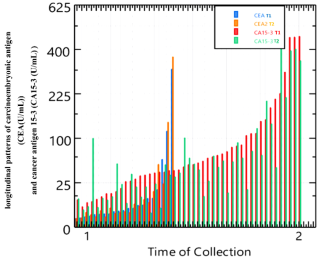
Table 4 presents the changes in cancer resistance biomarkers expressed as medians with interquartile ranges. CEA levels remained stable over time, with median values of 4.12 U/mL (IQR: 2.28–12.21) at baseline and 4.10 U/mL (IQR: 2.30–14.25) at follow-up, showing no statistically significant change (p = 0.545). In contrast, CA15-3 levels demonstrated a significant temporal reduction from 49.49 U/mL (IQR: 27.00–106.60) to 41.80 U/mL (IQR: 12.11–73.30), corresponding to a statistically significant longitudinal change (p = 0.004). This decline suggests a treatment-associated response over time, particularly relevant for breast cancer patients. Longitudinal assessment revealed no consistent age-related temporal pattern for CRP or CEA (Table A2).
Table 4. Longitudinal cancer resistance biomarkers.

Biomarker

Time 1 (After 3 months)

Time 2 (After 6 months)

p-value

CEA (U/mL)

4.12 (IQR: 2.28–12.21)

4.10 (IQR: 2.30–14.25)

0.545

CA15-3 (U/mL)

49.49 (IQR: 27.00–106.6)

41.80 (IQR: 12.11–73.30)

0.004

The Interquartile Range (IQR) is the range between the 25th percentile (Q1) and the 75th percentile (Q3). It represents the middle 50% of the data, excluding extreme low and high values.
T1, T2 represent Time point 1 and Time point 2 intervals of collection.

Download: Download full-size image

Figure 1. CEA and CA15-3 Changes over time of chemotherapy.
Figure 1 presents the combined longitudinal patterns of carcinoembryonic antigen (CEA) and cancer antigen 15-3 (CA15-3) during the course of chemotherapy, providing an integrated visual assessment of tumor biomarker dynamics over time. The figure clearly demonstrates differential responsiveness of the two biomarkers to treatment exposure. While CEA values exhibited wide dispersion and minimal shift in central tendencies between baseline and follow-up, CA15-3 showed a distinct downward trajectory, indicating a treatment-associated biological response. The stability of CEA across the chemotherapy period suggests that this marker is relatively insensitive to short-term therapeutic effects in this heterogeneous cancer cohort. In contrast, the marked reduction in CA15-3 over time reflects effective suppression of tumor activity, particularly in malignancies characterized by MUC-1 overexpression. The consistent decline observed across participants suggests that CA15-3 captures biologically meaningful reductions in tumor cell turnover and circulating tumor antigen shedding during chemotherapy. This pattern supports its role as a sensitive indicator of treatment response and a potential early marker for identifying therapeutic efficacy or emerging resistance.
Chemotherapeutics, albumin, inflammation and cancer resistance
Table 5 highlights distinct longitudinal responses of cancer resistance biomarkers to different chemotherapies. CEA levels showed variable responses across drugs, with adriblastine-treated patients exhibiting a significant increase in CEA from Time 1 to Time 2 (p = 0.001). These findings indicate marker- and drug-specific sensitivity of CEA. In contrast, CA15-3 demonstrated a consistent and statistically significant longitudinal decline across several chemotherapy agents, particularly in combination regimens. In adriblastine-treated patients, CA15-3 values decreased markedly over follow-up (p < 0.01), indicating a sustained treatment-associated reduction. Albumin levels showed mild temporal variation, with transient reductions at Time 2 (3rd month collection) in higher-intensity regimens, followed by recovery at Time 3 (6th month collection), although these changes did not reach statistical significance (p > 0.05). CRP levels displayed wide certain variability among drugs with carboplatin (42.52 ± 8.94) demonstrating the highest inflammatory levels. Overall, CA15-3 emerged as the most responsive longitudinal cancer marker to chemotherapy exposure.
Table 5. Albumin, CRP and Cancer resistance markers stratified by chemotherapeutic regiments over time.

Drugs

Albumin (g/L)

T1 (At enrolment -Baseline)

T2 (After 3 months)

T3 (After 6 months)

P value

Average

30.20 ± 9.23

Adriblastine (n=13)

29.04 ± 3.11a

28.85 ± 7.94a

33.44 ± 7.28a

0.345

Cyclophosphamide (n=21)

31.39 ± 5.94a

29.22 ± 7.13a

31.88 ± 7.86a

0.690

Cisplatin (n=24

34.39 ± 8.46a

28.40 ± 8.82a

33.30 ± 15.88a

0.783

5-Flu (n=15)

32.51 ± 7.68a

29.14 ± 8.73a

32.26 ± 13.19a

0.135

Carboplatin (n=22

27.83 ± 7.15a

25.93 ± 8.43a

29.46 ± 9.96a

0.246

Transtuzumab (n=6)

29.02 ± 7.27b

25.35 ± 5.53a

31.90 ± 12.26b

0.049

Drugs

CRP

CEA (U/mL)

CA15-3 (U/mL)

T1 (After 3 months)

T2 (After 6 months)

P

T1 (After 3 months)

T2 (After 6 months)

p

Average

21.64 ± 2.89

29.32 ± 16.83

84.73 ± 16.43

Adriblastine (n=13)

18.31 ± 7.59

27.45 ± 15.57a

31.19 ± 18.09a

0.094

74.77 ± 20.31a

91.81 ± 35.85b

0.001

Cyclophosphamide (n=21)

21.00 ± 7.09

27.45 ± 15.57a

31.19 ± 18.09a

0.078

66.93 ± 14.11a

74.62 ± 23.50a

0.123

Cisplatin (n=24

16.75 ± 5.39

34.59 ± 31.27a

39.72 ± 36.37a

0.765

27.72 ± 17.39a

108.89 ± 99.33b

0.001

5-Flu (n=15)

24.29 ± 9.11

10.82 ± 7.19a

26.53 ± 23.48a

0.567

83.72± 19.48a

96.52 ± 27.81a

0.421

Carboplatin (n=22

42.52 ± 8.94

76.89 ± 60.71a

80.92 ± 71.62a

0.329

120.80 ± 47.48a

100.98 ± 38.58a

0.245

Transtuzumab (n=6)

11.17 ± 7.38

27.45 ± 15.57a

31.19 ± 18.09a

0.745

52.52 ± 16.42a

34.07 ± 10.65b

0.042

Results are presented as median (interquartile range, IQR) for cancer resistance biomarkers, including carcinoembryonic antigen (CEA), CA15-3, C-reactive protein (CRP), and albumin. Biomarker measurements were obtained at Time 1, Time 2, and Time 3. Differences across chemotherapy agents at each time point were analysed using the Kruskal–Wallis test, while longitudinal trends within agents were assessed using the Friedman test. Data with different letter are significantly different, p-value < 0.05.
Biomarkers across chemotherapeutic regimens
Table 6 evaluates the influence of chemotherapy regimen intensity on longitudinal biomarker trajectories. No significant regimen-related effects were observed for AST, ALT, AST/ALT ratio, albumin, urea, CEA, or CA15-3 (all p > 0.05). However, eGFR at Time 3 differed significantly across regimens (p = 0.006), with lower mean values observed in patients receiving more intensive therapy. This finding suggests a potential cumulative regimen-dependent renal effect emerging over time (Table 6 and Table A3).
Table 6. Effect of combination chemotherapy regimen on longitudinal biomarker changes.

Biomarker

Significant effect across regimens

p-value

AST (U/L)

No

>0.05

ALT (U/L)

No

>0.05

AST/ALT

No

>0.05

Albumin (g/L)

No

>0.05

Urea (mg/dL)

No

>0.05

eGFR (mL/min/1.73 m²), (Time 3)

Yes (Tetratherapy effects)

0.006

CEA (U/mL)

No

>0.05

CA15-3 (U/mL)

No

>0.05

Detailed mixed-effects outputs are provided in Table A3.
Biomarker performance over the treatment period
Table 7 presents the absolute percentage change (ΔT3–T1) and Friedman test results assessing monotonic directional changes in biomarker levels over the chemotherapy period. Urea showed a slight absolute reduction of -1.53%, with no statistically significant monotonic change across time points (χ² = 2.025, df = 2, p = 0.363), indicating overall stability of urea levels during follow-up. In contrast, eGFR demonstrated a statistically significant decline of -3.77% from baseline to Time 3, with the Friedman test confirming a significant monotonic change over time (χ² = 3.499, df = 2, p = 0.044), indicating a consistent directional reduction in renal filtration capacity during chemotherapy. Hepatic enzymes AST exhibited a negligible absolute change (−0.01%), with no significant monotonic trend (χ² = 3.780, df = 2, p = 0.151) across the treatment period, while ALT showed a small increase of 0.75% that was not statistically significant (χ² = 0.151, df = 2, p = 0.927). Similarly, the AST/ALT ratio increased minimally by 0.16%, without evidence of a significant directional change over time (χ² = 1.832, df = 2, p = 0.400), suggesting preserved hepatocellular enzyme balance throughout follow-up. Albumin demonstrated a statistically significant monotonic decline over the chemotherapy period, with an absolute reduction of −1.20% and a significant Friedman test result (χ² = 11.24, df = 2, p = 0.004), indicating a consistent downward trend across time points. Among cancer resistance biomarkers, CEA showed a modest absolute increase of 3.74%, but without a significant monotonic trend (χ² = 0.121, df = 1, p = 0.990). In contrast, CA15-3 exhibited a pronounced absolute reduction of −12.98%, with the Friedman test confirming a statistically significant monotonic decrease over time (χ² = 7.68, df = 1, p = 0.006). Overall, the analysis identifies eGFR, albumin, and CA15-3 as the biomarkers demonstrating significant and consistent directional changes during chemotherapy, while urea and liver enzymes remained largely unchanged.
Table 7. Friedman test analysis of absolute biomarker changes during the chemotherapy period.

Markers

N

 T3-T1 (%)

X2

Df

P

CI (LB-UB)

Urea

120

-1.53 (-0.0153)

2.025

2

0.363

0.354 – 0.373

eGFR

120

-3.77 (-0.0377)

3.499

2

0.044

0.164 – 0.178

AST

120

-0.01 (0.0001)

3.780

2

0.151

0.144 – 0.158

ALT

120

0.75 (0.0075)

0.151

2

0.927

0.925 – 0.935

AST/ALT

120

0.16 (0.0016)

1.832

2

0.400

0.410 – 0.429

Albumin

120

-1.20 (-0.0120)

11.24

2

0.004

0.003 – 0.005

CEA

120

3.74 (0.0374)

0.121

1

0.990

0.998 – 1.00

CA15-3

120

-12.98 (0.1298)

7.68

1

0.006

0.006 – 0.010

Values represent absolute percentage change from baseline to end of follow-up (ΔT3–T1). Friedman’s test was used to assess monotonic directional changes in biomarker levels across repeated measurements during chemotherapy. X2 denotes the Friedman`s chi squared test statistic with corresponding degrees of freedom (df). Monte Carlo exact significance was applied where appropriate. A p-value < 0.05 was considered statistically significant. CI indicates the 95% confidence interval for the estimated change.
Wilcoxon signed-rank test for biomarker change over time
A Wilcoxon signed-rank test was conducted to determine the effect of time on several medical markers (CEA, CA15-3, AST, ALT, eGFR, and Albumin). The results indicated a statistically significant decrease in CA15-3 levels between the first and second time points (Z = -2.804, p < 0.005). Specifically, 70.2% of the 120 participants showed a decrease in CA15-3 levels over time while 29.8% showed increase. No statistically significant differences were observed for the remaining markers CEA, AST, ALT and albumin (p > 0.05). While the change in eGFR did not reach significance (z = -1.793, p > 0.073), a notable trend toward a decrease was observed, with 57.1% of the participants showing lower levels at the 3rd time point compared to 42.9% participants with higher levels Table 8.
Table 8. Time variation comparison of tumour markers and biochemical parameters using Wilcoxon Signed-Rank test.

Test Pair (Time 3 – Time 1)

N

Z-score

P Value

Monte Carlo Sig. (2-tailed)

Result Interpretation

AST T3 – T1

120

-0.610

0.542

0.333

No Significant Change

ALT T3 – T1

120

-0.064

0.949

0.952

No Significant Change

eGFR T3 – T1

120

-1.793

0.073

0.077

No Significant Change (Trend observed)

Alb T3 – T 1

120

-1.188

0.235

0.243

No Significant Change

CEA T2 – T1

120

-1.008

0.313

0.333

No Significant Change

CA15-3 T2 - T 1

120

-2.804

0.005

0.005

Significant decrease observed

Z-score is reported as a negative value to represent the direction of ranks provided by the output. P values were considered significant at p < 0.05 and Monte Carlo sig. p-value as standard and adds robustness to findings, Wilcoxon Signed-Rank test.
Spearman correlation analysis
Spearman’s rank correlation analysis revealed predominantly weak-to-moderate, time-dependent associations between demographic factors, chemotherapeutic agents, and longitudinal biomarker levels. Sex showed a weak positive correlation with monotherapy exposure (ρ = 0.186, p = 0.042), while age demonstrated a strong and consistent positive correlation with CEA levels at Time 1 (ρ = 0.592, p = 0.005) and Time 3 (ρ = 0.645, p = 0.002), indicating increasing tumor marker levels with advancing age over follow-up. The Spearman’s rank correlation analysis also confirmed time-dependent, drug-specific monotonic associations, with cyclophosphamide showing significant negative correlations with urea at Time 2 (ρ ≈ −0.22, p < 0.05), consistent with the stable urea patterns observed in Table 6.
Longitudinal drug–biomarker correlations revealed time-specific effects, with cisplatin demonstrating a significant inverse correlation with eGFR at Time 1 (ρ =-0.197, p < 0.032) (Table 9), supporting its early renal impact. For liver biomarkers, capecitabine and paclitaxel correlated positively with AST/ALT ratio at Time 2 (p < 0.05), aligning with the transient hepatic enzyme shifts reported in Table 7. Capecitabine showed a positive association with AST/ALT ratio at Time 2 (ρ = 0.220, p = 0.016) alongside an inverse correlation with urea at Time 1 (ρ = −0.212, p = 0.021) and a positive correlation with eGFR at Time 3 (ρ = 0.182, p = 0.048). Paclitaxel exposure was negatively correlated with urea at Time 3 (ρ = −0.188, p = 0.040) and positively correlated with AST/ALT ratio at Time 2 (ρ = 0.227, p = 0.013). Toxol showed an inverse correlation with albumin at Time 1 (ρ = −0.245, p = 0.007) and a positive correlation with CRP (ρ = 0.233, p = 0.015). Combination regimen 4AC60 was positively and inversely correlated Time 2 with AST/ALT ratio (ρ = 0.261, p = 0.004) and ALT (ρ = −0.204, p = 0.002), respectively. Trastuzumab exposure demonstrated positive correlations with eGFR at Time 1 (ρ = 0.198, p = 0.031) and Time 3 (ρ = 0.233, p = 0.011), as well as with AST/ALT ratio at Time 2 (ρ = 0.202, p = 0.028). Treatment intensity analysis showed that monotherapy and tetra-therapy were inversely and positively correlated at Time 3 with ALT (ρ = −0.229, p = 0.013), and AST/ALT ratio (ρ = 0.236, p = 0.010), respectively. Importantly, CA15-3 showed significant negative correlations with treatment exposure over time, reinforcing the consistent decline observed in Table 8. No strong correlations (ρ ≥ 0.7) were identified, indicating graded longitudinal biomarker responses rather than abrupt changes (Table 9).
Table 9. Spearmanns (rho) correlation analysis.

Factor

Drugs

Ρ

P

Sex

Monotherapy

0.186

0.042

Age

Transtuzummab

0.218

0.017

Cyclophosphamide

-0.257

0.005

Adriblastine

-0.232

0.011

Bevocipzumab

0.205

0.025

Toxol

CRP

0.233

0.015

Drug

Biomarker

Time point 1

Time point 2

Time point 3

Ρ

p-value

Ρ

p-value

Ρ

p-value

Cyclophosphamide

UREA

0.047

0.609

-0.224

0.014

-0.070

0.448

Cisplatin

eGFR

-0.197

0.032

0.113

0.219

0.056

0.547

AST

-0.221

0.016

-0.025

0.790

-0.091

0.326

ALT

-0.039

0.671

-0.208

0.023

-0.098

0.293

Capecatabine

UREA

-0.212

0.021

-0.048

0.606

-0.133

0.149

eGFR

0.062

0.500

-0.058

0.528

0.182

0.048

AST/ALT

0.030

0.747

0.220

0.016

0.091

0.328

ALT

-0.039

0.671

-0.208

0.023

-0.098

0.293

Toxol

Albumin

-0.245

0.007

-0.115

0.217

-0.031

0.736

Paclitaxel

UREA

-0.036

0.700

-0.147

0.108

-0.188

0.040

AST/ALT

0.096

0.297

0.227

0.013

0.006

0.952

ALT

-0.168

0.067

-0.181

0.049

0.058

0.532

4AC60

AST/ALT

0.033

0.725

0.261

0.004

0.131

0.159

ALT

-0.002

0.982

-0.204

0.002

-0.041

0.657

Transtuzumab

eGFR

0.198

0.031

0.158

0.086

0.233

0.011

AST/ALT

0.012

0.894

0.202

0.028

0.048

0.609

Monotherapy

ALT

-0030

0.743

-0.132

0.154

-0.229

0.013

Age

CEA

0.592

0.005

-

-

0.645

0.002

Tetratherapy

AST/ALT

-0.031

0.769

0.069

0.455

0.236

0.010

Spearman’s rank correlation coefficient (ρ) was used to assess the strength and direction of monotonic associations between chemotherapeutic agents, clinical variables, and biomarker levels at each follow-up time point. Correlation coefficients (ρ) range from −1 to +1, where positive values indicate direct associations and negative values indicate inverse associations. Longitudinal correlations were evaluated separately at Time 1 (T1), Time 2 (T2), and Time 3 (T3) to account for time-dependent treatment effects. p-values represent two-tailed significance testing. Statistically significant associations were defined as p < 0.05. Biomarkers were not assumed to be normally distributed (tested by skewness and kurtoses <<-4 and >> +4); therefore, non-parametric correlation analysis was applied.
Discussion
The majority of the study participants in this study (77.5%) were female, which is consistent with the groups high incidence of breast and cervical cancer cases, with more than half of the cohort being 60 years of age or older, the majority were older adults. Nearly 60% of patients were diagnosed at advanced stages specifically stage III-IV. Treatment plans varied but bi-therapy was the most common modality (47.2%) and cisplatin-based therapy was common (20.0%). The most prevalent cancer, accounting for 35.0% of the sample, was breast cancer. This is consistent with regional cancer epidemiology where women represent the greatest proportion of oncology admissions . The high frequency of stage III and IV disease aligns with reports showing late presentation as a common challenge in sub-Saharan Africa, limiting curative treatment options and increasing dependence on systemic chemotherapy . The demographic skew towards elderly patients may also partially explain the elevated organ toxicity rates, as age-related declines in hepatic and renal reserve influence pharmacokinetics and increase susceptibility to treatment-induced injury . Thisstudy also provides a comprehensive longitudinal evaluation of the effects of chemotherapy on renal, hepatic, and tumour-associated biomarkers, integrating conventional group comparisons, correlation analyses, and non-parametric trend testing. This study further captures directional, time-dependent biological responses that are often missed in cross-sectional approaches. Overall, the findings demonstrate selective biomarker responsiveness, with renal filtration capacity (eGFR), albumin, and CA15-3 showing significant monotonic changes over time, while urea, liver enzymes, and CEA remained largely stable.
Consistent increases in urea and decreasing eGFR levels in approximately one-quarter of patients highlight the nephrotoxic tendencies of commonly used agents such as cisplatin and carboplatin, which can induce tubular necrosis, oxidative stress, and impaired DNA repair pathways . These findings align with previous studies reporting elevated risks of acute kidney injury in cisplatin and carboplatin-treated populations . Unexpectedly, the tetra-therapy group exhibited lower urea levels compared to mono- and bi-therapy groups; such paradoxical patterns may be attributed to regimen composition, patient selection factors, or compensatory adaptation mechanisms, indicating a need for regimen-specific toxicity analyses . The significant decline in eGFR confirmed by Friedman testing, despite stable urea levels, highlights early renal stress rather than overt nephrotoxicity, as mentioned. This dissociation is clinically and biologically relevant. Estimated glomerular filtration rate (eGFR) reflects glomerular filtration and renal microvascular integrity, which are known to be sensitive to cumulative chemotherapeutic exposure, particularly in regimens involving platinum-based agents or combination therapies . Cisplatin induces mitochondrial dysfunction, reactive oxygen species generation, and tubular apoptosis, leading to progressive reductions in filtration capacity, even before nitrogenous waste accumulates . In contrast, urea is a relatively late and nonspecific marker of renal impairment, often remaining stable until advanced dysfunction occurs. The modest magnitude of eGFR decline observed in this cohort suggests subclinical renal stress from combination therapies, rather than overt nephrotoxicity, a finding further supported by the absence of strong correlations between chemotherapy agents and renal biomarkers. Instead, weak-to-moderate, time-specific correlations indicate gradual physiological adaptation rather than abrupt injury. These findings reinforce the value of longitudinal non-parametric trend testing, as the significant Friedman result confirms a consistent directional effect across time points, despite relatively small absolute changes.
Hepatic biomarkers demonstrated clinically meaningful elevations in AST and ALT, especially in patients receiving tetra-therapy, suggesting cumulative hepatocellular stress with increasing drug combinations. This agrees with evidence that multi-agent regimens accelerate mitochondrial dysfunction and lipid peroxidation, heightening hepatotoxicity risk . The observed decline in albumin among 25.8% of patients further underscores impaired hepatic synthetic capacity, a known predictor of poor treatment tolerance and adverse outcomes . Hepatic transaminases (AST, ALT) and the AST/ALT ratio exhibited minimal absolute changes and non-significant Friedman test results, indicating overall hepatic biochemical stability during chemotherapy. This pattern suggests that hepatocellular stress was mild, transient, or effectively compensated, aligning with previous reports where chemotherapy induces fluctuating but non-progressive enzyme elevations . In contrast, albumin demonstrated a statistically significant monotonic decline (-1.20%, p = 0.004) across follow-up. Albumin is not merely a marker of hepatic synthetic function but an integrative biomarker influenced by nutritional status, systemic inflammation, disease burden, and treatment-related metabolic stress . The discordance between stable transaminases and declining albumin suggests that systemic inflammatory and metabolic factors, rather than direct hepatocellular injury, predominated during chemotherapy. Hypoalbuminemia has been independently associated with poor treatment tolerance, altered drug binding, and adverse oncologic outcomes, further emphasis insights clinical relevance .
The divergent longitudinal behaviour of CEA and cancer antigen 15-3 (CA15-3) observed in this study underscores important differences in their biological relevance and clinical utility during chemotherapy. CEA levels remained largely unchanged over time despite active treatment, suggesting limited sensitivity to short-term therapeutic response in this heterogeneous cancer population. CEA expression is known to be influenced by tumour burden (age, smoking status, and inflammatory states), which may blunt its responsiveness during early treatment phases and contribute to poor discriminatory power for chemotherapy resistance . Similar patterns have been reported where persistent CEA levels indicate suboptimal response due to tumour microenvironment adaptations or upregulation of drug efflux transporters . This cancer-type specificity reinforces the need for biomarker-tailored monitoring protocols . In contrast, CA15-3 exhibited a pronounced and statistically significant monotonic decline during chemotherapy, highlighting its superior sensitivity as a treatment-response biomarker. CA15-3 is derived from MUC-1 glycoprotein, which is overexpressed and aberrantly shed by breast and other epithelial tumour cells, particularly metastatic disease . The observed reduction in CA15-3 likely reflects effective cytoreduction and decreased tumor cell turnover, consistent with prior evidence linking declining CA15-3 levels to favourable tumor cell turnover, consistent with prior evidence linking declining CA15-3 levels to favourable chemotherapy response and improved prognosis . Importantly, CA15-3 also demonstrated significant negative correlations with treatment exposure and a robust Friedman monotonic trend, reinforcing its role as a dynamic biomarker capable of capturing subtle longitudinal treatment effects. Collectively, these findings position CA15-3, rather than CAE, as a more reliable indicator of chemotherapy responsiveness and early resistance detection in resource-limited oncology settings.
Overall, the study highlights substantial hepato-renal toxicity and mixed treatment responses among cancer patients receiving chemotherapy in Cameroon. These findings emphasise the need for individualised toxicity monitoring, regimen-specific risk stratification, early identification of chemoresistance, and integration of environmental exposure assessments into oncology care.
This study has several limitations that should be considered when interpreting the findings. First, the heterogeneous distribution of cancer types and chemotherapy regimens may have introduced biological variability that limits tumour-specific inference, particularly for biomarkers such as CEA that exhibit cancer-type dependency. Second, although the longitudinal design strengthens causal interpretation, tumour markers were assessed at only two time points, which may not fully capture delayed or nonlinear resistance patterns. Third, inflammatory markers were assessed semi-quantitatively, which may have reduced sensitivity to subtle inflammatory fluctuations. Finally, the study was conducted at a single oncology centre, potentially limiting generalizability to other African settings with different treatment protocols and population characteristics. Despite these constraints, the consistency of CA15-3 trends across analyses supports the robustness of the core findings.
Conclusions
This study provides compelling evidence that integrated biomarker monitoring offers valuable insight into chemotherapy response and subclinical organ toxicity among cancer patients in Cameroon. While hepatic enzymes remained largely stable, significant monotonic declines in albumin and estimated glomerular filtration rate indicate cumulative metabolic and renal stress during treatment, particularly with intensive and platinum-based regimens. Among tumor markers, CA15-3 emerged as a sensitive and consistent indicator of chemotherapy response, demonstrating significant longitudinal and monotonic reductions, whereas CEA showed limited responsiveness and appeared influenced by host-related factors such as age. These findings highlight the clinical utility of CA15-3 as a dynamic marker for early treatment evaluation and resistance surveillance in low-resource oncology settings. Incorporating longitudinal tumor marker profiling alongside routine hepato-renal monitoring may enhance individualized treatment decisions, minimize toxicity, and improve therapeutic outcomes in sub-Saharan Africa.
Abbreviations

AST

Aspartate Transaminase

ALT

Alanine Transaminase

eGFR

Estimated Glomerular Filtration

CRP

C-reactive Proteins

CEA

Carcinoembryonic Antigen

CA15-3

Cancer Antigen15-3

CKD-EPI

Chronic Kidney Disease Epidemiology Collaboration

SD

Standard Deviation

Alb

Albumin

Scr

Serum Creatinine

BCG

Bromocresol Green

RDT

Rapid Diagnostic Test

Acknowledgments
The authors acknowledge the staff at the oncology center and the participants who volunteer to take part in the study.
Author Contributions
Pamela Siri: Conceptualization, Data Curation, Investigation, Project Administration, Methodology, Resources, Writing – original draft, Writing – review & editing.
Junior Tegha Kum Muankang: Conceptualization, Data Curation, Formal Analysis, Methodology, Software, Visualization, Writing – original draft, Writing – review & editing.
Angie Abia Wilfred: Data Curation, Methodology, Software, Writing – review & editing.
Modest Ekia-Abeiya: Data Curation, Methodology, Software, Writing – review & editing.
Gabriela Leslie Yemdjo Kamguia: Data Curation, Methodology, Software, Writing – review & editing.
Faustin Pascal Manfo Tsague: Conceptualization, Formal Analysis, Methodology, Supervision, Validation, Writing – review & editing.
Edouard Nantia Akono:Conceptualization, Data Curation, Investigation, Methodology, Project Administration, Resources, Supervision, Validation, Visualization, Writing – review & editing.
Funding
Authors declare that this research benefited from no funding from private or public institutions.
Data Availability Statement
All data regarding this work is made available by the authors.
Conflicts of Interest
The authors declare no conflicts of interest.
Appendix
Table A1. Socio-demographic information of the study participants.

Variables

Categories

Frequency (n)

Percentage (%)

Gender

Male

27

22.5

Female

93

77.5

Total

120

100.0

Age group (years)

20 – 29

4

3.3

30 – 39

7

5.8

40 – 49

20

16.7

50 – 59

26

21.7

60 – 69

34

28.3

> =70

29

24.2

Total

120

100.0

Marital status

Single

32

26.7

Married

61

50.8

Divorce

5

4.2

Widow/Widower

22

18.3

Total

120

100.0

Educational level

None

5

4.2

Primary

33

27.5

Secondary

47

39.2

Tertiary

35

29.2

Total

120

100.0

Region of origin

West

20

16.7

Southwest

24

20.0

Littoral

56

46.7

South

2

1.7

Northwest

10

8.3

Centre

8

6.7

Total

120

100.0

Religion

Christian

116

96.7

Muslim

2

1.7

Others

2

1.7

Total

120

100.0

Cancer Stage

Stage I

2

1.6

Stage II

20

16.7

Stage III

30

25.0

Stage IV

41

34.2

Total

120

100

Chemotherapy agents

Cisplastin

24

20.0

Carboplatin

22

18.3

Cyclophosphamide

21

17.5

5 Flu

15

12.5

Adablastin

13

10.8

CDDP

7

5.8

Transtuzumab

6

5.0

Paclitaxel

5

4.2

Bevocizumab

4

3.3

Capecatabine

4

3.3

O4AXC

4

3.3

Naxotere-Herceptin

2

1.7

Tamoxifen

1

0.8

Nevalbin

1

0.8

Total

120

100

Form of therapy

Monotherapy

32

26.7

Bi-Therapy

59

47.2

Tri-therapy

19

15.8

Tetra-therapy

10

8.3

Total

120

100.0

n: Frequencies,%: Percentages.
Table A2. Longitudinal stratification of biomarkers by age.

Biomarker

Time Point of collection

19–29 (n=7)

30–39 (n=20)

40–49 (n=26)

AST (U/L)

T1

24.33±7.24

29.27±20.20

31.11±14.38

T2

17.44±4.95

28.69±10.54

22.20±9.53

T3

23.94±6.92

26.55±9.23

30.00±9.47

ALT (U/L)

T1

21.73±6.67

19.19±11.61

22.31±14.73

T2

19.53±8.81

24.50±12.37

20.72±11.45

T3

22.67±14.28

19.09±11.56

19.80±11.52

AST/ALT ratio

T1

1.26±0.74

1.69±0.85

1.64±0.79

T2

1.06±0.61

1.39±0.71

1.87±0.88

T3

1.49±0.98

1.82±1.14

1.86±0.92

Albumin (g/L)

T1

31.31±13.51

31.10±7.60

30.95±4.68

T2

27.07±8.42

30.40±6.93

26.24±4.34

T3

26.08±10.12

31.69±10.59

31.72±14.53

Urea (mg/dL)

T1

38.87±9.03

36.16±10.83

33.64±10.15

T2

30.44±9.21

34.23±11.43

32.45±8.73

T3

28.29±16.60

33.11±9.51

31.35±8.04

eGFR (mL/min/1.73 m²)

T1

128.17±5.37

127.04±10.01

127.65±15.76

T2

131.72±6.36

118.85±18.22

120.25±21.81

T3

112.29±16.40

120.58±12.01

124.15±16.33

CRP (mg/L)

25.80±40.31

32.22±37.84

22.00±27.57

CEA (ng/mL)

T1

0.00±0.00

2.32±0.00

41.42±110.94

T2

1.33±0.68

48.08±128.88

CA15-3 (U/mL)

T1

74.99±51.60

103.04±125.35

45.48±56.84

T2

64.24±84.23

94.51±116.07

55.67±118.70

Biomarker

50–59 (n=24)

60–69 (n=26)

70–79 (n=15)

80–89 (n=2)

Total (n=120)

AST (U/L)

24.54±8.34

25.16±7.33

24.03±11.58

10.80±0.99

26.54±12.78

25.03±10.80

20.70±9.20

33.21±17.73

22.90±3.96

24.65±11.65

22.93±11.80

25.59±12.85

30.12±9.43

22.85±8.56

26.57±10.74

ALT (U/L)

20.01±10.12

20.97±11.10

19.96±12.12

7.55±3.04

20.45±11.65

22.26±12.72

21.92±13.79

23.04±13.63

10.60±2.97

21.98±12.38

24.14±13.15

17.40±9.03

26.64±12.45

30.65±7.14

21.20±11.82

AST/ALT ratio

1.54±1.15

1.77±1.74

0.20±3.83

1.53±0.48

1.45±1.78

1.40±1.07

1.25±0.78

1.77±0.90

2.19±0.24

1.29±1.17

1.15±0.77

1.93±1.38

1.23±0.44

0.73±0.11

1.61±1.05

Albumin (g/L)

33.05±7.44

33.55±10.86

28.04±7.57

32.95±13.22

31.66±8.37

29.97±9.11

29.29±9.97

25.59±8.91

27.60±17.25

28.36±8.24

30.37±10.69

30.86±9.87

27.80±8.87

39.40±3.96

30.59±11.07

Urea (mg/dL)

33.18±11.44

35.95±10.84

26.79±10.59

35.25±11.10

33.95±10.88

30.31±10.74

36.40±10.53

37.13±12.77

41.45±3.46

33.79±10.65

33.30±10.10

31.61±12.53

34.43±10.92

38.75±2.76

32.42±10.56

eGFR (mL/min/1.73 m²)

125.12±14.70

115.35±29.88

134.71±17.58

140.98±17.01

125.50±19.44

120.89±28.31

118.60±26.58

126.27±11.88

138.56±20.44

121.52±22.27

122.53±17.69

119.56±18.44

132.54±36.02

125.99±5.70

122.61±20.02

CRP (mg/L)

CEA (ng/mL)

17.57±27.21

18.00±27.29

15.40±25.36

49.50±65.76

30.20±21.64

32.14±56.54

15.00±21.52

12.16±8.27

0.00±0.00

27.45±10.23

38.09±67.73

9.48±8.67

29.88±28.45

0.00±0.00

31.19±8.89

CA15-3 (U/mL)

110.88±109.39

62.76±36.77

172.21±187.03

10.00±0.00

91.21±15.03

92.99±72.12

39.22±22.60

121.32±156.38

5.02±0.00

78.24±10.71

Values represent Mean±Std. Deviation
Table A3. Influence of chemotherapy on liver, kidney and cancer markers.

Biomarker

Time

Monotherapy (n=32)

Bitherapy (n=59)

Tritherapy (n=19)

Tetratherapy (n=10)

Total (120)

p value

AST (U/L)

T1

25.87±13.13

25.59±8.92

25.93±8.21

16.25±8.21

25.30±10.17

0.347

T2

24.49±10.35

24.04±10.06

27.81±12.51

33.75±21.94

25.09±11.13

0.413

T3

25.32±10.79

26.88±10.11

28.06±10.39

32.60±22.73

26.86±10.92

0.161

ALT (U/L)

T1

20.16±12.10

19.02±11.62

20.12±10.88

13.78±4.77

19.24±11.38

0.764

T2

18.66±11.78

22.39±12.24

23.24±12.08

15.20±13.71

21.18±12.14

0.413

T3

17.16±11.82

21.04±11.47

26.02±13.18

16.70±5.82

20.44±11.80

0.161

AST/ALT ratio

T1

1.44±0.55

1.46±2.56

1.49±0.55

1.44±1.18

1.46±1.94

0.999

T2

1.24±2.06

1.27±0.72

1.53±1.01

2.57±0.79

1.35±1.27

0.235

T3

1.95±1.17

1.65±1.08

1.21±0.47

2.11±1.66

1.69±1.09

0.211

Albumin (g/L)

T1

31.06±6.61

31.29±7.34

32.48±7.19

26.50±8.89

31.18±7.15

0.554

T2

27.80±6.77

28.07±8.05

29.98±10.60

27.93±8.63

28.24±8.01

0.885

T3

32.76±15.29

30.59±9.71

29.23±9.93

34.85±13.86

31.19±11.56

0.725

Urea (mg/dL)

T1

33.39±12.03

33.85±9.39

31.53±11.58

31.28±20.31

33.32±10.81

0.900

T2

35.80±10.99

32.86±10.19

31.15±11.32

32.73±19.38

33.42±10.91

0.609

T3

33.10±10.29

31.29±10.31

31.93±12.36

36.40±16.94

32.08±10.75

0.770

eGFR (mL/min/1.73 m²)

T1

128.43±13.97

125.45±16.27

124.24±20.13

133.03±3.47

126.43±15.83

0.685

T2

125.27±12.55

116.36±29.95

126.45±18.88

130.26±4.35

120.70±24.55

0.297

T3

126.39±17.01

120.08±17.17

117.08±16.36

154.51±56.69

122.90±20.80

0.006

CEA (ng/mL)

T1

3.45±2.17

50.09±109.11

10.82±10.16

27.69±78.14

0.547

T2

3.92±3.29

53.07±127.09

26.53±33.20

31.32±90.39

0.633

CA15-3 (U/mL)

T1

52.16±41.88

85.34±105.60

79.94±91.65

102.22±83.61

77.62±88.51

0.761

T2

59.09±60.05

72.36±122.16

67.09±65.74

73.44±61.60

68.27±95.00

0.987

Values represent Mean±Std. Deviation
References
[1] Sung H, Ferlay J, Siegel RL, Laversanne M, soerjomataram I, jemal A, et al. Global cancer statistics 2020: GLOBOCAN estimates of incidence and mortality worldwide-for 36 cancers in 185 countries. CA Cancer J Clin. 2021, 71(3), 209-49.
[2] Allemani C, Matsuda T, DiCarlo V, Harewood R, Matz M, Nikšić M, et al. Global surveillance of trends in cancer survival 2000-14(CONCORD-3): Analysis of individual records for 37 513 025 patients diagnosed with one of 18 cancers from 322 population-based registries in 71 countries. Lancet 2018, 391(10125), 1023-75.
[3] Holohan C, Van Schaeybroeck S, Longley DB, Johnston PG. Cancer drug resistance: An evolving paradigm. Nat Rev Cancer. 2013, 13(10), 714-26.
[4] Longley DB, Johnston PG. Molecular mechanisms of drug resistance. J Pathol. 2025, 205(2), 275-92.
[5] Gottesman MM, Lavi O, Hall MD, Gillet JP. Toward a better understanding of the complexicity of cancer drug resistance. Annu Rev PharmacolToxicol. 2016, 56, 85-102.
[6] Nicolini A, Tartarelli G, Carpi A, Metelli MR, Ferrari P, Anselmi L, et al. Intensive post-operative follow-up of breast cancer patients with tumour markers: CEA, TPA or CA15.3 vs MCA and MCA-CA15.3 vs CEA-TPA-CA15.3 panel in the early detection of distant metastases. BMC Cancer. 2006, 6, 269.
[7] Duffy MJ. Tumor markers in clinical practice: A review focusing on common solid cancers. Med Princ Pract. 2013, 22(1), 4-11.
[8] Seale KN, Tkaczuk KHR. Circulating biomarkers in breast cancer Clin Breast Cancer. 2022, 22(3), e319-e331.
[9] Amjad MT, Chidharla A, Kasi A. Cancer Chemotherapy, [Updated 2023 Feb 27]. In: Stat Pearls [Internet]. Treasure Island (FL): Stat Pearls Publishing. 2025.
[10] McDonald GB, Hinds MS, Fisher LD, Schoch HG, Wolford JL, Banaji M, Hardin BJ, Shulman HM, Clift RA. Veno-occlusive disease of the liver and multiorgan failure after bone marrow transplantation: a cohort study of 355 patients. Ann Intern Med. 1993, 118(4), 255-67.
[11] Lopez J, Carl A, Burtis, Edward R, Ashwood and David E. Bruns(eds): Tietz textbook of Clinical Chemistry and Molecular Diagnosis (5th edition): Elsevier, st. Louis, USA, 2012, 2238pp. Indian J Clin Biochem. 2013, 28(1), 104-5.
[12] Conklin KA. Chemotherapy-associated oxidative stress: impact on chemotherapeutic effectiveness. Integrative Cancer Therapies. 2004, 3(4), 294-300.
[13] Pabla N, Dong Z. Cisplatin nephrotoxicity: mechanism and reno-protective strategies. Kidney Int. 2008, 73(9), 994-1007.
[14] Pepys MB, Hirschfield GM. C-reactive protein: A critical update. J Clin Invest. 2003, 111(12), 1805-12.
[15] Roxburgh CSG, Mc Millan DC. Cancer and systemic inflammation: Treat the tumour and treat the host. Br J Cancer. 2014, 110(6), 1409-12.
[16] Joko-Fru WY, Miranda-Filho A, Soerjomataram I, Egue M, Akele-Akpo MT, N`da G, et al. Breast cancer survival in sub-Saharan Africa by age, stage at diagnosis and human development index: A population-based registry study. Int J Cancer. 2020, 146(5), 1208-1218.
[17] Ferlay J, Ervik M, Lam F, Colombet M, Mery L, Piñeros M, et al., Global cancer observatory: Cancer Today. Lyon: International Agency for Research on Cancer: 2021.
[18] Kabel AM. Tumor markers of breast cancer: New prospective. J Oncol Sci. 2017, 3, 5e11.
[19] Daneil WW. Biostatistics: A foundation for analysis in the health sciences. 7th ed. New York: John Wiley & Sons, 1999.
[20] Toora BD, Rajagopal G. Measurement of creatinine by Jaffe`s reaction, determination of concentration of sodium hydroxide required for maximum color development. Indian J Exp Biol. 2002, 40(3), 352-354.
[21] Inker LA, Eneanya ND, Coresh J, Tighiouart H, Wang D, Sang Y, et al. New creatinine and cystatin C-based equations to estimate GFR. N Engl J Med. 2021, 385(19), 1737-49.
[22] Talke H, Schubert A. Urease determination in blood serum with the new blood urea determination technic. Klin Wochenschr. 1965, 43, 174-5.
[23] Bergmeyer HU, Hørder M, Rej R. Approved recommendations IFCC methods for the measurement of catalytic concentration of enzymes. J Clin Chem Clin Biochem. 1986, 24(7), 481-95.
[24] Doumas BT, Watson WA, Biggs HG. Albumin standards and the measurement of serum albumin with bromocresol green. Clin Chim Acta. 1971, 31(1), 87-96.
[25] Sharma R, Aashima, Nanda M, Fronterre C, Sewagudde P, Ssentongo AE, et al. Mapping Cancer in Africa: A comprehensive and comparable characterization of 34 cancer types using estimates from GLOBOCAN 2020. Front Public Health. 2022, 10, 839835.
[26] Crombag MR, Joerger M, Thülimann B, Schellens JH, Beijnen JH, Huitema AD. Pharmacokinetics of selected anti-cancer drugs in elderly cancer patients: Focus on breast cancer. Cancer (Basel). 2016, 8(1), 6.
[27] Lyrio RMDC, Rocha BRA, Corrêa ALRM, Mascarenhas MGS, Santos FL, Maia RDH, et al. Chemotherapy-induced acute kidney injury: epidemiology, pathophysiology, and therapeutic approaches. Front Nephrol. 2024, 4, 1436896.
[28] Ströhr W, Paulides M, Bielack S, Jürgens H, Koscielniak E, Rossi R, et al. Nephrotoxicity of cisplatin and carboplatin in sarcoma patients: a report from the late effective surveillance system. Pediatr Blood Cancer. 2007, 48(2), 140-7.
[29] Arany I, Safirstein RL. Cisplatin nephrotoxicity. Semin Nephrol. 2003, 23(5), 460-4.
[30] Launay-Vacher V, Rey JB, Insard-Bagnis C, Deray G, Daouphars M. Prevention of cisplatin nephrotoxicity: State of the heart and recommendations from the European Society of clinical Pharmacy special interest group on cancer care. Cancer ChemotherPharmacol. 2008, 61(6), 903-909.
[31] Chen C, Xie D, Gewirtz DA, Li N. Nephrotoxicity in cancer treatment: An update. Adv Cancer Res. 2022, 155, 77-129.
[32] Thatishetty AV, Agresti N, O`Brien CB. Chemotherapy-induced hepatotoxicity. Clin Liver Dis. 2013, 17(4), 671-86.
[33] Tang Q, Li X, Sun CR. Predictive evaluation of serum albumin levels on cancer survival: a prospetive cohort study. Front Oncol. 2024, 14, 1323192.
[34] Zimmerman HJ. Drug-induced liver disease. Clin Liver Dis. 2000, 4(1), 73-96.
[35] Don BR, Kavsen G. Serum albumin: Relationship to inflammation and nutrition. Semin Dial. 2004, 17(6), 432-7.
[36] Gupta D, Lis CG. Pretreatment serum albumin as a predictor of cancer survival: A systematic review. Nutr J. 2010, 9, 69.
[37] Hall C, Clarke L, Pal A, Buchwald P, Eglinton T, Wakeman C, et al. A review of the role of carcinoembryonic antigen in clinical practice. Ann Coloproctol. 2019, 35(6), 94-305.
[38] AlDoughaim M, AlSuhebany N, AlZahrani M, AlQahtani T, Al Ghamdi S, et al. Cancer biomarkers and precision oncology: A review of recent trends and innovations. Clin Med Insights Oncol. 2024, 18, 11795549241298541.
[39] Duffy MJ, Evoy D, McDermott EW. CA15-3: Uses and limitation as a biomarker for breast cancer. Clin Chim Acta. 2010, 411(23-24), 1869-74.
Cite This Article
  • APA Style

    Siri, P., Muankang, J. T. K., Wilfred, A. A., Ekia-Abeiya, M., Kamguia, G. L. Y., et al. (2026). Cancer Antigen 15-3 and Carcinoembryonic Antigen Chemotherapeutic Response and Associated Hepato-Renal Toxicity in Cameroonian Cancer Patients. Journal of Cancer Treatment and Research, 14(1), 9-27. https://doi.org/10.11648/j.jctr.20261401.12

    Copy | Download

    ACS Style

    Siri, P.; Muankang, J. T. K.; Wilfred, A. A.; Ekia-Abeiya, M.; Kamguia, G. L. Y., et al. Cancer Antigen 15-3 and Carcinoembryonic Antigen Chemotherapeutic Response and Associated Hepato-Renal Toxicity in Cameroonian Cancer Patients. J. Cancer Treat. Res. 2026, 14(1), 9-27. doi: 10.11648/j.jctr.20261401.12

    Copy | Download

    AMA Style

    Siri P, Muankang JTK, Wilfred AA, Ekia-Abeiya M, Kamguia GLY, et al. Cancer Antigen 15-3 and Carcinoembryonic Antigen Chemotherapeutic Response and Associated Hepato-Renal Toxicity in Cameroonian Cancer Patients. J Cancer Treat Res. 2026;14(1):9-27. doi: 10.11648/j.jctr.20261401.12

    Copy | Download

  • @article{10.11648/j.jctr.20261401.12,
      author = {Pamela Siri and Junior Tegha Kum Muankang and Angie Abia Wilfred and Modest Ekia-Abeiya and Gabriela Leslie Yemdjo Kamguia and Faustin Pascal Manfo Tsague and Edouard Nantia Akono},
      title = {Cancer Antigen 15-3 and Carcinoembryonic Antigen Chemotherapeutic Response and Associated Hepato-Renal Toxicity in Cameroonian Cancer Patients},
      journal = {Journal of Cancer Treatment and Research},
      volume = {14},
      number = {1},
      pages = {9-27},
      doi = {10.11648/j.jctr.20261401.12},
      url = {https://doi.org/10.11648/j.jctr.20261401.12},
      eprint = {https://article.sciencepublishinggroup.com/pdf/10.11648.j.jctr.20261401.12},
      abstract = {Background: Chemotherapy remains central to cancer management in sub-Saharan Africa but is frequently complicated by treatment resistance and cumulative hepato-renal toxicity. Longitudinal biomarker monitoring may improve early detection of subclinical organ dysfunction and therapeutic response. This study evaluated longitudinal changes in hepatic, renal, inflammatory, and tumor-associated biomarkers to elucidate chemotherapy response and resistance patterns among cancer patients receiving systemic therapy in Cameroon. Materials and Methods: A longitudinal observational study was conducted among 120 cancer patients treated at the Cameroon Oncology Centre (February-July 2025). Serum liver enzymes (aspartate aminotransferase (AST), alanine aminotransferase (ALT)), albumin, urea, creatinine-derived estimated glomerular filtration rate (eGFR), C-reactive protein (CRP) measurement was done once at the end of the chemotherapeutic period were measured at baseline and over three follow-up time points at two-month intervals, while cancer biomarkers, namely carcinoembryonic antigen (CEA), and cancer antigen 15-3 (CA15-3) were screened within two interval periods. Non-parametric analyses (Kruskal–Wallis, Friedman tests) assessed group differences and monotonic trends, while Spearman’s correlation evaluated treatment–biomarker associations. Results: Participants were predominantly female (77.5%), with advanced-stage disease (Stage III–IV: 59.2%). Liver enzymes remained largely stable throughout follow-up, indicating preserved hepatocellular integrity. In contrast, albumin exhibited a significant monotonic decline (−1.20%, p = 0.004), reflecting cumulative metabolic and inflammatory stress. Renal function showed a modest but significant decline in eGFR (−3.77%, p = 0.044), particularly among platinum-based regimens, despite stable urea levels. Tumour marker analysis revealed a pronounced and consistent reduction in CA15-3 (−12.98%, p = 0.006), whereas CEA showed no significant longitudinal trend. Drug-specific correlations supported time-dependent renal and hepatic effects, particularly with cisplatin and combination therapies. Conclusion: Longitudinal biomarker profiling reveals subclinical renal stress, systemic metabolic burden, and differential tumour marker responsiveness during chemotherapy. CA15-3 and eGFR emerged as sensitive indicators of treatment response and toxicity, underscoring the value of integrated biomarker monitoring in resource-limited oncology settings.},
     year = {2026}
    }
    

    Copy | Download

  • TY  - JOUR
    T1  - Cancer Antigen 15-3 and Carcinoembryonic Antigen Chemotherapeutic Response and Associated Hepato-Renal Toxicity in Cameroonian Cancer Patients
    AU  - Pamela Siri
    AU  - Junior Tegha Kum Muankang
    AU  - Angie Abia Wilfred
    AU  - Modest Ekia-Abeiya
    AU  - Gabriela Leslie Yemdjo Kamguia
    AU  - Faustin Pascal Manfo Tsague
    AU  - Edouard Nantia Akono
    Y1  - 2026/02/26
    PY  - 2026
    N1  - https://doi.org/10.11648/j.jctr.20261401.12
    DO  - 10.11648/j.jctr.20261401.12
    T2  - Journal of Cancer Treatment and Research
    JF  - Journal of Cancer Treatment and Research
    JO  - Journal of Cancer Treatment and Research
    SP  - 9
    EP  - 27
    PB  - Science Publishing Group
    SN  - 2376-7790
    UR  - https://doi.org/10.11648/j.jctr.20261401.12
    AB  - Background: Chemotherapy remains central to cancer management in sub-Saharan Africa but is frequently complicated by treatment resistance and cumulative hepato-renal toxicity. Longitudinal biomarker monitoring may improve early detection of subclinical organ dysfunction and therapeutic response. This study evaluated longitudinal changes in hepatic, renal, inflammatory, and tumor-associated biomarkers to elucidate chemotherapy response and resistance patterns among cancer patients receiving systemic therapy in Cameroon. Materials and Methods: A longitudinal observational study was conducted among 120 cancer patients treated at the Cameroon Oncology Centre (February-July 2025). Serum liver enzymes (aspartate aminotransferase (AST), alanine aminotransferase (ALT)), albumin, urea, creatinine-derived estimated glomerular filtration rate (eGFR), C-reactive protein (CRP) measurement was done once at the end of the chemotherapeutic period were measured at baseline and over three follow-up time points at two-month intervals, while cancer biomarkers, namely carcinoembryonic antigen (CEA), and cancer antigen 15-3 (CA15-3) were screened within two interval periods. Non-parametric analyses (Kruskal–Wallis, Friedman tests) assessed group differences and monotonic trends, while Spearman’s correlation evaluated treatment–biomarker associations. Results: Participants were predominantly female (77.5%), with advanced-stage disease (Stage III–IV: 59.2%). Liver enzymes remained largely stable throughout follow-up, indicating preserved hepatocellular integrity. In contrast, albumin exhibited a significant monotonic decline (−1.20%, p = 0.004), reflecting cumulative metabolic and inflammatory stress. Renal function showed a modest but significant decline in eGFR (−3.77%, p = 0.044), particularly among platinum-based regimens, despite stable urea levels. Tumour marker analysis revealed a pronounced and consistent reduction in CA15-3 (−12.98%, p = 0.006), whereas CEA showed no significant longitudinal trend. Drug-specific correlations supported time-dependent renal and hepatic effects, particularly with cisplatin and combination therapies. Conclusion: Longitudinal biomarker profiling reveals subclinical renal stress, systemic metabolic burden, and differential tumour marker responsiveness during chemotherapy. CA15-3 and eGFR emerged as sensitive indicators of treatment response and toxicity, underscoring the value of integrated biomarker monitoring in resource-limited oncology settings.
    VL  - 14
    IS  - 1
    ER  - 

    Copy | Download

Author Information