
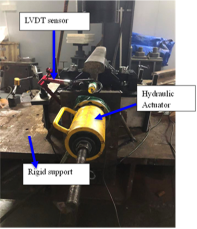
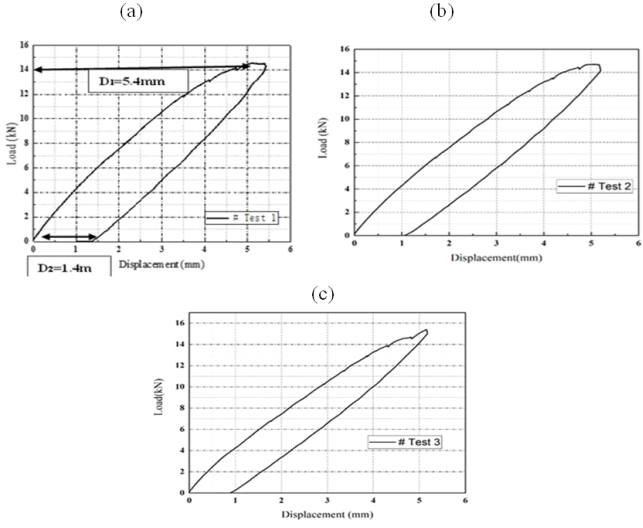
Railway fastening systems are a crucial component of railway tracks, playing a significant role in ensuring the stability of the track and preventing gauge widening and rolling. The ability to resist longitudinal loads along the rail is among the most important qualities a good fastening system should have. This value is usually measured as a fastening system’s longitudinal restraint and has stipulated procedures to perform the test, in accordance with the international standard or the European standard requirements. Longitudinal loads mainly occur due to creep, rail thermal expansion and contraction, acceleration and deceleration of the train. In view of the fact that the modern tracks experiences large longitudinal forces, the fastening systems should provide adequate restraint force to withstand these types of forces. In this paper, we will study the longitudinal restraint of the recently developed Jiuzhou floating fastener. The test is conducted in accordance with the procedure provided by the European railway fastening system testing standard. The fastener was fastened to a concrete block, and a hydraulic actuator of 25kN was used to apply a push to the rail fixed to the concrete block by the floating fastener. A displacement accelerometer was placed on the end of the rail at the centroid region of the rail to ensure that accurate and reliable results were collected. A push force was applied on the rail until the rail slipped from the assembly while simultaneously recording the rail displacement in relative to the support using the displacement sensors. The load is then unloaded to zero. This procedure was repeated for four times without any adjustment to the set-up, the first data was ignored, and the other three data were collected and averaged to obtain the final longitudinal restraint of the fastening assembly. The floating fastening assembly longitudinal restraint was calculated to be 14.04kN, which satisfactorily meets the standard requirement for longitudinal restraint value which should not be less than 9kN for fasteners intended for high-speed railways.
| Published in | Journal of Civil, Construction and Environmental Engineering (Volume 11, Issue 2) |
| DOI | 10.11648/j.jccee.20261102.13 |
| Page(s) | 48-52 |
| Creative Commons |
This is an Open Access article, distributed under the terms of the Creative Commons Attribution 4.0 International License (http://creativecommons.org/licenses/by/4.0/), which permits unrestricted use, distribution and reproduction in any medium or format, provided the original work is properly cited. |
| Copyright |
Copyright © The Author(s), 2026. Published by Science Publishing Group |
Longitudinal Restrain, Floating Fastener, Railway Track, Railway Fastening Assembly
Test | D3 elastic longitudinal displacement | Longitudinal force (kN) |
|---|---|---|
#Test 1 | 5.415-1= 4.415mm | 13.76 |
#Test 2 | 5.14-0.57 = 4.57mm | 14.42 |
#Test 3 | 5.16-0.78= 4.38mm | 13.95 |
Average value | 4.45mm | 14.04 |
BS EN | British Standards European Norm |
LVDT | Linear Variable Displacement Transducer |
mm | Millimeters |
Hz | Hertz |
kN | Kilo Newton |
| [1] | Z. Zhang, B. Andrawes, and J. R. Edwards, ‘Parametric Study on the Distribution of Longitudinal Load in Railway Track under Dynamic Wheel Loading using Finite Element Analysis’, 2015. [Online]. Available: |
| [2] |
‘Cost vs. Performance: Rail Fastening Systems in High-Speed Railways - SFFST’. Accessed: Feb. 07, 2026. [Online]. Available:
https://www.sffst.com/cost-vs-performance-rail-fastening-systems-in-high-speed-railways/ |
| [3] | Christian J. Khachaturian, Marcus S. Dersch, P.E, J. Riley Edwards, Ph.D., P.E, Matheus Trizotto ‘EFFECT OF LONGITUDINAL FASTENER STIFFNESS AND FASTENING SYSTEM LOADING ’Proceedings of the 2021 Joint Rail Conference, April 20-21, 2021, Virtual, Online 2021.JRC2021-1066, 5pages |
| [4] | I. Lotfy and M. A. Issa, ‘Evaluation of the longitudinal restraint, uplift resistance, and long-term performance of high-density polyethylene crosstie rail support system using static and cyclic loading’, Proc. Inst. Mech. Eng. F J. Rail Rapid Transit, vol. 231, no. 8, pp. 835-849, Sep. 2017, |
| [5] | M. A. Toprak et al., ‘Experimental Investigation on the Performance of Rail Fastening Systems’, in International Conference on Civil, Structural and Transportation Engineering, Avestia Publishing, 2021. |
| [6] |
‘Test method and Requirements for Rail FasteningSystem’, Rail and Modern Transports Research Ceter, NSTDA.30pages
https://www.nstda.or.th/rmt/wpcontent/uploads/2023/o9/Sutee_Test-method-and-requirements-for-rail-fastening-system-1.pdf Accessed: 2026-03-29. |
| [7] |
‘Railway infrastructure-Rail fastening systems-Part 2: Test method for longitudinal rail restraint Infrastructure ferroviaire-Systèmes de fixation du rail-Partie 2: Méthode d’essai pour la détermination de résistance longitudinale au glissement’, 2021. [Online]. Available:
https://standards.iteh.ai/catalog/standards/sist/bb194e05-31d5-41cd-8d24- |
| [8] |
Pandrol Track Systems ‘Vanguard Fastening Systems’. ISSUE 4 2015
https://www.oems.no/wp-content/uploads/2016/01/Vanguard1.pdf |
| [9] | ‘Vanguard Common Interface Fastening systems Range Common Interface’. [Online]. Available: |
| [10] |
‘BS EN 13146-1:2019 - Railway applications. Track. Test methods for fastening systems. Determination of longitudinal rail restraint’. Accessed: Feb. 03, 2026. [Online]. Available:
https://landingpage.bsigroup.com/LandingPage/Standard?UPI=000000000030326158 |
| [11] | ‘Railway applications. Track. Test methods for fastening systems’, Nov. 2014, |
| [12] | ‘Railway applications. Track. Test methods for fastening systems’, Feb. 2019, |
| [13] | ‘BS EN 13146-1:2012+A1:2014 | 30 Apr 2012 | BSI Knowledge’. Accessed: Jan. 28, 2026. [Online]. Available: |
APA Style
Zhiping, Z., Rempeyian, J. K., Sampson, K. N., Xingzhe, Q., Ahmed, A. (2026). Longitudinal Restrain of the Newly Developed Floating Fastener. Journal of Civil, Construction and Environmental Engineering, 11(2), 48-52. https://doi.org/10.11648/j.jccee.20261102.13
ACS Style
Zhiping, Z.; Rempeyian, J. K.; Sampson, K. N.; Xingzhe, Q.; Ahmed, A. Longitudinal Restrain of the Newly Developed Floating Fastener. J. Civ. Constr. Environ. Eng. 2026, 11(2), 48-52. doi: 10.11648/j.jccee.20261102.13
AMA Style
Zhiping Z, Rempeyian JK, Sampson KN, Xingzhe Q, Ahmed A. Longitudinal Restrain of the Newly Developed Floating Fastener. J Civ Constr Environ Eng. 2026;11(2):48-52. doi: 10.11648/j.jccee.20261102.13
@article{10.11648/j.jccee.20261102.13,
  author = {Zeng Zhiping and Joel Koilel Rempeyian and Kofi Nti Sampson and Qi Xingzhe and Ayaz Ahmed},
  title = {Longitudinal Restrain of the Newly Developed Floating Fastener},
  journal = {Journal of Civil, Construction and Environmental Engineering},
  volume = {11},
  number = {2},
  pages = {48-52},
  doi = {10.11648/j.jccee.20261102.13},
  url = {https://doi.org/10.11648/j.jccee.20261102.13},
  eprint = {https://article.sciencepublishinggroup.com/pdf/10.11648.j.jccee.20261102.13},
  abstract = {Railway fastening systems are a crucial component of railway tracks, playing a significant role in ensuring the stability of the track and preventing gauge widening and rolling. The ability to resist longitudinal loads along the rail is among the most important qualities a good fastening system should have. This value is usually measured as a fastening system’s longitudinal restraint and has stipulated procedures to perform the test, in accordance with the international standard or the European standard requirements. Longitudinal loads mainly occur due to creep, rail thermal expansion and contraction, acceleration and deceleration of the train. In view of the fact that the modern tracks experiences large longitudinal forces, the fastening systems should provide adequate restraint force to withstand these types of forces. In this paper, we will study the longitudinal restraint of the recently developed Jiuzhou floating fastener. The test is conducted in accordance with the procedure provided by the European railway fastening system testing standard. The fastener was fastened to a concrete block, and a hydraulic actuator of 25kN was used to apply a push to the rail fixed to the concrete block by the floating fastener. A displacement accelerometer was placed on the end of the rail at the centroid region of the rail to ensure that accurate and reliable results were collected. A push force was applied on the rail until the rail slipped from the assembly while simultaneously recording the rail displacement in relative to the support using the displacement sensors. The load is then unloaded to zero. This procedure was repeated for four times without any adjustment to the set-up, the first data was ignored, and the other three data were collected and averaged to obtain the final longitudinal restraint of the fastening assembly. The floating fastening assembly longitudinal restraint was calculated to be 14.04kN, which satisfactorily meets the standard requirement for longitudinal restraint value which should not be less than 9kN for fasteners intended for high-speed railways.},
 year = {2026}
}
TY  - JOUR
T1  - Longitudinal Restrain of the Newly Developed Floating Fastener
AU  - Zeng Zhiping
AU  - Joel Koilel Rempeyian
AU  - Kofi Nti Sampson
AU  - Qi Xingzhe
AU  - Ayaz Ahmed
Y1  - 2026/04/21
PY  - 2026
N1  - https://doi.org/10.11648/j.jccee.20261102.13
DO  - 10.11648/j.jccee.20261102.13
T2  - Journal of Civil, Construction and Environmental Engineering
JF  - Journal of Civil, Construction and Environmental Engineering
JO  - Journal of Civil, Construction and Environmental Engineering
SP  - 48
EP  - 52
PB  - Science Publishing Group
SN  - 2637-3890
UR  - https://doi.org/10.11648/j.jccee.20261102.13
AB  - Railway fastening systems are a crucial component of railway tracks, playing a significant role in ensuring the stability of the track and preventing gauge widening and rolling. The ability to resist longitudinal loads along the rail is among the most important qualities a good fastening system should have. This value is usually measured as a fastening system’s longitudinal restraint and has stipulated procedures to perform the test, in accordance with the international standard or the European standard requirements. Longitudinal loads mainly occur due to creep, rail thermal expansion and contraction, acceleration and deceleration of the train. In view of the fact that the modern tracks experiences large longitudinal forces, the fastening systems should provide adequate restraint force to withstand these types of forces. In this paper, we will study the longitudinal restraint of the recently developed Jiuzhou floating fastener. The test is conducted in accordance with the procedure provided by the European railway fastening system testing standard. The fastener was fastened to a concrete block, and a hydraulic actuator of 25kN was used to apply a push to the rail fixed to the concrete block by the floating fastener. A displacement accelerometer was placed on the end of the rail at the centroid region of the rail to ensure that accurate and reliable results were collected. A push force was applied on the rail until the rail slipped from the assembly while simultaneously recording the rail displacement in relative to the support using the displacement sensors. The load is then unloaded to zero. This procedure was repeated for four times without any adjustment to the set-up, the first data was ignored, and the other three data were collected and averaged to obtain the final longitudinal restraint of the fastening assembly. The floating fastening assembly longitudinal restraint was calculated to be 14.04kN, which satisfactorily meets the standard requirement for longitudinal restraint value which should not be less than 9kN for fasteners intended for high-speed railways.
VL  - 11
IS  - 2
ER  -
School of Civil Engineering, Central South University, Changsha, China
School of Civil Engineering, Central South University, Changsha, China

Information



 Share This Article
 Twitter
 Linked In
 Facebook
 Copy
Copy Download