
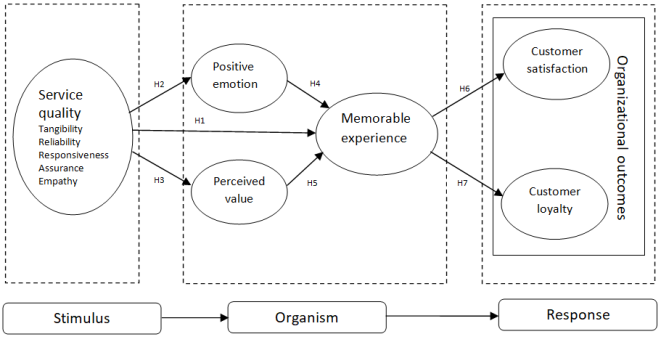
This study aims to explore hotel service quality and its emotional and behavioral impacts within the context of the hotel industry in Nepal. Specifically, it examines the relationships between service quality, perceived value, positive emotions, memorable experiences, customer satisfaction, and customer loyalty by employing the stimulus-organism-response (SOR) framework. A quantitative approach was utilized for the study. Data were collected from hotel customers in Nepal. The hypothesized relationships were tested with structural equation modeling using SPSS and AMOS. The study found that service quality significantly influences the internal psychological and emotional states of customers. Specifically, service quality positively affects perceived value, positive emotions, and memorable experiences, suggesting that high-quality hotel services enhance customer’s cognitive evaluation and emotional reactions during their stay. Consistent with the organism component of the SOR theory, perceived value and positive emotions play important mediating roles in translating service quality into memorable experiences. Similarly, memorable experiences serve as a key organism state that links internal reactions to behavioral outcomes. Memorable experiences mediate the relationships between service quality and both customer satisfaction and customer loyalty, which represent response stage in the SOR framework. Overall, the findings strongly support the applicability of the SOR theory in explaining customer behavior in the hotel industry. Service quality acts as environmental stimulus that shapes customer’s cognitive and emotional states, which in turn drive favorable behavioral responses such as satisfaction and loyalty. By highlighting the sequential process through which service quality influences internal psychological mechanisms and subsequent behavioral outcomes, this study provides a deeper theoretical understanding of customer experience formation in hospitality settings. Moreover, findings of this study offer valuable insights for enhancing service strategies and improving customer experiences.
| Published in | International Journal of Hospitality & Tourism Management (Volume 10, Issue 1) |
| DOI | 10.11648/j.ijhtm.20261001.23 |
| Page(s) | 139-156 |
| Creative Commons |
This is an Open Access article, distributed under the terms of the Creative Commons Attribution 4.0 International License (http://creativecommons.org/licenses/by/4.0/), which permits unrestricted use, distribution and reproduction in any medium or format, provided the original work is properly cited. |
| Copyright |
Copyright © The Author(s), 2026. Published by Science Publishing Group |
Service Quality, Perceived Value, Positive Emotion, Memorable Experience, Customer Satisfaction, Customer Loyalty
Variable | Measurement items | Codes | Source |
|---|---|---|---|
Service Quality (SQ) | Tangibility | Ho et al. (2013) and Parasuraman et al. (1985 & 1988). | |
The furniture and room in the hotel are modern and comfortable. | TG1 | ||
The interior and exterior decoration in this hotel is appealing. | TG2 | ||
The employees have a neat appearance and are well-groomed. | TG3 | ||
The hotel facilities are up to date. | TG4 | ||
The hotel has a great view. | TG5 | ||
The hotel room is clean. | TG6 | ||
Reliability | |||
The hotel staff can provide the correct information of service. | REL1 | ||
Hotel staffs offer services following the customers’ requests in advance. | REL2 | ||
The reservation systems are very comfortable to use and informative. | REL3 | ||
Checking-in and checking-out are not too long. | REL4 | ||
Hotel staffs comply with health safety procedures. | REL5 | ||
Responsiveness | |||
The staffs are courteous. | RES1 | ||
The hotel staffs are determined and ready to provide the service. | RES2 | ||
The hotel staffs adapted service and flexibility. | RES3 | ||
The hotel staffs are willing to perform their duty. | RES4 | ||
The hotel staffs provide the service and can solve problems promptly. | RES5 | ||
Assurance | |||
The hotel staffs are professional and knowledgeable in answering the customer question. | ASU1 | ||
The hotel staffs can communicate well. | ASU2 | ||
The hotel staffs are sufficient to support the hotel to perform their job. | ASU3 | ||
The hotel staffs have the skills and abilities to provide the service. | ASU4 | ||
The hotel has a security system to ensure customer safety | ASU5 | ||
The hotel is cleaned and disinfected regularly for health safety. | ASU6 | ||
Empathy | |||
Hotel staffs pay great attention to the customers during the whole period of stay. | EMP1 | ||
Hotel staffs treat every customer equally. | EMP2 | ||
Hotel staffs can assist customers without any request. | EMP3 | ||
Hotel staffs can exceed customer expectations. | EMP4 | ||
The hotel staffs listen to customers' complaints and sincerely correct their service. | EMP5 | ||
Perceived value (PV) | I have a huge saving from staying at this hotel. | PV1 | Jones, Mak et al. (2007) |
I really appreciate the free breakfast included in this hotel stay. | PV2 | ||
This hotel has the best value for great services. | PV3 | ||
I got the best room rate than any of the other hotels in the area. | PV4 | ||
This is a first-class hotel at the best rate possible. | PV5 | ||
I value the discount rate/room upgrades at this hotel. | PV6 | ||
Positive Emotion (PE) | I get a sense of amazement in the hotel services. | PE1 | Hosany et al. (2017) |
I get a sense of caring in hotel services. | PE2 | ||
I get a sense of inspiration in hotel services. | PE3 | ||
I get a sense of joy in hotel services. | PE4 | ||
I get a sense of love in hotel services. | PE5 | ||
I get a sense of pleasure in hotel services. | PE6 | ||
Memorable Experience (ME) | The hotel service is outstanding. | ME1 | Prentice, Ferreira et al. (2022), Oh et al., (2007) and Kim (2014) |
I feel very stimulated during my stay. | ME2 | ||
I feel very pleased during my stay. | ME3 | ||
I have wonderful memories of my visit to this hotel. | ME4 | ||
I won’t forget my experience visiting this hotel. | ME5 | ||
I will remember many positive things about this hotel. | ME6 | ||
This hotel stay provided me a variety of opportunities to experience local way of life | ME7 | ||
From this hotel stay, I learned a lot about the local history and culture. | ME8 | ||
I participated on a lot of recreational activities during the hotel stay. | ME9 | ||
Service staffs were friendly and willing to help me. | ME10 | ||
Service staffs provided me information about hotel and the destination. | ME11 | ||
The hotel had uniquely designed infrastructure. | ME12 | ||
The hotel had a high quality of infrastructure. | ME13 | ||
The hotel had good signage and directions. | ME14 | ||
The hotel had a good availability of tourism information. | ME15 | ||
The hotel was unclean. | ME16 | ||
The hotel had a bad smell. | ME17 | ||
The hotel was unsafe. | ME18 | ||
It was inconvenient to reach to the hotel. | ME19 | ||
It took me long hours to get to the hotel. | ME20 | ||
It was difficult to travel around the hotel. | ME21 | ||
The service staffs provided highly customized services. | ME22 | ||
The service staffs provided impressive services. | ME23 | ||
The hotel was located at beautiful geographical location. | ME24 | ||
There was a beautiful landscape around the hotel. | ME25 | ||
The hotel had a unique architecture. | ME26 | ||
The hotel provided special cuisines. | ME27 | ||
The hotel had interesting buildings. | M28 | ||
Customer Satisfaction (CS) | Overall, I am satisfied with the hotel service. | CS1 | Khattab and Aldehayyat (2011) |
I am satisfied with my decision to visit this hotel. | CS2 | ||
My choice of this hotel was a wise idea. | CS3 | ||
I will say positive things about this hotel. | CS4 | ||
Customer Loyalty (CL) | I would like to revisit the hotel. | CL1 | Lai (2019) |
I would like to stay at this hotel. | CL2 | ||
I would like to prefer this hotel as the first choice when I revisit the place. | CL3 | ||
I will stay again at this hotel because of the service quality. | CL4 |
N | % | ||
|---|---|---|---|
Gender | Male | 192 | 61.7% |
Female | 119 | 38.3% | |
Age | Below 20 years | 12 | 3.9% |
20-29 years | 184 | 59.2% | |
30-39 years | 85 | 27.3% | |
40-49 years | 14 | 4.5% | |
Above 50 years | 16 | 6.1% | |
Education Level | Primary | 8 | 2.6% |
Secondary or senior secondary | 33 | 10.6% | |
Bachelor's Degree | 146 | 46.9% | |
Master Degree and above | 124 | 39.9% | |
Occupation | Student | 102 | 32.8% |
Employed | 170 | 54.7% | |
Unemployed | 29 | 9.3% | |
Retired | 10 | 3.2% | |
Monthly Income | Below Rs.20000 | 91 | 29.3% |
Rs.20000-30000 | 33 | 10.6% | |
Rs.30000-40000 | 42 | 13.5% | |
Rs.40000-50000 | 32 | 10.3% | |
Rs.50000-100000 | 81 | 26.0% | |
Above 1000000 | 32 | 10.3% | |
Service quality | Perceived value | Positive emotion | Memorable experience | Customer satisfaction | Customer loyalty | |
|---|---|---|---|---|---|---|
TG1 | 0.632 | |||||
TG2 | 0.642 | |||||
TG3 | 0.671 | |||||
TG4 | 0.656 | |||||
TG5 | 0.624 | |||||
TG6 | 0.674 | |||||
REL1 | 0.629 | |||||
REL2 | 0.655 | |||||
REL3 | 0.682 | |||||
RES1 | 0.580 | |||||
RES2 | 0.605 | |||||
RES3 | 0.713 | |||||
RES4 | 0.602 | |||||
RES5 | 0.589 | |||||
ASU1 | 0.733 | |||||
ASU2 | 0.662 | |||||
ASU3 | 0.551 | |||||
ASU5 | 0.702 | |||||
ASU6 | 0.745 | |||||
EMP1 | 0.748 | |||||
EMP2 | 0.676 | |||||
EMP3 | 0.749 | |||||
EMP4 | 0.760 | |||||
EMP5 | 0.729 | |||||
PV1 | 0.606 | |||||
PV2 | 0.706 | |||||
PV3 | 0.820 | |||||
PV4 | 0.770 | |||||
PV5 | 0.752 | |||||
PV6 | 0.811 | |||||
PE1 | 0.789 | |||||
PE2 | 0.808 | |||||
PE3 | 0.820 | |||||
PE4 | 0.739 | |||||
PE5 | 0.838 | |||||
PE6 | 0.686 | |||||
ME1 | 0.807 | |||||
ME2 | 0.707 | |||||
ME3 | 0.778 | |||||
ME4 | 0.812 | |||||
ME5 | 0.747 | |||||
ME6 | 0.808 | |||||
ME7 | 0.669 | |||||
ME8 | 0.684 | |||||
ME9 | 0.787 | |||||
ME10 | 0.744 | |||||
ME11 | 0.745 | |||||
ME12 | 0.747 | |||||
ME13 | 0.657 | |||||
ME14 | 0.660 | |||||
ME15 | 0.672 | |||||
ME16 | 0.801 | |||||
ME17 | 0.807 | |||||
ME18 | 0.789 | |||||
ME19 | 0.794 | |||||
ME20 | 0.775 | |||||
ME21 | 0.727 | |||||
ME23 | 0.700 | |||||
ME24 | 0.510 | |||||
ME25 | 0.544 | |||||
ME26 | 0.665 | |||||
ME27 | 0.622 | |||||
ME28 | 0.655 | |||||
CS1 | 0.686 | |||||
CS2 | 0.741 | |||||
CS3 | 0.764 | |||||
CS4 | 0.762 | |||||
CL1 | 0.798 | |||||
CL2 | 0.768 | |||||
CL3 | 0.795 | |||||
CL4 | 0.802 | |||||
Chronbach α | 0.969 | 0.904 | 0.937 | 0.931 | 0.912 | 0.956 |
CR | 0.997 | 0.969 | 0.983 | 0.979 | 0.942 | 0.964 |
Variables | Service quality | Perceived value | Positive emotion | Memorable experience | Customer satisfaction | Customer loyalty |
|---|---|---|---|---|---|---|
Service quality | 0.991 | |||||
Perceived value | 0.798 | 0.892 | ||||
Positive emotion | 0.789 | 0.811 | 0.773 | |||
Memorable experience | 0.678 | 0.816 | 0.768 | 0.755 | ||
Customer satisfaction | 0.695 | 0.746 | 0.719 | 0.692 | 0.860 | |
Customer loyalty | 0.712 | 0.820 | 0.751 | 0.744 | 0.846 | 0.707 |
Variables | R Square |
|---|---|
Perceived value | 0.637 |
Positive emotion | 0.623 |
Memorable experience | 0.460 |
Customer satisfaction | 0.483 |
Customer loyalty | 0.508 |
Estimates | P-Values | Results | ||
|---|---|---|---|---|
H1 Service quality | Memorable experience | 0.790 | 0.000 | Significant |
H2 Service quality | Positive emotion | 0.806 | 0.000 | Significant |
H3 Service quality | Perceived value | 0.795 | 0.000 | Significant |
H4 Positive emotion | Memorable experience | 0.838 | 0.000 | Significant |
H5 Perceived value | Memorable experience | 0.857 | 0.000 | Significant |
H6 Memorable experience | Customer satisfaction | 0.718 | 0.007 | Significant |
H7 Memorable experience | Customer loyalty | 0.737 | 0.009 | Significant |
Estimates | P-Values | Results | |||
|---|---|---|---|---|---|
Service quality | Perceived value | Memorable experience | 0.532 | 0.000 | Significant |
Service quality | Positive emotion | Memorable experience | 0.434 | 0.000 | Significant |
Service quality | Memorable experience | Customer satisfaction | 0.333 | 0.000 | Significant |
Service quality | Memorable experience | Customer loyalty | 0.472 | 0.000 | Significant |
SOR | Stimulus-Organism-Response |
SPSS | Statistical Package for Social Sciences |
AMOS | Analysis of Moment Structure |
SEM | Structural Equation Modeling |
CR | Composite Reliability |
AVE | Average Variance Extracted |
| [1] | Abbas, M. (2023). "Relationship between Service Quality and Customer Satisfaction." Advances in Business & Industrial Marketing Research 1(2): 68-75. |
| [2] | Agapito, D., J. Mendes and P. Valle (2013). "Exploring the conceptualization of the sensory dimension of tourist experiences." Journal of destination marketing & management 2(2): 62-73. |
| [3] | Al Khattab, S. A. and J. S. Aldehayyat (2011). "Perceptions of service quality in Jordanian hotels." International Journal of Business and Management 6(7): 226. |
| [4] | Ali, B. J., B. Gardi, B. J. Othman, S. A. Ahmed, N. B. Ismael, P. A. Hamza, H. M. Aziz, B. Y. Sabir, S. Sorguli and G. Anwar (2021). "Hotel service quality: The impact of service quality on customer satisfaction in hospitality." International Journal of Engineering, Business and Management 5(3): 14-28. |
| [5] | Ali, F., K. Hussain and N. A. Ragavan (2014). "Memorable customer experience: Examining the effects of customers experience on memories and loyalty in Malaysian resort hotels." Procedia-Social and Behavioral Sciences 144: 273-279. |
| [6] | Bagozzi, R. P., M. Gopinath and P. U. Nyer (1999). "The role of emotions in marketing." Journal of the academy of marketing science 27(2): 184-206. |
| [7] | Bastiaansen, M., X. D. Lub, O. Mitas, T. H. Jung, M. P. Ascenção, D.-I. Han, T. Moilanen, B. Smit and W. Strijbosch (2019). "Emotions as core building blocks of an experience." International Journal of Contemporary Hospitality Management 31(2): 651-668. |
| [8] | Bigovic, M. and J. Prašnikar (2015). "Predicting tourists' behavioural intentions at the destination level." Current Issues in Tourism 18(8): 744-764. |
| [9] | Brochado, A., J. M. Cristovao Verissimo and J. C. L. de Oliveira (2022). "Memorable tourism experiences, perceived value dimensions and behavioral intentions: a demographic segmentation approach." Tourism Review 77(6): 1472-1486. |
| [10] | Chen, C.-F. and F.-S. Chen (2010). "Experience quality, perceived value, satisfaction and behavioral intentions for heritage tourists." Tourism management 31(1): 29-35. |
| [11] | Chen, Z. and A. J. Dubinsky (2003). "A conceptual model of perceived customer value in e-commerce: A preliminary investigation." Psychology & marketing 20(4): 323-347. |
| [12] | Cheung, G. W., H. D. Cooper-Thomas, R. S. Lau and L. C. Wang (2024). "Reporting reliability, convergent and discriminant validity with structural equation modeling: A review and best-practice recommendations." Asia pacific journal of management 41(2): 745-783. |
| [13] | Cronin Jr, J. J., M. K. Brady and G. T. M. Hult (2000). "Assessing the effects of quality, value, and customer satisfaction on consumer behavioral intentions in service environments." Journal of retailing 76(2): 193-218. |
| [14] | Donovan, R. J., J. R. Rossiter, G. Marcoolyn and A. Nesdale (1994). "Store atmosphere and purchasing behavior." Journal of retailing 70(3): 283-294. |
| [15] | Fornell, C. and D. F. Larcker (1981). Structural equation models with unobservable variables and measurement error: Algebra and statistics, Sage publications Sage CA: Los Angeles, CA. |
| [16] | Gössling, S., D. Scott and C. M. Hall (2020). "Pandemics, tourism and global change: a rapid assessment of COVID-19." Journal of sustainable tourism 29(1): 1-20. |
| [17] | Gregory, B. T., S. G. Harris, A. A. Armenakis and C. L. Shook (2009). "Organizational culture and effectiveness: A study of values, attitudes, and organizational outcomes." Journal of business research 62(7): 673-679. |
| [18] | Ha, J. and S. S. Jang (2010). "Effects of service quality and food quality: The moderating role of atmospherics in an ethnic restaurant segment." International journal of hospitality management 29(3): 520-529. |
| [19] | Han, H. and K.-J. Back (2007). "Assessing customers' emotional experiences influencing their satisfaction in the lodging industry." Journal of Travel & Tourism Marketing 23(1): 43-56. |
| [20] | Hao, W., Banerjee, S., & Das, S. K. (2025). “The interconnection between customer trust, customer trust, and brand loyalty among consumers of smart hotel chains in first-tier cities in China”. Journal of Advance Research in Business, Management and Accounting 11(5), 81-87. |
| [21] | Horng, J.-S. and H. Hsu (2021). "Esthetic Dining Experience: The relations among aesthetic stimulation, pleasantness, memorable experience, and behavioral intentions." Journal of Hospitality Marketing & Management 30(4): 419-437. |
| [22] | Huang, Y.-f., Y. Zhang and H. Quan (2019). "The relationship among food perceived value, memorable tourism experiences and behaviour intention: The case of the Macao food festival." International Journal of Tourism Sciences 19(4): 258-268. |
| [23] |
Industry, N. H. (2020). Retrieved from
https://careratingsnepal.com/wp-content/uploads/2020/05/Nepalese-Hotel-Industry-An-Overview-1.pdf |
| [24] | Ismail, A., M. M. B. Abdullah and S. K. Francis (2009). "Exploring the relationships among service quality features, perceived value and customer satisfaction." Journal of Industrial Engineering and Management (JIEM) 2(1): 230-250. |
| [25] | Jang, S. S. and Y. Namkung (2009). "Perceived quality, emotions, and behavioral intentions: Application of an extended Mehrabian–Russell model to restaurants." Journal of Business research 62(4): 451-460. |
| [26] | Jones, D. L., B. Mak and J. Sim (2007). "A new look at the antecedents and consequences of relationship quality in the hotel service environment." Services Marketing Quarterly 28(3): 15-31. |
| [27] | Keiningham, T. L., Rust, R. T., Lariviere, B., Aksoy, L., & Williams, L. (2018). “A roadmap for driving customer word-of-mouth”. Journal of Service Management, 29(1), 2-38. |
| [28] | Kim, J.-H. (2013). "A cross-cultural comparison of memorable tourism experiences of American and Taiwanese college students." Anatolia 24(3): 337-351. |
| [29] | Kim, J.-H., J. B. Ritchie and B. McCormick (2012). "Development of a scale to measure memorable tourism experiences." Journal of Travel research 51(1): 12-25. |
| [30] | Lai, C.-S., K.-C. Chiu and B. Otgonsuren (2019). GM (1, N) Analysis of the Influence of E-service Quality on Customer Satisfaction of Mongolian E-commerce. Proceedings of the 2019 3rd international conference on e-society, e-education and e-technology. |
| [31] | Lee, K.-J. (2014). "Attitudinal dimensions of professionalism and service quality efficacy of frontline employees in hotels." International Journal of Hospitality Management 41: 140-148. |
| [32] | Li, M., D. Yin, H. Qiu and B. Bai (2022). "Examining the effects of AI contactless services on customer psychological safety, perceived value, and hospitality service quality during the COVID-19 pandemic." Journal of Hospitality Marketing & Management 31(1): 24-48. |
| [33] | Liat, C. B., S. Mansori and C. T. Huei (2014). "The associations between service quality, corporate image, customer satisfaction, and loyalty: Evidence from the Malaysian hotel industry." Journal of hospitality marketing & management 23(3): 314-326. |
| [34] | Lim, W. M. (2025). “What is quantitative research? An overview and guidelines”. Australasian Marketing Journal, 33(3), 325-348. |
| [35] | Lin, I. Y. and A. S. Mattila (2010). "Restaurant servicescape, service encounter, and perceived congruency on customers' emotions and satisfaction." Journal of hospitality marketing & management 19(8): 819-841. |
| [36] | Liu, C.-R., Y.-C. Wang, T. M. Kuo, H. Chen and C.-H. Tsui (2022). "Memorable dining experiences with five senses: Conceptualization and scale development." Journal of Hospitality and Tourism Management 53: 198-207. |
| [37] | Lo, A., C. Wu and H. Tsai (2015). "The impact of service quality on positive consumption emotions in resort and hotel spa experiences." Journal of Hospitality Marketing & Management 24(2): 155-179. |
| [38] | Marinkovic, V., V. Senic, D. Ivkov, D. Dimitrovski and M. Bjelic (2014). "The antecedents of satisfaction and revisit intentions for full-service restaurants." Marketing Intelligence & Planning 32(3): 311-327. |
| [39] | Mason, D. D., C. Tideswell and E. Roberts (2006). "Guest perceptions of hotel loyalty." Journal of Hospitality & Tourism Research 30(2): 191-206. |
| [40] | Murray, J. C., R. J. Harrington, P. K. Chathoth and M. S. Khan (2025). "Exploring memorable experiences in luxury hotels." International Journal of Contemporary Hospitality Management 37(1): 296-315. |
| [41] | Nikou, S. and M. M. Khiabani (2020). "Service quality, mediation effect of customer satisfaction, customer loyalty, and moderating role of interpersonal relationship: Case of four-star hotels in Kuala Lumpur, Malaysia." Asian Journal of Economics, Business and Accounting 19(4): 1-18. |
| [42] | Nobar, H. B. K. and R. Rostamzadeh (2018). "The impact of customer satisfaction, customer experience and customer loyalty on brand power: empirical evidence from hotel industry." Journal of Business Economics and Management 19(2): 417-430. |
| [43] | Obeng, H. A., R. Arhinful, L. Mensah and C. C. Mensah (2025). "The mediating role of service quality in the relationship between corporate social responsibility and sustainable competitive advantages in an emerging economy." Business Strategy & Development 8(1): e70099. |
| [44] | Oh, H., A. M. Fiore and M. Jeoung (2007). "Measuring experience economy concepts: Tourism applications." Journal of travel research 46(2): 119-132. |
| [45] | Oh, H., & Kim, K. (2017). “Customer satisfaction, service quality, and customer value: years 2000-2015”. International Journal of Contemporary Hospitality Management, 29(1), 2-29. |
| [46] | Oh, M. and S. Kim (2022). "Role of emotions in fine dining restaurant online reviews: the applications of semantic network analysis and a machine learning algorithm." International Journal of Hospitality & Tourism Administration 23(5): 875-903. |
| [47] | Oliveira, A. V., B. F. Oliveira and M. D. Vassallo (2023). "Airport service quality perception and flight delays: Examining the influence of psychosituational latent traits of respondents in passenger satisfaction surveys." Research in Transportation Economics 102: 101371. |
| [48] | Oriade, A. and P. Schofield (2019). "An examination of the role of service quality and perceived value in visitor attraction experience." Journal of destination marketing & management 11: 1-9. |
| [49] | Ozili, P. K. (2023). The acceptable R-square in empirical modelling for social science research. Social research methodology and publishing results: A guide to non-native English speakers, IGI global: 134-143. |
| [50] | Pine, B. J. and J. H. Gilmore (1998). Welcome to the experience economy, Harvard Business Review Press Cambridge, MA, USA. |
| [51] | Prayag, G., S. Hosany, B. Muskat and G. Del Chiappa (2017). "Understanding the relationships between tourists’ emotional experiences, perceived overall image, satisfaction, and intention to recommend." Journal of travel research 56(1): 41-54. |
| [52] | Prentice, C., S. Dominique-Ferreira, A. Ferreira and X. A. Wang (2022). "The role of memorable experience and emotional intelligence in senior customer loyalty to geriatric hotels." Journal of Retailing and Consumer Services 64: 102788. |
| [53] | Ramya, N., A. Kowsalya and K. Dharanipriya (2019). "Service quality and its dimensions." EPRA International Journal of Research & Development 4(2): 38-41. |
| [54] | Ribeiro, M. A. and G. Prayag (2019). "Perceived quality and service experience: Mediating effects of positive and negative emotions." Journal of Hospitality Marketing & Management 28(3): 285-305. |
| [55] | Rolando, B. (2025). "The effect of service quality and price on customer loyalty in online culinary business." International Journal of Economics And Business Studies 2(1): 14-32. |
| [56] | Rust, R. T., A. J. Zahorik and T. L. Keiningham (1995). "Return on quality (ROQ): Making service quality financially accountable." Journal of marketing 59(2): 58-70. |
| [57] | Schmitt, B. (1999). "Experiential marketing." Journal of marketing management 15(1-3): 53-67. |
| [58] | Servidio, R. and I. Ruffolo (2016). "Exploring the relationship between emotions and memorable tourism experiences through narratives." Tourism Management Perspectives 20: 151-160. |
| [59] | Setiono, B. A. and S. Hidayat (2022). "Influence of service quality with the dimensions of reliability, responsiveness, assurance, empathy and tangibles on customer satisfaction." International Journal of Economics, Business and Management Research 6(09): 330-341. |
| [60] | Shrestha, N. (2021). "Factor analysis as a tool for survey analysis." American journal of Applied Mathematics and statistics 9(1): 4-11. |
| [61] | Sipe, L. J. and M. R. Testa (2018). "From satisfied to memorable: An empirical study of service and experience dimensions on guest outcomes in the hospitality industry." Journal of Hospitality Marketing & Management 27(2): 178-195. |
| [62] | Smith, M. K., S. Ferrari and L. Puczkó (2016). Service innovations and experience creation in spas, wellness and medical tourism. The handbook of managing and marketing tourism experiences, Emerald Group Publishing Limited: 299-319. |
| [63] | Souki, G. Q., L. M. Antonialli, A. A. d. S. Barbosa and A. S. Oliveira (2020). "Impacts of the perceived quality by consumers’ of à la carte restaurants on their attitudes and behavioural intentions." Asia Pacific Journal of Marketing and Logistics 32(2): 301-321. |
| [64] | Sweeney, J. C. and G. N. Soutar (2001). "Consumer perceived value: The development of a multiple item scale." Journal of retailing 77(2): 203-220. |
| [65] | Torres, E. N. (2014). “Deconstructing service quality and customer satisfaction: Challenges and directions for future research”. Journal of Hospitality Marketing & Management, 23(6), 652-677. |
| [66] | Tsaur, S.-H. and Y.-C. Lin (2004). "Promoting service quality in tourist hotels: the role of HRM practices and service behavior." Tourism management 25(4): 471-481. |
| [67] | Tung, V. W. S. and J. B. Ritchie (2011). "Exploring the essence of memorable tourism experiences." Annals of tourism research 38(4): 1367-1386. |
| [68] | Umasuthan, H., O.-J. Park and J.-H. Ryu (2017). "Influence of empathy on hotel guests’ emotional service experience." Journal of Services Marketing 31(6): 618-635. |
| [69] | Vada, S., C. Prentice, S. Filep and B. King (2022). "The influence of travel companionships on memorable tourism experiences, well-being, and behavioural intentions." International Journal of Tourism Research 24(5): 714-724. |
| [70] | Vuorinen, I., R. Järvinen and U. Lehtinen (1998). "Content and measurement of productivity in the service sector: a conceptual analysis with an illustrative case from the insurance business." International Journal of Service Industry Management 9(4): 377-396. |
| [71] | Walls, A., F. Okumus, Y. Wang and D. J.-W. Kwun (2011). "Understanding the consumer experience: An exploratory study of luxury hotels." Journal of Hospitality Marketing & Management 20(2): 166-197. |
| [72] | Wei, H. and C. Prentice (2022). "Addressing service profit chain with artificial and emotional intelligence." Journal of Hospitality Marketing & Management 31(6): 730-756. |
| [73] | Westland, J. C. (2015). “Structural equation models”. Stud. Syst. Decis. Control, 22(5), 152. |
| [74] | Wu, C. H.-J. and R.-D. Liang (2009). "Effect of experiential value on customer satisfaction with service encounters in luxury-hotel restaurants." International Journal of Hospitality Management 28(4): 586-593. |
| [75] | Wu, S. H., & Gao, Y. (2019). “Understanding emotional customer experience and co-creation behaviours in luxury hotels”. International Journal of Contemporary Hospitality Management, 31(11), 4247-4275. |
| [76] | Zeithaml, V. A., L. L. Berry and A. Parasuraman (1988). "Communication and control processes in the delivery of service quality." Journal of marketing 52(2): 35-48. |
| [77] | Zomerdijk, L. G., & Voss, C. A. (2010). “Service design for experience-centric services”. Journal of service research, 13(1), 67-82. |
APA Style
Pande, K., Subedi, K. R., Haque, M. J. (2026). Service Quality and Customer Responses in Hotels: A Stimulus–Organism–Response Perspective. International Journal of Hospitality & Tourism Management, 10(1), 139-156. https://doi.org/10.11648/j.ijhtm.20261001.23
ACS Style
Pande, K.; Subedi, K. R.; Haque, M. J. Service Quality and Customer Responses in Hotels: A Stimulus–Organism–Response Perspective. Int. J. Hosp. Tour. Manag. 2026, 10(1), 139-156. doi: 10.11648/j.ijhtm.20261001.23
@article{10.11648/j.ijhtm.20261001.23,
  author = {Kiranraj Pande and Kripal Raj Subedi and Md Jamirul Haque},
  title = {Service Quality and Customer Responses in Hotels:
A Stimulus–Organism–Response Perspective},
  journal = {International Journal of Hospitality & Tourism Management},
  volume = {10},
  number = {1},
  pages = {139-156},
  doi = {10.11648/j.ijhtm.20261001.23},
  url = {https://doi.org/10.11648/j.ijhtm.20261001.23},
  eprint = {https://article.sciencepublishinggroup.com/pdf/10.11648.j.ijhtm.20261001.23},
  abstract = {This study aims to explore hotel service quality and its emotional and behavioral impacts within the context of the hotel industry in Nepal. Specifically, it examines the relationships between service quality, perceived value, positive emotions, memorable experiences, customer satisfaction, and customer loyalty by employing the stimulus-organism-response (SOR) framework. A quantitative approach was utilized for the study. Data were collected from hotel customers in Nepal. The hypothesized relationships were tested with structural equation modeling using SPSS and AMOS. The study found that service quality significantly influences the internal psychological and emotional states of customers. Specifically, service quality positively affects perceived value, positive emotions, and memorable experiences, suggesting that high-quality hotel services enhance customer’s cognitive evaluation and emotional reactions during their stay. Consistent with the organism component of the SOR theory, perceived value and positive emotions play important mediating roles in translating service quality into memorable experiences. Similarly, memorable experiences serve as a key organism state that links internal reactions to behavioral outcomes. Memorable experiences mediate the relationships between service quality and both customer satisfaction and customer loyalty, which represent response stage in the SOR framework. Overall, the findings strongly support the applicability of the SOR theory in explaining customer behavior in the hotel industry. Service quality acts as environmental stimulus that shapes customer’s cognitive and emotional states, which in turn drive favorable behavioral responses such as satisfaction and loyalty. By highlighting the sequential process through which service quality influences internal psychological mechanisms and subsequent behavioral outcomes, this study provides a deeper theoretical understanding of customer experience formation in hospitality settings. Moreover, findings of this study offer valuable insights for enhancing service strategies and improving customer experiences.},
 year = {2026}
}
TY  - JOUR
T1  - Service Quality and Customer Responses in Hotels:
A Stimulus–Organism–Response Perspective
AU  - Kiranraj Pande
AU  - Kripal Raj Subedi
AU  - Md Jamirul Haque
Y1  - 2026/04/07
PY  - 2026
N1  - https://doi.org/10.11648/j.ijhtm.20261001.23
DO  - 10.11648/j.ijhtm.20261001.23
T2  - International Journal of Hospitality & Tourism Management
JF  - International Journal of Hospitality & Tourism Management
JO  - International Journal of Hospitality & Tourism Management
SP  - 139
EP  - 156
PB  - Science Publishing Group
SN  - 2640-1800
UR  - https://doi.org/10.11648/j.ijhtm.20261001.23
AB  - This study aims to explore hotel service quality and its emotional and behavioral impacts within the context of the hotel industry in Nepal. Specifically, it examines the relationships between service quality, perceived value, positive emotions, memorable experiences, customer satisfaction, and customer loyalty by employing the stimulus-organism-response (SOR) framework. A quantitative approach was utilized for the study. Data were collected from hotel customers in Nepal. The hypothesized relationships were tested with structural equation modeling using SPSS and AMOS. The study found that service quality significantly influences the internal psychological and emotional states of customers. Specifically, service quality positively affects perceived value, positive emotions, and memorable experiences, suggesting that high-quality hotel services enhance customer’s cognitive evaluation and emotional reactions during their stay. Consistent with the organism component of the SOR theory, perceived value and positive emotions play important mediating roles in translating service quality into memorable experiences. Similarly, memorable experiences serve as a key organism state that links internal reactions to behavioral outcomes. Memorable experiences mediate the relationships between service quality and both customer satisfaction and customer loyalty, which represent response stage in the SOR framework. Overall, the findings strongly support the applicability of the SOR theory in explaining customer behavior in the hotel industry. Service quality acts as environmental stimulus that shapes customer’s cognitive and emotional states, which in turn drive favorable behavioral responses such as satisfaction and loyalty. By highlighting the sequential process through which service quality influences internal psychological mechanisms and subsequent behavioral outcomes, this study provides a deeper theoretical understanding of customer experience formation in hospitality settings. Moreover, findings of this study offer valuable insights for enhancing service strategies and improving customer experiences.
VL  - 10
IS  - 1
ER  -
School of Business Administration, Dongbei University of Finance and Economics, Dalian, China
Biography: Kiranraj Pande holds a PhD from Dongbei University of Finance and Economics, China. His research interests include customer experience, hospitality services, and sustainable tourism.

School of Business Administration, Dongbei University of Finance and Economics, Dalian, China
Biography: Kripal Raj Subedi is a master graduate from School of Business Administration, Donbei University of Finance and Economics. His research interests include hospitality services, restaurant experiences, and culinary tourism.

Num International College, National University of Management, Phnom Penh, Cambodia
Biography: Md Jamirul Haque is a dedicated researcher and passionate educator with over 15 years of academic experience. He holds a PhD from Dongbei University of Finance and Economics, China, and an MBA from International American University, USA. Currently affiliated with NUM International College, National University of Management, Cambodia, he teaches business and Management, supervise graduate research, and actively conducts studies on hospitality management and green campus initiatives.


Information



 Share This Article
 Twitter
 Linked In
 Facebook
 Copy
Copy Download