
Background: Intragastric balloons (IGBs) are temporary endoscopic devices used for weight management in patients with obesity; while bacterial colonization of IGBs is well recognized, fungal infection remains rarely reported. Case Presentation: We describe a 24-year-old male who developed candidal infection of an intragastric balloon after completing a 14-day course of dexamethasone (8 mg daily), equivalent to approximately 53 mg of prednisone daily, prescribed for presumed allergic rhinitis. Six weeks after balloon placement for obesity management (body mass index [BMI]: 37.2 kg/m²), he presented with epigastric discomfort, nausea, and intermittent vomiting. Upper gastrointestinal endoscopy revealed extensive white-cream fungal plaques covering the balloon surface with mild surrounding mucosal erythema. Microbiological analysis of gastric aspirate confirmed Candida albicans (>10⁵ colony-forming units [CFU]/mL) on culture, with positive potassium hydroxide (KOH) preparation and Periodic Acid-Schiff (PAS) staining. The balloon was removed endoscopically and the patient was treated with fluconazole (400 mg loading dose, then 200 mg daily for 14 days), with complete symptom resolution within five days and eradication confirmed on repeat endoscopy and culture at four weeks. Conclusion: This case illustrates that even short-term corticosteroid therapy can predispose patients with an indwelling IGB to opportunistic fungal colonization. Clinicians should maintain a high index of suspicion for fungal infection in IGB patients who develop new gastrointestinal symptoms during or after immunosuppressive therapy, and early endoscopic evaluation, balloon removal, and antifungal therapy achieve favorable outcomes.
| Published in | International Journal of Gastroenterology (Volume 10, Issue 2) |
| DOI | 10.11648/j.ijg.20261002.12 |
| Page(s) | 74-79 |
| Creative Commons |
This is an Open Access article, distributed under the terms of the Creative Commons Attribution 4.0 International License (http://creativecommons.org/licenses/by/4.0/), which permits unrestricted use, distribution and reproduction in any medium or format, provided the original work is properly cited. |
| Copyright |
Copyright © The Author(s), 2026. Published by Science Publishing Group |
Intragastric Balloon, Fungal Infection, Dexamethasone, Immunosuppression, Obesity Management
IGB | Intragastric Balloon |
BMI | Body Mass Index |
BP | Blood Pressure |
HR | Heart Rate |
CRP | C-Reactive Protein |
WBC | White Blood Cell (count) |
KOH | Potassium Hydroxide |
PAS | Periodic Acid-Schiff |
CFU | Colony-Forming Unit |
HIV | Human Immunodeficiency Virus |
| [1] | Genco A, Cipriano M, Bacci V, et al. BioEnterics Intragastric Balloon (BIB): a short-term, double-blind, randomised, controlled, crossover study on weight reduction in morbidly obese patients. Int J Obes. 2006; 30(1): 129-133. |
| [2] | Kumar N, Sahdala HN, Shaikh M, et al. Intragastric Balloons: Past, Present, and Future. Obes Surg. 2020; 30(2): 670-675. |
| [3] | Stavrou G, Shrewsbury A, Kotzampassi K. Six intragastric balloons: Which to choose? World J Gastrointest Endosc. 2021; 13(8): 238-259. |
| [4] | De Castro ML, Morales MJ, Del Campo V, et al. Efficacy, Safety, and Tolerance of Two Types of Intragastric Balloons Placed in Obese Subjects: A Double-Blind Comparative Study. Obes Surg. 2010; 20(12): 1642-1646. |
| [5] | Pasha SF, Acosta RD, Chandrasekhara V, et al. The role of endoscopy in the bariatric surgery patient. Gastrointest Endosc. 2015; 81(5): 1063-1072. |
| [6] | Pfaller MA, Diekema DJ. Epidemiology of invasive candidiasis: a persistent public health problem. Clin Microbiol Rev. 2007; 20(1): 133-163. |
| [7] | Rhen T, Cidlowski JA. Antiinflammatory action of glucocorticoids—new mechanisms for old drugs. N Engl J Med. 2005; 353(16): 1711-1723. |
| [8] | Prado A, Brito RO, Pereira ECA, Becker TCA, Negri M, Svidzinski TIE. The fungus Candida glabrata in intragastric balloon. Int J Case Rep Images. 2021; 12: 101246Z01AP2021. |
| [9] | Guirgis M, Kumar P, Laurens J, Madhok B. Spontaneous Hyperinflation of Intragastric Balloons: A Systematic Review. Gastrointest Disord. 2025; 7(3): 55. |
| [10] | Chastain DB, Spradlin M, Ahmad H, Henao-Martínez AF. Unintended Consequences: Risk of Opportunistic Infections Associated With Long-term Glucocorticoid Therapies in Adults. Clin Infect Dis. 2024; 78(4): e37-e56. |
| [11] | Kim MF, et al. Glucocorticoids as a risk factor for infection and adverse outcomes in non-HIV and non-transplant patients with cryptococcal meningitis. Mycoses. 2024; 67: e13709. |
| [12] | Kumar D, Rani A, Awani N. Molecular Determinants Involved in Candida albicans Biofilm Formation and Regulation. Mol Biotechnol. 2024; 66(7): 1640-1659. |
| [13] | Idris I, Anyiam O. Intragastric balloons for obesity: critical review of device design, efficacy, tolerability, and unmet clinical needs. Diabetes Obes Metab. 2025; 27(Suppl 2): 20-34. |
| [14] | Espinet-Coll E, Del Pozo-García AJ, Turró-Arau R, et al. Evaluating the Safety of the Intragastric Balloon: Spanish Multicenter Experience in 20,680 Cases and with 12 Different Balloon Models. Obes Surg. 2024; 34(8): 2766-2777. |
| [15] | Goodman MC, Chang P, Minteer W, Nguyen D, Gopalkrishnan K, Phan J. Patient Complications and Device Issues Associated With FDA-Approved Intragastric Balloons Available in the USA: A MAUDE Database Study. Proc (Bayl Univ Med Cent). 2024; 38(1): 63-68. |
| [16] | Edathodu Z, Khan SA, Peedikayil MC. Comparative Efficacy and Long-Term Outcomes of Intragastric Balloons for Obesity: A Systematic Review and Meta-Analysis. Cureus. 2025; 17(7): e88002. |
| [17] | Pappas PG, Kauffman CA, Andes DR, et al. Clinical Practice Guideline for the Management of Candidiasis: 2016 Update by the Infectious Diseases Society of America. Clin Infect Dis. 2016; 62(4): e1-e50. |
APA Style
Semeya, A. A., Elsaeed, W., Hassan, M. A., Hossam, S. (2026). Corticosteroid-Induced Candida Albicans Colonization of an Intragastric Balloon: A Case Report and Literature Review. International Journal of Gastroenterology, 10(2), 74-79. https://doi.org/10.11648/j.ijg.20261002.12
ACS Style
Semeya, A. A.; Elsaeed, W.; Hassan, M. A.; Hossam, S. Corticosteroid-Induced Candida Albicans Colonization of an Intragastric Balloon: A Case Report and Literature Review. Int. J. Gastroenterol. 2026, 10(2), 74-79. doi: 10.11648/j.ijg.20261002.12
AMA Style
Semeya AA, Elsaeed W, Hassan MA, Hossam S. Corticosteroid-Induced Candida Albicans Colonization of an Intragastric Balloon: A Case Report and Literature Review. Int J Gastroenterol. 2026;10(2):74-79. doi: 10.11648/j.ijg.20261002.12
@article{10.11648/j.ijg.20261002.12,
  author = {Atteyat Aboelmaged Semeya and Walaa Elsaeed and Mahmoud Ahmed Hassan and Shahenda Hossam},
  title = {Corticosteroid-Induced Candida Albicans Colonization of an Intragastric Balloon: A Case Report and Literature Review},
  journal = {International Journal of Gastroenterology},
  volume = {10},
  number = {2},
  pages = {74-79},
  doi = {10.11648/j.ijg.20261002.12},
  url = {https://doi.org/10.11648/j.ijg.20261002.12},
  eprint = {https://article.sciencepublishinggroup.com/pdf/10.11648.j.ijg.20261002.12},
  abstract = {Background: Intragastric balloons (IGBs) are temporary endoscopic devices used for weight management in patients with obesity; while bacterial colonization of IGBs is well recognized, fungal infection remains rarely reported. Case Presentation: We describe a 24-year-old male who developed candidal infection of an intragastric balloon after completing a 14-day course of dexamethasone (8 mg daily), equivalent to approximately 53 mg of prednisone daily, prescribed for presumed allergic rhinitis. Six weeks after balloon placement for obesity management (body mass index [BMI]: 37.2 kg/m²), he presented with epigastric discomfort, nausea, and intermittent vomiting. Upper gastrointestinal endoscopy revealed extensive white-cream fungal plaques covering the balloon surface with mild surrounding mucosal erythema. Microbiological analysis of gastric aspirate confirmed Candida albicans (>10⁵ colony-forming units [CFU]/mL) on culture, with positive potassium hydroxide (KOH) preparation and Periodic Acid-Schiff (PAS) staining. The balloon was removed endoscopically and the patient was treated with fluconazole (400 mg loading dose, then 200 mg daily for 14 days), with complete symptom resolution within five days and eradication confirmed on repeat endoscopy and culture at four weeks. Conclusion: This case illustrates that even short-term corticosteroid therapy can predispose patients with an indwelling IGB to opportunistic fungal colonization. Clinicians should maintain a high index of suspicion for fungal infection in IGB patients who develop new gastrointestinal symptoms during or after immunosuppressive therapy, and early endoscopic evaluation, balloon removal, and antifungal therapy achieve favorable outcomes.},
 year = {2026}
}
TY  - JOUR
T1  - Corticosteroid-Induced Candida Albicans Colonization of an Intragastric Balloon: A Case Report and Literature Review
AU  - Atteyat Aboelmaged Semeya
AU  - Walaa Elsaeed
AU  - Mahmoud Ahmed Hassan
AU  - Shahenda Hossam
Y1  - 2026/08/20
PY  - 2026
N1  - https://doi.org/10.11648/j.ijg.20261002.12
DO  - 10.11648/j.ijg.20261002.12
T2  - International Journal of Gastroenterology
JF  - International Journal of Gastroenterology
JO  - International Journal of Gastroenterology
SP  - 74
EP  - 79
PB  - Science Publishing Group
SN  - 2640-169X
UR  - https://doi.org/10.11648/j.ijg.20261002.12
AB  - Background: Intragastric balloons (IGBs) are temporary endoscopic devices used for weight management in patients with obesity; while bacterial colonization of IGBs is well recognized, fungal infection remains rarely reported. Case Presentation: We describe a 24-year-old male who developed candidal infection of an intragastric balloon after completing a 14-day course of dexamethasone (8 mg daily), equivalent to approximately 53 mg of prednisone daily, prescribed for presumed allergic rhinitis. Six weeks after balloon placement for obesity management (body mass index [BMI]: 37.2 kg/m²), he presented with epigastric discomfort, nausea, and intermittent vomiting. Upper gastrointestinal endoscopy revealed extensive white-cream fungal plaques covering the balloon surface with mild surrounding mucosal erythema. Microbiological analysis of gastric aspirate confirmed Candida albicans (>10⁵ colony-forming units [CFU]/mL) on culture, with positive potassium hydroxide (KOH) preparation and Periodic Acid-Schiff (PAS) staining. The balloon was removed endoscopically and the patient was treated with fluconazole (400 mg loading dose, then 200 mg daily for 14 days), with complete symptom resolution within five days and eradication confirmed on repeat endoscopy and culture at four weeks. Conclusion: This case illustrates that even short-term corticosteroid therapy can predispose patients with an indwelling IGB to opportunistic fungal colonization. Clinicians should maintain a high index of suspicion for fungal infection in IGB patients who develop new gastrointestinal symptoms during or after immunosuppressive therapy, and early endoscopic evaluation, balloon removal, and antifungal therapy achieve favorable outcomes.
VL  - 10
IS  - 2
ER  -
Department of Hepatogastroenterology, Benha Teaching Hospital, Benha, Egypt
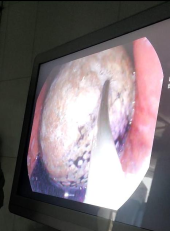
Figure 1. Endoscopic view of the intragastric balloon showing extensive white-cream fungal plaques with a smooth balloon contour; the endoscope tip is visible in the field.
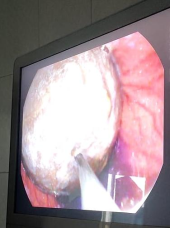
Figure 2. Close-up endoscopic view demonstrating confluent white-yellowish fungal colonies with irregular borders and mild surrounding gastric mucosal erythema.
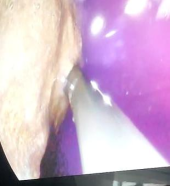
Figure 3. Endoscopic view highlighting the distribution of fungal colonization across the balloon surface, showing confluent and scattered plaque patterns typical of Candida infection.
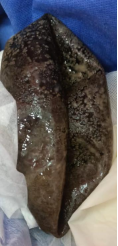
Figure 4. Gross specimen photograph of the removed intragastric balloon showing extensive dark brown-black discoloration with adherent fungal biofilm covering large portions of the surface.

Information



 Share This Article
 Twitter
 Linked In
 Facebook
 Copy
Copy Download