Research Article | | Peer-Reviewed

Causal Role of Immune Cells in Inflammatory Bowel Disease: A Mendelian Randomization (MR) Study

Received: 26 March 2025     Accepted: 10 April 2025     Published: 29 April 2025
Views:       Downloads:
Abstract

The present Mendelian randomization study investigated the potential causal relationship between immunophenotypes and inflammatory bowel diseases (IBD), including Crohn’s disease (CD) and ulcerative colitis (UC). Results demonstrated that immunophenotypes, such as CD28 on CD39+ resting Treg and CD25 on IgD+ CD24− showed nominal significant protective effects on CD and UC, respectively. Conversely, specific immunophenotypes also exhibited nominal significant risk effects on CD and UC, including CD39 on CD39+ CD8br and IgD on IgD+ CD38dim, respectively. Collectively, our findings highlight the potential role of immune cell phenotypes in the development of CD and UC as evidenced by data analysis from the FinnGen database. Therefore, the present study contributes to understanding the genetic basis of IBD and highlights the significance of immune cell phenotypes in disease pathogenesis.

Published in International Journal of Gastroenterology (Volume 9, Issue 1)
DOI 10.11648/j.ijg.20250901.14
Page(s) 25-31
Creative Commons

This is an Open Access article, distributed under the terms of the Creative Commons Attribution 4.0 International License (http://creativecommons.org/licenses/by/4.0/), which permits unrestricted use, distribution and reproduction in any medium or format, provided the original work is properly cited.

Copyright

Copyright © The Author(s), 2025. Published by Science Publishing Group

Keywords

Inflammatory Bowel Diseases, Crohn’s Disease, Ulcerative Colitis, Immunity, MR Analysis

1. Introduction
Inflammatory bowel disease (IBD) is a persistent and recurring intestinal condition affecting over 6.8 million individuals globally . The disease includes two main subtypes, Crohn's disease (CD) and ulcerative colitis (UC), which are driven by a complex etiology involving genetic, microbial, immune response abnormalities, and environmental factors, along with their interactions . Recently, there has been a steady rise in the prevalence of IBD in China, with rates reaching 10.04 per 100,000 individuals in 2016 , which is expected to increase and affect nearly 1.5 million population by the year 2025 . Due to the lack of targeted therapeutic interventions, many patients with IBD face various complications, including anal fistula, intestinal obstruction, abdominal infection, anxiety, depression, and significant financial burden .
Immune cells are essential in the development and advancement of IBD. The disruption of the intestinal epithelial barrier causes dysbiosis of gut microbiota and initiates an inflammatory cascade leading to the development of the disease . Intestinal immune cells, classified into innate and adaptive types, are crucial in immune responses related to IBD. Innate immune cells, such as macrophages, dendritic cells, neutrophils, natural killer cells, and innate lymphoid cells, secrete cytokines, chemokines, and antimicrobial agents to trigger inflammation, facilitating phagocytosis, antigen presentation, and the activation of the adaptive immune system . Advanced studies on immune cells have revealed an increasing number of immune cell subtypes; however, their relationship with IBD remains unclear.
Mendelian randomization (MR) is a powerful epidemiological method that leverages genetic variation to evaluate the causal link between risk factors and diseases . Confounders significantly impact causal inference in epidemiology, while genetic variation in Mendelian Randomization (MR) studies facilitates random allele allocation to offspring, akin to randomized controlled trials . MR effectively addresses confounding factors, reverse causality, and issues of representativeness and feasibility often found in observational studies and randomized controlled trials . To date, MR has not assessed the association between immune cells and IBD.
This study employed a two-sample MR approach to explore the causal link between immune cells and IBD, aiming to provide a theoretical basis for understanding their association with IBD pathogenesis.
2. Materials and Methods
2.1. Study Design
We conducted two-sample MR analyses to assess the causal relationship between 731 immune cell traits, categorized into 7 groups, and inflammatory bowel disease (IBD), encompassing ulcerative colitis (UC) and Crohn's disease (CD). MR analysis must satisfy three core assumptions: 1) instrumental variables should be strongly correlated with exposure factors; 2) they must not be associated with confounding factors related to the exposure-outcome relationship; 3) they should only be influenced by exposure factors and outcome variables.
2.2. Genome-wide Association Study (GWAS) Data Sources
We acquired data from FinnGen study's data freeze 10, consisting of around 19 million SNPs linked to IBD. The dataset comprised 2,033 patients with CD and 5,931 patients with UC, alongside 409,940 healthy controls for CD and 405,386 for UC. Access the summary statistics from the Finngen public data release 10 at Googleapis.com/finngen-public-data-r10/summary_stats/. All cases in this study were of European origin.
The GWAS Catalog offers public access to summary statistics for immune traits, with accession numbers from GCST0001391 to GCST000212113 . A comprehensive analysis of 731 immunophenotypes was conducted using diverse metrics, including absolute cell counts (AC; n = 118), median fluorescence intensities (MFI) for surface antigen levels (n = 389), morphological parameters (MP; n = 32), and relative cell counts (RC; n = 192). The MFI, AC, and RC estimates encompassed B cells, CDCs, mature T cells, monocytes, myeloid cells, TBNK (T cells, B cells, natural killer cells), and Treg panels, while the MP focused on CDC and TBNK cells. The first GWAS on immune traits analyzed a cohort of 3,757 individuals of European ancestry, ensuring no overlap between cohorts. Approximately 22 million SNPs were genotyped using high-density arrays and subsequently imputed with a Sardinian sequence-based reference panel . Associations between SNPs and immune traits were tested while considering covariates such as sex, age, and age squared (Supplementary File 1).
2.3. Selection of Instrumental Variables (IVs)
To meet the first MR hypothesis, SNPs strongly associated with each immune trait were set to P < 1 × 10⁻⁵ with a linkage disequilibrium [LD] r2 threshold < 0.001 within a 10000 kb distance . The second hypothesis of MR posited that genetic variation remains unaffected by confounding factors. To verify this, the Phenoscanner database (http://www.phenoscanner.medschl.cam.ac.uk/) was utilized to confirm no associations existed between the selected SNPs and known confounders. Moreover, SNPs exhibiting significant heterogeneity were excluded and those significantly correlated with each immune trait were identified.
The strength of each instrumental variable (IV) was assessed by computing the F-statistic with the formula F = R²(N−2)/(1−R²), where R² represents the proportion of variability in physical activity explained by each IV, and N denotes the sample size of the genome-wide association study (GWAS) for the SNP-physical activity correlation . The R2 was calculated as 2 × EAF × (1−EAF) × beta2, where EAF represented the effect allele frequency and beta was the standard error of the genetic effect (CD in Supplementary File 2, UC in Supplementary File 3).
2.4. Statistical Analysis
This study utilized random effects inverse variance weighted (IVW), weighted median, and MR Egger methods in a two-sample Mendelian randomization (MR) analysis to evaluate the potential causal relationship between immune traits and inflammatory bowel disease (IBD) using odds ratio (OR) values. Since the conventional IVW method may be susceptible to ineffective instrument bias or pleiotropy, we performed a sensitivity analysis to examine the reliability and resilience of the IVW findings. The heterogeneity of the chosen instrumental variables was evaluated using Cochran's Q statistic and its associated p-values. To address horizontal pleiotropy, the MR Egger intercept test and leave-one-out analyses were utilized, with the intercept term's significance indicating the presence of horizontal pleiotropy . Furthermore, the MR-PRESSO method was employed to identify and remove horizontally variable outliers that could potentially influence the estimation outcomes significantly. Furthermore, scatter plots demonstrated that outliers had no significant impact on the results, while funnel plots confirmed the correlation's strength without heterogeneity.
All analyses were performed using R 4.3.0 software. The TwoSampleMR R package (version 0.5.7) was utilized for MR analyses. A two-sided P-value of 0.05 was established for global testing, and a Bonferroni-corrected P-value of 6.84 x 10^-5 was applied for region-level analyses involving 731 MR estimates. A p-value below 0.05 was deemed significant.
3. Results
3.1. The Causal Effect of Immunophenotypes on CD
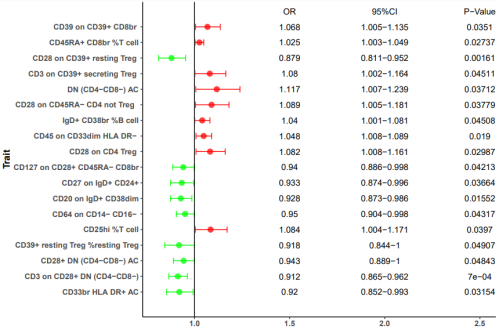
The IVW method results indicated significant protective effects of nine immunophenotypes on CD: CD28 on CD39+ resting Treg (Treg panel, OR = 0.879, 95% CI = 0.811−0.952, P = 0.00161), CD27 on IgD+ CD24+ (B cell panel, OR = 0.94, 95% CI = 0.886−0.998, P = 0.04213), CD20 on IgD+ CD38dim (B cell panel, OR = 0.933, 95% CI = 0.874−0.996, P = 0.03664), CD64 on CD14-CD16- (Monocyte panel, OR = 0.928, 95% CI = 0.873−0.986, P = 0.01552), HVEM on CD8br (T cell maturation panel, OR = 0.95, 95% CI = 0.904−0.998, P = 0.04317), CD39+ resting Treg% resting Treg (Treg panel, OR = 0.918, 95% CI = 0.844−1, P = 0.04907), CD28+ DN (CD4-CD8-) AC (Treg panel, OR = 0.943, 95% CI = 0.889−1, P = 0.04843), CD3 on CD28+DN (CD4-CD8-) (Treg panel, OR = 0.912, 95% CI = 0.865−0.962, P = 0.0007), and CD33br HLA DR+ AC (Myeloid cell panel, OR = 0.92, 95% CI = 0.852−0.993, P = 0.03154). Nominal significant risk effects of nine immunophenotypes on CD were identified: CD39 on CD39+ CD8br (Treg panel, OR 1.068, 95% CI 1.005−1.135, P = 0.0351), CD45RA+ CD8br% T cell (Maturation stages of T cell panel, OR 1.025, 95% CI 1.003−1.049, P = 0.02737), CD3 on CD39+ secreting Treg (Treg panel, OR 1.08, 95% CI 1.002−1.164, P = 0.04511), DN (CD4-CD8-) AC (Maturation stages of T cell panel, OR 1.117, 95% CI 1.007−1.239, P = 0.03712), IgD+ CD38br%B cell (B cell panel, OR 1.089, 95% CI 1.005−1.181, P = 0.03779), CD45 on CD33dim HLA DR- (Myeloid cell panel, OR 1.04, 95% CI 1.001−1.081, P = 0.04508), CD28 on CD4 Treg (Treg panel, OR 1.048, 95% CI 1.008−1.089, P = 0.019), CD127 on CD28+ CD45RA- CD8br (Treg panel, OR 1.082, 95% CI 1.008−1.161, P = 0.02987), and CD25hi% T cell (Treg panel, OR 1.084, 95% CI 1.004−1.171, P = 0.0397) (Figure 1, Supplementary Figure 1, Supplementary File 4). Similar results were obtained by weighted mode and weighted median methods (Supplementary File 4). The respective scatter plots are shown in Supplementary Figure 2.
Figure 1. Forest plots showed the causal associations between CD and immune cell traits.
3.2. The Causal Effect of Immunophenotypes on UC
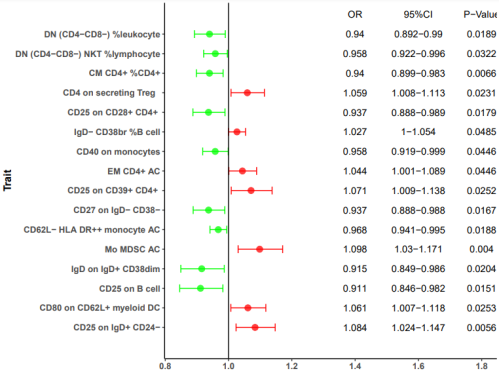
The IVW method revealed significant protective effects of nine immunophenotypes on UC: CD25 on IgD+ CD24- (B cell panel, OR 0.94, 95% CI 0.892−0.99, P = 0.0189), CD80 on CD62L+ myeloid DC (cDC panel, OR 0.958, 95% CI 0.922−0.996, P = 0.0322), CD25 on B cell (B cell panel, OR 0.94, 95% CI 0.899−0.983, P = 0.0066), CD62L− HLA DR++ monocyte AC (cDC panel, OR 0.937, 95% CI 0.888−0.989, P = 0.0179), CD25 on CD39+ CD4+ (Treg panel, OR 0.958, 95% CI 0.919−0.999, P = 0.0446), IgD-CD38br% B cell (B cell panel, OR 0.937, 95% CI 0.888−0.988, P = 0.0167), CD25 on CD28+ CD4+ (Treg, OR 0.968, 95% CI 0.941−0.995, P = 0.0188), IgD- CD27- AC (B cell panel, OR 0.915, 95% CI 0.849−0.986, P = 0.0204), and CM CD4+% CD4+ (Maturation stages of T cell panel, OR 0.911, 95% CI 0.846−0.982, P = 0.0151). Nominally significant risk effects of seven immunophenotypes on CD were identified: IgD on IgD+ CD38dim (B cell panel, OR 1.055, 95% CI 1.001−1.111, P = 0.0448), CD27 on IgD-CD38- (B cell, OR 1.027, 95% CI 1−1.054, P = 0.0485), EM CD4+ AC (T cell maturation stages panel, OR 1.044, 95% CI 1.001−1.089, P = 0.0446), CD40 on monocytes (Monocyte panel, OR 1.071, 95% CI 1.009−1.138, P = 0.0252), CD4 on secreting Treg (Treg panel, OR 1.098, 95% CI 1.03−1.171, P = 0.004), DN (CD4-CD8-) NKT% lymphocyte (TBAK panel, OR 1.061, 95% CI 1.007−1.118, P = 0.0253), and DN (CD4−CD8−)% leukocyte (TBAK panel, OR 1.084, 95% CI 1.024−1.147, P = 0.0056) (Figure 2, Supplementary Figure 3, Supplementary File 5). Similar results were obtained by weighted mode and weighted median methods (Supplementary File 5). The respective scatter plots are shown in Supplementary Figure 4.
Figure 2. Forest plots showed the causal associations between UC and immune cell traits.
3.3. Sensitivity Analysis
Cochran's Q test indicated no significant heterogeneity among the IV estimates from individual variants (P > 0.05) (Supplementary Files 6 and 7 for CD and UC, respectively). Heterogeneity refers to the variation in causal estimates obtained for each SNP, indicating the consistency of results (global-test P-value > 0.05) (CD in Supplementary File 8, UC in Supplementary File 9). Alternatively, a low level of heterogeneity implies a high level of reliability in MR estimates. Furthermore, the leave-one-out sensitivity analysis evaluated the impact of individual SNP loci on the overall causal relationship. The results indicated that the exclusion of a single SNP and subsequent analysis did not affect the aforementioned causal relationship significantly (CD in Supplementary Figure 5, UC in Supplementary Figure 6). Moreover, no evidence of directional horizontal pleiotropy was found in the funnel plot (CD in Supplementary Figure 7, UC in Supplementary Figure 8) and MR Egger intercept (CD in Supplementary File 10, UC in Supplementary File 11).
4. Discussion
This study employed MR analysis on extensive publicly available genetic data to assess the causal link between 731 immune cell traits and IBD incidence. Results demonstrated nominal significant causal effects of 18 and 16 immunophenotypes on CD and UC, respectively. Moreover, sensitivity analysis confirmed the relationship between identified immunophenotypes and IBD.
The findings of our research are consistent with the previous reports. A study using alkaline phosphatase immunohistochemistry found a significant presence of interleukin-2 receptor (CD25)-bearing T cells in the inflamed intestinal lamina propria of patients with Crohn's disease compared to healthy intestinal tissue . Wang et al found that CD24+/CD27+ B cells from healthy individuals suppressed TNFα secretion by monocytes and IFNγ secretion by T cells. In contrast, patients with CD exhibited a decrease in both the quantity and effectiveness of CD24+/CD27+ B cells. In addition, Oshitani et al found an increase in CD3, CD4, CD8, CD20, CD68, CD45RA, CD45RO, and CD11a T cells in the lamina propria and submucosa of CD specimens compared to healthy controls, as shown by immunological double staining. Linton et al. found that patients (n = 20) with moderate to severe CD exhibited a significantly higher frequency of circulating CD14(+) HLA-DR monocytes compared to healthy controls (n = 14). Mitsialis et al found that colonic mucosa samples from IBD patients showed increased levels of HLA-DR+CD38+ T cells, including cytokine-secreting T-regulatory cells, CXCR3+ plasmablasts, and IL1B+ macrophages and monocytes, compared to healthy controls. Patient samples with CD were identified by IL1B+HLA-DR+CD38+ T cells, IL1B+TNF+IFNG+ naïve B cells, IL1B+ dendritic cells, and IL1B+ plasmacytoid dendritic cells, whereas UC samples showed increased IL17A+ CD161+ effector memory T cells, IL17A+ T-regulatory cells, HLA-DR+CD56+ granulocytes, and decreased type 3 innate lymphoid cells. Wang et al. found significantly reduced levels of CD24(+), CD38+, and CD5(+) Bregs in the peripheral blood and intestinal tissue of UC patients compared to the control group, using flow cytometry. Various studies reported that CD4+ T cells may contribute to the pathogenesis of UC.
This study employed a two-sample MR analysis using data from extensive GWAS cohorts of around 400,000 participants, ensuring robust statistical power. Our findings utilized genetic instrumental variables, and causal relationships were evaluated using various Mendelian Randomization analytical methods. The findings were robust and not influenced by horizontal pleiotropy or other confounding factors. It is crucial to recognize several limitations of our study. The study's focus on populations of European ancestry limits its ability to identify genetic differences across diverse ethnic groups, countries, and regions, restricting the generalizability of the findings. Second, the lack of comprehensive clinical data limited the feasibility of subgroup analyses and obstructed the identification of specific causal relationships.
5. Conclusion
In conclusion, our study underscored the causal links between diverse immunophenotypes and IBD, highlighting the complex interactions between the immune system and the disease. Our findings provide a new avenue for exploring the biological understanding of IBD, potentially leading to early intervention and treatment strategies.
Abbreviations

IBD

Inflammatory Bowel Diseases

CD

Crohn’s Disease

UC

Ulcerative Colitis

MR

Mendelian Randomization

MFI

Median Fluorescence Intensities

IVW

Inverse Variance Weighted

OR

Odds Ratio

Acknowledgments
We thank Bullet Edits Limited for the linguistic editing and proofreading of the manuscript. We also thank Figraw (www.figdraw.com) for the materials provided in the scientific research drawing.
Statement of Ethics
Not applicable.
Author Contributions
Heng Shi: Data curation, Software, Writing – Original Draft, Writing – Reviewing & Editing
Qin Peng: Writing – Reviewing, Editing, and Supervision, Data curation, Software, Writing – Original Draft, Writing – Reviewing & Editing
Data Availability Statement
The data that support the findings of this study are openly available in the Finland database at https://www.finngen.fi/en/access_results. Further enquiries can be directed to the corresponding author.
Funding
The research was financially supported by (1) the Shaoyang Science and Technology Plan Project (No. 2023ZD0113). (2) the Shaoyang "Xiaohe" Talent Project.
Conflict of Interest
The authors have no conflicts of interest to declare.
References
[1] R. Caruso, B. C. Lo, G. Núñez, Host-microbiota interactions in inflammatory bowel disease. Nat Rev Immunol. 20 411-426,
[2] The global, regional, and national burden of inflammatory bowel disease in 195 countries and territories, 1990-2017: a systematic analysis for the Global Burden of Disease Study 2017. Lancet Gastroenterol Hepatol. 5 17-30,
[3] M. Agrawal, K. H. Allin, F. Petralia, J. F. Colombel, T. Jess, Multiomics to elucidate inflammatory bowel disease risk factors and pathways. Nat Rev Gastroenterol Hepatol. 19 399-409,
[4] L. Xu, B. He, J. Li, P. Shen, L. Hu, G. Liu, J. Wang, L. Duan, S. Zhan, S. Wang, Incidence of Inflammatory Bowel Disease in Urban China: A Nationwide Population-based Study. Clin Gastroenterol Hepatol. 21 3379-3386.e3329,
[5] G. G. Kaplan, The global burden of IBD: from 2015 to 2025. Nat Rev Gastroenterol Hepatol. 12 720-727,
[6] T. H. Bisgaard, K. H. Allin, L. Keefer, A. N. Ananthakrishnan, T. Jess, Depression and anxiety in inflammatory bowel disease: epidemiology, mechanisms and treatment. Nat Rev Gastroenterol Hepatol. 19 717-726,
[7] M. Agrawal, E. A. Spencer, J. F. Colombel, R. C. Ungaro, Approach to the Management of Recently Diagnosed Inflammatory Bowel Disease Patients: A User's Guide for Adult and Pediatric Gastroenterologists. Gastroenterology. 161 47-65,
[8] A. Sharma, S. Szymczak, M. Rühlemann, S. F. -Wolf, C. Knecht, J. Enderle, S. Schreiber, A. Franke, W. Lieb, M. Krawczak, A. Dempfle, Linkage analysis identifies novel genetic modifiers of microbiome traits in families with inflammatory bowel disease. Gut Microbes. 14 2024415,
[9] Q. Lu, M. -F. Yang, Y. J. Liang, J. Xu, H. -M. Xu, Y. -Q. Nie, L. -S. Wang, J. Yao, D. -F. Li, Immunology of Inflammatory Bowel Disease: Molecular Mechanisms and Therapeutics. J Inflamm Res. 15 1825-1844,
[10] E. Birney, Mendelian Randomization. Cold Spring Harb Perspect Med. 12
[11] G. S. Davey, G. Hemani, Mendelian randomization: genetic anchors for causal inference in epidemiological studies. Hum Mol Genet. 23 R89-98,
[12] G. Hemani, J. Zheng, B. Elsworth, K. H. Wade, V. Haberland, D. Baird, C. Laurin,. The MR-Base platform supports systematic causal inference across the human phenome. eLife. 7
[13] V. Orrù, M. Steri, C. Sidore, M. Marongiu, V. Serra, S. Olla, G. Sole, S. Lai, M. Dei, Complex genetic signatures in immune cells underlie autoimmunity and inform therapy. Nat Genet. 52 1036-1045,
[14] C. Sidore, F. Busonero, A. Maschio, E. Porcu, S. Naitza, M. Zoledziewska, A. Mulas, Genome sequencing elucidates Sardinian genetic architecture and augments association analyses for lipid and blood inflammatory markers. Nat Genet. 47 1272-1281,
[15] A. Auton, A. Auton, L. D. Brooks, R. M. Durbin, E. P. Garrison, H. M. Kang, J. O. Korbel,. A global reference for human genetic variation. Nature. 526 68-74,
[16] C. Wang, D. Zhu, D. Zhang, X. Zuo, L. Yao, T. Liu, X. Ge, C. He, Y. Zhou, Z. Shen, Causal role of immune cells in schizophrenia: Mendelian randomization (MR) study. BMC psychiatry. 23 590,
[17] A. J. Noyce, D. A. Kia, G. Hemani, A. Nicolas, T. R. Price, Estimating the causal influence of body mass index on risk of Parkinson disease: A Mendelian randomisation study. PLoS Med. 14 e1002314,
[18] S. Burgess, S. G Thompson, Avoiding bias from weak instruments in Mendelian randomization studies. Int J Epidemiol. 40 755-764,
[19] N. Dimou, K. K. Tsilidis, B. Banbury, R. M. Martin, S. J. Lewis, N. Kazmi, T. M. Robinson, D. Albanes, Physical activity and risks of breast and colorectal cancer: a Mendelian randomisation analysis. Nat Commun. 11 597
[20] S. Burgess, S. G. Thompson, Interpreting findings from Mendelian randomization using the MR-Egger method. Eur J Epidemiol. 32 377-389,
[21] M. Y. Choy, J. A. Walker-Smith, C. B. Williams, T. T. MacDonald, Differential expression of CD25 (interleukin-2 receptor) on lamina propria T cells and macrophages in the intestinal lesions in Crohn's disease and ulcerative colitis. Gut. 31 1365-1370,
[22] Zheng, Y. W. Ge, Y. Ma, G. Xie, W. Wang, L. Han, B. Bian, L. Li, L. Shen, miR-155 Regulates IL-10-Producing CD24(hi)CD27(+) B Cells and Impairs Their Function in Patients with Crohn's Disease. Front Immunol. 8 914,
[23] N. Oshitani, F. Hato, S. Kitagawa, J. Masuyama, K. Higuchi, T. Matsumoto, T. Arakawal. Expression of 4C8 antigen, a novel transendothelial migration-associated molecule on activated T lymphocytes, in inflammatory bowel disease. Journal Pathol. 197 589-594,
[24] L. Linton, M. Karlsson, J. Grundström, E. Hjalmarsson, A. Lindberg, HLA-DR(hi) and CCR9 Define a Pro-Inflammatory Monocyte Subset in IBD. Clin Transl Gastroenterol. 3 e29,
[25] Mitsialis, V. S. Wall, P. Liu, J. Ordovas-Montanes, T. Parmet,. Single-Cell Analyses of Colon and Blood Reveal Distinct Immune Cell Signatures of Ulcerative Colitis and Crohn's Disease. Gastroenterology. 159 591-608.e510,
[26] X. Wang, Y. Zhu, M. Zhang, H. Wang, Y. Jiang, P. Gao. Ulcerative Colitis Is Characterized by a Decrease in Regulatory B Cells. J Crohns Colitis. 10, 1212-1223,
[27] L. Chapuy, M. Bsat, M. Rubio, S. Sarkizova, A. Therrien, A. Weber, G. Soucy, A. -C. Villani, M. Sarfati, IL-12 and Mucosal CD14+ Monocyte-Like Cells Induce IL-8 in Colonic Memory CD4+ T Cells of Patients With Ulcerative Colitis but not Crohn's Disease. J Crohns Colitis. 14 79-95,
[28] Y. Wang, H. Zhang, H. He, K. Ai, W. Yu, X. Xiao, Y. Qin, L. Zhang, H. Xiong, G. Zhou, LRCH1 suppresses migration of CD4(+) T cells and refers to disease activity in ulcerative colitis. Int J Medical Sci. 17 599-608,
[29] Q. Fan, M. Li, W. Zhao, K. Zhang, M. Li, W. Li. Hyper α2,6-Sialylation Promotes CD4(+) T-Cell Activation and Induces the Occurrence of Ulcerative Colitis. Adv Sci (Weinheim). 10
Cite This Article
  • APA Style

    Shi, H., Peng, Q. (2025). Causal Role of Immune Cells in Inflammatory Bowel Disease: A Mendelian Randomization (MR) Study. International Journal of Gastroenterology, 9(1), 25-31. https://doi.org/10.11648/j.ijg.20250901.14

    Copy | Download

    ACS Style

    Shi, H.; Peng, Q. Causal Role of Immune Cells in Inflammatory Bowel Disease: A Mendelian Randomization (MR) Study. Int. J. Gastroenterol. 2025, 9(1), 25-31. doi: 10.11648/j.ijg.20250901.14

    Copy | Download

    AMA Style

    Shi H, Peng Q. Causal Role of Immune Cells in Inflammatory Bowel Disease: A Mendelian Randomization (MR) Study. Int J Gastroenterol. 2025;9(1):25-31. doi: 10.11648/j.ijg.20250901.14

    Copy | Download

  • @article{10.11648/j.ijg.20250901.14,
      author = {Heng Shi and Qin Peng},
      title = {Causal Role of Immune Cells in Inflammatory Bowel Disease: A Mendelian Randomization (MR) Study
    },
      journal = {International Journal of Gastroenterology},
      volume = {9},
      number = {1},
      pages = {25-31},
      doi = {10.11648/j.ijg.20250901.14},
      url = {https://doi.org/10.11648/j.ijg.20250901.14},
      eprint = {https://article.sciencepublishinggroup.com/pdf/10.11648.j.ijg.20250901.14},
      abstract = {The present Mendelian randomization study investigated the potential causal relationship between immunophenotypes and inflammatory bowel diseases (IBD), including Crohn’s disease (CD) and ulcerative colitis (UC). Results demonstrated that immunophenotypes, such as CD28 on CD39+ resting Treg and CD25 on IgD+ CD24− showed nominal significant protective effects on CD and UC, respectively. Conversely, specific immunophenotypes also exhibited nominal significant risk effects on CD and UC, including CD39 on CD39+ CD8br and IgD on IgD+ CD38dim, respectively. Collectively, our findings highlight the potential role of immune cell phenotypes in the development of CD and UC as evidenced by data analysis from the FinnGen database. Therefore, the present study contributes to understanding the genetic basis of IBD and highlights the significance of immune cell phenotypes in disease pathogenesis.
    },
     year = {2025}
    }
    

    Copy | Download

  • TY  - JOUR
    T1  - Causal Role of Immune Cells in Inflammatory Bowel Disease: A Mendelian Randomization (MR) Study
    
    AU  - Heng Shi
    AU  - Qin Peng
    Y1  - 2025/04/29
    PY  - 2025
    N1  - https://doi.org/10.11648/j.ijg.20250901.14
    DO  - 10.11648/j.ijg.20250901.14
    T2  - International Journal of Gastroenterology
    JF  - International Journal of Gastroenterology
    JO  - International Journal of Gastroenterology
    SP  - 25
    EP  - 31
    PB  - Science Publishing Group
    SN  - 2640-169X
    UR  - https://doi.org/10.11648/j.ijg.20250901.14
    AB  - The present Mendelian randomization study investigated the potential causal relationship between immunophenotypes and inflammatory bowel diseases (IBD), including Crohn’s disease (CD) and ulcerative colitis (UC). Results demonstrated that immunophenotypes, such as CD28 on CD39+ resting Treg and CD25 on IgD+ CD24− showed nominal significant protective effects on CD and UC, respectively. Conversely, specific immunophenotypes also exhibited nominal significant risk effects on CD and UC, including CD39 on CD39+ CD8br and IgD on IgD+ CD38dim, respectively. Collectively, our findings highlight the potential role of immune cell phenotypes in the development of CD and UC as evidenced by data analysis from the FinnGen database. Therefore, the present study contributes to understanding the genetic basis of IBD and highlights the significance of immune cell phenotypes in disease pathogenesis.
    
    VL  - 9
    IS  - 1
    ER  - 

    Copy | Download

Author Information