
Reliable solar-resource inputs are essential for photovoltaic (PV) and hybrid-system design, but temporal matching and measurement traceability require scrutiny where reference records are scarce. This study compares SM206-SOLAR ground observations, Copernicus Atmosphere Monitoring Service (CAMS) Radiation Service v4.6 estimates and Linke-model irradiance for Dosso, Niger, in May and August 2021. The CAMS v4.6 dataset documents the coordinates, altitude, UTC intervals and irradiation units. Ground records at nominal local observation times were paired with centered 30-minute CAMS means constructed from adjacent 15-minute intervals. Requiring both intervals to have Reliability = 1 retained 339 and 320 pairs, respectively, distributed over 31 dates in each month. Statistics were calculated across daily means formed from identical retained times in the two series. Mean ground and CAMS irradiances were 881.31 and 627.71 W m-2 in May, and 696.29 and 530.66 W m-2 in August. Ground-minus-CAMS mean differences were +253.59 W m-2 (+40.40%) and +165.64 W m-2 (+31.21%); root-mean-square differences were 268.28 and 190.73 W m-2, with correlations of 0.620 and 0.898. Sensitivity checks using preceding or following intervals, or retaining lower-reliability intervals, did not remove the positive mean differences. Six-point Linke comparisons on 1 May and 1 August gave root-mean-square differences of 347.70 and 278.76 W m-2. The CAMS product identity and temporal aggregation are explicitly documented, but undocumented sensor calibration and orientation, instantaneous-versus-interval sampling and limited clear-sky characterization prevent ranking the sources by accuracy. The results support qualification of irradiance inputs; they do not quantify PV-yield or system-sizing errors.
| Published in | International Journal of Energy and Power Engineering (Volume 15, Issue 5) |
| DOI | 10.11648/j.ijepe.20261505.12 |
| Page(s) | 139-147 |
| Creative Commons |
This is an Open Access article, distributed under the terms of the Creative Commons Attribution 4.0 International License (http://creativecommons.org/licenses/by/4.0/), which permits unrestricted use, distribution and reproduction in any medium or format, provided the original work is properly cited. |
| Copyright |
Copyright © The Author(s), 2026. Published by Science Publishing Group |
Solar Resource Assessment, Photovoltaic System Design, CAMS Radiation Service, Ground Observation, Linke Turbidity, Irradiance Uncertainty, Sahel
Source | Nature | Resolution used | Role in this study |
|---|---|---|---|
SM206-SOLAR | Local ground observation of global irradiance | Hourly manual observations, 07: 00-18: 00 local (UTC+01: 00) | Local observational series |
CAMS/SoDa | CAMS Radiation Service v4.6 all-sky horizontal irradiation | 15-minute UTC intervals, Wh m-2; retrieved 20 September 2026 | Converted to centered proxies at retained field times |
Linke model | Empirical irradiance calculated using vapour pressure derived from relative humidity | 08: 00-18: 00 local time at 2-hour intervals; six times per date | Illustrative diurnal comparison |
SOURCE CONSISTENCY AT DOSSO | MAY AND AUGUST 2021 | |
|---|---|
DAILY GROUND-CAMS COMPARISON | ILLUSTRATIVE LINKE CHECK |
SM206-SOLAR records + CAMS v4.6 UTC exports | Measured temperature and humidity + matching ground observations |
Match local/UTC times; Wh m-2 → W m-2 Centered proxy; both Reliability flags = 1 | RH/100 → Pv → TL Local time → solar elevation → irradiance |
Identical times → daily means, 31 dates/month Metrics + timing/reliability sensitivity | Six times per date: 1 May and 1 August MBE, MAE, RMSE and r |
Interpret alongside calibration, sensor orientation, temporal support and empirical-model limitations | |
Implications for PV resource inputs — no PV yield or system sizing simulated | |
Indicator | May 2021 | August 2021 |
|---|---|---|
Paired dates (n) | 31 | 31 |
Retained observation-time pairs | 339 | 320 |
Pairs per date (range) | 10-11 | 6-11 |
Mean ground (W m-2) | 881.31 | 696.29 |
Mean CAMS (W m-2) | 627.71 | 530.66 |
MBE, ground − CAMS (W m-2) | +253.59 | +165.64 |
Relative bias (%) | +40.40 | +31.21 |
MAE (W m-2) | 253.59 | 170.35 |
RMSE (W m-2) | 268.28 | 190.73 |
Pearson r | 0.620 | 0.898 |
Indicator | 1 May 2021 | 1 August 2021 |
|---|---|---|
MAE, ground − Linke model (W m-2) | 283.48 | 246.67 |
RMSE (W m-2) | 347.70 | 278.76 |
MBE (W m-2) | +233.59 | +67.43 |
Pearson r | 0.791 | 0.739 |
CAMS | Copernicus Atmosphere Monitoring Service |
MAE | Mean Absolute Error |
MBE | Mean Bias Error |
PV | Photovoltaic |
RMSE | Root Mean Square Error |
SoDa | Solar Radiation Data Portal |
UTC | Coordinated Universal Time |
| [1] | Dobos, A. P. PVWatts Version 5 Manual. National Renewable Energy Laboratory, NREL/TP-6A20-62641. 2014. |
| [2] |
Baare Ali, A., Hamidine, M., Sani Dan Nomao, H., Boukar, M., Madougou, S. Air humidity influence on global solar radiation on the surface of a photovoltaic module in Niger: Case of the city of Dosso. International Journal of Innovation and Applied Studies. 2023, 40(1), 167–178.
https://ijias.issr-journals.org/abstract.php?article=IJIAS-23-150-19 |
| [3] | Sawadogo, W., Bliefernicht, J., Fersch, B., Salack, S., Guug, S., Diallo, B., Ogunjobi, K. O., Nakoulma, G., Tanu, M., Meilinger, S., Kunstmann, H. Hourly global horizontal irradiance over West Africa: A case study of one-year satellite- and reanalysis-derived estimates vs. in situ measurements. Renewable Energy. 2023, 216, 119066. |
| [4] | Qu, Z., Oumbe, A., Blanc, P., Espinar, B., Gesell, G., Gschwind, B., Klüser, L., Lefèvre, M., Saboret, L., Schroedter-Homscheidt, M., Wald, L. Fast radiative transfer parameterisation for assessing the surface solar irradiance: The Heliosat-4 method. Meteorologische Zeitschrift. 2017, 26(1), 33–57. |
| [5] | Schroedter-Homscheidt, M., Azam, F., Betcke, J., Hanrieder, N., Lefèvre, M., Saboret, L., Saint-Drenan, Y.-M. Surface solar irradiation retrieval from MSG/SEVIRI based on APOLLO Next Generation and HELIOSAT-4 methods. Meteorologische Zeitschrift. 2022, 31(6), 455–476. |
| [6] | Clauzel, L., Anquetin, S., Lavaysse, C., Bergametti, G., Bouet, C., Siour, G., Lapere, R., Marticorena, B., Thomas, J. Solar radiation estimation in West Africa: Impact of dust conditions during the 2021 dry season. Atmospheric Chemistry and Physics. 2025, 25, 997–1021. |
| [7] | Marchand, M., Ghennioui, A., Wey, E., Wald, L. Comparison of several satellite-derived databases of surface solar radiation against ground measurement in Morocco. Advances in Science and Research. 2018, 15, 21–29. |
| [8] | Salazar, G., Gueymard, C. A., Galdino, J. B., de Castro Vilela, O., Fraidenraich, N. Solar irradiance time series derived from high-quality measurements, satellite-based models, and reanalyses at a near-equatorial site in Brazil. Renewable and Sustainable Energy Reviews. 2020, 117, 109478. |
| [9] | Ineichen, P., Perez, R. A new airmass independent formulation for the Linke turbidity coefficient. Solar Energy. 2002, 73(3), 151–157. |
| [10] | Eissa, Y., Munawwar, S., Oumbe, A., Blanc, P., Ghedira, H., Wald, L., Bru, H., Goffe, D. Validating surface downwelling solar irradiances estimated by the McClear model under cloud-free skies in the United Arab Emirates. Solar Energy. 2015, 114, 17–31. |
| [11] | Lefèvre, M., Oumbe, A., Blanc, P., Espinar, B., Gschwind, B., Qu, Z., Wald, L., Schroedter-Homscheidt, M., Hoyer-Klick, C., Arola, A., Benedetti, A., Kaiser, J. W., Morcrette, J.-J. McClear: A new model estimating downwelling solar radiation at ground level in clear-sky conditions. Atmospheric Measurement Techniques. 2013, 6, 2403–2418. |
| [12] | Pfeifroth, U., Drücke, J., Kothe, S., Trentmann, J., Schröder, M., Hollmann, R. SARAH-3 – satellite-based climate data records of surface solar radiation. Earth System Science Data. 2024, 16, 5243–5265. |
| [13] | Kakou, P.-C. K., Laouali, D., Aka, B., Osei, J. A., Ette, N. F. K., Frey, G. Multi-Timescale Validation of Satellite-Derived Global Horizontal Irradiance in Côte d’Ivoire. Remote Sensing. 2025, 17(6), 998. |
| [14] | Ngah Onana, D. A., Owona Atangana, P. B., Mbuko Tcheutchoua, M., Wandji Nyamsi, W. Assessing Satellite-Based Data Products Estimating Daily Means of Solar Irradiance at Surface over South Cameroon Plateau and Potential Improvements. Remote Sensing. 2026, 18(9), 1434. |
| [15] | Lezaca Galeano, J. E., Saint-Drenan, Y.-M., Schroedter-Homscheidt, M. A Probabilistic Approach to Quantify the Uncertainty of the 1 Min Irradiance Estimates from the Copernicus Atmosphere Monitoring Service (CAMS) Radiation Service. Solar RRL. 2025, 9(22), e202500568. |
| [16] |
SoDa. CAMS Radiation Service. Service description and data access. Available from:
https://www.soda-pro.com/web-services/radiation/cams-radiation-service (accessed 20 September 2026). |
| [17] |
SoDa. Guidelines to Compare Datasets. Available from:
https://www.soda-pro.com/help/general-knowledge/guidelines-to-compare-datasets (accessed 20 September 2026). |
| [18] | Nollas, F. M., Salazar, G. A., Gueymard, C. A. Quality control procedure for 1-minute pyranometric measurements of global and shadowband-based diffuse solar irradiance. Renewable Energy. 2023, 202, 40–55. |
| [19] | Allen, R. G., Pereira, L. S., Raes, D., Smith, M. Crop Evapotranspiration: Guidelines for Computing Crop Water Requirements. FAO Irrigation and Drainage Paper 56. Rome: Food and Agriculture Organization of the United Nations; 1998. Chapter 3, Meteorological data. |
| [20] |
National Oceanic and Atmospheric Administration, Global Monitoring Division. General Solar Position Calculations. Available from:
https://gml.noaa.gov/grad/solcalc/solareqns.PDF (accessed 20 September 2026). |
| [21] | Wandji Nyamsi, W., Lindfors, A. Detecting clear-sky periods from photovoltaic power measurements. Meteorological Applications. 2024, 31(3), e2201. |
| [22] | Mol, W., Heusinkveld, B., Mangan, M. R., Hartogensis, O., Veerman, M., van Heerwaarden, C. Observed patterns of surface solar irradiance under cloudy and clear-sky conditions. Quarterly Journal of the Royal Meteorological Society. 2024, 150(761), 2338–2363. |
| [23] | Papadimitriou, N., Fountoulakis, I., Gkikas, A., Papachristopoulou, K., Kazantzidis, A., Kazadzis, S., Pfenninger, S., Kapsomenakis, J., Eleftheratos, K., Argiriou, A. A., Doppler, L., Zerefos, C. S. PV power modelling using solar radiation from ground-based measurements and CAMS: Assessing the diffuse component related uncertainties leveraging the Global Solar Energy Estimator (GSEE). Atmospheric Measurement Techniques. 2026, 19, 1227–1244. |
| [24] | Hategan, S.-M., Paulescu, E., Paulescu, M. Atmospheric aerosol effects on spectral mismatch and the resulting uncertainty in photovoltaic performance. Scientific Reports. 2026, 16, 5339. |
| [25] | Nwokolo, S. C. A comprehensive review of empirical models for estimating global solar radiation in Africa. Renewable and Sustainable Energy Reviews. 2017, 78, 955–995. |
APA Style
Hamidine, M., Ali, A. B., Saley, H. A., Boukar, M. (2026). Cross-Comparison of Ground Observations, CAMS Estimates, and Linke-Model Irradiance for Photovoltaic System Design in Sahelian Niger. International Journal of Energy and Power Engineering, 15(5), 139-147. https://doi.org/10.11648/j.ijepe.20261505.12
ACS Style
Hamidine, M.; Ali, A. B.; Saley, H. A.; Boukar, M. Cross-Comparison of Ground Observations, CAMS Estimates, and Linke-Model Irradiance for Photovoltaic System Design in Sahelian Niger. Int. J. Energy Power Eng. 2026, 15(5), 139-147. doi: 10.11648/j.ijepe.20261505.12
@article{10.11648/j.ijepe.20261505.12,
  author = {Mahamadou Hamidine and Aminou Baare Ali and Hamidou Arouna Saley and Makinta Boukar},
  title = {Cross-Comparison of Ground Observations, CAMS Estimates, and Linke-Model Irradiance for Photovoltaic System Design in Sahelian Niger},
  journal = {International Journal of Energy and Power Engineering},
  volume = {15},
  number = {5},
  pages = {139-147},
  doi = {10.11648/j.ijepe.20261505.12},
  url = {https://doi.org/10.11648/j.ijepe.20261505.12},
  eprint = {https://article.sciencepublishinggroup.com/pdf/10.11648.j.ijepe.20261505.12},
  abstract = {Reliable solar-resource inputs are essential for photovoltaic (PV) and hybrid-system design, but temporal matching and measurement traceability require scrutiny where reference records are scarce. This study compares SM206-SOLAR ground observations, Copernicus Atmosphere Monitoring Service (CAMS) Radiation Service v4.6 estimates and Linke-model irradiance for Dosso, Niger, in May and August 2021. The CAMS v4.6 dataset documents the coordinates, altitude, UTC intervals and irradiation units. Ground records at nominal local observation times were paired with centered 30-minute CAMS means constructed from adjacent 15-minute intervals. Requiring both intervals to have Reliability = 1 retained 339 and 320 pairs, respectively, distributed over 31 dates in each month. Statistics were calculated across daily means formed from identical retained times in the two series. Mean ground and CAMS irradiances were 881.31 and 627.71 W m-2 in May, and 696.29 and 530.66 W m-2 in August. Ground-minus-CAMS mean differences were +253.59 W m-2 (+40.40%) and +165.64 W m-2 (+31.21%); root-mean-square differences were 268.28 and 190.73 W m-2, with correlations of 0.620 and 0.898. Sensitivity checks using preceding or following intervals, or retaining lower-reliability intervals, did not remove the positive mean differences. Six-point Linke comparisons on 1 May and 1 August gave root-mean-square differences of 347.70 and 278.76 W m-2. The CAMS product identity and temporal aggregation are explicitly documented, but undocumented sensor calibration and orientation, instantaneous-versus-interval sampling and limited clear-sky characterization prevent ranking the sources by accuracy. The results support qualification of irradiance inputs; they do not quantify PV-yield or system-sizing errors.},
 year = {2026}
}
TY  - JOUR
T1  - Cross-Comparison of Ground Observations, CAMS Estimates, and Linke-Model Irradiance for Photovoltaic System Design in Sahelian Niger
AU  - Mahamadou Hamidine
AU  - Aminou Baare Ali
AU  - Hamidou Arouna Saley
AU  - Makinta Boukar
Y1  - 2026/10/14
PY  - 2026
N1  - https://doi.org/10.11648/j.ijepe.20261505.12
DO  - 10.11648/j.ijepe.20261505.12
T2  - International Journal of Energy and Power Engineering
JF  - International Journal of Energy and Power Engineering
JO  - International Journal of Energy and Power Engineering
SP  - 139
EP  - 147
PB  - Science Publishing Group
SN  - 2326-960X
UR  - https://doi.org/10.11648/j.ijepe.20261505.12
AB  - Reliable solar-resource inputs are essential for photovoltaic (PV) and hybrid-system design, but temporal matching and measurement traceability require scrutiny where reference records are scarce. This study compares SM206-SOLAR ground observations, Copernicus Atmosphere Monitoring Service (CAMS) Radiation Service v4.6 estimates and Linke-model irradiance for Dosso, Niger, in May and August 2021. The CAMS v4.6 dataset documents the coordinates, altitude, UTC intervals and irradiation units. Ground records at nominal local observation times were paired with centered 30-minute CAMS means constructed from adjacent 15-minute intervals. Requiring both intervals to have Reliability = 1 retained 339 and 320 pairs, respectively, distributed over 31 dates in each month. Statistics were calculated across daily means formed from identical retained times in the two series. Mean ground and CAMS irradiances were 881.31 and 627.71 W m-2 in May, and 696.29 and 530.66 W m-2 in August. Ground-minus-CAMS mean differences were +253.59 W m-2 (+40.40%) and +165.64 W m-2 (+31.21%); root-mean-square differences were 268.28 and 190.73 W m-2, with correlations of 0.620 and 0.898. Sensitivity checks using preceding or following intervals, or retaining lower-reliability intervals, did not remove the positive mean differences. Six-point Linke comparisons on 1 May and 1 August gave root-mean-square differences of 347.70 and 278.76 W m-2. The CAMS product identity and temporal aggregation are explicitly documented, but undocumented sensor calibration and orientation, instantaneous-versus-interval sampling and limited clear-sky characterization prevent ranking the sources by accuracy. The results support qualification of irradiance inputs; they do not quantify PV-yield or system-sizing errors.
VL  - 15
IS  - 5
ER  -
Department of Physics, Dan Dicko Dankoulodo University of Maradi, Maradi, Niger
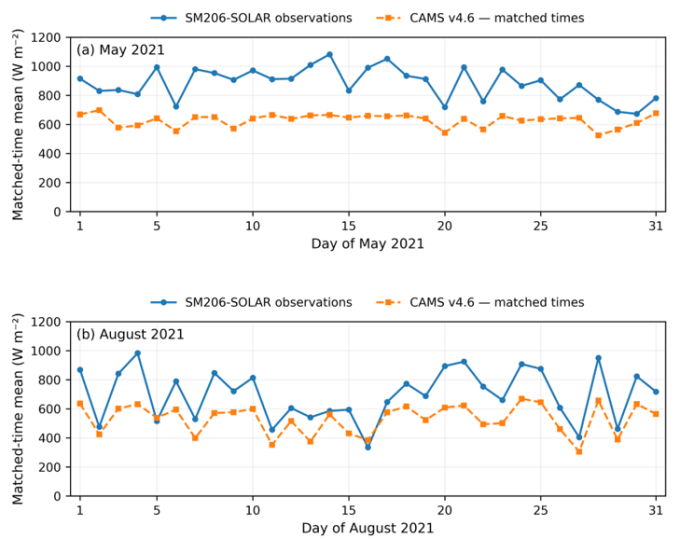
Figure 1. Daily matched-time mean irradiance in (a) May and (b) August 2021. Ground observations and centered CAMS v4.6 proxies use identical retained times after reliability screening. The panels share a vertical scale. Lines connect daily summaries; they do not represent interpolated ground measurements.
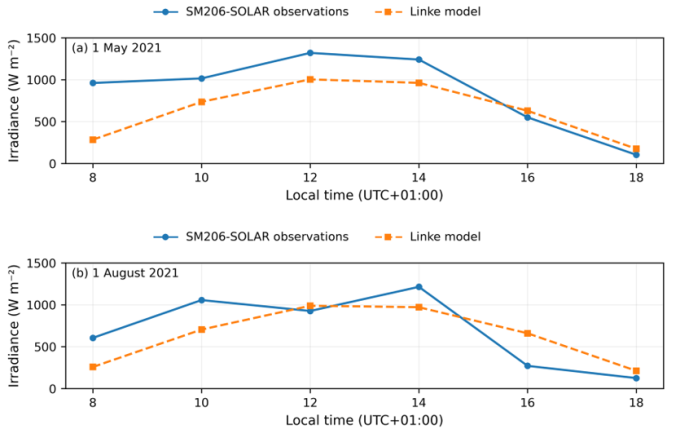
Figure 2. Ground observations and Linke-model irradiance at 08: 00, 10: 00, 12: 00, 14: 00, 16: 00 and 18: 00 local time (UTC+01: 00) on (a) 1 May and (b) 1 August 2021. All six points are retained. The panels share axis scales; connecting lines do not imply additional observations. The comparisons remain illustrative because calibration and clear-sky representativeness are unverified.

Information



 Share This Article
 Twitter
 Linked In
 Facebook
 Copy
Copy Download