Research Article | | Peer-Reviewed

Analysis of Onset, Cessation, and Length of the Growing Season and Its Implication for Agricultural Production in Uromi, Edo State

Received: 6 May 2026     Accepted: 21 May 2026     Published: 10 June 2026
Views:       Downloads:
Abstract

Irregular rainfall limits adequate crop production within the Uromi in south – south agroecological zone of Nigeria. This study was carried out to analyse the rainfall pattern, onset and cessation of rainy season including the length of growing season for agricultural production in Uromi, Edo state. Secondary data collected from NiMET maproom for the period 1991 – 2024 were used. The result revealed a variation in rainfall pattern in the area which led to variation in onset and cessation of rainfall including length of growing season. A very high variability in the onset of rain was observed with a CV of 95%, cessation has a CV of 30.67% indicating a high variability while length of growing season has a low variability with a CV of 3.88%. The trend analysis shows that onset of the rainy season has a negative trend of y = -0.1329x + 9.8556 with an R-squared value of 0.0304. A positive trend was observed for cessation of rain with a best fit line equation y = 0.1134x + 13.369 and a low R2 of 0.0605 which is discernible trend in the data. The length of growing season has a positive slope (y = 0.2527x + 217.7) and an R2 of 0.0853. The observed trend in the area may have been triggered off by intrinsic and extrinsic factors. This information is very important to farmers in Uromi in deciding on crop types to be cultivated and on planning sowing dates as a function of observed onset dates. The study recommend Farmers should change/shift their planting period to appropriate time since the onset date has changed in order to avoid crop damage at the early stage, Government should provide the farmers with early matured crop and improved crop varieties, mitigation/adaptation action is highly needed in order to cope with the problem.

Published in International Journal of Environmental Monitoring and Analysis (Volume 14, Issue 3)
DOI 10.11648/j.ijema.20261403.13
Page(s) 120-129
Creative Commons

This is an Open Access article, distributed under the terms of the Creative Commons Attribution 4.0 International License (http://creativecommons.org/licenses/by/4.0/), which permits unrestricted use, distribution and reproduction in any medium or format, provided the original work is properly cited.

Copyright

Copyright © The Author(s), 2026. Published by Science Publishing Group

Keywords

Length of Rainy Season, Onset and Cessation Dates, Rainfall, Rainy Season, Uromi

1. Introduction
Global ecosystems are experiencing changes in rainfall amount, intensity, and temporal distributions and this poses great challenge to agricultural production . Rainfall is undoubtedly the most critical hydroclimatic variable that has profound effect on agricultural production and water resources management . Given the trend of climate change, whereby global temperature has been increasing in the past decades , the rainfall characteristics—including total amount, intensity, frequency, onset, and cessation are very important to determining agricultural productivity in tropical regions .
The gravity of the changes noticed in rainfall is its effect on the actual planting dates which has serious implication for farmers’ decision since the onset date of rain has become unpredictable over the years . The implication of this scenario is the issue of a dry spell that is capable of causing crop failures and waste of resources . The dry spell is the first occurrence of unsustainable rainfall that deceives farmers into planting .
One of the climate indicators frequently requested by farmers for their planning is the onset of rain . Onset of rainy in season mean different things to different professionals but to a farmer, it simply means the rainy season by the day after which they can expect a continuity of wet days, indicating that water availability will meet crop water requirements . The Nigerian Meteorological Agency define Onset date as the point when the amount of water that plant can access in the soil reaches 50% of the soil’s total water holding capacity measured cumulatively from the start of the rainy season . A day is considered to be rainy at least 1 mm observed accumulated to 20 mm over 5 days with at least 3 rain days and dry spell not exceeding 7 days in the next 21 days. This definition is in line with Food and Agricultural Organization definition that refers onset in the context of agriculture and climatology dates as when moisture supply from precipitation and soil storage equals or exceeds half the potential evapotranspiration.
On the other hand, cessation date does not refer to the last day of rainfall rather when the amount of rainfall can no longer guarantee effective crop production. Cessation of rainfall has been referred to as any day there are 21 or more consecutive days of rainfall that is less than 50% of the decadal crop requirement from September 1st . The date of onset and cessation often determines the length of the growing season, which is key for high crop yields . The length of the growing season is referred to as the number of days when plant growth takes place and it is determined by the onset and cessation dates of the rains. It naturally exhibits spatial and temporal variation due to shifts in onset and cessation dates .
In Nigeria, the challenge of feeding a rapidly growing population is already significant. Widespread poverty, urbanization, insecurity and demographic pressures have strained agricultural productivity and food supply systems . These challenges pose the mismatch between food demand and domestic production, with many households facing rising food prices and nutritional insecurity. Climate change is currently increasing this precarious situation by distorting traditional farming calendars, decrease in crop yields, and threats to the stability of food systems thus leading to crisis in the national food system. This challenge calls for a critical analysis of the onset and cessation dates including the length of the growing season to enable proper planning activities in the season.
Since rainfall is a very important climatic factor for crop production, crop yields may be affected by either a late onset or early cessation of the growing season as well as high rate of dry spells within the growing season. Agricultural planning activities for sustainable food production is dependent on rainfall, therefore the knowledge of rainfall onset and cessation variation as well as length of the growing season is of great importance .
There have been studies on onset and cessation of rain in Nigeria but mostly in the Northern part of the country . A few studies were conducted in the south . Available search showed that in Edo state, there was a study on the Effects of Rainy Season Onset, Cessation, and Length on Food Security and Sustainable Crop Production in Edo State, Nigeria but non in Uromi, Esan North East, a place noted by as an agrarian area. The goal of this study therefore is to determine the patterns of changes of onset and cessation of rainfall as well as the length of growing season in Uromi. This information could contribute to successful planning for crop production; selection of the crop type and variety, timing of sowing, short-term seed storage and harvesting. The specific objectives of the study are to:
1) determine the trends onset and cessation dates as well as length of the growing season for the period of 1991 to 2024
2) the variation in onset and cessation dates as well as length of the growing season for the period of 1991 to 2024
2. Study Area and Methodology
2.1. Location and Data Collections
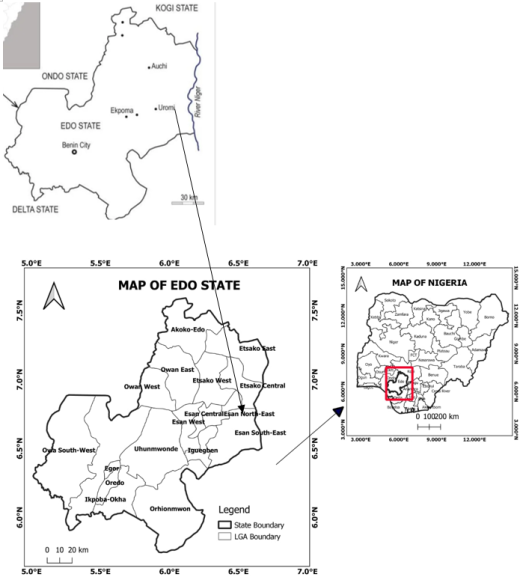
The study area consisted of rural and urban communities in Uromi, headquarter of Esan North East Local Government Area of Edo state. The area lies within Latitudes 6.7140° N and Longitudes 6.3279° E. The 2006 National census put Uromi population at 119,346 people but it is estimated to be 180,200 people as at 2024 with a land area of about 255.399 Kilometer square and an estimated population of 195,757 (National Population Commission, 2022). The area has about 22 villages which include Amedokhian, Arue, Awo, Efandion, Egbele, Eguare-Uromi, Eko-Ibadin, Eror, Ewoyi, Idumoza, Ivue, Obeidu, Onewa, Ubierumu Ne- Oke, Ubierumu Ne- Uwa, Ukoni, Unuwazi, Utako and Uwalo.
Uromi which is located in Edo central has a tropical climate with an annual rainfall averaging 1540 mm, mean temperature of 31°C and mean annual relative humidity ranging from 30.50 to 94.00% . The village of Ivue is located at the highest point in Esan with about 1,490 feet above the sea level.
The area stands topmost on the plateau sitting at about 1000 feet above sea level, with the village of Ivue occupying the highest point on the Esan plateau with about 1,490 feet above sea level . The seasonal pattern is characterised by rain from April to October and dry season from early November to March.
Figure 1. Map of Edo state indicating the location of Uromi.
2.2. Methodology
2.2.1. Source of Data
The data for this research is strictly secondary data. The rainfall data; mean monthly rainfall from 1991-2020 and onset and cessation data from 1991 to 2024 were extracted from NiMET maproom. In addition, other materials like journals, textbooks, maps, and any related note were consulted.
2.2.2. Data Analysis
The onset and cessation dates was determined using the Walters formulation as modified by .
Onset/End=DMTM=(51–AP)
Where;
DM = Days of onset in a month
TM = Total rainfall that exceeds 51 mm in a month.
AP = accumulated rainfall of previous months just before the month in reference.
51 mm = the threshold of rainfall for both Onset/End month. where such onset date was followed by rainfall amount less than 51 mm, the next rain day date that is up to 51 mm or more will be chosen.
SD=√Σ(xi−¯x)2/n−1
SD = Standard Deviation
¯x = mean value of the observations
n = The number of observations
3. Results and Discussions
3.1. Rainfall Patterns in Uromi
Source: NiMET Maproom (2026)

Download: Download full-size image

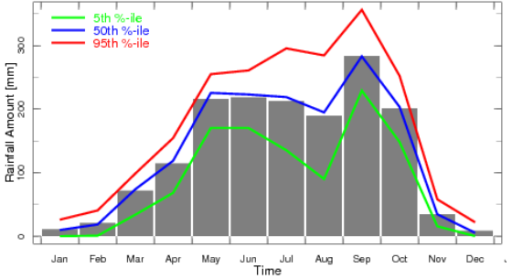
Figure 2. Monthly Rainfall Pattern in the Study area.
Figure 2 shows the monthly rainfall pattern in Uromi. The mean monthly rainfall climatology of the area between 1991 and 2020 shows an average monthly rainfall ranging from 10mm in December to 280mm/month in September. This is in line with the report of nomadseason (2024) that observed a mean monthly rainfall of 7mm in December and 267mm in Sept between 2017 and 2022 in Uromi, Esan North East. December, January and February with less than 51mm of monthly rainfall can be regarded as the dry months. This is as noted by that any month with less than 51mm average rainfall is dry. However, the months of March to October are wet months having an average rainfall of 67mm in March and 280mm in September. These periods are therefore regarded as having heavy rainfall according to who noted that any rainfall that has about 60mm in a month is termed to be heavy. December, January and February can be actually regarded as dry months, since the recorded average rainfall are less than 51 mm. Rainfall in Uromi is influenced by intrinsic and extrinsic factors. One of them is Intertropical Discontinuity (ITD). The ITD is positioned in the equatorial trough, a continuous low-pressure region that marks the geographic equator, where surface trade winds converge to generate a zone of heightened mean convection, cloudiness, and precipitation; transporting heat and moisture from surface evaporation and sensible heating . It has been noted that, apart from the contribution of ITD to rainfall distribution in Nigeria, other factors controlling rainfall include the ocean-atmosphere interaction, relief, line squall and the local features .
3.2. Variations
Table 1 below presents a data set from 1991 – 2024 detailing the planting window (onset) and crop maturity date (cessation date) including length of growing season for each year. A detailed analysis of the data is necessary for understanding the changes in crop during development and its interaction with the environment over time, and its implications for agricultural practices. According to , a Coefficient of Variance (CV) is used to classify the degree of variability in the following order; less (CV < 20%), moderate (20 < CV < 30%), high (CV > 30%), very high (CV > 40%) and CV > 70%.
3.2.1. Variation in Onset Dates of Rainfall
The data set in Table 1 is clearly not normally distributed. The mean onset date was 8th of April, with a coefficient variation of 95%, the implication of this is that from one year to the other, onset of rainfall for the growing season is likely to change from the expected by about 95% indicating a very high variability. Standard Deviation of ±8 days, in other words from one year to the next, onset of rainfall for the growing season is likely to commence 8 days before the expected date, just as much as it is likely to arrive 8 days later than the normally expected onset date. The earliest onset date was 1st of April and 28th of April 2000 was the last onset date within the period of study which indicates yearly variations as observed by that rainfall onset dates could vary remarkably on annual basis. This finding is similar to that of who observed that rainfall typically commences within April in Uyo, Akwa Ibom state, a state within south -south region of Nigeria just like Uromi in Edo state.
3.2.2. Variation in Rainfall Cessation Dates
The minimum rainfall cessation date observed is 5th November, the highest is 26th November while the average cessation 15th November. The cessation date has a standard deviation of 4.6 (5) and CV of 30.67. The data set shows variability, as evidenced by CV is 30.67 which indicates a relatively high variability. These statistics suggests that the cessation of rainfall values exhibit significant dispersion around the mean. The findings of this study is in conformity with .
3.2.3. Variation in Length of Growing Season
The data in Table 1 indicate both increases and decreases in the length of growing season over the chosen years (1991- 2024) with a mean value of 222 days. The standard deviation is 8.62 while the CV is 3.62. Having a standard deviation of 8.62 and a Coefficient of Variation (CV) of 3.62% indicates that the data has low variability relative to the mean, but the absolute dispersion (8.62) is meaningful only in the context of the data's magnitude.
Table 1. Rainfall onset dates, cessation and length of growing season.

Year

planting window Onset Date

crop maturity (Cessation) Date

Length of the growing Season (Days/year)

1991

4th April

14th Nov

224

1992

7th April

13th Nov

220

1993

19th April

15th Nov

210

1994

1st April

16th Nov

229

1995

11th April

17th Nov

220

1996

2nd April

9th Nov

221

1997

1st April

19th Nov

232

1998

18th April

11th Nov

207

1999

20th April

14th Nov

208

2000

4th April

17th Nov

227

2001

7th April

7th Nov

214

2002

4th April

17th Nov

227

2003

28th April

19th Nov

205

2004

2nd April

15th Nov

227

2005

4th April

13th Nov

223

2006

2nd April

14th Nov

226

2007

13th April

15th Nov

216

2008

18th April

5th Nov

210

2009

1st April

17th Nov

230

2010

1st April

19th Nov

232

2011

1st April

15th Nov

228

2012

8th April

18th Nov

224

2013

5th April

16th Nov

225

2014

7th April

19th Nov

226

2015

25th April

14th Nov

203

2016

9th April

14th Nov

219

2017

4th April

16th Nov

226

2018

5th April

21st Nov

230

2019

16th April

23rd Nov

221

2020

1st April

11th Nov

224

2021

5th April

24th Nov

233

2022

1st April

9th Nov

222

2023

1st April

26th Nov

239

2024

1st April

10th Nov

224

Mean

8

15

222.12

STD

7.6

4.6

8.62

CV (%)

95

30.67

3.88

Source: Author’s Analysis, 2026
3.3. Trends in the Onset, Cessation Dates and Length of Growing Season (LOS)
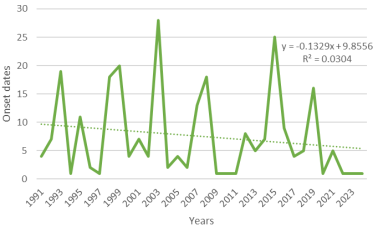
The trend analysis was carried out to identify the direction and magnitude of the relationships in the onset, cessation and Length of growing season (LOS). It showed the existence of a significant trend in the assessed parameters. The onset of the rainy season has a negative trend of y = -0.1329x + 9.8556 (Figure 3). This equation indicates a decreasing trend in the onset dates of the rainy season over time in the study area. With an R-squared value of 0.0304, only 3.04% of variability in the onset dates of rainy season can be explained by the linear relationship with time.
Source: Author’s Analysis 2026

Download: Download full-size image

Figure 3. Yearly onset dates of rain in Uromi (1991 – 2024).
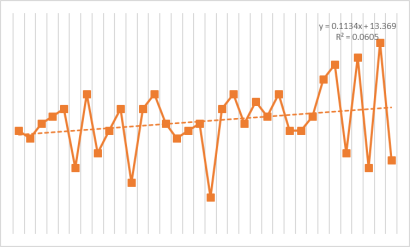
The analysis of the cessation dates of the rainy season reveals a notable trend, as indicated by the best fit line equation y = 0.1134x + 13.369 (Figure 4). This equation demonstrates a positive slope, suggesting an increasing trend in the cessation dates of the rainy season over time. A positive slope of 0.1134 in a trend analysis indicates a delayed rainfall cessation over time. An (R)-squared value of (0.0605) demonstrates that time accounts for only (6.05%) of the variance in rainy season end dates, suggesting a weak correlation between the two variables. It also indicates a discernible trend in the data. The positive slope of the trend line implies that, averagely, the rainy season has been ending late, in recent time in the study area. This changes in rainfall cessation dates significantly impact agricultural planning, hydrological resource management, and seasonal ecological processes. This finding is similar to an earlier study by .
Source: Author’s Analysis 2026

Download: Download full-size image

Figure 4. Yearly cessation dates of rain in Uromi (1991 – 2024).
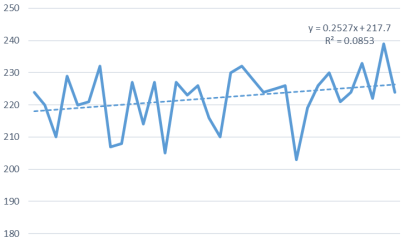
The analysis of the length of growing season indicates a discernible trend, as shown in the best fit line equation y = 0.2527x + 217.7 of Figure 5. The positive slope denotes an upward trend in the length of the growing season over time. A coefficient of determination R2 of 0.0853 demonstrates that while temporal changes account for 8.53% of the variance in rainy season length, the underlying trend remains statistically significant. The positive slope of the trend line implies that, on average, the rainy season has been longer in recent years. This increased duration of the rainy season can have significant implications for various sectors, including agriculture, water resource management, and ecosystem dynamics.
Source: Author’s Analysis 2026

Download: Download full-size image

Figure 5. Length of growing season in Uromi (1991 – 2024).
4. Discussion
A variability analysis of onset and cessation of rain including length of growing season is of great importance for policy makers in their decision making and farmers in their decision of what to plant and when to plant it as rainfall plays leading role in deciding cropping calendar in red-fed agriculture. It has been noted that rain-fed agriculture and farmers’ income are threatened by highly variable dates of onset and end of the rainy season .
In line with this, the Uromi inhabitants, the farmers’ income and food production can be boosted via sustainable planning with little supply of irrigation to ensure multiple crops growing seasons annually. This is necessary to avert food scarcity and food insecurity in the study area and beyond. Though the late end of the rainy season is not a prominent feature of the rainfall regime in Uromi, the years with later dates significantly had longer growing seasons. The observed trend in the area may have been triggered off by some factors, including climate change, land use management, and variability natural climate . Variations in the timing and duration of rainy seasons are heavily influenced by climate change which induces shifts in precipitation. Additionally, changes in land-use pattern specifically deforestation and urbanization—significantly impact local weather patterns and seasonal length.
It has been reported that lack of synergy between rainfall onsets and agronomic decisions such as sowing date is one of the main factors causing low productivity globally implying that Uromi in Edo state is not excluded. Onset of rainy season is very important to crop production, as a few days delay in onset of the rainy season can make drought conditions more imminent. This therefore means that early identification and warning of drought conditions can save lives and livelihoods through informed preparedness.
5. Conclusion
The ability to predict the onset and cessation dates as well as the amount and the distribution of rainfall each year are usually some of the needs of farmers and extension agents to ensure high yield of crops. From this study, climate variability has significant influence on onset and cessation dates of rainfall in the study area. The identified onset and cessation dates and the lengths of the growing season are quite valuable for planning of rain fed agricultural activities which is what is practiced in the study area.
Analysis of onset results indicate that there exists organized progression of rainfall onset within the Uromi indicating that the South west air mass has influence on the rainy season. There is a very high and high variation of onset and cessation of rain in the area within the time (1991 -2024). Only length of growing season was observed to have very low variability. The variability observed may have been caused by El Niño-Southern Oscillation (ENSO) which is a major driver of early or late onsets . El Niño events can disrupt traditional rainfall patterns, causing delays, while La Niña phases often correlate with delayed onset in many regions.
A negative slope was observed for the onset of rain analysis which implies that the date is decreasing with time. The positive slope in cessation of rain and length of growing season had implies that the rainy season starts early in recent times while cessation dates arrive late. Consequently, the length of rainy season is long. This showed that the trend of onset and cessation dates and length of rainy season are characterized by marked variability.
6. Recommendations
In view of the foregoing, it is recommended that Farmers must adjust their planting schedules to align with shifting rainfall patterns to prevent early-stage crop damage. Additionally, the government should supply improved seeds and deploy agricultural extension workers to rural areas to train farmers on modern techniques. Urgent mitigation and adaptation strategies are critical to building resilience against climate variability.
Abbreviations

CV

Coefficient of Variance

ITD

Intertropical Discontinuity

NIMET

Nigerian Meteorological Agency

SD

Standard Deviation

Author Contributions
Perpetua Nkeiruka Oby Iyere-Usiahon: Conceptualization, Methodology, Writing – review & editing
Onyilo Desmond Onyilo: Writing – review & editing
Conflicts of Interest
The authors declare that there is no conflicts of interests regarding the publication of this paper.
References
[1] Adegoke Fayose, C. (2025). Recent Patterns of Temperature and Rainfall Variation in a Tropical Rainforest Location. Turkish Journal of Agriculture - Food Science and Technology, 13(9), 2708–2717.
[2] Adeleke, E. A. and Olabode, A. D. (2025). Analysis of rainfall and windflow patterns in southwestern Nigeria. Meteorology Hydrology and Water Management, 13(2), 23–34.
[3] Ajieh, M. (2025). Evaluation of Groundwater in Uromi, Edo State, Nigeria. International Journal of Scientific and Engineering Research.
[4] Alli, Adekunle and Omofunmi, Olorunwa. (2021). Trend Significance Levels of Rain Onset and Cessation and Lengths of the Wet and Dry Seasons in Epe, Lagos State, Nigeria. Makara Journal of Technology. 25. 79.
[5] Ani KJ, Anyika VO, Mutambara E (2022), "The impact of climate change on food and human security in Nigeria". International Journal of Climate Change Strategies and Management, Vol. 14 No. 2 pp. 148–167,
[6] Atiah, W. A.; Muthoni, F. K.; Kotu, B.; Kizito, F.; Amekudzi, L. K. (2021). Trends of Rainfall Onset, Cessation, and Length of Growing Season in Northern Ghana: Comparing the Rain Gauge, Satellite, and Farmer’s Perceptions. Atmosphere 2021, 12, 1674.
[7] Atiah, W. A.; Amekudzi, L. K.; Akum, R. A.; Quansah, E.; Antwi-Agyei, P.; Danuor, S. K. (2021). Climate Variability and Impacts on Maize (Zea Mays) Yield in Ghana, West Africa. Available online:
[8] Atiah, W. A.; Tsidu, G. M.; Amekudzi, L.; Yorke, C. (2020). Trends and interannual variability of extreme rainfall indices over Ghana, West Africa. Theor. Appl. Climatol. 2020, 140, 1393–1407.
[9] Ayomide, Arowolo and Oluleye, Ayodeji. (2021). Assessing the Influence of Inter Tropical Discontinuity on Total Column Ozone Variation Over West Africa.
[10] Bagus S. W., Paul D. and Ike S. A (2025). An analysis of rainfall variability and its association with agricultural productivity in the Brantas River Basin, Indonesia: Insights from a 26-year analysis. Ecohydrology & Hydrobiology, Volume 25, Issue 4, 2025, 100674,
[11] Chinago Budnukaeku Alexander (2026). Analysis of Trend, Variability, and Characteristics of Rainfall over Benin City, Nigeria (1981–2021). International Journal of Innovative Environmental Studies Research 14(1): 160-171, Jan.-Mar., 2026 © Seahi Publications, 2026
[12] Dawood Omolumen Egbefo. The role of Agriculture in Economic Development and Inter-Group Relations in Pre-Colonial Esan Economy. Research J. Humanities and Social Sciences. 8(2): April- June, 2017, 139-150.
[13] Ekene l., Ekwezuo C. and Ezeh C. (2024). Variability of the Onset and End Dates of the Rainy Season in Owerri, Imo State, Nigeria. International Journal of Science Letters. 6. 2024.
[14] Endoro, O., Boyitie, P. and Omonigho, M.. (2025). Effects of Rainy Season Onset, Cessation, and Length on Food Security and Sustainable Crop Production in Edo State, Nigeria. Journal of Applied Sciences and Environmental Management. 29. 3482-3492.
[15] Eruola A. O., Makinde A. A., Eruola G. A. and Ayoola K. O. (2021). Assessment of the Rainfall Exceedance in Nigeria. Nigerian Journal of Technology (NIJOTECH) Vol. 40, No. 4 July, 2021, pp. 751 –761
[16] (FAO) (2017). Food and Agricultural Organization, FAO Strategy on Climate Change. Rome, Italy.
[17] Fekadie Bazie Enyew, Dejene Sahlu, Gashaw Bimrew Tarekegn, Yakob Umer, Belen Marti-Cardona, Bedassa R. Cheneka, Daniel Asfaw Bekele, Daniel Ayalew Mengistu, Sarkawt Hama, Zinaw D. Shenga, Sisay E. Debele (2025). Future changes in rainy seasons in the Upper Blue Nile Basin: Impacts on agriculture and water resources, Natural Hazards Research, Volume 5, Issue 4, 2025, Pages 960-974,
[18] Ferijal, T., Batelaan, O., Shanafield, M and Alfahmi F. (2022).. Determination of rainy season onset and cessation based on a flexible driest period. Th Furqon eor Appl Climatol 148, 91–104 (2022).
[19] Idumu M., Ishaya S., Bello E., and Ifeka A. (2020). Evaluation of Onset and Cessation of Rainfall and Temperature on Maize Yield in Akure, Ondo State, Nigeria.
[20] Islam H, M, T, Ahmed S., Kamruzzaman M., Kumar V and Bhandari H. (2025). Impact of rainfall variability and extremes on crop intensification and diversification in the coastal region of Bangladesh, Environmental and Sustainability Indicators, Volume 27, 2025, 100813,
[21] Mohammed Bukar Ngamdu and Ahmadu Goni (2024). Analysis Of Rainfall Onset, Cessation and Length of the Growing Season and its Variability Effects on Crop Production in Karasuwa Local Government Area, Yobe State,. Wukari International Studies Journal, VOL 8(3), July, 2024.
[22] Mohammed Mohammed Jiji, Ibrahim Audu and Ayuba Muhammad Magaji (2025). The Impact of Rural-Urban Migration on Food Security in Gombe Metropolis, Gombe State, Nigeria. Journal of Political Discourse Vol. 3, Issue 1, No. 1 / March 2025
[23] Mosisa Tujuba Wakjira, Nadav Peleg, Daniela Anghileri, Darcy Molnar, Tena Alamirew, Johan Six, Peter Molnar (2021). Rainfall seasonality and timing: implications for cereal crop production in Ethiopia, Agricultural and Forest Meteorology, Volume 310, 2021, 108633,
[24] NiMET (2026). Nigerian Meteorological Agency, 2026 Seasonal Climate Prediction, CLIMATE SCIENCE for SUSTAINABLE DEVELOPMENT.
[25] NiMET (2021). 2021 SEASONAL CLIMATE PREDICTION (SCP).
[26] Ogunbode, T. O. Esan, V. I. Samson, T. K. Oyelowo, O. J. and Asifat, J. T. (2022). Rainfall Trend and its Implications for Sustainable Crop Production and Water Resources Management: A Case Study of Iwo, Nigeria. J. Appl. Sci. Environ. Manage, 26(8) 1415-1422.
[27] Olanipon, Damilola & Adewoyin, Adelowo & Eludoyin, Adebayo. (2025). Climatic Variability and Associated Changes in a Nigerian Nature Forest Reserve. Oxford Open Climate Change. 5.
[28] Olaniran, O. J. (1983) The Onset of the Rains and the Start of the Growing Season in Nigeria. Nigerian Geographical Journal, 26, 81-88.
[29] Omay, Paulino & Muthama, Nzioka & Kinama, Josiah & Artan, Guleid & Atheru, Zachary. (2023). Changes and variability in rainfall onset, cessation, and length of rainy season in the IGAD region of Eastern Africa. Theoretical and Applied Climatology. 151.
[30] Omotosho JB, Balogun AA, Ogunjobi K (2000) Predicting monthly and seasonal rainfall, onset and cessation of the rainy season in West Africa using only surface data. Int J Climatol 20: 865–880.
[31] Pellegrini, C., Sammartino, I., Schieber, J., Tesi, T., Paladini de Mendoza, F., Rossi, V., Chiggiato, J., Schroeder, K., Gallerani, A., Langone, L., Trincardi, F. and Amorosi, A. (2024), On depositional processes governing along-strike facies variations of fine-grained deposits: Unlocking the Little Ice Age subaqueous clinothems on the Adriatic shelf. Sedimentology, 71: 941-973.
[32] Sagar S. Vakhare, Arpit Chopra, Jigar Pandya, Dr. Sailesh Iyer (2024). An Analysis of Seasonal Trend Variation in Rainfall and Temperature Pattern in Ahmedabad Region of Gujarat, IndiaIjraset Journal For Research in Applied Science and Engineering Technology. IJRASET65005.
[33] Udeh P. C. (2025). Policing and Crime Control in Uromi, Esan North-East Local Government Area of Edo State, Nigeri. a An Unpublished M.Sc Thesis Submitted to the Department of Sociology and Anthropology, Faculty of Social sciences, University of Benin, Benin City, Edo State, Nigeria in partial Fulfilment of The requirements for the award of Master's Degree in Sociology and Anthropology (Criminology).
[34] Usoh Godwin A. (2025), Determination of Onset of the Farming Season of Maize in Uyo Local Government Area, Akwa Ibom State. Advanced Journal of Science, Technology and Engineering 5(2), 1-13.
[35] Weppa Wanno Farms (2018): Weather Station Annual Reports. Wepa Wanno, Edo State, Nigeria. 2018.
[36] Zitta, Solomon. (2021). Analysis of Rainfall Onset, Cessation and Length of Rainy Season in the Guinea Savanna Region of Nigeria. 2. 105 - 116.
[37] Matteo Zampieri, Andrea Toreti, Michele Meroni, Dragana Bojovic, Sara Octenjak, Raül Marcos-Matamoros, Stefano Materia, Ladislaus Chang'a, Mecklina Merchades, María del Mar Chaves Montero, Felix Rembold, Alberto Troccoli, Indrani Roy, Ibrahim Hoteit, (2023). Seasonal forecasts of the rainy season onset over Africa: Preliminary results from the FOCUS-Africa project, Climate Services, Volume 32, 2023, 100417,
[38] Ikpe, Elisha and Ariko J. D. (2020). Trends In Rainfall Onset, Cessation and Length of Growing Season and its Implication on Sorghum Yield in Katsina State, Nigeria. Gombe Journal of Geography and Environmental Studies.
Cite This Article
  • APA Style

    Iyere-Usiahon, P. N. O., Onyilo, O. D. (2026). Analysis of Onset, Cessation, and Length of the Growing Season and Its Implication for Agricultural Production in Uromi, Edo State. International Journal of Environmental Monitoring and Analysis, 14(3), 120-129. https://doi.org/10.11648/j.ijema.20261403.13

    Copy | Download

    ACS Style

    Iyere-Usiahon, P. N. O.; Onyilo, O. D. Analysis of Onset, Cessation, and Length of the Growing Season and Its Implication for Agricultural Production in Uromi, Edo State. Int. J. Environ. Monit. Anal. 2026, 14(3), 120-129. doi: 10.11648/j.ijema.20261403.13

    Copy | Download

    AMA Style

    Iyere-Usiahon PNO, Onyilo OD. Analysis of Onset, Cessation, and Length of the Growing Season and Its Implication for Agricultural Production in Uromi, Edo State. Int J Environ Monit Anal. 2026;14(3):120-129. doi: 10.11648/j.ijema.20261403.13

    Copy | Download

  • @article{10.11648/j.ijema.20261403.13,
      author = {Perpetua Nkeiruka Oby Iyere-Usiahon and Onyilo Desmond Onyilo},
      title = {Analysis of Onset, Cessation, and Length of the Growing Season and Its Implication for Agricultural Production in Uromi, Edo State},
      journal = {International Journal of Environmental Monitoring and Analysis},
      volume = {14},
      number = {3},
      pages = {120-129},
      doi = {10.11648/j.ijema.20261403.13},
      url = {https://doi.org/10.11648/j.ijema.20261403.13},
      eprint = {https://article.sciencepublishinggroup.com/pdf/10.11648.j.ijema.20261403.13},
      abstract = {Irregular rainfall limits adequate crop production within the Uromi in south – south agroecological zone of Nigeria. This study was carried out to analyse the rainfall pattern, onset and cessation of rainy season including the length of growing season for agricultural production in Uromi, Edo state. Secondary data collected from NiMET maproom for the period 1991 – 2024 were used. The result revealed a variation in rainfall pattern in the area which led to variation in onset and cessation of rainfall including length of growing season. A very high variability in the onset of rain was observed with a CV of 95%, cessation has a CV of 30.67% indicating a high variability while length of growing season has a low variability with a CV of 3.88%. The trend analysis shows that onset of the rainy season has a negative trend of y = -0.1329x + 9.8556 with an R-squared value of 0.0304. A positive trend was observed for cessation of rain with a best fit line equation y = 0.1134x + 13.369 and a low R2 of 0.0605 which is discernible trend in the data. The length of growing season has a positive slope (y = 0.2527x + 217.7) and an R2 of 0.0853. The observed trend in the area may have been triggered off by intrinsic and extrinsic factors. This information is very important to farmers in Uromi in deciding on crop types to be cultivated and on planning sowing dates as a function of observed onset dates. The study recommend Farmers should change/shift their planting period to appropriate time since the onset date has changed in order to avoid crop damage at the early stage, Government should provide the farmers with early matured crop and improved crop varieties, mitigation/adaptation action is highly needed in order to cope with the problem.},
     year = {2026}
    }
    

    Copy | Download

  • TY  - JOUR
    T1  - Analysis of Onset, Cessation, and Length of the Growing Season and Its Implication for Agricultural Production in Uromi, Edo State
    AU  - Perpetua Nkeiruka Oby Iyere-Usiahon
    AU  - Onyilo Desmond Onyilo
    Y1  - 2026/06/10
    PY  - 2026
    N1  - https://doi.org/10.11648/j.ijema.20261403.13
    DO  - 10.11648/j.ijema.20261403.13
    T2  - International Journal of Environmental Monitoring and Analysis
    JF  - International Journal of Environmental Monitoring and Analysis
    JO  - International Journal of Environmental Monitoring and Analysis
    SP  - 120
    EP  - 129
    PB  - Science Publishing Group
    SN  - 2328-7667
    UR  - https://doi.org/10.11648/j.ijema.20261403.13
    AB  - Irregular rainfall limits adequate crop production within the Uromi in south – south agroecological zone of Nigeria. This study was carried out to analyse the rainfall pattern, onset and cessation of rainy season including the length of growing season for agricultural production in Uromi, Edo state. Secondary data collected from NiMET maproom for the period 1991 – 2024 were used. The result revealed a variation in rainfall pattern in the area which led to variation in onset and cessation of rainfall including length of growing season. A very high variability in the onset of rain was observed with a CV of 95%, cessation has a CV of 30.67% indicating a high variability while length of growing season has a low variability with a CV of 3.88%. The trend analysis shows that onset of the rainy season has a negative trend of y = -0.1329x + 9.8556 with an R-squared value of 0.0304. A positive trend was observed for cessation of rain with a best fit line equation y = 0.1134x + 13.369 and a low R2 of 0.0605 which is discernible trend in the data. The length of growing season has a positive slope (y = 0.2527x + 217.7) and an R2 of 0.0853. The observed trend in the area may have been triggered off by intrinsic and extrinsic factors. This information is very important to farmers in Uromi in deciding on crop types to be cultivated and on planning sowing dates as a function of observed onset dates. The study recommend Farmers should change/shift their planting period to appropriate time since the onset date has changed in order to avoid crop damage at the early stage, Government should provide the farmers with early matured crop and improved crop varieties, mitigation/adaptation action is highly needed in order to cope with the problem.
    VL  - 14
    IS  - 3
    ER  - 

    Copy | Download

Author Information
  • Federal Department of Agriculture, Federal Ministry of Agriculture and Food Security, Abuja, Nigeria

  • Applied Meteorological Services Department, Nigerian Meteorological Agency, Abuja, Nigeria