
The work presented is an analysis of solar photovoltaic production, the objective of which is to study the effect of seasonal atmospheric parameters on the production of solar photovoltaic power plants in Burkina Faso. It is a study based on in situ measurements and observation data from the MODIS sensor aboard the Terra satellite. Thus, an analysis of aerosol variability at the national scale shows that aerosol levels peak during the winter months of February, the spring months of March, April, and May, and the summer month of June. This distribution of aerosols is consistent with the dynamics of the Harmattan wind and convective systems, which explain the nature of aerosols dominated by coarse particles associated with desert dust. Furthermore, this seasonality of aerosols is confirmed by the annual cycles of AOD and Angstrom coefficient observed at the study sites where the power plants are located. In addition, a combined qualitative analysis of the AOD cycle and available solar potential shows the direct effect of aerosols on the radiation required for solar photovoltaic conversion. This effect of aerosols on solar power plant output is corroborated by a negative correlation that demonstrates their significant ability to influence the efficiency of solar power plant output. Furthermore, the study of the seasonal effect of climatic parameters indicates, through annual cycles and correlation coefficients, the negative impact of temperature and relative humidity on the output of solar photovoltaic systems. This is contrary to the effect of sunlight, although it depends on the weather, location, and environmental factors. The same applies to wind speed, which is favorable to the production cycle of power plants, although it is the main vector for the emission of mineral dust that settles on the surface of the modules. In short, atmospheric parameters generally have a negative impact on photovoltaic power plant production in a Sahelian-type climate strongly influenced by desert dust.
| Published in | International Journal of Atmospheric and Oceanic Sciences (Volume 10, Issue 1) |
| DOI | 10.11648/j.ijaos.20261001.13 |
| Page(s) | 25-37 |
| Creative Commons |
This is an Open Access article, distributed under the terms of the Creative Commons Attribution 4.0 International License (http://creativecommons.org/licenses/by/4.0/), which permits unrestricted use, distribution and reproduction in any medium or format, provided the original work is properly cited. |
| Copyright |
Copyright © The Author(s), 2026. Published by Science Publishing Group |
Aerosol, Climate Parameters, Solar Photovoltaic Production, MODIS, Burkina Faso
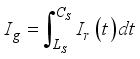 (1)
(1) 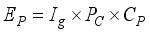 (2)
(2)  is a key indicator, just like atmospheric transparency visibility defined by aerosols, and depends on altitude (z), wavelength
  and attenuation coefficient
  according to the following equation (3)
 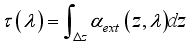 (3)
(3) 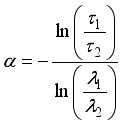 (4)
(4)  are the individual variables considered and
  their respective means
 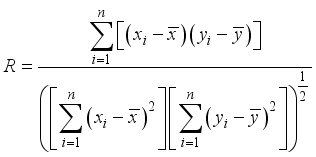 (5)
(5) AOD | Aerosol Optical Depth |
MODIS | MODerate Resolution Imaging Spectro-radiometer |
NASA | National Aeronautics and Space Administration |
PV | Photovoltaic |
SCADA | Supervisory Control and Data Acquisition |
| [1] | F. Shaik, S. S. Lingala, and P. Veeraboina, “Effect of various parameters on the performance of solar PV power plant: a review and the experimental study,” Sustainable Energy Research, vol. 12, no. 1, 2023, |
| [2] | P. R. Epstein, Buonocore, J. J., Eckerle, K., Hendryx, M., Stout, B. M., Heinberg, R., Clapp, R. W., May, B., Reinhart, N. L., Ahern, M. M., Doshi, S. K., and Glustrom, L, “Full cost accounting for the life cycle of coal,” Annals of the New York Academy of Sciences, vol. 1219, no. 1, pp. 73–98, 2011, |
| [3] | P. J. Landrigan, Fuller, R., Acosta, N. J. R., Adeyi, O., Arnold, R., Basu, N. (Nil), Balde, A. B., Bertollini, R., Bose-O’Reilly, S., Boufford, J. I., Breysse, P. N., Chiles, T., Mahidol, C., Coll-Seck, A. M., Cropper, M. L., Fobil, J., Fuster, V., Greenstone, M., Haines, A., … Zhong, M., “The Lancet Commission on pollution and health,” The Lancet, vol. 391, no. 10119, pp. 462–512, 2018, |
| [4] | H. Wang, B. W. Ang, and B. Su, “A Multi-region Structural Decomposition Analysis of Global CO2 Emission Intensity,” Ecological Economics, vol. 142, pp. 163–176, 2017, |
| [5] | IPCC, “Climate Change 2001: The Scientific Basis,” 2001. |
| [6] | M. Z. Jacobson, Delucchi, M. A., Bauer, Z. A. F., Goodman, S. C., Chapman, W. E., Cameron, M. A., Bozonnat, C., Chobadi, L., Clonts, H. A., Enevoldsen, P., Erwin, J. R., Fobi, S. N., Goldstrom, O. K., Hennessy, E. M., Liu, J., Lo, J., Meyer, C. B., Morris, S. B., Moy, K. R., … Yachanin, A. S., “100% Clean and Renewable Wind, Water, and Sunlight All-Sector Energy Roadmaps for 139 Countries of the World,” Joule, vol. 1, no. 1, pp. 108–121, 2017, |
| [7] | D. Millstein, R. Wiser, M. Bolinger, and G. Barbose, “The climate and air-quality benefits of wind and solar power in the United States,” Nat. Energy, vol. 2, no. 9, 2017, |
| [8] | E. Lu and D. Wang, “Impacts of Climate Change on River Regimes in Africa,” River Studies, vol. 2, no. 1, pp. 174–185, 2025, |
| [9] | I. Neher, S. Crewell, S. Meilinger, U. Pfeifroth, and J. Trentmann, “Photovoltaic power potential in West Africa using long-term satellite data,” Atmos. Chem. Phys., vol. 20, no. 21, pp. 12871–12888, 2020, |
| [10] | S. Goni, Adannou, H. A., Diop, D., Kriga, A., Khayal, ahamoud Y., Nebon, B., Cheidikh Beye, A., Aziz Niang, S. A., and Drame, M. S., “Observation and Simulation of Available Solar Energy at N’Djamena, Chad,” Smart Grid and Renewable Energy, vol. 10, no. 06, pp. 165–178, 2019, |
| [11] | B. Nebon, Drame, M. S., Bruno, K., Hassime, G., Niang, D. N., Sall, S. M., Florent, K. P., and Joseph, B. D., “Study of Aerosol Impact on the Solar Potential Available in Burkina Faso, West Africa,” International Journal of Environment and Climate Change, vol. 9, no. 5, pp. 297–310, 2019, |
| [12] | S. A. A. Niang, A. Gueye, A. Sarr, D. Diop, S. Goni, and B. Nebon, “Comparative Study of Available Solar Potential for Six Stations of Sahel,” Smart Grid and Renewable Energy, vol. 14, no. 08, pp. 153–167, 2023, |
| [13] | J. D. Mondol, Y. G. Yohanis, and B. Norton, “The impact of array inclination and orientation on the performance of a grid-connected photovoltaic system,” Renew. Energy, vol. 32, no. 1, pp. 118–140, 2007, |
| [14] | M. M. Fouad, L. A. Shihata, and E. S. I. Morgan, “An integrated review of factors influencing the performance of photovoltaic panels,” Renewable and Sustainable Energy Reviews, vol. 80, no. July 2016, pp. 1499–1511, 2017, |
| [15] | V. Prema and K. Uma Rao, “Development of statistical time series models for solar power prediction,” Renew. Energy, vol. 83, pp. 100–109, 2015, |
| [16] | M. M. Rahman, M. Hasanuzzaman, and N. A. Rahim, “Effects of various parameters on PV-module power and efficiency,” Energy Convers. Manag., vol. 103, pp. 348–358, 2015, |
| [17] | S. Nižetić, D. Čoko, A. Yadav, and F. Grubišić-Čabo, “Water spray cooling technique applied on a photovoltaic panel: The performance response,” Energy Convers. Manag., vol. 108, pp. 287–296, 2016, |
| [18] | S. A. M. Said, G. Hassan, H. M. Walwil, and N. Al-Aqeeli, “The effect of environmental factors and dust accumulation on photovoltaic modules and dust-accumulation mitigation strategies,” Renewable and Sustainable Energy Reviews, vol. 82, no. May 2017, pp. 743–760, 2018, |
| [19] | M. Mani and R. Pillai, “Impact of dust on solar photovoltaic (PV) performance: Research status, challenges and recommendations,” Renewable and Sustainable Energy Reviews, vol. 14, no. 9, pp. 3124–3131, 2010, |
| [20] | A. Khodakaram-Tafti, M. Yaghoubi, and A. Ferrantelli, “Outdoor assessment and modeling of dust deposition impact on optimal tilt angle and operating temperature of photovoltaics,” International Journal of Environmental Science and Technology, vol. 22, no. 15, pp. 16061–16078, 2025, |
| [21] | J. Lin, Z. J. Zheng, J. L. Yu, and Y. L. Bai, “A thin liquid film and its effects in an atomic force microscopy measurement,” Chinese Physics Letters, vol. 26, no. 8, pp. 8–12, 2009, |
| [22] | B. S. Yilbas, H. Ali, A. Al-Sharafi, and N. Al-Aqeeli, “Environmental mud adhesion on optical glass surface: Effect of mud drying temperature on surface properties,” Solar Energy, vol. 150, pp. 73–82, 2017, |
| [23] | Z. Rana, Zamora, P. P., Soliz, A., Soler, D., Reyes Cruz, V. E., Cobos-Murcia, J. A., and Galleguillos Madrid, F. M., “Solar Panel Corrosion: A Review,” Int. J. Mol. Sci., vol. 26, no. 13, 2025, |
| [24] | O. K. Segbefia, A. G. Imenes, and T. O. Sætre, “Moisture ingress in photovoltaic modules: A review,” Solar Energy, vol. 224, no. June, pp. 889–906, 2021, |
| [25] | A. Ndiaye, A. Charki, A. Kobi, C. M. F. Kebe, P. A. Ndiaye, and V. Sambou, “Degradations of silicon photovoltaic modules: A literature review,” Solar Energy, vol. 96, pp. 140–151, 2013, |
| [26] | G. T. Chala, S. A. Sulaiman, and S. M. Al Alshaikh, “Effects of climatic conditions of Al Seeb in Oman on the performance of solar photovoltaic panels,” Heliyon, vol. 10, no. 10, p. e30944, 2024, |
| [27] | A. Vasel and F. Iakovidis, “The effect of wind direction on the performance of solar PV plants,” Energy Convers. Manag., vol. 153, no. September, pp. 455–461, 2017, |
| [28] | F. Basson, F. Zougmore, J. Somda, J.-M. Dipama, and H. Wendpagnangde Ilboudo, “Analysis of Burkina Faso’s National Climate Change Adaptation Plan and Its Ability to Achieve Its Objectives,” European Scientific Journal, ESJ, vol. 16, no. 27, p. 149, 2020, |
| [29] | B. Nebon, M. S. Drame, K. Bruno, K. P. Florent, S. M. Sall, and D. Joseph, “Optical and microphysical analysis of aerosols in Sahelian Zone: Case of the Ouagadougou City in Burkina Faso,” Elixir International Journal, vol. 119, pp. 50975–50982, 2018. |
| [30] | N. Bado, M. Ladifata, Y. W. Charles, T. Karim, and F. P. Kieno, “Seasonal Analysis of Aerosol Frequency and Assessment of the Radiative Impact of a Dust Episode in Burkina Faso, West Africa,” Physical Science International Journal, vol. 29, no. 3, pp. 50–61, 2025, |
| [31] | B. Soro, Diallo, A., Bazyomo, S. D. Y. B., Ouedraogo, A., Salack, S., Bathiebo, D. J., and Kam, S., “Optimal Sizing of Output Energy of PV Power Plants under Extreme Climate Conditions: Case of Sudanian Sahel,” Current Journal of Applied Science and Technology, vol. 43, no. 10, pp. 66–83, 2024, |
| [32] | B. Ibrahim, H. Karambiri, J. Polcher, H. Yacouba, and P. Ribstein, “Changes in rainfall regime over Burkina Faso under the climate change conditions simulated by 5 regional climate models,” Clim. Dyn., vol. 42, no. 5–6, pp. 1363–1381, 2014, |
| [33] | B. Kabore, S. Kam, G. W. P. Ouedraogo, and D. J. Bathiebo, “A Study of Climate Change in Burkina Faso from 1983 to 2012: The Case of the Cities of Bobo Dioulasso, Ouagadougou, and Dori,” Arabian Journal of Earth Sciences, vol. 4, no. 2, pp. 50–59, 2017. |
| [34] | P. N. Kabore, A. Ouedraogo, M. Sanon, P. Yaka, and L. Some, “Characterization of climate variability in the north-central region of Burkina Faso between 1961 and 2015,” Climatologie, vol. 14, pp. 82–95, 2017. |
| [35] | E. Kymakis, S. Kalykakis, and T. M. Papazoglou, “Performance analysis of a grid connected photovoltaic park on the island of Crete,” Energy Convers. Manag., vol. 50, no. 3, pp. 433–438, 2009, |
| [36] | S. F. Palm, L. Youssef, S. Waita, T. N. Nyangonda, K. Radouane, and A. Chebak, “Performance Evaluation of Burkina Faso’s 33 MW Largest Grid-Connected PV Power Plant,” Energies (Basel)., vol. 16, no. 17, 2023, |
| [37] | N. Bado, Ouedraogo, A., Guengane, H., Maurice Ky, T. S., Bazyomo, S. D., Korgo, B., Drame, M. S., Sall, S. M., Kieno, F. P., and Bathiebo, D. J., “Climatological Analysis of Aerosols Optical Properties by Airborne Sensors and in Situ Measurements in West Africa: Case of the Sahelian Zone,” Open Journal of Air Pollution, vol. 08, no. 04, pp. 118–135, 2019, |
| [38] | R. Pincus, Hubanks, P. A., Platnick, S., Meyer, K., Holz, R. E., Botambekov, D., and Wall, C. J., “Updated observations of clouds by MODIS for global model assessment,” Earth Syst. Sci. Data, vol. 15, no. 6, pp. 2483–2497, 2023, |
| [39] | N. Bado, E. Korsaga, B. Dianda, M. S. Drame, B. Korgo, and F. P. Kieno, “Impact of typical days on the optical and microphysical parameters of aerosols in urban zone of Burkina Faso, West Africa,” Asian Journal of Atmospheric Environment, vol. 19, no. 1, 2025, |
| [40] | A. L. Bonkaney, S. Madougou, and R. Adamou, “Impact of Climatic Parameters on the Performance of Solar Photovoltaic (PV) Module in Niamey,” Smart Grid and Renewable Energy, vol. 08, no. 12, pp. 379–393, 2017, |
| [41] | M. S. Drame, M. Camara, and A. T. Gaye, “Intra-Seasonal Variability of Aerosols and Their Radiative Impacts on Sahel Climate during the Period 2000-2010 Using AERONET Data,” International Journal of Geosciences, vol. 4, pp. 267–273, 2013, |
| [42] | S. Engelstaedter, I. Tegen, and R. Washington, “North African dust emissions and transport,” Earth. Sci. Rev., vol. 79, pp. 73–100, 2006, |
| [43] | B. T. Johnson, S. R. Osborne, J. M. Haywood, and M. A. J. Harrison, “Aircraft measurements of biomass burning aerosol over West Africa during DABEX,” J. Geophys. Res., vol. 113, pp. 1–15, 2008, |
| [44] | B. Korgo, J. C. Roger, and J. Bathiebo, “Climatology of air mass trajectories and aerosol optical thickness over Ouagadougou,” Global Journal of Pure and Aplied Sciences, vol. 19, pp. 169–181, 2013, |
| [45] | B. Nebon, Mamadou Simina Drame, Saidou Moustapha Sall, Korgo Bruno, Demba Ndao Niang, Kieno P. Florent and Bathiebo Dieudonne Joseph, “Intra-Seasonal and Annual Variation of Aerosols and Their Radiative Impact in the Sahelian Zone of Burkina Faso,” Atmospheric and Climate Sciences, vol. 09, no. 01, pp. 62–74, 2019, |
| [46] | A. Kouassi, Paul Assamoi, Sylvain Bigot, Adama Diawara, Guy Schayes, Fidèle Yoroba et Benjamin Kouassi, “Study of the West African climate using the M.A.R. regional atmospheric model,” Climatologie, vol. 7, pp. 39–55, 2010, |
| [47] | N. Bado, Serge Dimitri Bazyomo, Germain Wende Pouire Ouedraogo, Bruno Korgo, Mamadou Simina Drame, Florent P. Kieno, Sie Kam, “Contribution of Satellite Observations in the Optical and Microphysical Characterization of Aerosols in Burkina Faso, West Africa,” Atmospheric and Cli mate Sciences, vol. 14, pp. 154–171, 2024, |
| [48] | J. M. Haywood, J. Pelon, P. Formenti, N. Bharmal, M. Brooks, G. Capes, P. Chazette, C. Chou, S. Christopher, H. Coe, J. Cuesta, Y. Derimian, K. Desboeufs, G. Greed, M. Harrison, B. Heese, E. J. Highwood, B. Johnson, M. Mallet, B. Marticorena, J. Marsham, S. Milton, G. Myhre, S. R. Osborne, D. J. Parker, J.-L. Rajot, M. Schulz, A. Slingo, D. Tanre, and P. Tulet, “Overview of the Dust and Biomass-burning Experiment and African Monsoon Multidisciplinary Analysis Special Observing Period-0,” J. Geophys. Res., vol. 113, no. October, pp. 1–20, 2008, |
| [49] | J. Barry, Stefanie Meilinger, Klaus Pfeilsticker, Anna Herman-Czezuch, Nicola Kimiaie, Christopher Schirrmeister, Rone Yousif, Tina Buchmann, Johannes Grabenstein, Hartwig Deneke, Jonas Witthuhn, Claudia Emde, Felix Gödde, Bernhard Mayer, Leonhard Scheck, Marion Schroedter-Homscheidt, Philipp Hofbauer, and Matthias Struck, “Irradiance and cloud optical properties from solar photovoltaic systems,” Atmos. Meas. Tech., vol. 16, no. 20, pp. 4975–5007, 2023, |
| [50] | B. Marticorena, J. Haywood, H. Coe, P. Formenti, C. Liousse, M. Mallet and J. Pelon, “Tropospheric aerosols over West Africa: highlights from the AMMA international program,” Atmospheric Science Letters, vol. 12, pp. 19–23, 2011, |
| [51] | M. Drame, B. O. Bilal, M. Camara, V. Sambou, and A. Gaye, “Impacts of aerosols on available solar energy at Mbour, Senegal,” Journal of Renewable and Sustainable Energy, vol. 4, pp. 1–13, 2012, |
| [52] | M. S. Ahmed, R. Karal, B. K. Das, and A. Das, “Experimental investigation of cooling, wind velocity, and dust deposition effects on solar PV performance in a tropical climate in Bangladesh,” Case Studies in Thermal Engineering, vol. 50, no. August, p. 103409, 2023, |
| [53] | A. Zhang, Aoxing Zhang, Yuhang Wang, Yuzhong Zhang, Rodney J. Weber, Yongjia Song, Ziming Ke, and Yufei Zou, “Modeling the global radiative effect of brown carbon: A potentially larger heating source in the tropical free troposphere than black carbon,” Atmos. Chem. Phys., vol. 20, no. 4, pp. 1901–1920, 2020, |
| [54] | D. Crisp, “Absorption of sunlight by water vapor in cloudy conditions: A partial explanation for the cloud absorption anomaly,” Geophys. Res. Lett., vol. 24, no. 5, pp. 571–574, 1997, |
| [55] | C. Hill and R. L. Jones, “Absorption of solar radiation by water vapor in clear and cloudy skies: Implications for anomalous absorption,” J. Geophys. Res., vol. 105, no. D7, pp. 9421–9428, 2000, |
APA Style
Bado, N., Dianda, B., Drame, M. S., Namoano, Y., Kieno, F. P., et al. (2026). Study of the Seasonal Effect of Atmospheric Parameters on Solar Photovoltaic Production in Burkina Faso, West Africa. International Journal of Atmospheric and Oceanic Sciences, 10(1), 25-37. https://doi.org/10.11648/j.ijaos.20261001.13
ACS Style
Bado, N.; Dianda, B.; Drame, M. S.; Namoano, Y.; Kieno, F. P., et al. Study of the Seasonal Effect of Atmospheric Parameters on Solar Photovoltaic Production in Burkina Faso, West Africa. Int. J. Atmos. Oceanic Sci. 2026, 10(1), 25-37. doi: 10.11648/j.ijaos.20261001.13
@article{10.11648/j.ijaos.20261001.13,
  author = {Nebon Bado and Boureima Dianda and Mamadou Simina Drame and Yacouba Namoano and Florent Pelega Kieno and Sie Kam},
  title = {Study of the Seasonal Effect of Atmospheric Parameters on Solar Photovoltaic Production in Burkina Faso, West Africa},
  journal = {International Journal of Atmospheric and Oceanic Sciences},
  volume = {10},
  number = {1},
  pages = {25-37},
  doi = {10.11648/j.ijaos.20261001.13},
  url = {https://doi.org/10.11648/j.ijaos.20261001.13},
  eprint = {https://article.sciencepublishinggroup.com/pdf/10.11648.j.ijaos.20261001.13},
  abstract = {The work presented is an analysis of solar photovoltaic production, the objective of which is to study the effect of seasonal atmospheric parameters on the production of solar photovoltaic power plants in Burkina Faso. It is a study based on in situ measurements and observation data from the MODIS sensor aboard the Terra satellite. Thus, an analysis of aerosol variability at the national scale shows that aerosol levels peak during the winter months of February, the spring months of March, April, and May, and the summer month of June. This distribution of aerosols is consistent with the dynamics of the Harmattan wind and convective systems, which explain the nature of aerosols dominated by coarse particles associated with desert dust. Furthermore, this seasonality of aerosols is confirmed by the annual cycles of AOD and Angstrom coefficient observed at the study sites where the power plants are located. In addition, a combined qualitative analysis of the AOD cycle and available solar potential shows the direct effect of aerosols on the radiation required for solar photovoltaic conversion. This effect of aerosols on solar power plant output is corroborated by a negative correlation that demonstrates their significant ability to influence the efficiency of solar power plant output. Furthermore, the study of the seasonal effect of climatic parameters indicates, through annual cycles and correlation coefficients, the negative impact of temperature and relative humidity on the output of solar photovoltaic systems. This is contrary to the effect of sunlight, although it depends on the weather, location, and environmental factors. The same applies to wind speed, which is favorable to the production cycle of power plants, although it is the main vector for the emission of mineral dust that settles on the surface of the modules. In short, atmospheric parameters generally have a negative impact on photovoltaic power plant production in a Sahelian-type climate strongly influenced by desert dust.},
 year = {2026}
}
TY  - JOUR
T1  - Study of the Seasonal Effect of Atmospheric Parameters on Solar Photovoltaic Production in Burkina Faso, West Africa
AU  - Nebon Bado
AU  - Boureima Dianda
AU  - Mamadou Simina Drame
AU  - Yacouba Namoano
AU  - Florent Pelega Kieno
AU  - Sie Kam
Y1  - 2026/06/15
PY  - 2026
N1  - https://doi.org/10.11648/j.ijaos.20261001.13
DO  - 10.11648/j.ijaos.20261001.13
T2  - International Journal of Atmospheric and Oceanic Sciences
JF  - International Journal of Atmospheric and Oceanic Sciences
JO  - International Journal of Atmospheric and Oceanic Sciences
SP  - 25
EP  - 37
PB  - Science Publishing Group
SN  - 2640-1150
UR  - https://doi.org/10.11648/j.ijaos.20261001.13
AB  - The work presented is an analysis of solar photovoltaic production, the objective of which is to study the effect of seasonal atmospheric parameters on the production of solar photovoltaic power plants in Burkina Faso. It is a study based on in situ measurements and observation data from the MODIS sensor aboard the Terra satellite. Thus, an analysis of aerosol variability at the national scale shows that aerosol levels peak during the winter months of February, the spring months of March, April, and May, and the summer month of June. This distribution of aerosols is consistent with the dynamics of the Harmattan wind and convective systems, which explain the nature of aerosols dominated by coarse particles associated with desert dust. Furthermore, this seasonality of aerosols is confirmed by the annual cycles of AOD and Angstrom coefficient observed at the study sites where the power plants are located. In addition, a combined qualitative analysis of the AOD cycle and available solar potential shows the direct effect of aerosols on the radiation required for solar photovoltaic conversion. This effect of aerosols on solar power plant output is corroborated by a negative correlation that demonstrates their significant ability to influence the efficiency of solar power plant output. Furthermore, the study of the seasonal effect of climatic parameters indicates, through annual cycles and correlation coefficients, the negative impact of temperature and relative humidity on the output of solar photovoltaic systems. This is contrary to the effect of sunlight, although it depends on the weather, location, and environmental factors. The same applies to wind speed, which is favorable to the production cycle of power plants, although it is the main vector for the emission of mineral dust that settles on the surface of the modules. In short, atmospheric parameters generally have a negative impact on photovoltaic power plant production in a Sahelian-type climate strongly influenced by desert dust.
VL  - 10
IS  - 1
ER  -
Department of Physics, Joseph KI-ZERBO University, Ouagadougou, Burkina Faso;Department of Physics Cheikh Anta DIOP University, Dakar, Senegal
Department of Physics, Joseph KI-ZERBO University, Ouagadougou, Burkina Faso;Energy department, National Center for Scientific and Technological Research, Ouagadougou, Burkina Faso
Department of Physics, Joseph KI-ZERBO University, Ouagadougou, Burkina Faso
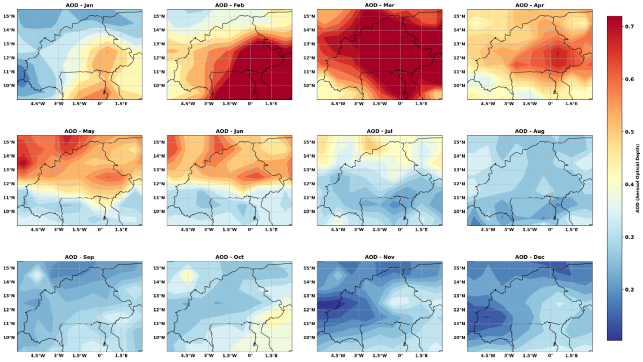
Figure 1. Interannual spatial distribution of aerosol optical depth at 550 nm.
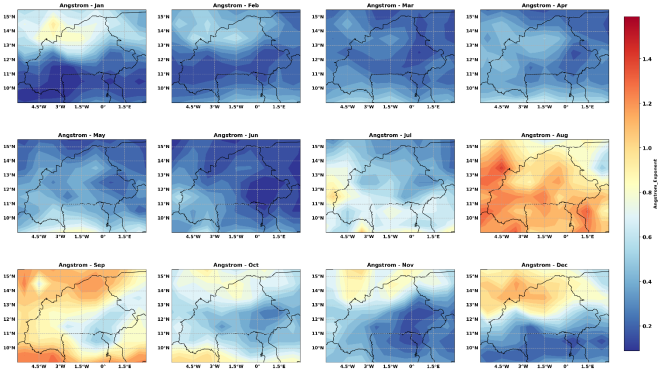
Figure 2. Interannual spatial distribution of the Angström coefficient.
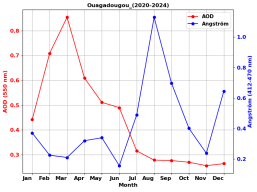
Figure 3. Representation of the annual cycles of AOD at 550 nm and the Angström coefficient measured in the spectral band between 412 nm and 470 nm.
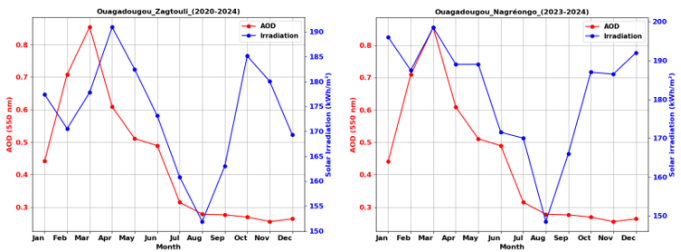
Figure 4. Annual cycle of AOD and solar potential at the Zagtouli and Nagreongo sites.
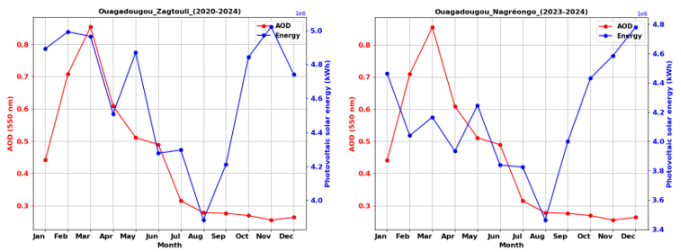
Figure 5. Annual cycle of AOD and solar photovoltaic production at the Zagtouli and Nagreongo sites.
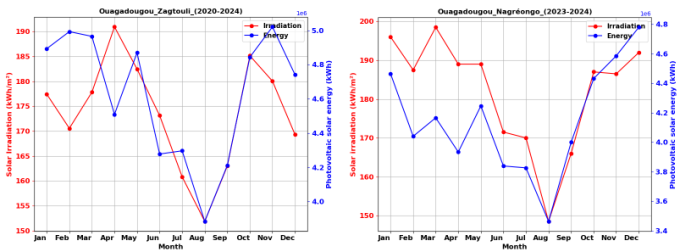
Figure 6. Annual cycle of irradiation and solar photovoltaic production at the Zagtouli and Nagreongo sites.
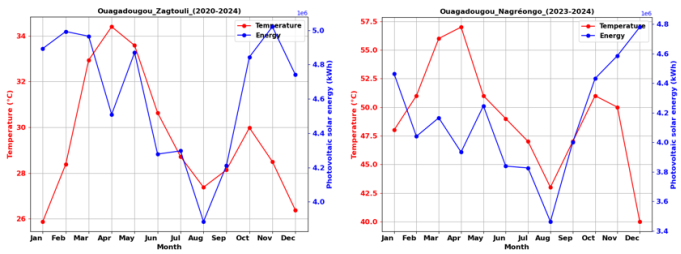
Figure 7. Annual cycle of temperature and solar photovoltaic production at the Zagtouli and Nagreongo sites.
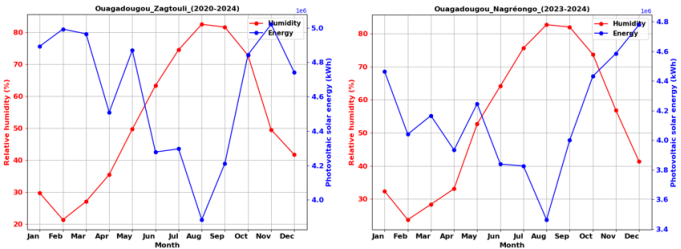
Figure 8. Annual cycle of relative humidity and solar photovoltaic production at the Zagtouli and Nagreongo sites.
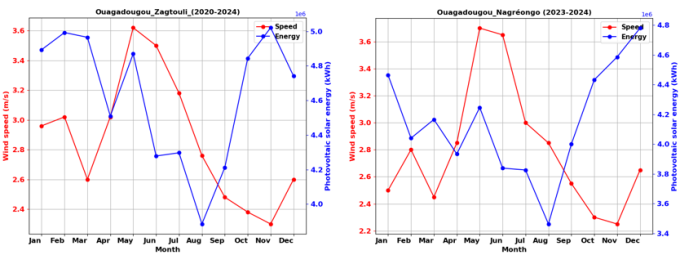
Figure 9. Annual cycle of wind speed and solar photovoltaic production at the Zagtouli and Nagreongo sites.

Information



 Share This Article
 Twitter
 Linked In
 Facebook
 Copy
Copy Download