Abstract
Island power systems are inherently characterized by high fuel import dependency, limited generation diversity, constrained economies of scale, and elevated vulnerability to extreme weather events, resulting in higher system costs and reduced operational resilience. This paper presents a technical and strategic assessment of a proposed high-voltage direct current (HVDC) submarine interconnection between the Dominican Republic (DR) and Puerto Rico (PR) across the Mona Passage. The study evaluates comparative system characteristics including installed capacity, peak demand, renewable penetration, infrastructure constraints, and long-term demand projections. While Puerto Rico operates a mature but spatially constrained grid with limited demand growth and aging infrastructure, the Dominican Republic exhibits sustained load growth, greater siting flexibility, and expanding generation capacity with increasing renewable integration. The analysis demonstrates that the net economic and reliability benefits of the interconnection are maximized when incremental firm and renewable-supporting generation is developed in the Dominican Republic and transmitted to Puerto Rico via a controllable HVDC link. The HVDC configuration enables asynchronous grid coupling, bidirectional dispatchable power exchange, improved stability margins, reserve sharing, and enhanced system adequacy. Results indicate that coordinated generation–transmission planning under this architecture reduces total system costs, supports higher renewable penetration, and strengthens resilience under extreme-event contingencies. The proposed DR–PR HVDC interconnection constitutes a technically feasible and economically justified platform for regional power system optimization and Caribbean electricity market integration.
Keywords
HVDC Transmission, Submarine Power Cables, Island Power Systems, Electricity Market Integration,
Renewable Energy Integration, Caribbean Energy Systems
1. Introduction
Electric power systems in island environments are typically characterized by high generation costs, fuel import dependency, and limited system redundancy
| [1] | World Bank and Tractebel Engineering, Prefeasibility Study for the Interconnection of Dominican Republic, and Puerto Rico Power Systems, 2012. |
| [4] | CIGRE, “HVDC Submarine Power Transmission Systems,” Technical Brochures. |
| [5] | IEEE Power & Energy Society, publications on regional power system interconnections. |
[1, 4, 5]
. In the Caribbean, these challenges are compounded by exposure to extreme weather events and constrained land availability for infrastructure development.
Historically, electricity planning in Caribbean island systems has been conducted independently at the national level
| [1] | World Bank and Tractebel Engineering, Prefeasibility Study for the Interconnection of Dominican Republic, and Puerto Rico Power Systems, 2012. |
| [5] | IEEE Power & Energy Society, publications on regional power system interconnections. |
[1, 5]
. While this approach ensures sovereignty over energy policy, it often leads to suboptimal investment decisions, excess reserve margins, and higher electricity tariffs. Advances in HVDC submarine cable technology now enable the interconnection of island systems over long distances, creating opportunities for regional system optimization
| [4] | CIGRE, “HVDC Submarine Power Transmission Systems,” Technical Brochures. |
| [5] | IEEE Power & Energy Society, publications on regional power system interconnections. |
| [6] | Nunez-Ramirez, F. H., Pacheco Valls, L. & Vila Bramon, J., 2025. Power Market Interconnection in the Caribbean Region. https://doi.org/10.11648/j.epes.20251405.12 |
[4-6]
.
This paper evaluates the strategic case for an HVDC interconnection between the Dominican Republic and Puerto Rico, with particular emphasis on the optimal geographical allocation of new generation assets.
2. Objective of the DR–PR Interconnection
The primary objectives of the proposed HVDC interconnection are to:
1) Enable secure and controllable power exchange between DR and PR
2) Decouple generation sitting from electricity consumption
3) Reduce total system costs through coordinated planning
4) Improve reliability and reduce reserve requirements
5) Facilitate higher penetration of renewable energy
6) Enhance resilience to extreme weather events
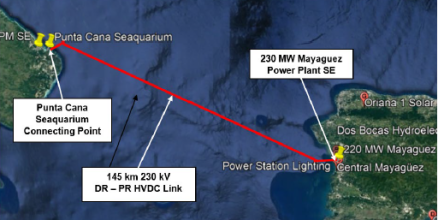
Figure 1. The Dominican Republic – Puerto Rico HVDC Interconnection.
Figure 1 shows the schematic representation of the interconnection between the Dominican Republic and Puerto Rico through a HVDC subsea cable:
3. Overview of the Dominican Republic Electricity System
The Dominican Republic is one of the largest electricity markets in the Caribbean, with a population exceeding 10 million inhabitants and sustained long-term demand growth. Installed generation capacity is approximately 6,423 MW, with a maximum demand of about 3,252 MW
.
Renewable energy represents approximately 24.5% of installed capacity
| [8] | National Energy Commission (CNE), “The Dominican Republic has reached 24.5% renewable energy and has a portfolio of more than 7,400 MW in new projects” Press Release, Santo Domingo, Dominican Republic, Jun. 13, 2025. Available:
https://cne.gob.do/noticia/rd-alcanza-24-5-de-renovables-y-tiene-en-carpeta-mas-de-7400-mw-en-nuevos-proyectos/ |
| [9] | International Renewable Energy Agency (IRENA), Dominican Republic: Renewable Energy Statistics Profile, Central America and the Caribbean, Abu Dhabi, UAE, 2023–2024. Available: https://www.irena.org/Statistics/View-Data-by-Topic/Country-Profiles. |
[8, 9]
, supported by a diversified mix of hydroelectric, wind, solar photovoltaic, and biomass resources. Major base-load additions and ongoing grid rehabilitation programs have significantly improved system adequacy and operational flexibility.
These characteristics position the Dominican Republic as a suitable host for large-scale generation projects serving both domestic demand and potential exports.
Table 1 provide the profile of the Dominican Republic’s power system.
Table 1. Profile of the Dominican Republic’s Power Systems.
Profile of the Dominican Republic's Power System |
Year | Total Installed Capacity (MW) | Peak Demand (MW) | Renewable Capacity (MW) | Renewable Share (%) | Notes / Source |
2019 | 4870 | 2506 | 1184 | 24,3 | MEM / CNE / IRENA |
2020 | 5000 | 2600 | 1200 | 24,0 | MEM / IRENA |
2021 | 5300 | 2800 | 1300 | 24,5 | MEM |
2022 | 5600 | 3000 | 1450 | 25,9 | MEM / CNE |
2023 | 5900 | 3200 | 1600 | 27,1 | MEM |
2024 | 6200 | 3640 | 1750 | 28,2 | MEM Annual Report 2024 |
2025 | 6423 | 3252 | 1850 | 24,5 | MEM Monthly Bulletin / CNE Jun-2025 |
MEM: Ministry of Energy and Mines; CNE: Energy National Commission; IRENA: International Renewable Energy Agency |
Technical Comments:
1) Official sources from the Ministry of Energy and Mines (MEM) show a significant increase in installed capacity between 2024 and 2025 (monthly bulletins). The MEM also published the annual peak demand for 2024 (3,640 MW) and monthly peak demand figures for 2025.
2) The National Energy Commission (CNE) reported (June 13, 2025) that renewables account for approximately 24.5% of the total energy mix and have a very large project portfolio (>7,400 MW), confirming a robust pipeline for expansion
.
3) IRENA offers a consolidated and useful statistical profile for international comparisons (renewable capacity data by technology).
4. Overview of the Puerto Rico Electricity System
Table 2. Profile of Puerto Rico’s Power Systems.
Profile of the Puerto Rico's Power System |
Year | Total Installed Capacity (MW) | Peak Demand (MW) | Renewable Capacity (MW) | Renewable Share (%) | Notes / Source |
2019 | 5839 | 2866 | 307 | 5,2 | PREPA / EIA |
2020 | 5800 | 2800 | 320 | 5,5 | EIA |
2021 | 5750 | 2700 | 550 | 9,6 | EIA / Distributed PV |
2022 | 5900 | 2600 | 800 | 13,6 | EIA / LUMA |
2023 | 6100 | 2550 | 1000 | 16,4 | LUMA / PREB |
2024 | 6300 | 2512 | 1150 | 18,3 | LUMA Dec-2024 Report |
2025 | 6300 | 2900 | 1230 | 19,5 | LUMA / DOE /PREB Mid-2025 |
PREPA: Puerto Rico Electric Power Authority; EIA: Energy Information Administration; LUMA Energy: Private Company of Transmission and Distributions System in Puerto Rico; DOE: Department of Energy |
Puerto Rico operates a mature electricity system with installed capacity of approximately 6,300 MW and a maximum demand of about 2,900 MW
| [3] | U.S. Department of Energy, Puerto Rico Energy Snapshot, 2020. |
| [11] | LUMA Energy, Monthly Generation Performance Report, Dec. 2024, and monthly reports 2024–2025, San Juan, Puerto Rico. Available: https://lumapr.com/resources/publications/ |
| [12] | U.S. Energy Information Administration (EIA), Puerto Rico State Energy Profile, Washington, DC, USA, Mar. 2025. Available: https://www.eia.gov/states/puerto_rico/ |
[3, 11, 12]
. Despite apparent capacity margins, effective system performance is constrained by aging infrastructure, unit deratings, and vulnerability to hurricanes and other extreme events
| [11] | LUMA Energy, Monthly Generation Performance Report, Dec. 2024, and monthly reports 2024–2025, San Juan, Puerto Rico. Available: https://lumapr.com/resources/publications/ |
| [13] | U.S. Department of Energy (DOE) and National Renewable Energy Laboratory (NREL), Puerto Rico Grid Resilience and Transitions to 100% Renewable Energy (PR100 Study), Golden, CO, USA, 2023–2024. Available:
https://www.energy.gov/grid-deployment/puerto-rico-grid-resilience-and-transitions-100-renewable-energy |
| [14] | Puerto Rico Energy Bureau (PREB), Regulatory Dockets and Orders on Resource Adequacy, Emergency Generation, and Energy Storage, San Juan, Puerto Rico, 2024–2025. Available: https://energia.pr.gov |
[11, 13, 14]
.
Renewable energy penetration remains limited to approximately 19.5% of installed capacity, despite aggressive policy targets
| [11] | LUMA Energy, Monthly Generation Performance Report, Dec. 2024, and monthly reports 2024–2025, San Juan, Puerto Rico. Available: https://lumapr.com/resources/publications/ |
| [12] | U.S. Energy Information Administration (EIA), Puerto Rico State Energy Profile, Washington, DC, USA, Mar. 2025. Available: https://www.eia.gov/states/puerto_rico/ |
[11, 12]
. Electricity prices in Puerto Rico are among the highest in the Caribbean, adversely affecting economic competitiveness and increasing sensitivity to fuel price volatility.
Land availability, permitting complexity, and grid fragility significantly constrain the deployment of large-scale new generation facilities on the island.
The profile of Puerto Rico’s Power System is given in
Table 2:
Technical Comments:
1) Puerto Rico has a gap between installed capacity and actual available capacity due to aging and deratings; peak demand is approximately 2.5–2.9 GW, but availability can be much lower, which is why supplemental and emergency resources (PREB orders, temporary contracts) have been requested.
2) The deployment of distributed solar has been massive in 2022–2025 (from approximately 228 MW in 2021 to approximately 1,230 MW in June 2025 (according to regulatory summaries), which substantially changes effective capacity and operational requirements (variability, storage needs).
3) PR100 (DOE/NLRE) provides technical pathways and recommended storage capacities to meet targets (e.g., 40% to 100%) and is the primary source for transition projections.
5. Power Demand Outlook
Demand projections indicate a structural divergence between both systems
| [7] | Ministry of Energy and Mines (MEM), Energy Generation and Management Bulletin, 2024–2025 series (monthly issues), and Annual Bulletin 2024, Santo Domingo, Dominican Republic, 2024–2025. Available:
https://mem.gob.do/category/sector-electrico/boletin-de-generacion-y-gestion-de-energia/ |
| [10] | AES Dominicana, Investor Presentation – Q4 2024 Results and Market Outlook, Santo Domingo, Dominican Republic, May 2025. Available: https://www.aesdominicana.com/investors |
| [13] | U.S. Department of Energy (DOE) and National Renewable Energy Laboratory (NREL), Puerto Rico Grid Resilience and Transitions to 100% Renewable Energy (PR100 Study), Golden, CO, USA, 2023–2024. Available:
https://www.energy.gov/grid-deployment/puerto-rico-grid-resilience-and-transitions-100-renewable-energy |
[7, 10, 13]
. The Dominican Republic is expected to experience continued demand growth driven by economic expansion and electrification, while Puerto Rico’s demand is expected to remain relatively flat
| [11] | LUMA Energy, Monthly Generation Performance Report, Dec. 2024, and monthly reports 2024–2025, San Juan, Puerto Rico. Available: https://lumapr.com/resources/publications/ |
| [12] | U.S. Energy Information Administration (EIA), Puerto Rico State Energy Profile, Washington, DC, USA, Mar. 2025. Available: https://www.eia.gov/states/puerto_rico/ |
[11, 12]
.
This divergence implies that incremental generation capacity in Puerto Rico offers limited long-term economic justification, whereas the Dominican Republic requires new capacity to support growth and system modernization.
6. Technical Suitability of HVDC Interconnection
HVDC technology is the preferred solution for the DR–PR interconnection
| [1] | World Bank and Tractebel Engineering, Prefeasibility Study for the Interconnection of Dominican Republic, and Puerto Rico Power Systems, 2012. |
| [4] | CIGRE, “HVDC Submarine Power Transmission Systems,” Technical Brochures. |
| [5] | IEEE Power & Energy Society, publications on regional power system interconnections. |
| [6] | Nunez-Ramirez, F. H., Pacheco Valls, L. & Vila Bramon, J., 2025. Power Market Interconnection in the Caribbean Region. https://doi.org/10.11648/j.epes.20251405.12 |
[1, 4-6]
due to:
1) The length of the submarine crossing
2) Electrical decoupling of asynchronous systems
3) Full controllability of power flows
4) Improved system stability and reliability
5) Bidirectional operation capability
HVDC enables coordinated operation without requiring harmonization of operating standards, making it particularly suitable for interconnecting heterogeneous island grids
| [4] | CIGRE, “HVDC Submarine Power Transmission Systems,” Technical Brochures. |
| [5] | IEEE Power & Energy Society, publications on regional power system interconnections. |
[4, 5]
.
7. Justification for Locating New Generation in the Dominican Republic
From a system optimization perspective, locating new generation capacity in the Dominican Republic offers several advantages
| [1] | World Bank and Tractebel Engineering, Prefeasibility Study for the Interconnection of Dominican Republic, and Puerto Rico Power Systems, 2012. |
| [7] | Ministry of Energy and Mines (MEM), Energy Generation and Management Bulletin, 2024–2025 series (monthly issues), and Annual Bulletin 2024, Santo Domingo, Dominican Republic, 2024–2025. Available:
https://mem.gob.do/category/sector-electrico/boletin-de-generacion-y-gestion-de-energia/ |
| [8] | National Energy Commission (CNE), “The Dominican Republic has reached 24.5% renewable energy and has a portfolio of more than 7,400 MW in new projects” Press Release, Santo Domingo, Dominican Republic, Jun. 13, 2025. Available:
https://cne.gob.do/noticia/rd-alcanza-24-5-de-renovables-y-tiene-en-carpeta-mas-de-7400-mw-en-nuevos-proyectos/ |
[1, 7, 8]
:
1) Lower levelized cost of electricity due to economies of scale
2) Greater land availability and fewer permitting constraints
3) Improved fuel logistics and diversification options
4) Higher grid hosting capacity and operational flexibility
5) By contrast, Puerto Rico faces structural limitations that increase the cost and complexity of large-scale generation expansion. Installing new generation in the Dominican Republic and exporting power to Puerto Rico via HVDC reduces total system costs
| [1] | World Bank and Tractebel Engineering, Prefeasibility Study for the Interconnection of Dominican Republic, and Puerto Rico Power Systems, 2012. |
| [6] | Nunez-Ramirez, F. H., Pacheco Valls, L. & Vila Bramon, J., 2025. Power Market Interconnection in the Caribbean Region. https://doi.org/10.11648/j.epes.20251405.12 |
| [11] | LUMA Energy, Monthly Generation Performance Report, Dec. 2024, and monthly reports 2024–2025, San Juan, Puerto Rico. Available: https://lumapr.com/resources/publications/ |
[1, 6, 11]
, lowers reserve requirements, and improves reliability for both systems
8. Implications for Renewable Energy Integration
The Dominican Republic has nearly achieved its renewable energy target of 25% by 2025
| [8] | National Energy Commission (CNE), “The Dominican Republic has reached 24.5% renewable energy and has a portfolio of more than 7,400 MW in new projects” Press Release, Santo Domingo, Dominican Republic, Jun. 13, 2025. Available:
https://cne.gob.do/noticia/rd-alcanza-24-5-de-renovables-y-tiene-en-carpeta-mas-de-7400-mw-en-nuevos-proyectos/ |
| [9] | International Renewable Energy Agency (IRENA), Dominican Republic: Renewable Energy Statistics Profile, Central America and the Caribbean, Abu Dhabi, UAE, 2023–2024. Available: https://www.irena.org/Statistics/View-Data-by-Topic/Country-Profiles. |
[8, 9]
, demonstrating an operationally mature framework for renewable integration. Puerto Rico’s renewable targets—40% by 2024, 60% by 2040, and 100% by 2050
| [13] | U.S. Department of Energy (DOE) and National Renewable Energy Laboratory (NREL), Puerto Rico Grid Resilience and Transitions to 100% Renewable Energy (PR100 Study), Golden, CO, USA, 2023–2024. Available:
https://www.energy.gov/grid-deployment/puerto-rico-grid-resilience-and-transitions-100-renewable-energy |
| [14] | Puerto Rico Energy Bureau (PREB), Regulatory Dockets and Orders on Resource Adequacy, Emergency Generation, and Energy Storage, San Juan, Puerto Rico, 2024–2025. Available: https://energia.pr.gov |
[13, 14]
—require substantial additional capacity and backup resources.
Regional integration via HVDC allows renewable and firm low-cost generation developed in the Dominican Republic to contribute to Puerto Rico’s decarbonization objectives while mitigating the need for excessive local infrastructure expansion.
A significant advance in the development of the interconnection of electricity markets consists of the introduction of the concept of smart grids, a topic that we will analyze in a future research project in the Caribbean region
| [15] | M. Barnes, M. Belivanis, D. Jovcic, and S. T. R. T. Halder, “HVDC systems in smart grids: Technical and economic integration of renewable energy,” IEEE Transactions on Smart Grid, vol. 12, no. 1, pp. 51–60, Jan. 2021.
https://doi.org/10.1109/JPROC.2017.2672879 |
[15]
.
9. Methodology
This study adopts a structured analytical and comparative methodology to evaluate the technical, economic, and strategic feasibility of an HVDC interconnection between the Dominican Republic (DR) and Puerto Rico (PR). The research approach integrates secondary data analysis, power system characterization, and system-level optimization reasoning within a regional planning framework.
10. Conclusions
1) The HVDC interconnection between the Dominican Republic and Puerto Rico represents a transition from isolated national planning toward regional electricity system optimization
| [1] | World Bank and Tractebel Engineering, Prefeasibility Study for the Interconnection of Dominican Republic, and Puerto Rico Power Systems, 2012. |
| [5] | IEEE Power & Energy Society, publications on regional power system interconnections. |
| [13] | U.S. Department of Energy (DOE) and National Renewable Energy Laboratory (NREL), Puerto Rico Grid Resilience and Transitions to 100% Renewable Energy (PR100 Study), Golden, CO, USA, 2023–2024. Available:
https://www.energy.gov/grid-deployment/puerto-rico-grid-resilience-and-transitions-100-renewable-energy |
[1, 5, 13]
.
2) The analysis demonstrates that the benefits of the interconnection are maximized when new generation assets are located in the Dominican Republic and exported to Puerto Rico.
3) This configuration reduces total system costs, enhances reliability, supports renewable energy integration, and improves resilience to extreme events.
4) Beyond bilateral benefits, the project establishes a scalable platform for future Caribbean electricity market integration.
11. Final Recommendations
Based on the comparative technical, economic, and structural assessment of the electricity systems of the Dominican Republic and Puerto Rico, the following recommendations are proposed:
1. Adopt a Regional Optimization Approach to Power System Planning
Electricity planning in the Caribbean should evolve from isolated, country-specific strategies toward regional system optimization
| [1] | World Bank and Tractebel Engineering, Prefeasibility Study for the Interconnection of Dominican Republic, and Puerto Rico Power Systems, 2012. |
| [7] | Ministry of Energy and Mines (MEM), Energy Generation and Management Bulletin, 2024–2025 series (monthly issues), and Annual Bulletin 2024, Santo Domingo, Dominican Republic, 2024–2025. Available:
https://mem.gob.do/category/sector-electrico/boletin-de-generacion-y-gestion-de-energia/ |
| [13] | U.S. Department of Energy (DOE) and National Renewable Energy Laboratory (NREL), Puerto Rico Grid Resilience and Transitions to 100% Renewable Energy (PR100 Study), Golden, CO, USA, 2023–2024. Available:
https://www.energy.gov/grid-deployment/puerto-rico-grid-resilience-and-transitions-100-renewable-energy |
[1, 7, 13]
. The Dominican Republic–Puerto Rico HVDC interconnection should be treated not as a bilateral trading mechanism, but as strategic regional infrastructure enabling optimal allocation of generation resources across districts.
2. Prioritize the Dominican Republic as the Primary Location for New Large-Scale Generation
New firm and renewable-supporting generation assets intended to supply the interconnected market should be preferentially located in the Dominican Republic. This recommendation is supported by:
1) Greater land availability and fewer sitting constraints,
2) Lower development and permitting risk,
3) Superior capability to host large-scale generation and balancing resources, and
4) Stronger alignment with long-term demand growth trends.
Puerto Rico, by contrast, should avoid over-reliance on local large-scale generation expansion given its spatial, environmental, and grid constraints.
3. Implement the DR–PR Interconnection Using HVDC as a Controllable System Asset
The interconnection should be developed using HVDC technology, not only for technical feasibility but as an operational control tool. HVDC enables:
1) Full decoupling of system dynamics,
2) Bidirectional and dispatchable power flows,
3) Reduction of reserve requirements in both systems, and
4) Improved system stability under high renewable penetration.
4. Use the Interconnection to Support Puerto Rico’s Energy Transition Targets
Puerto Rico’s ambitious renewable energy targets (40% by 2025, 60% by 2040, 100% by 2050) face significant implementation risks if pursued exclusively through local generation. The HVDC interconnection should be leveraged to:
1) Complement local renewable deployment with regional imports,
2) Reduce the need for excessive local backup and overbuilding, and
3) Improve reliability during the transition to high renewable penetration,
5. Integrate Generation Expansion and Transmission Planning
Generation development in the Dominican Republic and HVDC transmission planning should be co-optimized, rather than treated as separate projects. Joint planning will maximize economic benefits, avoid stranded assets, and ensure that generation additions are synchronized with transmission capacity and system needs.
6. Strengthen Institutional and Regulatory Coordination
Successful implementation requires early and sustained coordination between regulators, system operators, and policymakers in both districts. Key actions include:
1) Harmonizing technical standards relevant to HVDC operation,
2) Establishing clear commercial and tariff frameworks for power exchange, and
3) Defining transparent rules for capacity, energy, and ancillary service transactions.
7. Position of the Project as a First Step Toward Broader Caribbean Integration
The DR–PR HVDC interconnection should be designed with future scalability in mind. It can serve as a foundational element for a wider Caribbean electricity market, enabling future interconnections with other island systems that exhibit complementary resource profiles.
Abbreviations
CNE | Energy National Commission (of the Dominican Republic) |
DOE | Department of Energy (of the United States of America) |
DR | Dominican Republic |
EIA | Energy Information Administration (of the United States of America) |
GW | Giga Watts |
HVDC | High Voltage Direct Current |
IRENA | International Renewable Energy Agency |
LUMA | Private Company of Transmission and Distribution (of Puerto Rico) |
MEM | Ministry of Energy and Mines (of the Dominican Republic) |
MW | Megawatts |
NLRE | National Laboratory of Renewable Energy |
PREPA | Puerto Rico Electric Power Agency |
PR | Puerto Rico |
Author Contributions
Francisco Núñez-Ramírez: Conceptualization, Methodology, Data curation, Investigation, Formal Analysis, Writing – original draft, Writing – review & editing
Conflicts of Interest
The author declares no conflicts of interest.
References
| [1] |
World Bank and Tractebel Engineering, Prefeasibility Study for the Interconnection of Dominican Republic, and Puerto Rico Power Systems, 2012.
|
| [2] |
U.S. Department of Energy, Dominican Republic Energy Snapshot, 2020.
|
| [3] |
U.S. Department of Energy, Puerto Rico Energy Snapshot, 2020.
|
| [4] |
CIGRE, “HVDC Submarine Power Transmission Systems,” Technical Brochures.
|
| [5] |
IEEE Power & Energy Society, publications on regional power system interconnections.
|
| [6] |
Nunez-Ramirez, F. H., Pacheco Valls, L. & Vila Bramon, J., 2025. Power Market Interconnection in the Caribbean Region.
https://doi.org/10.11648/j.epes.20251405.12
|
| [7] |
Ministry of Energy and Mines (MEM), Energy Generation and Management Bulletin, 2024–2025 series (monthly issues), and Annual Bulletin 2024, Santo Domingo, Dominican Republic, 2024–2025. Available:
https://mem.gob.do/category/sector-electrico/boletin-de-generacion-y-gestion-de-energia/
|
| [8] |
National Energy Commission (CNE), “The Dominican Republic has reached 24.5% renewable energy and has a portfolio of more than 7,400 MW in new projects” Press Release, Santo Domingo, Dominican Republic, Jun. 13, 2025. Available:
https://cne.gob.do/noticia/rd-alcanza-24-5-de-renovables-y-tiene-en-carpeta-mas-de-7400-mw-en-nuevos-proyectos/
|
| [9] |
International Renewable Energy Agency (IRENA), Dominican Republic: Renewable Energy Statistics Profile, Central America and the Caribbean, Abu Dhabi, UAE, 2023–2024. Available:
https://www.irena.org/Statistics/View-Data-by-Topic/Country-Profiles.
|
| [10] |
AES Dominicana, Investor Presentation – Q4 2024 Results and Market Outlook, Santo Domingo, Dominican Republic, May 2025. Available:
https://www.aesdominicana.com/investors
|
| [11] |
LUMA Energy, Monthly Generation Performance Report, Dec. 2024, and monthly reports 2024–2025, San Juan, Puerto Rico. Available:
https://lumapr.com/resources/publications/
|
| [12] |
U.S. Energy Information Administration (EIA), Puerto Rico State Energy Profile, Washington, DC, USA, Mar. 2025. Available:
https://www.eia.gov/states/puerto_rico/
|
| [13] |
U.S. Department of Energy (DOE) and National Renewable Energy Laboratory (NREL), Puerto Rico Grid Resilience and Transitions to 100% Renewable Energy (PR100 Study), Golden, CO, USA, 2023–2024. Available:
https://www.energy.gov/grid-deployment/puerto-rico-grid-resilience-and-transitions-100-renewable-energy
|
| [14] |
Puerto Rico Energy Bureau (PREB), Regulatory Dockets and Orders on Resource Adequacy, Emergency Generation, and Energy Storage, San Juan, Puerto Rico, 2024–2025. Available:
https://energia.pr.gov
|
| [15] |
M. Barnes, M. Belivanis, D. Jovcic, and S. T. R. T. Halder, “HVDC systems in smart grids: Technical and economic integration of renewable energy,” IEEE Transactions on Smart Grid, vol. 12, no. 1, pp. 51–60, Jan. 2021.
https://doi.org/10.1109/JPROC.2017.2672879
|
Cite This Article
-
APA Style
Nunez-Ramirez, F. (2026). Strategic Rationale for the Interconnection of the Dominican Republic and Puerto Rico Electricity Markets Through HVDC: Positioning the Dominican Republic as a Regional Generation Hub. American Journal of Electrical Power and Energy Systems, 15(1), 14-19. https://doi.org/10.11648/j.epes.20261501.12
 Copy
|
Copy
|
 Download
ACS Style
Nunez-Ramirez, F. Strategic Rationale for the Interconnection of the Dominican Republic and Puerto Rico Electricity Markets Through HVDC: Positioning the Dominican Republic as a Regional Generation Hub. Am. J. Electr. Power Energy Syst. 2026, 15(1), 14-19. doi: 10.11648/j.epes.20261501.12
Copy
|
Download
AMA Style
Nunez-Ramirez F. Strategic Rationale for the Interconnection of the Dominican Republic and Puerto Rico Electricity Markets Through HVDC: Positioning the Dominican Republic as a Regional Generation Hub. Am J Electr Power Energy Syst. 2026;15(1):14-19. doi: 10.11648/j.epes.20261501.12
Copy
|
Download
-
@article{10.11648/j.epes.20261501.12,
  author = {Francisco Nunez-Ramirez},
  title = {Strategic Rationale for the Interconnection of the Dominican Republic and Puerto Rico Electricity Markets Through HVDC: Positioning the Dominican Republic as a Regional Generation Hub},
  journal = {American Journal of Electrical Power and Energy Systems},
  volume = {15},
  number = {1},
  pages = {14-19},
  doi = {10.11648/j.epes.20261501.12},
  url = {https://doi.org/10.11648/j.epes.20261501.12},
  eprint = {https://article.sciencepublishinggroup.com/pdf/10.11648.j.epes.20261501.12},
  abstract = {Island power systems are inherently characterized by high fuel import dependency, limited generation diversity, constrained economies of scale, and elevated vulnerability to extreme weather events, resulting in higher system costs and reduced operational resilience. This paper presents a technical and strategic assessment of a proposed high-voltage direct current (HVDC) submarine interconnection between the Dominican Republic (DR) and Puerto Rico (PR) across the Mona Passage. The study evaluates comparative system characteristics including installed capacity, peak demand, renewable penetration, infrastructure constraints, and long-term demand projections. While Puerto Rico operates a mature but spatially constrained grid with limited demand growth and aging infrastructure, the Dominican Republic exhibits sustained load growth, greater siting flexibility, and expanding generation capacity with increasing renewable integration. The analysis demonstrates that the net economic and reliability benefits of the interconnection are maximized when incremental firm and renewable-supporting generation is developed in the Dominican Republic and transmitted to Puerto Rico via a controllable HVDC link. The HVDC configuration enables asynchronous grid coupling, bidirectional dispatchable power exchange, improved stability margins, reserve sharing, and enhanced system adequacy. Results indicate that coordinated generation–transmission planning under this architecture reduces total system costs, supports higher renewable penetration, and strengthens resilience under extreme-event contingencies. The proposed DR–PR HVDC interconnection constitutes a technically feasible and economically justified platform for regional power system optimization and Caribbean electricity market integration.},
 year = {2026}
}
Copy
|
Download
-
TY  - JOUR
T1  - Strategic Rationale for the Interconnection of the Dominican Republic and Puerto Rico Electricity Markets Through HVDC: Positioning the Dominican Republic as a Regional Generation Hub
AU  - Francisco Nunez-Ramirez
Y1  - 2026/02/26
PY  - 2026
N1  - https://doi.org/10.11648/j.epes.20261501.12
DO  - 10.11648/j.epes.20261501.12
T2  - American Journal of Electrical Power and Energy Systems
JF  - American Journal of Electrical Power and Energy Systems
JO  - American Journal of Electrical Power and Energy Systems
SP  - 14
EP  - 19
PB  - Science Publishing Group
SN  - 2326-9200
UR  - https://doi.org/10.11648/j.epes.20261501.12
AB  - Island power systems are inherently characterized by high fuel import dependency, limited generation diversity, constrained economies of scale, and elevated vulnerability to extreme weather events, resulting in higher system costs and reduced operational resilience. This paper presents a technical and strategic assessment of a proposed high-voltage direct current (HVDC) submarine interconnection between the Dominican Republic (DR) and Puerto Rico (PR) across the Mona Passage. The study evaluates comparative system characteristics including installed capacity, peak demand, renewable penetration, infrastructure constraints, and long-term demand projections. While Puerto Rico operates a mature but spatially constrained grid with limited demand growth and aging infrastructure, the Dominican Republic exhibits sustained load growth, greater siting flexibility, and expanding generation capacity with increasing renewable integration. The analysis demonstrates that the net economic and reliability benefits of the interconnection are maximized when incremental firm and renewable-supporting generation is developed in the Dominican Republic and transmitted to Puerto Rico via a controllable HVDC link. The HVDC configuration enables asynchronous grid coupling, bidirectional dispatchable power exchange, improved stability margins, reserve sharing, and enhanced system adequacy. Results indicate that coordinated generation–transmission planning under this architecture reduces total system costs, supports higher renewable penetration, and strengthens resilience under extreme-event contingencies. The proposed DR–PR HVDC interconnection constitutes a technically feasible and economically justified platform for regional power system optimization and Caribbean electricity market integration.
VL  - 15
IS  - 1
ER  -
Copy
|
Download





 Share This Article
 Twitter
 Linked In
 Facebook