This study aims to assess the impact of agricultural certification on smallholder cocoa producers in the Aboisso area of Côte d’Ivoire. To achieve this objective, interviews were conducted with managers of eight (08) cocoa cooperatives. In addition, surveys were administered to 48 certified cocoa producers and 30 non-certified producers. Descriptive statistical analyses were performed to examine the main socioeconomic characteristics of producers as well as their perceptions of certification schemes. Furthermore, a Factor Analysis of Mixed Data (FAMD) was conducted to explore the multidimensional structure of the dataset and identify relationships among variables. The results reveal a relatively mature farming population, dominated by producers aged between 35 and 45 years (50%), while young producers remain underrepresented (15.38%). In addition, the majority of certified producers (61.54%) marketed their cocoa through cooperatives, highlighting the central role of producer organizations in facilitating access to certification systems. Comparative analyses revealed significant differences in favor of certified producers, who were characterized by larger farm sizes, higher production levels, and substantially greater income levels (+58%) compared with non-certified producers. Moreover, the factorial analysis combined with hierarchical clustering identified three distinct groups of producers. Group 1 consisted mainly of non-certified producers characterized by low production and income levels. Group 2 comprised moderately structured certified producers, whereas Group 3 included highly structured and high-performing certified producers with greater production intensity and higher income levels. Overall, the findings suggest that agricultural certification is associated with improved economic performance and more advanced farm organization among cocoa producers in the Aboisso area.
This is an Open Access article, distributed under the terms of the Creative Commons Attribution 4.0 International License (http://creativecommons.org/licenses/by/4.0/), which permits unrestricted use, distribution and reproduction in any medium or format, provided the original work is properly cited.
For several decades, cocoa farming has been one of the main pillars of economic and social development in Côte d’Ivoire, the world’s leading cocoa producer. The country supplies approximately 40% of global cocoa production, with an annual output estimated at between 2 and 2.3 million tons of cocoa beans
[16]
International Cocoa Organization (ICCO). Cocoa Market Report for March 2024. Abidjan: ICCO, 2024; Available at: ICCO Official Website.
[16]
. This sector plays a strategic role in the national economy by contributing significantly to export earnings, gross domestic product (GDP), and the incomes of rural populations. More than one million producers and several million people depend directly or indirectly on cocoa-related activities for their livelihoods
[11]
Food and Agriculture Organization (FAO). The State of Food and Agriculture 2022: Leveraging Automation in Agriculture for Transforming Agrifood Systems, 2022; Rome: FAO.
[30]
World Bank. Côte d’Ivoire Economic and Development Overview. Washington (DC): World Bank Group, 2023; Available from: World Bank.
[11, 30]
. Thus, cocoa represents both a driver of economic growth and a major lever for poverty reduction in rural areas. However, despite its socioeconomic importance, the cocoa sector faces numerous environmental and social challenges. The expansion of cocoa plantations has greatly contributed to deforestation, forest ecosystem degradation, and biodiversity loss in several Ivorian regions
[27]
Schroth G., Ruf F., Kalischek N., Lang N., Renier, C., Daudt R. C., Addoah T., Thompson, W., Garrett, R., Schindler, K., & Wegner, J. D. Cocoa plantations are associated with deforestation in Côte d’Ivoire and Ghana. Nature Food, 2023; 4(5), 384–393.
. In addition to these environmental issues, low producer incomes, child labor, volatility in international prices, and the effects of climate change further weaken cocoa production systems
[29]
Voora V, Bermúdez S, Larrea C. Global Market Report: Cocoa Prices and Sustainability. Winnipeg (Canada): International Institute for Sustainable Development (IISD), 2023; 42 p.
[29]
. In response to these growing concerns, international markets, governments, and development organizations have promoted the implementation of agricultural certification schemes such as Rainforest Alliance and Fairtrade International in order to encourage more sustainable production practices.
Agricultural certifications aim to improve the economic, social, and environmental conditions of cocoa production through the adoption of good agricultural practices, compliance with environmental standards, improved working conditions, and enhanced product traceability. In theory, these certifications provide producers with several benefits, including access to technical training, financial premiums, specialized markets, and extension support services
[18]
Meemken, E.-M., Barrett, C. B., Michelson, H. C., Qaim, M., Reardon, T., & Sellare, J. Sustainability standards in global agrifood supply chains. Nature Food, 2021; 2, 758–765.
. Nevertheless, the actual effects of these certifications remain mixed. Some studies report improvements in yields and incomes among certified producers, whereas others highlight constraints related to certification costs, the complexity of standards, and inequalities in access to support mechanisms
[9]
Dietz, T., Grabs, J., and Estrella Chong, A. Mainstreamed voluntary sustainability standards and their impacts on smallholder farmers in global value chains. World Development, 2023; 161, 106089.
Ruf F., Schroth G., & Doffangui, K.. Climate change, cocoa migrations and deforestation in West Africa: What does the future hold? Sustainability Science, 2022; 17(1), 1–15.
In Côte d’Ivoire, public and private certification initiatives have expanded considerably in recent years, particularly in major cocoa-producing areas. However, the impacts of certification vary according to local contexts, producers’ organizational capacities, and the socioeconomic conditions of farms
[22]
Ruf F. Do so-called sustainable standards impoverish cocoa farmers? Interactions between deforestation in Côte d’Ivoire and Liberia, credit for fertilizer purchases, and declining prices. Cahiers Agricultures. 2021; 30: 38.,
. The locality of Aboisso therefore constitutes a relevant study area because of the importance of cocoa farming and the presence of cooperatives and certification programs within the region.
Despite the numerous studies conducted on the sustainability of the cocoa sector, few have comprehensively analyzed the economic, social, and environmental effects of agricultural certifications on smallholder producers in the locality of Aboisso. Furthermore, producers’ perceptions and the contextual factors influencing the adoption and effectiveness of certifications remain insufficiently documented. This lack of knowledge represents a scientific gap that the present study seeks to address.
The general objective of this study is to assess the effects of agricultural certifications on smallholder cocoa producers in the locality of Aboisso. More specifically, the study aims to: (i) analyze producers’ perceptions of agricultural certifications; (ii) identify the farming practices adopted by producers; (iii) evaluate the economic, social, and environmental effects of certifications; and finally, (iv) analyze the contextual factors influencing the adoption and effectiveness of agricultural certifications.
2. Profile of the Study Area
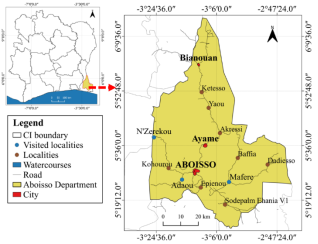
The Department of Aboisso, whose administrative center is the town of Aboisso, is located approximately 120 km from Abidjan, the economic capital of Côte d’Ivoire (Figure 1). According to the 2011 administrative reorganization and the General Population and Housing Census
[20]
RGPH. General Population and Housing Census: Global results. Republic of Côte d’Ivoire. 2021;37
[20]
, the Department of Aboisso belongs to the Sud-Comoé Region and covers an area of 4,662.17 km², with an estimated population of 222,053 inhabitants. It is one of the four departments of the Sud-Comoé Region, together with Adiaké, Grand-Bassam, and Tiapoum, and comprises the sub-prefectures of Aboisso, Adaou, Adjouan, Ayamé, Bianouan, Kouakro, Maféré, and Yaou. The present study was conducted in the localities of Maféré, Adaou, and N’Zerekou.
The Department of Aboisso is characterized by a hot and humid equatorial climate with abundant rainfall, averaging approximately 1,500 mm annually
[15]
Guillaumet J.L., & Adjanohoun E. Vegetation of Côte d’Ivoire. In: The Natural Environment of Côte d’Ivoire. 1971; 50: 166–262.
[15]
. The northeastern and eastern parts of the department exhibit a relatively rugged topography. Despite this uneven terrain, the area remains one of the major agricultural production zones in Côte d’Ivoire
[3]
Bi B. F. T., Konan Y., Bassa-Yao A. E., Kouamé-Tano E. M. L., Coulibaly W. K., Akoubet-Ouayogode A., & Kablan A. L. C. Ethnobotanical and phytochemical investigations of medicinal plants used against snake envenomation in Aboisso, Côte d’Ivoire. Pharmacopée et Médecine Traditionnelle Africaine. 2024; 23(1): 83–94.
[3]
. The department is drained by the Bia River, a major river system flowing from north to south across the region
[13]
Gbocho O. D., & Dago D. O. Degradation of the forest heritage in the Department of Aboisso: A consequence of the massive intrusion of urban elites into rural areas. Espace Géographique et Société Marocaine. 2021; 47/48: 129–143.
[13]
. The soils are predominantly highly leached ferrallitic soils developed under conditions of high rainfall, together with hydromorphic soils occurring mainly in lowland areas.
Originally, the vegetation cover of the department consisted mainly of dense tropical forests and hydromorphic formations
[14]
Gboko K. C. Evaluation of the performance of agricultural advisory services integrated into cocoa exporters’ certification programs in Côte d’Ivoire. Doctoral dissertation, National Institute of Higher Education for Agriculture, Food and Environment. 2020; 168 p.
[14]
. However, the natural vegetation of the Aboisso area has been largely degraded and replaced by anthropogenic landscapes dominated by fallows and agricultural plantations, including rubber, oil palm, and cocoa plantations
[19]
Pohé H., Dutron M. J., & Famisso O. S. F. Spatio-temporal dynamics of brown rot disease of cocoa pods caused by Phytophthora sp. in the Department of Aboisso (Côte d’Ivoire). Journal of Applied Biosciences. 2020; 145: 14842–14852.
[19]
.
The population of Aboisso is mainly composed of indigenous ethnic groups, particularly the Agni, as well as non-native Ivorian populations such as the Baoulé, Sénoufo, Attié, Abouré, and Ebrié, in addition to foreign communities including Burkinabé, Togolese, Ghanaians, and Nigeriens
[17]
Kouakou A. B. A., Malan D. F., & Kougbo M. D. Study of traditional cosmetic practices among the Agni-Sanwi people of Aboisso and Adiaké (Sud-Comoé Region, Côte d’Ivoire). Pharmacopée et Médecine Traditionnelle Africaine. 2024; 22(2): 73–85.
[17]
.
The local economy is predominantly based on agriculture, especially cash crops such as cocoa, coffee, rubber, and oil palm. Food crop production is also widely practiced and includes rice, yam, cassava, and eggplant cultivation
[5]
Brou D., Inza D., Kouadio K., Nagnin S., Jean K. K., & Issiaka S. Assessment and mapping of pollution vulnerability in confined aquifers using the DRASTIC method: Case of the Aboisso Region, southeastern Côte d’Ivoire. Editorial Advisory Board. 2005; 18(3): 500–513.
Figure 1. Location map of the study area in Côte d’Ivoire.
3. Methods
3.1. Data Collection
As part of this study, semi-structured interviews were first conducted with managers of certified cocoa producer cooperatives. Subsequently, individual surveys were administered to cooperative members owning certified cocoa farms as well as to independent producers operating non-certified farms. Interviews involved representatives from eight (8) cocoa cooperatives. In total, 48 certified cooperative members and 30 non-certified cocoa producers were surveyed. The questionnaires collected information on the socio-economic characteristics of producers and the technical and economic aspects of cocoa production systems. The variables investigated included farm size and production type (certified or non-certified), marital status, household size, farming experience, cocoa yield (kg/ha), selling price (FCFA/kg), marketing channels, land tenure status, type of certification (Rainforest Alliance, Rainforest Alliance/Fairtrade, or Fairtrade), certification costs, access to agricultural training, certification premiums, the contribution of certification schemes to the acquisition of agricultural equipment and related costs, as well as farming practices adopted by producers.
3.2. Data Analysis
Descriptive statistical analyses were performed to summarize the main socio-economic characteristics of producers and their perceptions of certification schemes. In addition, comparative analyses were conducted to assess differences between certified and non-certified producers. Mean comparisons were performed using Student’s t-test for independent samples. Statistical significance was assessed at the 10%, 5%, and 1% levels. To examine the multidimensional structure of the dataset and identify relationships among variables, a Factor Analysis of Mixed Data (FAMD) was carried out. The qualitative variables included certification status, education level, marital status, cooperative membership, access to technical support, participation in cocoa production training programs, and producers’ perceptions of the effects of certification. The quantitative variables comprised producer age, years of experience in cocoa farming, cultivated area, production costs, cocoa yield, and farm income. Furthermore, a Hierarchical Ascending Classification (HAC) was performed using the factorial coordinates obtained from the FAMD in order to identify homogeneous groups of producers. This classification approach, based on the principal components derived from the FAMD, reduces multicollinearity among variables and facilitates clustering using the most informative dimensions of the dataset. The analysis identified three distinct groups of producers. To characterize the groups generated by the hierarchical classification, a class characterization analysis was conducted using the v-test statistic. This method identifies the variables and categories that significantly discriminate each producer group, thereby highlighting the dominant characteristics associated with each cluster.
4. Results
4.1. Socio-Demographic Characteristics of Cocoa Farmers
The majority of the respondents surveyed were married (94.87%) and had attained primary-level education (57.69%). However, 21.79% of the producers had no formal education, while only 20.51% had completed secondary education (Table 1). In addition, most producers were male (92.31%), and the dominant age group was between 35 and 45 years old (50%).
Table 1. Socio-demographic characteristics of the producers surveyed.
Variables
Terms and conditions
Effective
Percentage (%)
Age
25-35 years old
12
15.38
35-45 years old
39
50
45 years and older
27
34.62
Sex
Women
6
7.69
Man
72
92.31
Marital status
Bachelor
4
5.13
Married
74
94.87
Education level
Primary
45
57.69
Secondary
16
20.51
None
17
21.79
4.2. Types of Certification Adopted by Cocoa Farmers
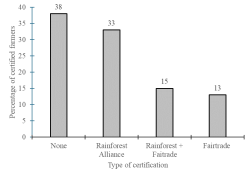
The results indicate that the majority of cocoa farmers surveyed owned certified plantations (Figure 2). Among the certification schemes identified, Rainforest Alliance certification was the most prevalent (33%), followed by dual Rainforest Alliance/Fairtrade certification (15%). Fairtrade-only certification accounted for 13% of the surveyed producers. Nevertheless, 38% of cocoa farmers operated non-certified plantations.
Figure 2. Types of certification adopted by cocoa farmers.
Table 2. Producers' Perceptions and Experiences Related to Agricultural Certification.
Variables
Terms and conditions
Effective
Percentage (%)
Destination of production
Other
30
38.46
Cooperative
48
61.54
Certification
No
30
38.46
Yes
48
61.54
Training received
No
36
46.15
Yes
42
53.85
Certification improves the price
No
30
38.46
Yes
48
61.54
Certification increases efficiency
No
30
38.46
Yes
48
61.54
Certification improves agricultural practices
No
30
38.46
Yes
48
61.54
Costs outweigh the benefits
No
48
61.54
Yes
30
38.46
Recommends to other producers
No
30
38.46
Yes
48
61.54
Member of a cooperative
No
30
38.46
Yes
48
61.54
Technical support received
No
41
52.56
Yes
37
47.44
Access to price information
No
23
29.49
Yes
55
70.51
4.3. Producers' Perceptions of Certification
The analysis reveals an overall positive perception of certification among cocoa producers (Table 2). Most respondents (61.54%) managed certified plantations and identified cooperatives as the primary channel for disseminating certification standards and opportunities. More than half of the producers (53.85%) reported having received agricultural training. Regarding the perceived effects of certification, the findings show a strong positive consensus among respondents. A majority of producers (61.54%) stated that certification contributes to higher selling prices, improved productivity, and better agricultural practices. However, this positive perception is moderated by concerns regarding certification costs. Although 61.54% of producers considered that the benefits of certification outweighed the associated costs, 38.46% expressed the opposite view. In addition, while 47.44% of respondents reported receiving technical support, slightly more than half (52.56%) indicated that they had not benefited from such assistance. Access to market price information was relatively high, with 70.51% of producers reporting that they had access to cocoa price information.
4.4. Comparison of Small Cocoa Producers According to Certification Status
The results of the mean comparison tests revealed significant differences between certified and non-certified producers (Table 3). Certified producers cultivated significantly larger farm areas (6.29 ha versus 4.97 ha; p < 0.01) and achieved substantially higher production levels (360.47 versus 241.00; p < 0.001). Similarly, certified producers recorded significantly higher average incomes than non-certified producers (1,009,313 FCFA versus 638,512 FCFA; p < 0.001), corresponding to an income difference of approximately 58% in favor of certified farmers. Conversely, non-certified producers incurred significantly higher labor costs (p < 0.01) and slightly higher equipment-related expenses (p < 0.10), despite having lower production levels. No statistically significant differences were observed regarding farming experience or household size, although non-certified producers appeared to be slightly older (p < 0.10).
Table 3. Comparison of the characteristics of certified and non-certified producers.
Variables
Uncertified (N=30) Average
Certified (N=48) Average
Difference
t-stat
p-value
Age (years)
44.90
41.58
3.32
1.77
0.081*
Household size
6.83
7.50
-0.67
-1.26
0.211
Experience (years)
11.67
11.17
0.50
0.59
0.554
Area (ha)
4.97
6.29
-1.33
-2.73
0.008***
Production
241.00
360.47
-119.47
-15.44
0.000***
Material cost
216,400
181,159
35,241
1.92
0.059*
Phytosanitary costs
134,533
143,209
-8,676
-0.61
0.546
Labor costs
273,467
216,723
56,744
3.37
0.001***
Income
638,512
1,009,313
-370 801
-15.97
0.000***
4.5. Typology of Producers According to Their Level of Integration into the Certification
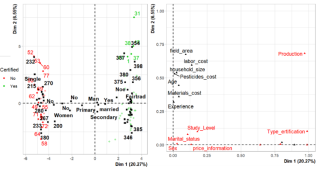
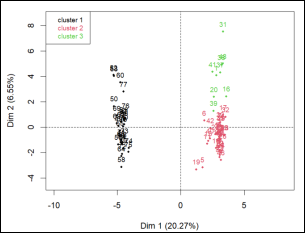
The Factor Analysis of Mixed Data (FAMD) revealed a structuring of producers around two principal dimensions, explaining 20.27% and 6.55% of the total inertia, respectively (Figure 3). The first dimension was strongly associated with certification status and economic variables, particularly production, gross income, and certification costs. Certified producers were predominantly distributed on the positive side of this axis, whereas non-certified producers were positioned on the opposite side. The factorial map of individuals and categories further showed that non-certified producers were mainly represented by single women with either no formal education or only primary education. In contrast, certified producers were more frequently associated with male gender, married status, and secondary education levels. The second dimension was mainly related to the structural characteristics of farms, including cultivated area, production costs (labor, inputs, and equipment), as well as producers’ age and farming experience. This dimension therefore reflects the broader socioeconomic profile of producers independently of certification status.
Figure 3. Distribution of individuals according to certification status.
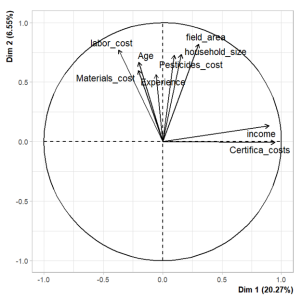
Furthermore, the correlation circle highlights strong relationships between farm size and production costs, as well as a positive association between certification and farm income (Figure 4). Non-certified producers tended to be older and characterized by higher labor and equipment costs, whereas certified producers were associated with higher income levels, larger cultivated areas, higher phytosanitary expenditures, and larger household sizes.
Figure 4. Correlation between cocoa producers and certification status.
4.6. Typology of Producers According to the Type of Certification
The hierarchical cluster analysis based on factorial components identified three distinct groups of producers (Figure 5). The first group, located on the negative side of the first factorial dimension, consisted mainly of non-certified producers characterized by lower production and income levels. The second and third groups, positioned on the positive side of the first dimension, corresponded primarily to certified producers. However, these two groups differed according to the second factorial dimension. The second group was composed of moderately sized certified farms, whereas the third group included more structured and economically intensive farms characterized by larger cultivated areas, higher production costs, and greater income levels.
Figure 5. Typology of planters according to certification types.
4.7. Characterization of Cocoa Producers
The analysis of the v-test values derived from the hierarchical cluster analysis revealed significant differences among the three producer groups identified (Table 4). The first group was mainly characterized by non-certified producers, with this category being strongly overrepresented within the cluster. This group was associated with the absence of certification costs, low production levels, and lower farm income. Producers in this category generally cultivated smaller farm areas and incurred relatively limited production expenses. The second group was significantly associated with certified producers and positive certification costs. Although these producers benefited from certification-related advantages such as training opportunities and cooperative integration, their production levels, farm sizes, and income remained intermediate compared with those of the third group. The third group was distinguished by strongly positive v-test values for variables related to production, income, cultivated area, and production costs (labor, agricultural inputs, and equipment). Producers in this cluster were certified and demonstrated higher levels of investment and production intensity. This group therefore corresponds to economically structured and high-performing certified cocoa farms.
Table 4. Characteristics of the groups resulting from the classification after factor analysis of the mixed data.
Terms and conditions
Class 1
Class 2
Class 3
Did not receive technical support
7.14
-5.75
-1.16
Received technical support
-7.14
5.75
1.16
Perception that certification does not improve agricultural practices
9.7
-7.5
-2.6
Perception that certification improves agricultural practices
-9.7
7.5
2.6
Perception that certification does not improve the price
9.7
-7.5
-2.6
Perception that certification improves the price
-9.7
7.5
2.6
Perception that certification does not increase yield
9.7
-7.5
-2.6
Perception that certification increases efficiency
-9.7
7.5
2.6
The producer is not certified
9.7
-7.5
-2.6
The producer is certified
-9.7
7.5
2.6
Perception that the cost of certification does not outweigh the benefits
-9.7
7.5
2.6
Perception that the cost of certification outweighs the benefits
9.7
-7.5
-2.6
The producer sells his cocoa to buyers and trackers
9.7
-7.5
-2.6
The producer sells his cocoa to the cooperative
-9.7
7.5
2.6
The producer has not received any training in cocoa farming.
8.1
-6.02
-2.19
The producer received training in cocoa farming
-8.1
6.02
2.19
The producer has no information on the price
2.54
-2.18
-0.442
The producer has the price information
-2.54
2.18
0.442
The producer is not a member of a cooperative
9.7
-7.5
-2.6
The producer is a member of a cooperative
-9.7
7.5
2.6
Education level: none
-3.98
0.792
3.7
Education level: none, primary
3.14
-1.57
-2.16
Do not recommend certification to other farmers
9.7
-7.5
-2.6
Recommend certification to other farmers
-9.7
7.5
2.6
Marital status: single
2.34
-1.9
-0.516
Marital status: married
-2.34
1.9
0.516
The producer is not certified.
9.7
-7.5
-2.6
The producer is Fairtrade certified.
-2.79
1.96
0.825
The producer is Rainforest Alliance certified.
-5.37
2.84
2.76
The producer is Rainforest Alliance and Fairtrade certified.
-3.16
3.92
-1.27
Producer's age
1.74
-3.75
3.22
Cost of agricultural equipment
1.89
-2.85
1.58
Cost of plant protection products
-0.609
-2.72
5.18
Labor costs
3.16
-5.43
3.68
Certification cost for the cooperative to which the cooperative belongs
-8.23
6.57
2.26
Producer's experience
0.597
-2.83
3.52
Income
-7.7
5.69
2.82
Area of the cocoa farm
-2.62
-1.3
6.03
Household size
-1.26
-1.84
4.79
5. Discussion
The results highlight a relatively mature farming population, dominated by producers aged between 35 and 45 years (50%), while young producers remain underrepresented (15.38%). This demographic structure corroborates the findings of
[8]
Colin J. P., & Ruf F. A plantation economy in the making. Revue Tiers Monde. 2011; 207(3): 169–187.
[8]
, who reported the progressive aging of cocoa farmers in Côte d’Ivoire and the declining attractiveness of the cocoa sector to younger generations. Such a trend constitutes a major challenge for the long-term sustainability and generational renewal of cocoa production systems. Furthermore, the strong predominance of male producers (92.31%) is consistent with the analysis of
[1]
Barrientos S., & Smith S. Do workers benefit from ethical trade? Assessing codes of labour practice in global production systems. Third World Quarterly. 2007; 28(4): 713–729.
, which showed that access to productive resources and certification mechanisms within West African cocoa value chains remains largely controlled by men. The limited representation of women among certified producers, as revealed by the factorial analysis, suggests the persistence of structural barriers related to land access, social capital, and literacy. Educational attainment also appears to be an important differentiating factor. Certified producers were more likely to have attained secondary education, confirming the findings of
[2]
Beuchelt T. D. & Zeller M. Profits and poverty: Certification's troubled link for Nicaragua's organic and fairtrade coffee producers, Ecological Economics, (2011), 70(7), 1316-1324.
, who demonstrated that human capital facilitates both the adoption of private sustainability standards and the understanding of technical certification requirements.
The findings further reveal that the majority of producers (61.54%) marketed their cocoa through cooperatives, a proportion identical to the certification rate observed in the study. This result confirms the pivotal role played by producer organizations in the dissemination and implementation of certification schemes such as Rainforest Alliance and Fairtrade International. Previous studies have shown that cooperative membership reduces transaction costs associated with certification while facilitating access to training programs and certification premiums
[24]
Ruf F., N'Dao, Y. & Lemeilleur, S. Certification du cacao, stratégie à hauts risques. Inter-réseaux Développement rural, (2013); 1-7.
[24]
. In the Ivorian context, cooperatives act as intermediaries between producers and certification bodies, particularly in the management of audits and the pooling of certification-related costs. The predominantly positive perceptions regarding the effects of certification—particularly improvements in prices, productivity, and farming practices—are consistent with the findings of
[23]
Ruf F., Kiendré J., & Di Roberto H. Fragile “organic cocoa” certification in Côte d’Ivoire: Why do Burkinabe farmers who dominate the sector not adhere to it? Cahiers Agricultures. 2026; 35: 2.
, who reported higher incomes and greater technical efficiency among certified cocoa producers in Côte d’Ivoire. Nevertheless, nearly 38% of producers considered that certification costs outweighed the associated benefits, thereby raising questions about the actual profitability and inclusiveness of voluntary sustainability standards
[4]
Blackman A., & Rivera, J. Producer-Level Benefits of Sustainability Certification. Conservation biology, (2011); 25(6), 1176-1185.
. In addition, the relatively high level of access to market price information (70.51%) suggests improved market integration among producers, which constitutes a key factor in strengthening producers’ bargaining power
[12]
Galtier F., David-Benz H., Subervie J., & Egg J. Agricultural market information systems in developing countries: New models and new impacts. Cahiers Agricultures. 2014; 23: 245–258.
The comparative analysis revealed significant differences in favor of certified producers, particularly with respect to cultivated area, production levels, and farm income, which was approximately 58% higher than that of non-certified producers. These findings corroborate empirical studies conducted in Ghana and Côte d’Ivoire
[7]
Chiputwa, B., Spielman, DJ & Qaim, M. Food Standards, Certification, and Poverty among Coffee Farmers in Uganda. World Development, (2015); 66, 400-412.
, which highlighted a positive relationship between certification and economic performance. The substantial income gap observed between certified and non-certified producers (370,801 FCFA) may be explained by several interrelated mechanisms, including access to certification premiums, improved agricultural practices, better phytosanitary management, and enhanced access to inputs and technical assistance. However, the literature also emphasizes the existence of potential selection bias, as producers with greater landholdings and financial resources are generally more likely to engage in certification schemes
[2]
Beuchelt T. D. & Zeller M. Profits and poverty: Certification's troubled link for Nicaragua's organic and fairtrade coffee producers, Ecological Economics, (2011), 70(7), 1316-1324.
. The significantly larger farm sizes observed among certified producers (6.29 ha compared with 4.97 ha) provide further evidence supporting this hypothesis. Moreover, the significant reduction in labor costs among certified producers suggests better farm organization and resource management, which may reflect higher levels of technical efficiency, as previously observed by
[10]
Fischer E., & Qaim, M. Linking Smallholders to Markets: Determinants and Impacts of Farmer Collective Action in Kenya. Développement mondial, (2012); 40(6), 1255-1268.
The factor analysis and hierarchical clustering further confirmed the existence of three distinct producer profiles: (i) non-certified producers characterized by low production and income levels, (ii) intermediate certified producers, and (iii) highly structured and high-performing certified producers. This heterogeneity is consistent with the findings of
[28]
Vally S., & Spreen C. A. Human rights in the World Bank’s education strategy to 2020. In: The World Bank and Education: Critiques and Alternatives. 2012; 173–187.
[28]
, who concluded that the impacts of certification are not homogeneous and largely depend on the initial socioeconomic conditions of farms. The third group, characterized by large cultivated areas and high production costs, reflects a model of capital intensification in which production growth is driven primarily by increased investment in machinery, agricultural inputs, and financial capital rather than labor expansion
[25]
Ruf F., Uribe Leitz, E., Gboko, K. C & Carimentrand. A. Des certifications inutiles? Les relations asymétriques entre coopératives, labels et cacaoculteurs en Côte d'Ivoire. Revue internationale des études du développement, (2019); (240), 31-61.
. By contrast, non-certified producers displayed a more homogeneous yet economically constrained profile. These findings suggest that certification functions more as a mechanism for reinforcing existing performance advantages than as an effective pathway for enabling economically vulnerable producers to catch up
[6]
Carimentrand A. Cocoa: Overview of deforestation and sustainability standards. 2020; 76 p.
[6]
.
6. Conclusion
This study highlights the socioeconomic and structural characteristics of cocoa producers engaged in certification schemes in the Aboisso area of Côte d’Ivoire. The findings reveal a relatively young farming population dominated by male producers (92.31%). Most respondents marketed their cocoa through cooperatives, which emerged as the principal institutional channel facilitating access to certification systems. The results further indicate that a majority of producers perceived certification positively, particularly in terms of improved selling prices, increased productivity, and enhanced agricultural practices. Nevertheless, these perceived benefits are moderated by the financial burden associated with certification costs. In addition, although nearly half of the producers reported receiving technical support, a substantial proportion still lacked access to extension and advisory services. The hierarchical clustering analysis identified three distinct categories of producers. The first group consisted mainly of non-certified producers characterized by lower production levels, smaller cultivated areas, and lower income. The second group included moderately structured certified producers, while the third group comprised highly structured and economically intensive certified farms with larger landholdings, higher production costs, and greater income levels. This typology demonstrates the considerable heterogeneity that exists among cocoa producers and confirms that the effects of certification are not uniform across farms. Overall, the study suggests that certification is associated with improved economic performance and more advanced farm structuring. However, access to certification remains socially and economically differentiated. The positive effects observed appear to benefit producers who already possess relatively greater productive assets and financial capacity. Consequently, certification schemes may reinforce pre-existing inequalities rather than fully promote the inclusion of the most vulnerable producers. These findings highlight the need for more inclusive certification policies, particularly through improved access to technical support, training, financial assistance, and institutional mechanisms targeting small-scale and resource-constrained cocoa farmers.
Abbreviations
FAMD
Factor Analysis of Mixed Data
GDP
Gross Domestic Product
HAC
Hierarchical Ascending Classification
Acknowledgments
The authors would like to thank the leaders of the cooperatives in Aboisso for allowing their members to answer the various questions during the fieldwork phase of this study.
Author Contributions
Kouakou Kouassi Apollinaire: Data curation, Formal Analysis, Methodology, Validation, Visualization, Writing – original draft
Konaté N’Golo: Data curation, Formal Analysis, Methodology, Resources
Mian Jacques Dutronc: Investigation, Methodology
Data Availability Statement
The data supporting the findings of this study are available from the corresponding author upon reasonable request. Access will be granted to researchers who meet the data-sharing criteria established by the relevant ethics committee or institutional review board.
Conflicts of Interest
The authors declare no conflicts of interest.
References
[1]
Barrientos S., & Smith S. Do workers benefit from ethical trade? Assessing codes of labour practice in global production systems. Third World Quarterly. 2007; 28(4): 713–729.
Beuchelt T. D. & Zeller M. Profits and poverty: Certification's troubled link for Nicaragua's organic and fairtrade coffee producers, Ecological Economics, (2011), 70(7), 1316-1324.
Bi B. F. T., Konan Y., Bassa-Yao A. E., Kouamé-Tano E. M. L., Coulibaly W. K., Akoubet-Ouayogode A., & Kablan A. L. C. Ethnobotanical and phytochemical investigations of medicinal plants used against snake envenomation in Aboisso, Côte d’Ivoire. Pharmacopée et Médecine Traditionnelle Africaine. 2024; 23(1): 83–94.
[4]
Blackman A., & Rivera, J. Producer-Level Benefits of Sustainability Certification. Conservation biology, (2011); 25(6), 1176-1185.
Brou D., Inza D., Kouadio K., Nagnin S., Jean K. K., & Issiaka S. Assessment and mapping of pollution vulnerability in confined aquifers using the DRASTIC method: Case of the Aboisso Region, southeastern Côte d’Ivoire. Editorial Advisory Board. 2005; 18(3): 500–513.
[6]
Carimentrand A. Cocoa: Overview of deforestation and sustainability standards. 2020; 76 p.
[7]
Chiputwa, B., Spielman, DJ & Qaim, M. Food Standards, Certification, and Poverty among Coffee Farmers in Uganda. World Development, (2015); 66, 400-412.
Colin J. P., & Ruf F. A plantation economy in the making. Revue Tiers Monde. 2011; 207(3): 169–187.
[9]
Dietz, T., Grabs, J., and Estrella Chong, A. Mainstreamed voluntary sustainability standards and their impacts on smallholder farmers in global value chains. World Development, 2023; 161, 106089.
Fischer E., & Qaim, M. Linking Smallholders to Markets: Determinants and Impacts of Farmer Collective Action in Kenya. Développement mondial, (2012); 40(6), 1255-1268.
Food and Agriculture Organization (FAO). The State of Food and Agriculture 2022: Leveraging Automation in Agriculture for Transforming Agrifood Systems, 2022; Rome: FAO.
[12]
Galtier F., David-Benz H., Subervie J., & Egg J. Agricultural market information systems in developing countries: New models and new impacts. Cahiers Agricultures. 2014; 23: 245–258.
Gbocho O. D., & Dago D. O. Degradation of the forest heritage in the Department of Aboisso: A consequence of the massive intrusion of urban elites into rural areas. Espace Géographique et Société Marocaine. 2021; 47/48: 129–143.
[14]
Gboko K. C. Evaluation of the performance of agricultural advisory services integrated into cocoa exporters’ certification programs in Côte d’Ivoire. Doctoral dissertation, National Institute of Higher Education for Agriculture, Food and Environment. 2020; 168 p.
[15]
Guillaumet J.L., & Adjanohoun E. Vegetation of Côte d’Ivoire. In: The Natural Environment of Côte d’Ivoire. 1971; 50: 166–262.
[16]
International Cocoa Organization (ICCO). Cocoa Market Report for March 2024. Abidjan: ICCO, 2024; Available at: ICCO Official Website.
[17]
Kouakou A. B. A., Malan D. F., & Kougbo M. D. Study of traditional cosmetic practices among the Agni-Sanwi people of Aboisso and Adiaké (Sud-Comoé Region, Côte d’Ivoire). Pharmacopée et Médecine Traditionnelle Africaine. 2024; 22(2): 73–85.
[18]
Meemken, E.-M., Barrett, C. B., Michelson, H. C., Qaim, M., Reardon, T., & Sellare, J. Sustainability standards in global agrifood supply chains. Nature Food, 2021; 2, 758–765.
Pohé H., Dutron M. J., & Famisso O. S. F. Spatio-temporal dynamics of brown rot disease of cocoa pods caused by Phytophthora sp. in the Department of Aboisso (Côte d’Ivoire). Journal of Applied Biosciences. 2020; 145: 14842–14852.
[20]
RGPH. General Population and Housing Census: Global results. Republic of Côte d’Ivoire. 2021;37
[21]
Ruben R., & Fort R. The Impact of Fair Trade Certification for Coffee Farmers in Peru. Développement mondial, (2012); 40(3), 570-582.
Ruf F. Do so-called sustainable standards impoverish cocoa farmers? Interactions between deforestation in Côte d’Ivoire and Liberia, credit for fertilizer purchases, and declining prices. Cahiers Agricultures. 2021; 30: 38.,
Ruf F., Kiendré J., & Di Roberto H. Fragile “organic cocoa” certification in Côte d’Ivoire: Why do Burkinabe farmers who dominate the sector not adhere to it? Cahiers Agricultures. 2026; 35: 2.
Ruf F., N'Dao, Y. & Lemeilleur, S. Certification du cacao, stratégie à hauts risques. Inter-réseaux Développement rural, (2013); 1-7.
[25]
Ruf F., Uribe Leitz, E., Gboko, K. C & Carimentrand. A. Des certifications inutiles? Les relations asymétriques entre coopératives, labels et cacaoculteurs en Côte d'Ivoire. Revue internationale des études du développement, (2019); (240), 31-61.
Ruf F., Schroth G., & Doffangui, K.. Climate change, cocoa migrations and deforestation in West Africa: What does the future hold? Sustainability Science, 2022; 17(1), 1–15.
Schroth G., Ruf F., Kalischek N., Lang N., Renier, C., Daudt R. C., Addoah T., Thompson, W., Garrett, R., Schindler, K., & Wegner, J. D. Cocoa plantations are associated with deforestation in Côte d’Ivoire and Ghana. Nature Food, 2023; 4(5), 384–393.
Vally S., & Spreen C. A. Human rights in the World Bank’s education strategy to 2020. In: The World Bank and Education: Critiques and Alternatives. 2012; 173–187.
[29]
Voora V, Bermúdez S, Larrea C. Global Market Report: Cocoa Prices and Sustainability. Winnipeg (Canada): International Institute for Sustainable Development (IISD), 2023; 42 p.
[30]
World Bank. Côte d’Ivoire Economic and Development Overview. Washington (DC): World Bank Group, 2023; Available from: World Bank.
Apollinaire, K. K., Djaha, K., N'Golo, K., Dutronc, M. J. (2026). Effects of Cocoa Certification on Small Producers in Rural Areas of Côte d’Ivoire: The Case of the Locality of Aboisso (Southern Côte d’Ivoire). American Journal of Life Sciences, 14(3), 92-101. https://doi.org/10.11648/j.ajls.20261403.14
Apollinaire, K. K.; Djaha, K.; N'Golo, K.; Dutronc, M. J. Effects of Cocoa Certification on Small Producers in Rural Areas of Côte d’Ivoire: The Case of the Locality of Aboisso (Southern Côte d’Ivoire). Am. J. Life Sci.2026, 14(3), 92-101. doi: 10.11648/j.ajls.20261403.14
Apollinaire KK, Djaha K, N'Golo K, Dutronc MJ. Effects of Cocoa Certification on Small Producers in Rural Areas of Côte d’Ivoire: The Case of the Locality of Aboisso (Southern Côte d’Ivoire). Am J Life Sci. 2026;14(3):92-101. doi: 10.11648/j.ajls.20261403.14
@article{10.11648/j.ajls.20261403.14,
  author = {Kouakou Kouassi Apollinaire and Kouamé Djaha and Konaté N'Golo and Mian Jacques Dutronc},
  title = {Effects of Cocoa Certification on Small Producers in Rural Areas of Côte d’Ivoire: The Case of the Locality of Aboisso (Southern Côte d’Ivoire)},
  journal = {American Journal of Life Sciences},
  volume = {14},
  number = {3},
  pages = {92-101},
  doi = {10.11648/j.ajls.20261403.14},
  url = {https://doi.org/10.11648/j.ajls.20261403.14},
  eprint = {https://article.sciencepublishinggroup.com/pdf/10.11648.j.ajls.20261403.14},
  abstract = {This study aims to assess the impact of agricultural certification on smallholder cocoa producers in the Aboisso area of Côte d’Ivoire. To achieve this objective, interviews were conducted with managers of eight (08) cocoa cooperatives. In addition, surveys were administered to 48 certified cocoa producers and 30 non-certified producers. Descriptive statistical analyses were performed to examine the main socioeconomic characteristics of producers as well as their perceptions of certification schemes. Furthermore, a Factor Analysis of Mixed Data (FAMD) was conducted to explore the multidimensional structure of the dataset and identify relationships among variables. The results reveal a relatively mature farming population, dominated by producers aged between 35 and 45 years (50%), while young producers remain underrepresented (15.38%). In addition, the majority of certified producers (61.54%) marketed their cocoa through cooperatives, highlighting the central role of producer organizations in facilitating access to certification systems. Comparative analyses revealed significant differences in favor of certified producers, who were characterized by larger farm sizes, higher production levels, and substantially greater income levels (+58%) compared with non-certified producers. Moreover, the factorial analysis combined with hierarchical clustering identified three distinct groups of producers. Group 1 consisted mainly of non-certified producers characterized by low production and income levels. Group 2 comprised moderately structured certified producers, whereas Group 3 included highly structured and high-performing certified producers with greater production intensity and higher income levels. Overall, the findings suggest that agricultural certification is associated with improved economic performance and more advanced farm organization among cocoa producers in the Aboisso area.},
 year = {2026}
}
TY  - JOUR
T1  - Effects of Cocoa Certification on Small Producers in Rural Areas of Côte d’Ivoire: The Case of the Locality of Aboisso (Southern Côte d’Ivoire)
AU  - Kouakou Kouassi Apollinaire
AU  - Kouamé Djaha
AU  - Konaté N'Golo
AU  - Mian Jacques Dutronc
Y1  - 2026/06/15
PY  - 2026
N1  - https://doi.org/10.11648/j.ajls.20261403.14
DO  - 10.11648/j.ajls.20261403.14
T2  - American Journal of Life Sciences
JF  - American Journal of Life Sciences
JO  - American Journal of Life Sciences
SP  - 92
EP  - 101
PB  - Science Publishing Group
SN  - 2328-5737
UR  - https://doi.org/10.11648/j.ajls.20261403.14
AB  - This study aims to assess the impact of agricultural certification on smallholder cocoa producers in the Aboisso area of Côte d’Ivoire. To achieve this objective, interviews were conducted with managers of eight (08) cocoa cooperatives. In addition, surveys were administered to 48 certified cocoa producers and 30 non-certified producers. Descriptive statistical analyses were performed to examine the main socioeconomic characteristics of producers as well as their perceptions of certification schemes. Furthermore, a Factor Analysis of Mixed Data (FAMD) was conducted to explore the multidimensional structure of the dataset and identify relationships among variables. The results reveal a relatively mature farming population, dominated by producers aged between 35 and 45 years (50%), while young producers remain underrepresented (15.38%). In addition, the majority of certified producers (61.54%) marketed their cocoa through cooperatives, highlighting the central role of producer organizations in facilitating access to certification systems. Comparative analyses revealed significant differences in favor of certified producers, who were characterized by larger farm sizes, higher production levels, and substantially greater income levels (+58%) compared with non-certified producers. Moreover, the factorial analysis combined with hierarchical clustering identified three distinct groups of producers. Group 1 consisted mainly of non-certified producers characterized by low production and income levels. Group 2 comprised moderately structured certified producers, whereas Group 3 included highly structured and high-performing certified producers with greater production intensity and higher income levels. Overall, the findings suggest that agricultural certification is associated with improved economic performance and more advanced farm organization among cocoa producers in the Aboisso area.
VL  - 14
IS  - 3
ER  -
Apollinaire, K. K., Djaha, K., N'Golo, K., Dutronc, M. J. (2026). Effects of Cocoa Certification on Small Producers in Rural Areas of Côte d’Ivoire: The Case of the Locality of Aboisso (Southern Côte d’Ivoire). American Journal of Life Sciences, 14(3), 92-101. https://doi.org/10.11648/j.ajls.20261403.14
Apollinaire, K. K.; Djaha, K.; N'Golo, K.; Dutronc, M. J. Effects of Cocoa Certification on Small Producers in Rural Areas of Côte d’Ivoire: The Case of the Locality of Aboisso (Southern Côte d’Ivoire). Am. J. Life Sci.2026, 14(3), 92-101. doi: 10.11648/j.ajls.20261403.14
Apollinaire KK, Djaha K, N'Golo K, Dutronc MJ. Effects of Cocoa Certification on Small Producers in Rural Areas of Côte d’Ivoire: The Case of the Locality of Aboisso (Southern Côte d’Ivoire). Am J Life Sci. 2026;14(3):92-101. doi: 10.11648/j.ajls.20261403.14
@article{10.11648/j.ajls.20261403.14,
  author = {Kouakou Kouassi Apollinaire and Kouamé Djaha and Konaté N'Golo and Mian Jacques Dutronc},
  title = {Effects of Cocoa Certification on Small Producers in Rural Areas of Côte d’Ivoire: The Case of the Locality of Aboisso (Southern Côte d’Ivoire)},
  journal = {American Journal of Life Sciences},
  volume = {14},
  number = {3},
  pages = {92-101},
  doi = {10.11648/j.ajls.20261403.14},
  url = {https://doi.org/10.11648/j.ajls.20261403.14},
  eprint = {https://article.sciencepublishinggroup.com/pdf/10.11648.j.ajls.20261403.14},
  abstract = {This study aims to assess the impact of agricultural certification on smallholder cocoa producers in the Aboisso area of Côte d’Ivoire. To achieve this objective, interviews were conducted with managers of eight (08) cocoa cooperatives. In addition, surveys were administered to 48 certified cocoa producers and 30 non-certified producers. Descriptive statistical analyses were performed to examine the main socioeconomic characteristics of producers as well as their perceptions of certification schemes. Furthermore, a Factor Analysis of Mixed Data (FAMD) was conducted to explore the multidimensional structure of the dataset and identify relationships among variables. The results reveal a relatively mature farming population, dominated by producers aged between 35 and 45 years (50%), while young producers remain underrepresented (15.38%). In addition, the majority of certified producers (61.54%) marketed their cocoa through cooperatives, highlighting the central role of producer organizations in facilitating access to certification systems. Comparative analyses revealed significant differences in favor of certified producers, who were characterized by larger farm sizes, higher production levels, and substantially greater income levels (+58%) compared with non-certified producers. Moreover, the factorial analysis combined with hierarchical clustering identified three distinct groups of producers. Group 1 consisted mainly of non-certified producers characterized by low production and income levels. Group 2 comprised moderately structured certified producers, whereas Group 3 included highly structured and high-performing certified producers with greater production intensity and higher income levels. Overall, the findings suggest that agricultural certification is associated with improved economic performance and more advanced farm organization among cocoa producers in the Aboisso area.},
 year = {2026}
}
TY  - JOUR
T1  - Effects of Cocoa Certification on Small Producers in Rural Areas of Côte d’Ivoire: The Case of the Locality of Aboisso (Southern Côte d’Ivoire)
AU  - Kouakou Kouassi Apollinaire
AU  - Kouamé Djaha
AU  - Konaté N'Golo
AU  - Mian Jacques Dutronc
Y1  - 2026/06/15
PY  - 2026
N1  - https://doi.org/10.11648/j.ajls.20261403.14
DO  - 10.11648/j.ajls.20261403.14
T2  - American Journal of Life Sciences
JF  - American Journal of Life Sciences
JO  - American Journal of Life Sciences
SP  - 92
EP  - 101
PB  - Science Publishing Group
SN  - 2328-5737
UR  - https://doi.org/10.11648/j.ajls.20261403.14
AB  - This study aims to assess the impact of agricultural certification on smallholder cocoa producers in the Aboisso area of Côte d’Ivoire. To achieve this objective, interviews were conducted with managers of eight (08) cocoa cooperatives. In addition, surveys were administered to 48 certified cocoa producers and 30 non-certified producers. Descriptive statistical analyses were performed to examine the main socioeconomic characteristics of producers as well as their perceptions of certification schemes. Furthermore, a Factor Analysis of Mixed Data (FAMD) was conducted to explore the multidimensional structure of the dataset and identify relationships among variables. The results reveal a relatively mature farming population, dominated by producers aged between 35 and 45 years (50%), while young producers remain underrepresented (15.38%). In addition, the majority of certified producers (61.54%) marketed their cocoa through cooperatives, highlighting the central role of producer organizations in facilitating access to certification systems. Comparative analyses revealed significant differences in favor of certified producers, who were characterized by larger farm sizes, higher production levels, and substantially greater income levels (+58%) compared with non-certified producers. Moreover, the factorial analysis combined with hierarchical clustering identified three distinct groups of producers. Group 1 consisted mainly of non-certified producers characterized by low production and income levels. Group 2 comprised moderately structured certified producers, whereas Group 3 included highly structured and high-performing certified producers with greater production intensity and higher income levels. Overall, the findings suggest that agricultural certification is associated with improved economic performance and more advanced farm organization among cocoa producers in the Aboisso area.
VL  - 14
IS  - 3
ER  -





 Share This Article
 Twitter
 Linked In
 Facebook
 Copy
Copy Download