
 ,
Rebecca Peniel Storph,
Cephas Adams Kumah,
Walter Quarm,
Wisdom Agbotey,
Evans Duah
Blood donors represent a critical resource for maintaining an adequate and safe blood supply. However, physiological factors such as sex and donation history may influence haematological parameters and donor health. This study assessed haematological indices according to sex and donation history among blood donors. A cross-sectional study was conducted among 237 eligible blood donors. Demographic characteristics and haematological parameters, including white blood cell (WBC) count, red blood cell (RBC) count, haemoglobin concentration, haematocrit, mean corpuscular volume (MCV), mean corpuscular haemoglobin (MCH), mean corpuscular haemoglobin concentration (MCHC), and platelet count, were analysed. Comparisons were performed according to sex and donation history, and multivariable regression models were used to identify independent predictors of haematological outcomes. Of the participants, 59.5% were male and 69.6% were first-time donors. Male donors had significantly higher haemoglobin concentrations, haematocrit values, and RBC counts than female donors, while female donors had significantly higher WBC counts. No significant differences in haemoglobin concentration, red-cell indices, WBC count, or platelet count were observed between first-time and repeat donors. Multivariable analysis demonstrated that male sex was independently associated with higher haemoglobin concentration, whereas increasing age was associated with a modest decline in haemoglobin levels. Donation history was not independently associated with haemoglobin concentration or other red-cell indices. Microcytosis and low MCH were identified in 16.0% and 8.9% of donors, respectively, but neither was associated with sex or donation history. These findings indicate that sex is an important determinant of haematological variation among blood donors, whereas donation history has limited influence on routine haematological parameters. Continued monitoring of donor haematological status remains important for maintaining donor health and ensuring a sustainable blood supply.
| Published in | American Journal of Laboratory Medicine (Volume 11, Issue 5) |
| DOI | 10.11648/j.ajlm.20261105.11 |
| Page(s) | 92-103 |
| Creative Commons |
This is an Open Access article, distributed under the terms of the Creative Commons Attribution 4.0 International License (http://creativecommons.org/licenses/by/4.0/), which permits unrestricted use, distribution and reproduction in any medium or format, provided the original work is properly cited. |
| Copyright |
Copyright © The Author(s), 2026. Published by Science Publishing Group |
Blood Donors, Haematological Indices, Haemoglobin, Donation History, Sex differences, Microcytosis, Donor Health, Blood Transfusion
Characteristic | Category or statistic | Value |
|---|---|---|
Sex | Male | 141 (59.5%) |
Female | 96 (40.5%) | |
Donation history | First-time | 165 (69.6%) |
Repeat | 72 (30.4%) | |
Age group | 16-17 years | 51 (21.5%) |
18-24 years | 136 (57.4%) | |
25-34 years | 34 (14.3%) | |
35-44 years | 13 (5.5%) | |
45 years or older | 3 (1.3%) | |
Donation-frequency category | First-time donor | 165 (69.6%) |
Second-time donor | 36 (15.2%) | |
Third-time donor | 16 (6.8%) | |
Four or more donations | 15 (6.3%) | |
Repeat donor; frequency unspecified | 5 (2.1%) | |
Age (years) | Mdn [IQR] | 19.00 [18.00, 23.00] |
WBC (10^9/L) | Mdn [IQR] | 6.09 [4.75, 8.66] |
RBC (10^12/L) | M (SD) | 4.63 (0.44) |
Haemoglobin (g/dL) | M (SD) | 13.55 (1.09) |
Haematocrit (%) | M (SD) | 39.39 (3.19) |
MCV (fL) | Mdn [IQR] | 85.60 [83.20, 87.00] |
MCH (pg) | Mdn [IQR] | 29.00 [28.40, 29.80] |
MCHC (g/dL) | M (SD) | 34.42 (1.34) |
Platelets (10^9/L) | M (SD) | 208.39 (74.92) |
Outcome | Male (n = 141) | Female (n = 96) | Rank-biserial r [95% CI] | p | Holm p |
|---|---|---|---|---|---|
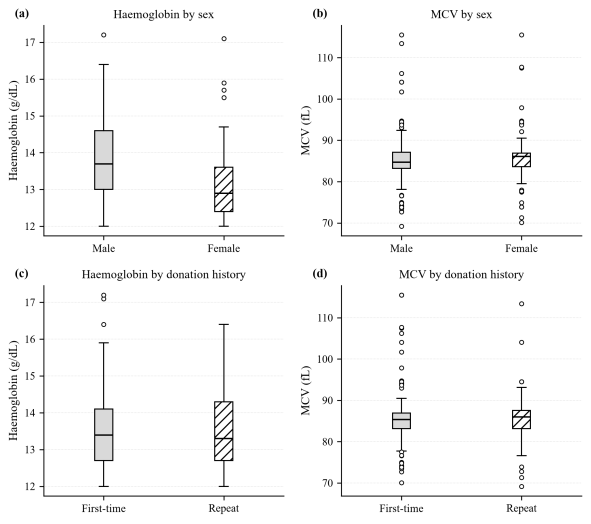
Haemoglobin (g/dL) | 13.70 [13.00, 14.60] | 12.90 [12.40, 13.60] | 0.44 [0.31, 0.57] | < 0.001 | < 0.001 |
Haematocrit (%) | 39.50 [37.70, 42.70] | 37.65 [36.40, 39.30] | 0.44 [0.31, 0.57] | < 0.001 | < 0.001 |
RBC (10^12/L) | 4.79 [4.50, 5.05] | 4.38 [4.21, 4.59] | 0.41 [0.28, 0.55] | < 0.001 | < 0.001 |
MCV (fL) | 84.70 [83.20, 87.10] | 86.15 [83.60, 86.93] | -0.06 [-0.21, 0.09] | 0.414 | 0.827 |
MCH (pg) | 28.90 [28.30, 29.80] | 29.10 [28.58, 29.82] | -0.08 [-0.23, 0.06] | 0.271 | 0.812 |
MCHC (g/dL) | 34.20 [33.70, 35.30] | 34.30 [33.58, 35.20] | 0.01 [-0.14, 0.16] | 0.902 | 0.902 |
Platelets (10^9/L) | 195.00 [147.00, 236.00] | 208.00 [170.75, 271.50] | -0.19 [-0.34, -0.04] | 0.015 | 0.059 |
WBC (10^9/L) | 5.65 [4.55, 7.85] | 6.58 [5.46, 9.35] | -0.24 [-0.38, -0.09] | 0.002 | 0.010 |
Outcome | First-time (n = 165) | Repeat (n = 72) | Test | Effect size [95% CI] | p | Holm p |
|---|---|---|---|---|---|---|
Haemoglobin (g/dL) | 13.55 (1.10) | 13.55 (1.08) | t | 0.00 [-0.28, 0.27] | 0.987 | 1.000 |
Haematocrit (%) | 38.50 [36.90, 41.40] | 38.75 [36.90, 41.57] | M-W | -0.01 [-0.17, 0.16] | 0.937 | 1.000 |
RBC (10^12/L) | 4.63 (0.46) | 4.62 (0.38) | t | 0.03 [-0.25, 0.31] | 0.825 | 1.000 |
MCV (fL) | 85.40 [83.20, 86.90] | 86.00 [83.15, 87.53] | M-W | -0.07 [-0.23, 0.10] | 0.412 | 1.000 |
MCH (pg) | 29.00 [28.40, 29.80] | 29.20 [28.35, 29.73] | M-W | -0.05 [-0.21, 0.11] | 0.580 | 1.000 |
MCHC (g/dL) | 34.30 [33.70, 35.20] | 34.20 [33.38, 35.30] | M-W | 0.02 [-0.15, 0.19] | 0.777 | 1.000 |
Platelets (10^9/L) | 204.00 [166.00, 246.00] | 185.50 [128.25, 249.25] | M-W | 0.12 [-0.05, 0.29] | 0.139 | 0.970 |
WBC (10^9/L) | 6.25 [4.92, 8.70] | 5.54 [4.61, 8.07] | M-W | 0.13 [-0.03, 0.30] | 0.101 | 0.807 |
Outcome | Predictor | B | 95% CI | Standardised beta | p | Adjusted R-squared |
|---|---|---|---|---|---|---|
Haemoglobin (g/dL) | Male sex | 0.837 | [0.58, 1.10] | 0.377 | < 0.001 | 0.143 |
Age, per year | -0.031 | [-0.05, -0.01] | -0.177 | 0.001 | ||
Repeat donation | -0.047 | [-0.34, 0.25] | -0.020 | 0.751 | ||
MCV (fL) | Male sex | -0.422 | [-2.22, 1.37] | -0.031 | 0.644 | -0.009 |
Age, per year | -0.056 | [-0.18, 0.07] | -0.053 | 0.388 | ||
Repeat donation | 0.208 | [-1.75, 2.16] | 0.014 | 0.834 | ||
MCH (pg) | Male sex | -0.144 | [-0.78, 0.49] | -0.029 | 0.657 | -0.003 |
Age, per year | -0.038 | [-0.08, 0.01] | -0.099 | 0.103 | ||
Repeat donation | 0.229 | [-0.49, 0.95] | 0.044 | 0.531 | ||
MCHC (g/dL) | Male sex | -0.002 | [-0.36, 0.36] | -0.001 | 0.992 | -0.002 |
Age, per year | -0.022 | [-0.05, 0.01] | -0.103 | 0.163 | ||
Repeat donation | 0.194 | [-0.21, 0.60] | 0.067 | 0.346 |
Outcome | Comparison | Exposed n/N (%) | Reference n/N (%) | OR [95% CI] | p |
|---|---|---|---|---|---|
Microcytosis | Male vs. female | 26/141 (18.4%) | 12/96 (12.5%) | 1.58 [0.76, 3.32] | 0.221 |
Microcytosis | Repeat vs. first-time | 11/72 (15.3%) | 27/165 (16.4%) | 0.92 [0.43, 1.98] | 0.834 |
Low MCH | Male vs. female | 14/141 (9.9%) | 7/96 (7.3%) | 1.40 [0.54, 3.61] | 0.483 |
Low MCH | Repeat vs. first-time | 4/72 (5.6%) | 17/165 (10.3%) | 0.51 [0.17, 1.58] | 0.237 |
Outcome | Predictor | Adjusted OR | 95% CI | Wald chi-square | p |
|---|---|---|---|---|---|
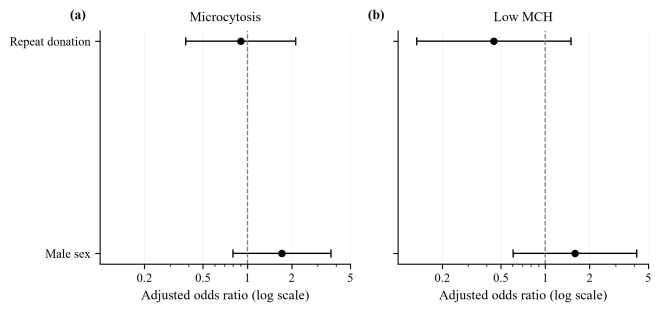
Microcytosis | Male sex | 1.716 | [0.80, 3.69] | 1.92 | 0.166 |
Age centred at 19 years | 0.839 | [0.72, 0.97] | 5.50 | 0.019 | |
Centred age squared | 1.009 | [1.00, 1.02] | 6.74 | 0.009 | |
Repeat donation | 0.902 | [0.38, 2.13] | 0.06 | 0.813 | |
Low MCH | Male sex | 1.591 | [0.61, 4.18] | 0.89 | 0.346 |
Age, per year | 1.007 | [0.93, 1.09] | 0.03 | 0.855 | |
Repeat donation | 0.448 | [0.13, 1.50] | 1.70 | 0.192 |
Model | Events/N | LR chi-square (df) | LR p | HL chi-square (df) | HL p | McFadden R-squared | AUC [95% CI] |
|---|---|---|---|---|---|---|---|
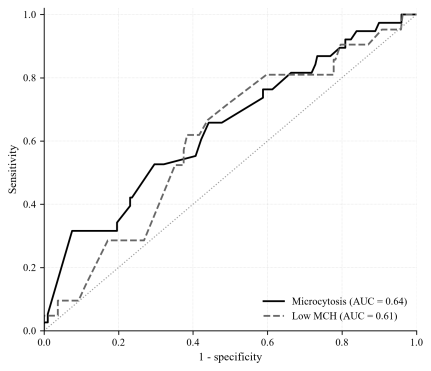
Microcytosis (quadratic age) | 38/237 | 8.98 (4) | 0.062 | 4.78 (8) | 0.781 | 0.043 | 0.642 [0.54, 0.74] |
Low MCH (linear age) | 21/237 | 2.49 (3) | 0.477 | 8.12 (8) | 0.422 | 0.018 | 0.606 [0.47, 0.74] |
Outcome | SW p | BP p | RESET p | Age-squared p | DW | Cook/leverage n | |Stud. resid.| > 3 | VIF range |
|---|---|---|---|---|---|---|---|---|
Haemoglobin (g/dL) | < 0.001 | 0.219 | 0.282 | 0.119 | 1.78 | 11 / 12 | 2 | 1.05-1.15 |
MCV (fL) | < 0.001 | 0.599 | 0.418 | 0.632 | 1.61 | 15 / 12 | 6 | 1.05-1.15 |
MCH (pg) | < 0.001 | 0.513 | 0.543 | 0.450 | 1.63 | 10 / 12 | 6 | 1.05-1.15 |
MCHC (g/dL) | < 0.001 | 0.238 | 0.405 | 0.010 | 1.81 | 12 / 12 | 4 | 1.05-1.15 |
Outcome | Male B (p) | Age B (p) | Repeat B (p) | Adjusted R-squared |
|---|---|---|---|---|
Haemoglobin (g/dL) | 0.76 (< 0.001) | -0.033 (0.002) | -0.10 (0.557) | 0.126 |
MCV (fL) | 0.43 (0.684) | -0.072 (0.267) | -0.74 (0.439) | -0.006 |
MCH (pg) | 0.20 (0.584) | -0.037 (0.113) | -0.08 (0.825) | -0.004 |
MCHC (g/dL) | 0.06 (0.790) | -0.014 (0.386) | 0.21 (0.360) | -0.009 |
AUC | Area Under the Receiver Operating Characteristic Curve |
BP | Breusch-Pagan Test |
CCTH | Cape Coast Teaching Hospital |
CI | Confidence Interval |
DW | Durbin-Watson Statistic |
EDTA | Ethylenediaminetetraacetic Acid |
FBC | Full Blood Count |
Hb | Haemoglobin |
HC3 | Heteroscedasticity-Consistent Covariance Matrix Estimator, Type 3 |
HCT | Haematocrit |
HL | Hosmer-Lemeshow Test |
IQR | Interquartile Range |
LR | Likelihood Ratio |
MCH | Mean Corpuscular Haemoglobin |
MCHC | Mean Corpuscular Haemoglobin Concentration |
MCV | Mean Corpuscular Volume |
M-W | Mann-Whitney U Test |
OR | Odds Ratio |
PLT | Platelet |
RBC | Red Blood Cell |
RESET | Regression Specification Error Test |
SD | Standard Deviation |
SW | Shapiro-Wilk Test |
VIF | Variance Inflation Factor |
WBC | White Blood Cell |
WHO | World Health Organization |
| [1] | Essel BKM, Quarm W, Fynn C, Storph RP, Duah E, Adela EM, et al. Silent Risks in the Blood Supply: Co‐Inherited Glucose‐6‐Phosphate Dehydrogenase Deficiency and Sickle Cell Trait Among Donors at the Cape Coast Teaching Hospital, Ghana: A Cross‐Sectional Study. Health Science Reports. 2026; 9(7): e72785. |
| [2] | WHO. Blood safety and availability. World Health Organisation. 2023. |
| [3] | WHO. Blood Donor Selection: Guidelines on Assessing Donor Suitability for Blood Donation: Geneva: World Health Organization; 2012. |
| [4] | Nubila T, Ukaejiofo EO, Nubila NI, Shu EN, Okwuosa CN, Okofu MB, et al. Hematological profile of apparently healthy blood donors at a tertiary hospital in Enugu, south east Nigeria: A pilot study. Nigerian Journal of Experimental and Clinical Biosciences. 2014; 2(1): 33-6. |
| [5] | Kebalo AH, Gizaw ST, Gnanasekaran N, Areda BG. Lipid and haematologic profiling of regular blood donors revealed health benefits. Journal of blood medicine. 2022: 385-94. |
| [6] | Njenga JK, Menza NC, Mathenge SG, Githanga JN. Hematological Profiles of Eligible Blood Donors at Kenyatta National Hospital, Kenya. International Blood Research & Reviews. 2022; 13(2): 24-31. |
| [7] | Cable RG, Glynn SA, Kiss JE, Mast AE, Steele WR, Murphy EL, et al. Iron deficiency in blood donors: the REDS‐II Donor Iron Status Evaluation (RISE) study. Transfusion. 2012; 52(4): 702-11. |
| [8] | Antwi-Baffour S, Mensah BT, Armah DNO, Asiedu HNA, Annison L. Evaluation of iron levels and hematological indices among blood donors at the Southern Zonal Blood Center, Accra, Ghana. Transfusion and Apheresis Science. 2025; 64(4): 104201. |
| [9] | Kassebaum NJ, Jasrasaria R, Naghavi M, Wulf SK, Johns N, Lozano R, et al. A systematic analysis of global anemia burden from 1990 to 2010. Blood. 2014; 123(5): 615-24. |
| [10] | Sysmex C. Sysmex XN-350 User Training Manual. Ver 5 onwards: Sysmex Corporation; 2020. Available from: |
| [11] | Bachman E, Feng R, Travison T, Li M, Olbina G, Ostland V, et al. Testosterone suppresses hepcidin in men: a potential mechanism for testosterone-induced erythrocytosis. The Journal of Clinical Endocrinology & Metabolism. 2010; 95(10): 4743-7. |
| [12] | Sholzberg M, Hillis C, Crowther M, Selby R. Diagnosis and management of iron deficiency in females. Canadian Medical Association Journal. 2025; 197(24): E680-E7. |
| [13] | Karita E, Ketter N, Price MA, Kayitenkore K, Kaleebu P, Nanvubya A, et al. CLSI-derived hematology and biochemistry reference intervals for healthy adults in eastern and southern Africa. PloS one. 2009; 4(2): e4401. |
| [14] | Kelem A, Engidaye G, Addisu B, Mandefro B, Teketelew BB, Berta DM, et al. Hematological reference intervals for adult population of Debre Berhan town, North East Ethiopia. Scientific Reports. 2025; 15(1): 14121. |
| [15] | Nkansah C, Appiah SK, Osei-Boakye F, Abbam G, Banyeh M, Andoh G, et al. Determinants of iron deficiency among blood donors: a cross-sectional study in a teaching hospital. Scientific Reports. 2026; 16(1): 10740. |
| [16] | Dhabangi A, Ssenyonga R, Siu G, Elaborot SA, Kyeyune D, Bates I. Iron deficiency in whole blood donors in a resource-poor setting: a cross-sectional study in Uganda. Transfusion Medicine. 2023; 33(3): 213-20. |
| [17] | Segbefia C, Telke S, Olayemi E, Ward C, Asamoah-Akuoko L, Appiah B, et al. Deferrals for low haemoglobin and anaemia among first-time prospective blood donors in Southern Ghana: results from the BLOODSAFE Ghana Iron and Nutritional Counselling Strategy Pilot (BLIS) study. Advances in Hematology. 2025; 2025(1): 9971532. |
APA Style
Essel, B. K. M., Storph, R. P., Kumah, C. A., Quarm, W., Agbotey, W., et al. (2026). Sex-Related Differences Predominate Over Donation History in Determining Haematological Indices Among Blood Donors: A Cross-Sectional Study. American Journal of Laboratory Medicine, 11(5), 92-103. https://doi.org/10.11648/j.ajlm.20261105.11
ACS Style
Essel, B. K. M.; Storph, R. P.; Kumah, C. A.; Quarm, W.; Agbotey, W., et al. Sex-Related Differences Predominate Over Donation History in Determining Haematological Indices Among Blood Donors: A Cross-Sectional Study. Am. J. Lab. Med. 2026, 11(5), 92-103. doi: 10.11648/j.ajlm.20261105.11
@article{10.11648/j.ajlm.20261105.11,
  author = {Bashirudeen Kofi Mensa Essel and Rebecca Peniel Storph and Cephas Adams Kumah and Walter Quarm and Wisdom Agbotey and Evans Duah},
  title = {Sex-Related Differences Predominate Over Donation History in Determining Haematological Indices Among Blood Donors: A Cross-Sectional Study},
  journal = {American Journal of Laboratory Medicine},
  volume = {11},
  number = {5},
  pages = {92-103},
  doi = {10.11648/j.ajlm.20261105.11},
  url = {https://doi.org/10.11648/j.ajlm.20261105.11},
  eprint = {https://article.sciencepublishinggroup.com/pdf/10.11648.j.ajlm.20261105.11},
  abstract = {Blood donors represent a critical resource for maintaining an adequate and safe blood supply. However, physiological factors such as sex and donation history may influence haematological parameters and donor health. This study assessed haematological indices according to sex and donation history among blood donors. A cross-sectional study was conducted among 237 eligible blood donors. Demographic characteristics and haematological parameters, including white blood cell (WBC) count, red blood cell (RBC) count, haemoglobin concentration, haematocrit, mean corpuscular volume (MCV), mean corpuscular haemoglobin (MCH), mean corpuscular haemoglobin concentration (MCHC), and platelet count, were analysed. Comparisons were performed according to sex and donation history, and multivariable regression models were used to identify independent predictors of haematological outcomes. Of the participants, 59.5% were male and 69.6% were first-time donors. Male donors had significantly higher haemoglobin concentrations, haematocrit values, and RBC counts than female donors, while female donors had significantly higher WBC counts. No significant differences in haemoglobin concentration, red-cell indices, WBC count, or platelet count were observed between first-time and repeat donors. Multivariable analysis demonstrated that male sex was independently associated with higher haemoglobin concentration, whereas increasing age was associated with a modest decline in haemoglobin levels. Donation history was not independently associated with haemoglobin concentration or other red-cell indices. Microcytosis and low MCH were identified in 16.0% and 8.9% of donors, respectively, but neither was associated with sex or donation history. These findings indicate that sex is an important determinant of haematological variation among blood donors, whereas donation history has limited influence on routine haematological parameters. Continued monitoring of donor haematological status remains important for maintaining donor health and ensuring a sustainable blood supply.},
 year = {2026}
}
TY  - JOUR
T1  - Sex-Related Differences Predominate Over Donation History in Determining Haematological Indices Among Blood Donors: A Cross-Sectional Study
AU  - Bashirudeen Kofi Mensa Essel
AU  - Rebecca Peniel Storph
AU  - Cephas Adams Kumah
AU  - Walter Quarm
AU  - Wisdom Agbotey
AU  - Evans Duah
Y1  - 2026/11/24
PY  - 2026
N1  - https://doi.org/10.11648/j.ajlm.20261105.11
DO  - 10.11648/j.ajlm.20261105.11
T2  - American Journal of Laboratory Medicine
JF  - American Journal of Laboratory Medicine
JO  - American Journal of Laboratory Medicine
SP  - 92
EP  - 103
PB  - Science Publishing Group
SN  - 2575-386X
UR  - https://doi.org/10.11648/j.ajlm.20261105.11
AB  - Blood donors represent a critical resource for maintaining an adequate and safe blood supply. However, physiological factors such as sex and donation history may influence haematological parameters and donor health. This study assessed haematological indices according to sex and donation history among blood donors. A cross-sectional study was conducted among 237 eligible blood donors. Demographic characteristics and haematological parameters, including white blood cell (WBC) count, red blood cell (RBC) count, haemoglobin concentration, haematocrit, mean corpuscular volume (MCV), mean corpuscular haemoglobin (MCH), mean corpuscular haemoglobin concentration (MCHC), and platelet count, were analysed. Comparisons were performed according to sex and donation history, and multivariable regression models were used to identify independent predictors of haematological outcomes. Of the participants, 59.5% were male and 69.6% were first-time donors. Male donors had significantly higher haemoglobin concentrations, haematocrit values, and RBC counts than female donors, while female donors had significantly higher WBC counts. No significant differences in haemoglobin concentration, red-cell indices, WBC count, or platelet count were observed between first-time and repeat donors. Multivariable analysis demonstrated that male sex was independently associated with higher haemoglobin concentration, whereas increasing age was associated with a modest decline in haemoglobin levels. Donation history was not independently associated with haemoglobin concentration or other red-cell indices. Microcytosis and low MCH were identified in 16.0% and 8.9% of donors, respectively, but neither was associated with sex or donation history. These findings indicate that sex is an important determinant of haematological variation among blood donors, whereas donation history has limited influence on routine haematological parameters. Continued monitoring of donor haematological status remains important for maintaining donor health and ensuring a sustainable blood supply.
VL  - 11
IS  - 5
ER  -
Laboratory Department, Cape Coast Teaching Hospital, Cape Coast, Ghana
Laboratory Department, Cape Coast Teaching Hospital, Cape Coast, Ghana
Laboratory Department, Cape Coast Teaching Hospital, Cape Coast, Ghana
Laboratory Department, Cape Coast Teaching Hospital, Cape Coast, Ghana
Department of Microbiology and Immunology, University of Cape Coast, Cape Coast, Ghana
Laboratory Department, Cape Coast Teaching Hospital, Cape Coast, Ghana

Information


 Share This Article
 Twitter
 Linked In
 Facebook

 Copy
 Download