
The aim of present paper is to find the frequencies using the mathematical model: Effect of parabolically varying non-homogeneity on thermally induced vibration of orthotropic trapezoidal plate with thickness varies parabolically in both directions. In the above model both thickness and density varies parabolically. Rayleigh-Ritz method is used to solve the governing differential equation for maximum strain energy and maximum kinetic energy for orthotropic trapezoidal plate. Two term deflection function corresponding to clamped-simply supported clamped-simply supported (C-S-C-S) boundary condition is defined by the product of the equation of the prescribed continuous piecewise boundary shape. The effect of frequencies for first and second mode investigated with the variations in structural parameters such as taper constant, non-homogeneity constant, aspect ratio and thermal gradient respectively. Differential equations for maximum strain energy and maximum kinetic energy for orthotropic trapezoidal plate are solved using the mathematica software. All the results are calculated with great accuracy and are displayed graphically. To validate the model all the results are also compared with the preexisting literature and fit well. So by developing such type of model we increase sustainability and also reduce the environmental hazards.
| Published in | American Journal of Applied Mathematics (Volume 14, Issue 1) |
| DOI | 10.11648/j.ajam.20261401.15 |
| Page(s) | 39-49 |
| Creative Commons |
This is an Open Access article, distributed under the terms of the Creative Commons Attribution 4.0 International License (http://creativecommons.org/licenses/by/4.0/), which permits unrestricted use, distribution and reproduction in any medium or format, provided the original work is properly cited. |
| Copyright |
Copyright © The Author(s), 2026. Published by Science Publishing Group |
Non Homogeneity, Aspect Ratio, Vibration, Density, Thickness Etc
| =0.0 | =0.6 | ||||||
|---|---|---|---|---|---|---|---|---|
|
|
|
| |||||
First Mode | Second Mode | First Mode | Second Mode | First Mode | Second Mode | First Mode | Second Mode | |
0.0 | 30.589 | 154.064 | 29.2556 | 147.332 | 31.5694 | 169.634 | 30.0839 | 161.416 |
0.2 | 27.7991 | 142.965 | 26.5868 | 136.72 | 28.9422 | 158.245 | 27.5798 | 150.581 |
0.4 | 24.6943 | 130.928 | 23.6168 | 125.213 | 26.0502 | 145.969 | 24.8233 | 138.904 |
0.6 | 21.1348 | 117.668 | 20.2119 | 112.535 | 22.7923 | 132.562 | 21.718 | 126.15 |
0.8 | 16.831 | 102.711 | 16.095 | 98.2363 | 18.9788 | 117.637 | 18.0832 | 111.954 |
1.0 | 10.9201 | 85.1694 | 10.4414 | 81.4684 | 14.1616 | 100.532 | 13.492 | 95.6747 |
=0.0 | =0.0 | =0.6 | =0.6 | |||||
|---|---|---|---|---|---|---|---|---|
First Mode | Second Mode | First Mode | Second Mode | First Mode | Second Mode | First Mode | Second Mode | |
0.25 | 35.6888 | 145.323 | 28.3814 | 120.11 | 35.7883 | 151.584 | 28.7843 | 126.454 |
0.50 | 28.7355 | 111.436 | 23.0381 | 93.0969 | 28.7925 | 117.357 | 23.4843 | 99.3246 |
0.75 | 23.829 | 86.1293 | 19.3147 | 72.7386 | 24.1977 | 91.9108 | 20.1725 | 79.038 |
1.0 | 20.5614 | 68.414 | 16.8739 | 58.408 | 21.4894 | 74.601 | 18.4092 | 65.348 |
| ||||||||
|---|---|---|---|---|---|---|---|---|
=0.0 | =0.0 | =0.6 | =0.6 | |||||
First Mode | Second Mode | First Mode | Second Mode | First Mode | Second Mode | First Mode | Second Mode | |
0.25 | 39.2842 | 210.645 | 30.3935 | 162.397 | 39.2842 | 218.645 | 32.0578 | 178.783 |
0.50 | 30.589 | 154.064 | 24.6943 | 130.928 | 31.5694 | 169.634 | 26.0502 | 145.969 |
0.75 | 25.3956 | 121.749 | 20.6833 | 104.527 | 26.3826 | 134.812 | 22.1526 | 117.492 |
1.0 | 20.5614 | 88.414 | 17.9946 | 84.0116 | 23.1717 | 107.673 | 19.9025 | 95.0264 |
=0.0 | =0.6 | |||||||
|---|---|---|---|---|---|---|---|---|
First Mode | Second Mode | First Mode | Second Mode | First Mode | Second Mode | First Mode | Second Mode | |
0.0 | 30.589 | 154.064 | 24.6943 | 130.928 | 31.057 | 160.398 | 25.2831 | 137.001 |
0.2 | 29.9001 | 150.581 | 24.1375 | 127.971 | 30.3439 | 156.631 | 24.7019 | 133.787 |
0.4 | 29.2556 | 147.332 | 23.6168 | 125.213 | 29.6776 | 153.129 | 24.1589 | 130.799 |
0.6 | 28.6511 | 144.291 | 23.1283 | 122.631 | 29.0533 | 149.861 | 23.6502 | 128.010 |
0.8 | 28.0825 | 141.437 | 22.6689 | 120.207 | 28.4668 | 146.801 | 23.1723 | 125.398 |
1.0 | 27.5464 | 138.75 | 22.2359 | 117.926 | 27.9143 | 143.927 | 22.7223 | 122.946 |
C-S | Clamped Simply Supported |
Temp | Temperature |
et. al | And Others |
i.e. | That is |
etc. | Et Cetera |
Eqn | Equation |
Vol. | Volume |
1(2) | Volume (Issue No.) |
Pp. | Page Number |
Fig. | Figure |
Id | Identity Document |
Electronic Mail | |
https | Hypertext Transfer Protocol Secure |
Density | |
, | Aspect Ratio |
Thermal Gradient | |
Taper Constant | |
Non-Homogeneity | |
Frequency Parameter | |
and | Non-Dimensional Variables |
and | Young’s Moduli |
Thickness | |
and | Temperature Excess Above the Reference Temperature and Origin |
Slope of Vibration of Moduli with Temperature | |
Angular Frequency | |
Minimum Plate Thickness | |
Maximum Strain Energy | |
Maximum Kinetic Energy | |
Flexural Rigidity | |
Torsion Rigidity |
| [1] | P. Sharma, A. Sharma and Geeta, “Effect of Non-Homogeneity on Thermally Induced Vibration of Orthotropic Trapezoidal Plate with Thickness Varies Linearly in Both Directions”, International Journal of research and analytical reviews (IJRAR), 12(2), 538-553, 2025. |
| [2] | A. Sharma, P. Sharma and Geeta, “Thermal effect on vibration of non- homogeneous orthotropic trapezoidal plate with thickness varies parabolically in both directions”, International Journal of Science, Engineering and Technology, 13(3), 1-12, 2025. |
| [3] | A. Sharma, P. Sharma and Geeta, “Mathematical modeling of vibration of non-homogeneous orthotropic trapezoidal plate with linear variation in density”, International Journal of Environmental Sciences, 11(4), 2073-2083, 2025. |
| [4] | A. Sharma, P. Sharma and Geeta, “Effect of linearly varying non-homogeneity on thermally induced vibration of orthotropic trapezoidal plate with thickness varies linearly in one direction and parabolically in other direction”, published as book chapter in International Conference on Recent Advances in Science, Engineering, Technology and Management, ISBN No.- “978-93-7298-920-5”, 1-13, 2025. |
| [5] | Arun K. Gupta and P. Sharma, “Study of thermally induced vibration of non-homogeneous trapezoidal plate with varying thickness and density”, American journal of Computational and Applied Mathematics, 2(6), 265-275, 2012. |
| [6] | Arun K. Gupta and P. Sharma, “Effect of linear thermal gradient on vibration of trapezoidal plates whose thickness varies parabolically”, Journal of Vibraation and Control 18(3), 395-403, 2012. |
| [7] | Arun K. Gupta and P. Sharma, “Thermal effect on frequencies of non-homogeneous trapezoidal plate with linearly varying thickness in one direction and linearly varying density in other direction”, Journal of Experimental and Applied Mechanics 3(2-3), 25-37, 2012. |
| [8] | A. K. Gupta and Shanu Sharma,“Thermally induced vibration of orthotropic trapezoidal plate of linearly varying thickness”, Journal of Vibration and Control, 17(10), 1591-1598, 2011. |
| [9] | A. K. Gupta and Shanu Sharma,“Free transverse vibration of orthotropic thin trapezoidal plate of parabolically varying thicknes subjected to linear temperature distribution”, Shock and Vibration, 2014(1), 392-325, 2014. |
| [10] | Kavita, Satish Kumar and Pragati Sharma,“Vibration analysis of clamped and simply supported non-homogeneous trapezoidal plate of varying thickness and density under thermal gradient”, Acta Technica, 63(6), 829-844, 2018. |
| [11] | Kavita, Satish Kumar and Pragati Sharma,“Thermal effect on vibrations of a symmetric non-homogeneous trapezoidal plate, whose thickness varies bilinearly and density varies parabolically”, Acta Technica, 62(1), 057-070, 2017. |
| [12] | A. W. Leissa, “Recent Studies in Plate Vibration 1981-1985 Part II, Complicating Effects,” The Shock and Vibration Digest, 19(3), 10-24, 1987. |
| [13] | A. W. Leissa, “Recent Studies in Plate Vibration 1981-1985 Part I, Clasical Theory,” The Shock and Vibration Digest, 19(2), 11-18, 1987. |
| [14] | A. W. Leissa, “Vibration of Plates”, NASASP-160, US Government Printing Office, Washington, DC, USA, 1969. |
| [15] | F. T. K. Au and M. F. Wang “Sound radiation from forced vibration of rectangular orthotropic plates under moving loads”, J. Sound and Vibration, 281, 1057-1075, 2005. |
| [16] | D. R. Avalos, H. A. Larrendo and P. A. A. Laura “Analysis of vibrating rectangular anistropic plate with free edge holes”, J. Sound and Vibration, 222, 691-695, 1999. |
| [17] | D. R. Avalos, H. A. Larrendo and P. A. A. Laura, “Transverse vibrations of simply supported plate of generalized anisotropy with an oblique cutout”, J. Sound and Vibration, 258, 773-776, 2002. |
| [18] | D. R. Avalos, H. A. Larrendo and P. A. A. Laura, “Transverse vibrations of simply supported rectangular plate with two rectangular cutout”, J. Sound and Vibration, 267, 967-977, 2003. |
| [19] | Arenas, P. Jorge, “On the vibration analysis of rectangular clamped plate using the virtual work principle”, J. Sound and Vibration, 266, 912-918, 2003. |
| [20] | J. S. Tomer and A. K. Gupta, “Vibration of orthotropic elliptic plate of non-uniform thickness and temperature”, J. Sound and Vibration, 96, 29-35, 1984. |
| [21] | J. S. Tomer and A. K. Gupta, “Thermal effect on frequencies of an orthotropic rectangular plate of linearly varying thickness”, J. Sound and Vibration, 90, 325-331, 1983. |
| [22] | J. S. Tomer and A. K. Gupta, “Harmonic temperature effect on vibration of an orthotropic rectangular plate of varying thickness”, AIAA Journal, 23(4), 633-636, 1985. |
| [23] | J. S. Tomer and A. K. Gupta, “Effect of exponential temperature variation on frequencies of an orthotropic rectangular plate of exponentially varying thickness”, Proceeding of the workshop on computer application in continues mechanics, March 11-13, Deptt. of Math. U. O. R., Roorkee, 183-188, 1986. |
| [24] | J. S. Tomer and A. K. Gupta, “Thermal effect on axisymmetric vibrations of an orthotropic circular plate of variable thickness”, AIAA Journal, 22(7), 1015-1017, 1984. |
| [25] | J. S. Tomer and A. K. Gupta, “Thermal effect on axisymmetric vibrations of an orthotropic circular plate of parabolically varying thickness”, Indian J. Pure Appl. Math., 16(5), 537-545, 1985. |
| [26] | J. S. Tomer and D. C. Gupta, “Axisymmetric vibrations of a circular plate of linearly varying thickness on an elastic foundation according to Medlin theory”, J. Sound and Vibration, 80, 281-286, 1982. |
| [27] | J. S. Tomer and V. S. Tiwari, “Effect of thermal gradient on frequencies of a circular plate of variable thickness”, J. Non-Equilib. Thermodynamics, 6, 115-122, 1981. |
| [28] | J. S. Tomer, R. K. Sharma and D. C. Gupta “Transverse vibration of non-uniform rectangular orthotropic plates”, AIAAS Journal, Vol. 21(7), 1050-1053, 1983. |
| [29] | D. A. Vega, S. A. Vera, P. A. A. Laura, R. H. Gutierrez and M. E. Pronsato, “Transverse vibration of an annular circular plate with free edge and an intermediate concentric circular support”, J. Sound and Vibration”, 223, 493-496, 1999. |
| [30] | A. Sharma, P. Sharma and Geeta, “Effect of parabolically varying non-homogeneity on thermally induced vibration of orthotropic trapezoidal plate with thickness varies linearly in one direction and parabolically in other direction”, Engineering Mathematics, 9(1), 16-25, 2025. |
APA Style
Sharma, A., Sharma, P., Geeta. (2026). Effect of Parabolically Varying Non-homogeneity on Thermally Induced Vibration of Orthotropic Trapezoidal Plate with Thickness Varies Parabolically in Both Directions. American Journal of Applied Mathematics, 14(1), 39-49. https://doi.org/10.11648/j.ajam.20261401.15
ACS Style
Sharma, A.; Sharma, P.; Geeta. Effect of Parabolically Varying Non-homogeneity on Thermally Induced Vibration of Orthotropic Trapezoidal Plate with Thickness Varies Parabolically in Both Directions. Am. J. Appl. Math. 2026, 14(1), 39-49. doi: 10.11648/j.ajam.20261401.15
@article{10.11648/j.ajam.20261401.15,
  author = {Amit Sharma and Pragati Sharma and Geeta},
  title = {Effect of Parabolically Varying Non-homogeneity on Thermally Induced Vibration of Orthotropic Trapezoidal Plate with Thickness Varies Parabolically in Both Directions},
  journal = {American Journal of Applied Mathematics},
  volume = {14},
  number = {1},
  pages = {39-49},
  doi = {10.11648/j.ajam.20261401.15},
  url = {https://doi.org/10.11648/j.ajam.20261401.15},
  eprint = {https://article.sciencepublishinggroup.com/pdf/10.11648.j.ajam.20261401.15},
  abstract = {The aim of present paper is to find the frequencies using the mathematical model: Effect of parabolically varying non-homogeneity on thermally induced vibration of orthotropic trapezoidal plate with thickness varies parabolically in both directions. In the above model both thickness and density varies parabolically. Rayleigh-Ritz method is used to solve the governing differential equation for maximum strain energy and maximum kinetic energy for orthotropic trapezoidal plate. Two term deflection function corresponding to clamped-simply supported clamped-simply supported (C-S-C-S) boundary condition is defined by the product of the equation of the prescribed continuous piecewise boundary shape. The effect of frequencies for first and second mode investigated with the variations in structural parameters such as taper constant, non-homogeneity constant, aspect ratio and thermal gradient respectively. Differential equations for maximum strain energy and maximum kinetic energy for orthotropic trapezoidal plate are solved using the mathematica software. All the results are calculated with great accuracy and are displayed graphically. To validate the model all the results are also compared with the preexisting literature and fit well. So by developing such type of model we increase sustainability and also reduce the environmental hazards.},
 year = {2026}
}
TY  - JOUR
T1  - Effect of Parabolically Varying Non-homogeneity on Thermally Induced Vibration of Orthotropic Trapezoidal Plate with Thickness Varies Parabolically in Both Directions
AU  - Amit Sharma
AU  - Pragati Sharma
AU  - Geeta
Y1  - 2026/02/06
PY  - 2026
N1  - https://doi.org/10.11648/j.ajam.20261401.15
DO  - 10.11648/j.ajam.20261401.15
T2  - American Journal of Applied Mathematics
JF  - American Journal of Applied Mathematics
JO  - American Journal of Applied Mathematics
SP  - 39
EP  - 49
PB  - Science Publishing Group
SN  - 2330-006X
UR  - https://doi.org/10.11648/j.ajam.20261401.15
AB  - The aim of present paper is to find the frequencies using the mathematical model: Effect of parabolically varying non-homogeneity on thermally induced vibration of orthotropic trapezoidal plate with thickness varies parabolically in both directions. In the above model both thickness and density varies parabolically. Rayleigh-Ritz method is used to solve the governing differential equation for maximum strain energy and maximum kinetic energy for orthotropic trapezoidal plate. Two term deflection function corresponding to clamped-simply supported clamped-simply supported (C-S-C-S) boundary condition is defined by the product of the equation of the prescribed continuous piecewise boundary shape. The effect of frequencies for first and second mode investigated with the variations in structural parameters such as taper constant, non-homogeneity constant, aspect ratio and thermal gradient respectively. Differential equations for maximum strain energy and maximum kinetic energy for orthotropic trapezoidal plate are solved using the mathematica software. All the results are calculated with great accuracy and are displayed graphically. To validate the model all the results are also compared with the preexisting literature and fit well. So by developing such type of model we increase sustainability and also reduce the environmental hazards.
VL  - 14
IS  - 1
ER  -
Department of Mathematics, Geeta University, Panipat, India
Department of Mathematics, National Institute of Technology, Kurukshetra, India
Department of Mathematics, Geeta University, Panipat, India
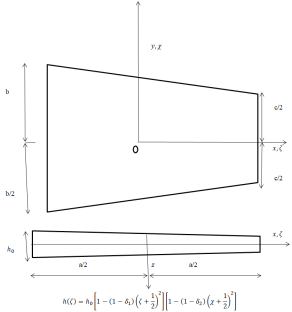
Figure 1. Geometry of orthotropic trapezoidal plate Figure 1.
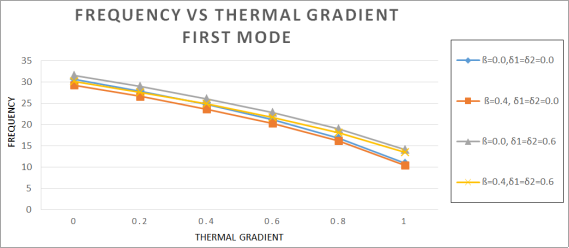
Figure 2. Represents the first mode of frequency parameter for a orthotropic trapezoidal plate for different values of thermal gradient and constant aspect ratios , non-homogeneity constant =0.0, 0.4 and Taper Constant.
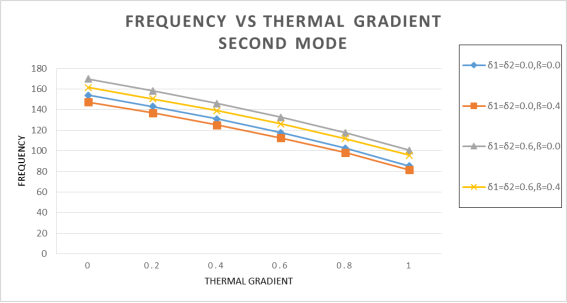
Figure 3. Represents the second mode values of frequency parameter for orthotropic trapezoidal plate for different values of thermal gradient and constant aspect ratios , non-homogeneity constant =0.0, 0.4 and Taper Constant.
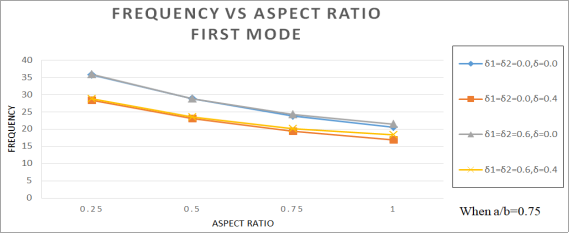
Figure 4. Represents the first mode values of frequency parameter for a orthotropic trapezoidal plate for different values of thermal gradient and constant aspect ratios , non-homogeneity constant =0.0, Thermal gradient and Taper Constant.
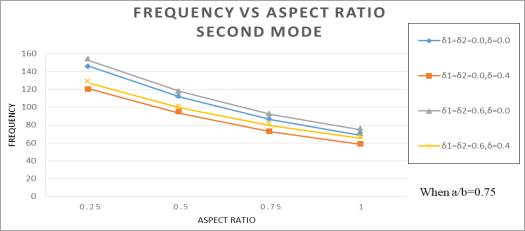
Figure 5. Represents the second mode values of frequency parameter for a orthotropic trapezoidal plate for different values of thermal gradient and constant aspect ratios , non-homogeneity constant =0.0, Thermal gradient and Taper Constant.
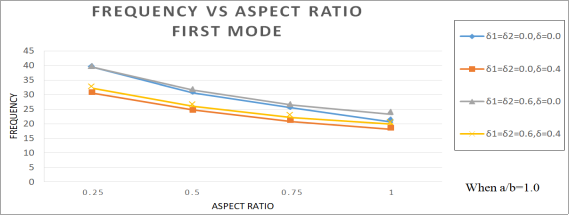
Figure 6. Represents the first mode values of frequency parameter for a orthotropic trapezoidal plate for different values of thermal gradient and constant aspect ratio , non-homogeneity constant =0.0, Thermal gradient and Taper Constant.
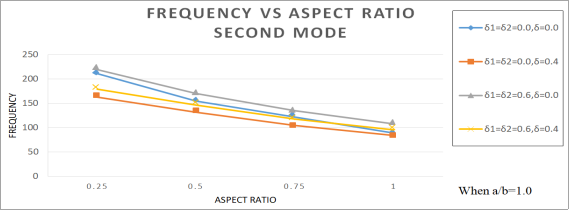
Figure 7. Represents the second mode values of frequency parameter for a orthotropic trapezoidal plate for different values of thermal gradient and constant aspect ratio , non-homogeneity constant =0.0, Thermal gradient and Taper Constant.
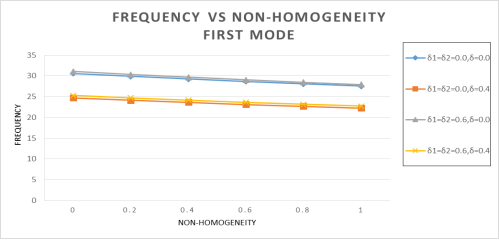
Figure 8. Represents the first mode values of frequency parameter for a orthotropic trapezoidal plate for different values of non-homogeneity constant and aspect ratios,, =0.0 =0.6 respectively.
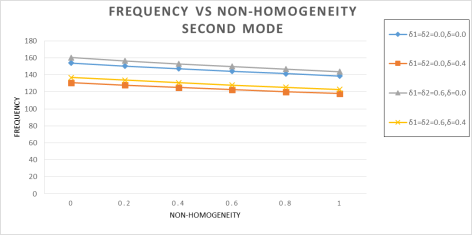
Figure 9. Represents the second mode values of frequency parameter for a orthotropic trapezoidal plate for different values of non-homogeneity constant and aspect ratios,, =0.0 =0.6 respectively.

Information



 Share This Article
 Twitter
 Linked In
 Facebook
 Copy
Copy Download