Marantaceae are ecologically and socio-economically important understory plants in Central African tropical forests, yet their spatial distribution in Cameroon remains insufficiently documented. This study employed georeferenced herbarium records from the National Herbarium of Cameroon to map the national distribution of Marantaceae species. Twelve genera were identified, indicating consistency in generic diversity across historical collections. Marantochloa emerged as the most widespread and dominant genus, reflecting its ecological adaptability and extensive local use, particularly for food wrapping and construction. Spatial analysis revealed a strong concentration of Marantaceae species in the humid forest zones of southern Cameroon, while occurrences in drier and savanna regions were sparse. These patterns highlight the combined influence of environmental conditions and species ecology on distribution. The findings demonstrate the effectiveness of herbarium-based spatial analysis for documenting plant diversity, identifying distribution hotspots, and informing conservation and sustainable use of forest plant resources.
This is an Open Access article, distributed under the terms of the Creative Commons Attribution 4.0 International License (http://creativecommons.org/licenses/by/4.0/), which permits unrestricted use, distribution and reproduction in any medium or format, provided the original work is properly cited.
Non-timber forest products (NTFPs) constitute an essential component of tropical forest ecosystems and play a critical role in supporting rural livelihoods, food security, and cultural practices across sub-Saharan Africa
[1]
Andersson, L. (1998). Phylogeny and classification of the Marantaceae. BotanicalJournaloftheLinneanSociety.
[2]
Arnold, J. E. M., & Ruiz Perez, M. (2001). Can non-timber forest products match tropical forest conservation and development objectives? WorldDevelopment,29(3), 437–447.
[11]
Ndoye, O., Ruiz Perez, M., & Eyebe, A. (1997). The markets of non-timber forest products in the humid forest zone of Cameroon. RuralDevelopmentForestryNetworkPaper, 22c, 1–13. Overseas Development Institute (ODI), London.
[1, 2, 11]
. Among NTFPs, understory plant groups are particularly important due to their close ecological association with forest structure and microclimatic conditions. Understanding the spatial distribution of such taxa is therefore fundamental for biodiversity conservation, sustainable resource management, and ecosystem-based livelihoods.
The family Marantaceae is a pantropical group of perennials; rhizomatous understory plants widely distributed in humid forest ecosystems
[1]
Andersson, L. (1998). Phylogeny and classification of the Marantaceae. BotanicalJournaloftheLinneanSociety.
[1]
. In Central Africa, Marantaceae species are especially abundant in lowland rainforests, swamp forests, and secondary forest formations, where they form dense ground cover and contribute significantly to forest dynamics
[8]
Koechlin, J. (1965). Marantaceae. In Flora of Cameroon (Vol. 4). National Museum of Natural History, Paris, France.
[13]
White, F. (1983). ThevegetationofAfrica:AdescriptivememoirtoaccompanytheUNESCO/AETFAT/UNSOvegetationmapofAfrica.UNESCO, Paris.
[8, 13]
. Ecologically, the family is strongly associated with high rainfall, shaded environments, and permanently moist soils, making it a useful indicator group for humid forest phytogeography.
In Cameroon, Marantaceae species are of both ecological and socio-economic importance. Several species, including Marantochloa purpurea, Halopegia azurea, Megaphrynium macrostachyum, and Haumania denckelmaniana, are widely harvested for food wrapping, household use, artisanal activities, and commercial trade
[10]
Ley, A. C. (2008). EvolutioninAfricanMarantaceae—Evidencefromfloralmorphology,ecologyandphylogeny (Unpublished doctoral thesis). University of Mainz, Germany.
[6]
Ingram, V., & Schure, J. (2010). Review of non-timber forest products (NTFPs) in Central Africa: Cameroon. NTFPsinCentralAfrica (pp. 1–56). Center for International Forestry Research (CIFOR), Bogor, Indonesia.
[10, 6]
. Despite their importance, information on the national-scale distribution of Marantaceae species remains fragmented, often limited to localized ecological studies or market-focused research.
Cameroon presents a unique phytogeographical context for studying Marantaceae distribution due to its pronounced ecological gradient, extending from humid forest ecosystems in the southern part of the country to savanna landscapes in the north
[8]
Koechlin, J. (1965). Marantaceae. In Flora of Cameroon (Vol. 4). National Museum of Natural History, Paris, France.
[12]
Shackleton, S., Shackleton, C., & Shanley, P. (2011). Non-timber forest products in the global context. In S. Shackleton, C. Shackleton, & P. Shanley (Eds.), Non-timberforestproductsintheglobalcontext (pp. 1–23). Springer, Berlin.
[8, 12]
. The southern half of Cameroon is characterized by bimodal and monomodal rainfall regimes that support evergreen and semi-deciduous forests, while the northern part is dominated by drier savanna systems with limited suitability for forest-dependent understory taxa. These contrasts are expected to strongly influence the occurrence, richness, and spatial concentration of Marantaceae species across the country.
Herbarium collections constitute one of the most reliable sources of long-term data for assessing plant distribution patterns, especially in regions where systematic field inventories are scarce
[5]
Graham, C. H., Ferrier, S., Huettman, F., Moritz, C., & Peterson, A. T. (2004). New developments in museum-based informatics and applications in biodiversity analysis. TrendsinEcology&Evolution.
[4]
Funk, V. A., Richardson, K. S., & Ferrier, S. (2005). Survey-gap analysis in expeditionary research: Where do we go from here? BiologicalJournaloftheLinneanSociety.
[5, 4]
. In Cameroon, the National Herbarium holds extensive botanical records collected over several decades, providing valuable historical and spatial insights into plant species occurrence. When properly georeferenced and analyzed using geographic information systems (GIS), herbarium records allow for robust mapping of species distributions and identification of phytogeographical trends at national and regional scales.
This study aims to map and analyze the spatial distribution of Marantaceae species in Cameroon using herbarium records from the National Herbarium. Specifically, the study seeks to (i) document the geographical occurrence of Marantaceae species across the country, (ii) examine distribution patterns in relation to major ecological zones, and (iii) contribute to phytogeographical knowledge relevant for conservation planning and sustainable management of Marantaceae as an important NTFP group. By providing a national-scale perspective, this study fills an important knowledge gap and establishes a baseline for future ecological, economic, and conservation-oriented research on Marantaceae in Cameroon.
2. Materials and Methods
2.1. Study Area
The study was conducted at the national scale of Cameroon, a country located in Central Africa between latitudes 2° and 13° N and longitudes 8° and 16° E. Cameroon is characterized by high ecological diversity, ranging from humid lowland forests in the southern part of the country to savanna landscapes in the northern part. The southern half of Cameroon is dominated by humid forest ecosystems associated with bimodal and monomodal rainfall regimes, while the northern half is characterized by drier savanna ecosystems with limited suitability for Marantaceae species. This ecological heterogeneity makes Cameroon an ideal setting for analyzing spatial distribution patterns of forest-dependent plant taxa such as Marantaceae.
2.2. Data Sources
Distribution data for Marantaceae species were obtained from the National Herbarium of Cameroon. Herbarium records included preserved specimens collected across different regions of Cameroon over multiple decades (1948-2025). For each specimen, associated metadata were extracted, including scientific name, collection locality, administrative region, habitat description (where available), collector name, and date of collection. Only specimens identified to species level and with clear locality information were retained for analysis.
To ensure taxonomic consistency, scientific names were verified using standard botanical references and updated nomenclature databases. Synonyms were harmonized to avoid duplication and ensure accuracy in species representation.
2.3. Data Cleaning and Georeferencing
Locality descriptions from herbarium labels were standardized and georeferenced using gazetteers, topographic maps, and geographic information system (GIS) tools. Records with ambiguous or unverifiable locations were excluded from spatial analysis. Duplicate specimens collected from the same locality and date were removed to minimize sampling bias. The cleaned dataset was compiled into a geospatial database containing species identity and geographic coordinates.
2.4. Spatial Analysis and Mapping
Spatial distribution mapping was carried out using GIS software (e.g., QGIS/ArcGIS). Georeferenced occurrence points were plotted on a national base map of Cameroon. Species distribution patterns were analyzed by overlaying occurrence data with ecological and administrative layers, including agro-ecological zones and major vegetation types. Distribution density maps were generated to visualize areas of high species occurrence and concentration.
The spatial analysis focused on identifying regional patterns of Marantaceae occurrence, particularly contrasts between humid forest zones and non-forest regions. Distribution patterns were interpreted in relation to ecological conditions such as rainfall regime, forest cover, and habitat specificity.
2.5. Data Analysis
Descriptive statistics were used to summarize species richness, frequency of occurrence, and regional representation. Species presence was compared across ecological zones to assess spatial clustering and distribution trends. The analysis emphasized phytogeographical interpretation rather than abundance estimation, recognizing that herbarium records represent presence data and may reflect historical collection effort.
2.6. Limitations of Herbarium-based Data
While herbarium records provide valuable historical and spatial information, they are subject to collection bias, uneven sampling intensity, and temporal gaps. These limitations were acknowledged in the interpretation of results. Nevertheless, herbarium data remain a robust and widely accepted source for large-scale distribution and phytogeographical studies, particularly in regions with limited long-term ecological monitoring.
3. Result and Discussion
3.1. Spatial Distribution of Marantaceae Species in Cameroon
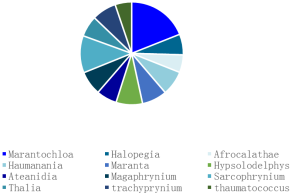
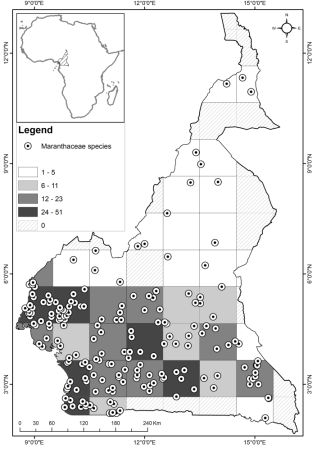
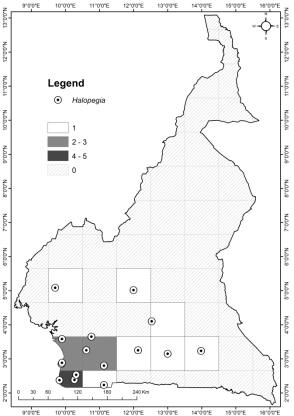
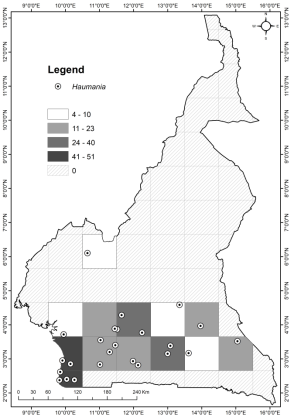
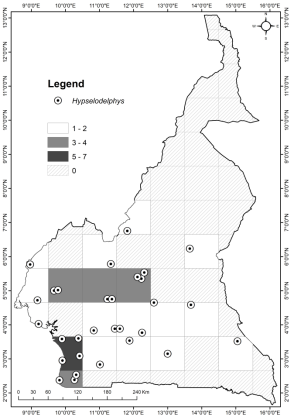
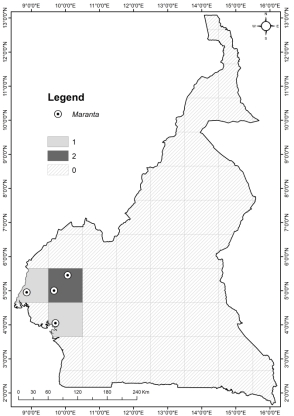
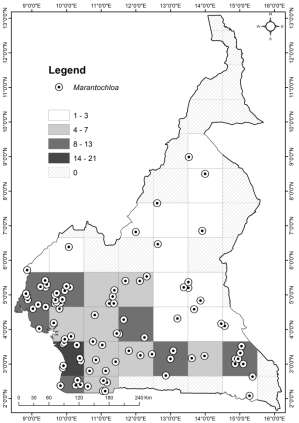
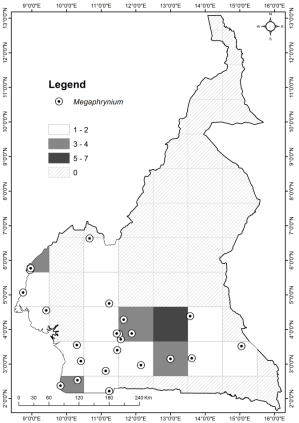
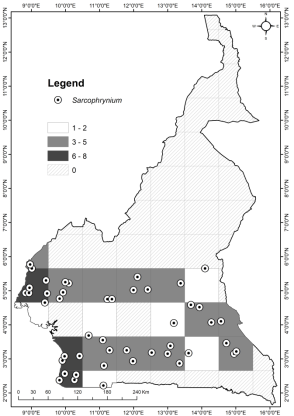
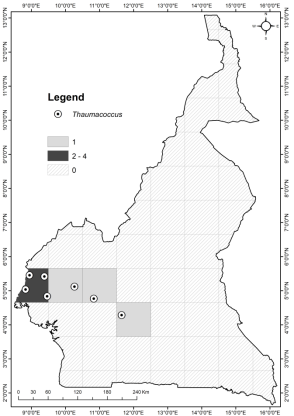
Figure 2 presents the spatial distribution of Marantaceae species in Cameroon derived from herbarium records. The map illustrates the geographical occurrence of species belonging to twelve (12) genera documented in the country, based on verified herbarium specimens. These records provide an overview of the national distribution patterns of Marantaceae and highlight areas of species occurrence across different ecological zones. Table 1 shows a total number of 1,060 herbarium records documented. Marantochloa was the most represented genus, accounting for 201 records (18.96%), followed by Sarcophrynium with 124 records (11.70%). Several genera showed intermediate representation, including Hypselodelphys, Maranta, Haumanania, Trachyphrynium, and Megaphrynium, each contributing between 7–8% of the total records. In contrast, lower representation was observed for Thaumatococcus (55 records; 5.19%), Afrocalathea (59 records; 5.57%), and Halopegia (69 records; 6.51%), which together accounted for the smallest proportion of herbarium specimens, while Figure 1 illustrates their relative proportions.
Figure 2. Spatial distribution of Marantaceae species.
3.2. Spatial Distribution of Marantaceae Genera
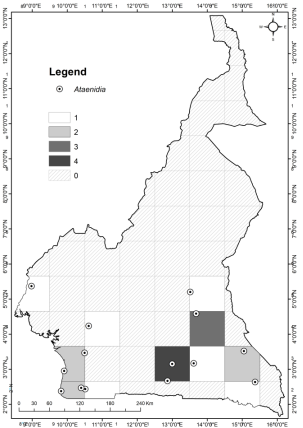
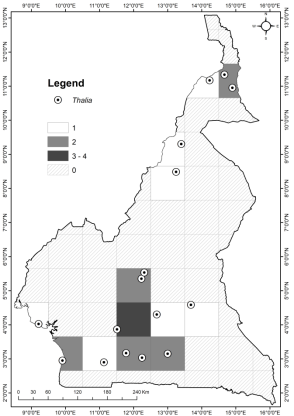
Herbarium records from the National Herbarium of Cameroon revealed the presence of twelve Marantaceae genera, namely Afrocalathea, Ataenidia, Halopegia, Haumania, Hypselodelphys, Maranta, Marantochloa, Megaphrynium, Sarcophrynium, Thalia, Thaumacoccus, and Trachyphrynium. This finding is consistent with earlier floristic studies, particularly that of
[7]
Marantaceae. In A. Letouzey (Ed.), FloreduCameroun (Vol. 4, pp. 1–156).
[7]
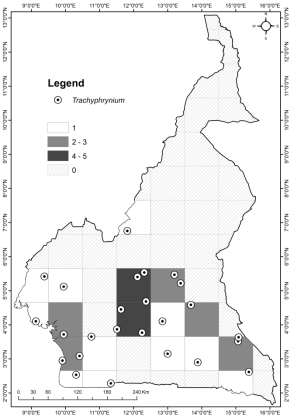
, who also reported twelve Marantaceae genera in Cameroon, suggesting a relative stability in generic diversity over time. Among the recorded genera, Marantochloa was the most representative and widely distributed, occurring across several agro-ecological zones of the country, especially within the humid forest regions. Its predominance indicates a high level of ecological adaptability and abundance compared to other genera, which were more sparsely distributed or restricted to specific habitats.
Figure 14. Spatial distribution map of the genus Trachyphrynium in Cameroon.
4. Discussion
The spatial distribution of Marantaceae species in Cameroon, as revealed by herbarium-based mapping, highlights clear patterns linked to ecological conditions and historical floristic trends. The identification of twelve genera confirms Cameroon as an important centre of Marantaceae diversity within Central Africa. This finding is consistent with earlier floristic work
[7]
Marantaceae. In A. Letouzey (Ed.), FloreduCameroun (Vol. 4, pp. 1–156).
[7]
, who similarly documented twelve Marantaceae genera in the country, suggesting that generic-level diversity has remained relatively stable over several decades despite increasing anthropogenic pressure on forest ecosystems. The persistence of these genera over time underscores the ecological resilience of the family and the continued relevance of herbarium records for understanding long-term biodiversity patterns.
The mapped distribution patterns show a strong concentration of Marantaceae occurrences within the humid forest zones of southern Cameroon. These areas are characterised by high rainfall, dense canopy cover, and relatively stable microclimatic conditions, which are known to favour the growth and persistence of understory herbaceous plants such as Marantaceae
[3]
Cable, S., & Cheek, M. (1998). TheplantsofMountCameroon:Aconservationchecklist. Royal Botanic Gardens, Kew.
[3]
. The spatial clustering observed in these zones supports the view that moisture availability and forest structure play a critical role in shaping the distribution of the family. In contrast, fewer records were observed in savanna-dominated or semi-arid regions, indicating ecological constraints on the expansion of most Marantaceae species beyond humid environments.
The dominance of genera such as Marantochloa, Sarcophrynium, and Megaphrynium in Cameroonian herbarium records is consistent with patterns reported from other parts of tropical Africa, where these genera are characteristic components of lowland and submontane rainforest understories. Similar dominance patterns have been documented in Central African forests and the Guineo-Congolian region, where Marantaceae diversity is highest
[3]
Cable, S., & Cheek, M. (1998). TheplantsofMountCameroon:Aconservationchecklist. Royal Botanic Gardens, Kew.
[7]
Marantaceae. In A. Letouzey (Ed.), FloreduCameroun (Vol. 4, pp. 1–156).
[9]
Letouzey, R. (1985). ExplanatorynotetothephytogeographicalmapofCameroonatascaleof1:500,000. International Institute for Vegetation Mapping, Toulouse.
[13]
White, F. (1983). ThevegetationofAfrica:AdescriptivememoirtoaccompanytheUNESCO/AETFAT/UNSOvegetationmapofAfrica.UNESCO, Paris.
[3, 7, 9, 13]
. Additionally, they are widely utilised by local communities for food wrapping, construction, and other socio-economic purposes, which may have increased its collection frequency and visibility in herbarium records. This interaction between ecological adaptability and human use likely contributes to its strong representation in both historical and contemporary datasets.
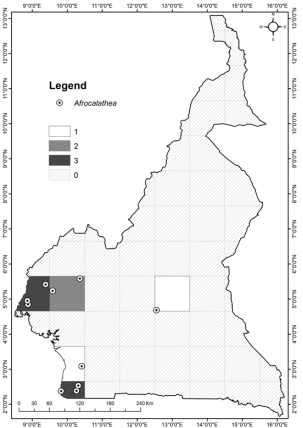
In contrast, genera such as Afrocalathea and Halopegia tend to show more restricted geographical ranges and fewer species, which may partly explain their lower representation in herbarium collections compared with more speciose and ecologically versatile genera.
Based on the spatial concentration of herbarium records, southern and central Cameroon, particularly the humid forest and bimodal rainfall zones, emerge as potential centers of diversity for Marantaceae. These regions are characterized by high rainfall, stable humidity, and extensive forest cover, which provide favourable ecological conditions for Marantaceae species. The repeated occurrence of multiple genera and species within these zones suggests both high species richness and long-term ecological stability, highlighting their importance for conservation planning, especially in the face of ongoing deforestation and land-use change.
While herbarium records provide valuable insights into species distribution, the observed patterns are likely influenced by a combination of sampling bias and species-specific ecological traits. Collection efforts are often concentrated along roads, research stations, and accessible forest areas, potentially under-representing remote regions
[5]
Graham, C. H., Ferrier, S., Huettman, F., Moritz, C., & Peterson, A. T. (2004). New developments in museum-based informatics and applications in biodiversity analysis. TrendsinEcology&Evolution.
[5]
. In addition, the natural history of species, including rarity, habitat specialization, endemism, and population size, may strongly influence herbarium representation. Rare or narrowly endemic species are less likely to be collected frequently, while widespread and conspicuous species are more commonly represented. Consequently, low herbarium representation should not be interpreted solely as low abundance in nature but may reflect both ecological rarity and limited collection effort. Nevertheless, when combined with spatial mapping, herbarium records provide valuable insights into broad-scale distribution patterns and serve as an effective tool for identifying centres of diversity and potential conservation priorities.
Overall, the spatial distribution patterns observed in this study reinforce the importance of Cameroon’s humid forest ecosystems for the conservation of Marantaceae diversity. The dominance of Marantochloa further highlights its ecological and socio-economic significance within the family. These findings provide a robust baseline for future studies integrating field surveys, population assessments, and conservation planning, as well as for exploring links between species distribution, utilisation, and market availability.
5. Conclusion
This study demonstrates the value of herbarium records combined with spatial mapping for understanding the distribution of Marantaceae in Cameroon. The analysis confirms the presence of twelve Marantaceae genera, in agreement with earlier floristic accounts, notably
[7]
Marantaceae. In A. Letouzey (Ed.), FloreduCameroun (Vol. 4, pp. 1–156).
[7]
, indicating a long-term stability in generic diversity within the country. The mapped distribution patterns reveal a strong association between Marantaceae occurrence and the humid forest zones of southern Cameroon, highlighting the importance of these ecosystems for the conservation of the family.
Among the identified genera, Marantochloa emerged as the most representative and widely distributed, reflecting its high ecological adaptability and broad habitat tolerance. Its dominance across multiple agro-ecological zones underscores its central ecological and socio-economic role within the Marantaceae family in Cameroon. Although herbarium data are subject to sampling bias, the spatial patterns generated in this study provide a robust baseline for future field-based validation, conservation planning, and sustainable utilization strategies.
Overall, the findings contribute to improved knowledge of Marantaceae spatial distribution in Cameroon and demonstrate the continued relevance of herbarium-based mapping as a tool for biodiversity assessment. Future studies integrating ecological variables, population dynamics, and ethnobotanical data will further enhance understanding of the factors driving distribution patterns and inform effective conservation and management interventions
Abbreviations
NTFPs
Non Timber Forest Products
GIS
Geographical Information System
Conflicts of Interest
The authors declares no conflict of interest.
References
[1]
Andersson, L. (1998). Phylogeny and classification of the Marantaceae. BotanicalJournaloftheLinneanSociety.
[2]
Arnold, J. E. M., & Ruiz Perez, M. (2001). Can non-timber forest products match tropical forest conservation and development objectives? WorldDevelopment,29(3), 437–447.
[3]
Cable, S., & Cheek, M. (1998). TheplantsofMountCameroon:Aconservationchecklist. Royal Botanic Gardens, Kew.
[4]
Funk, V. A., Richardson, K. S., & Ferrier, S. (2005). Survey-gap analysis in expeditionary research: Where do we go from here? BiologicalJournaloftheLinneanSociety.
[5]
Graham, C. H., Ferrier, S., Huettman, F., Moritz, C., & Peterson, A. T. (2004). New developments in museum-based informatics and applications in biodiversity analysis. TrendsinEcology&Evolution.
[6]
Ingram, V., & Schure, J. (2010). Review of non-timber forest products (NTFPs) in Central Africa: Cameroon. NTFPsinCentralAfrica (pp. 1–56). Center for International Forestry Research (CIFOR), Bogor, Indonesia.
[7]
Marantaceae. In A. Letouzey (Ed.), FloreduCameroun (Vol. 4, pp. 1–156).
[8]
Koechlin, J. (1965). Marantaceae. In Flora of Cameroon (Vol. 4). National Museum of Natural History, Paris, France.
[9]
Letouzey, R. (1985). ExplanatorynotetothephytogeographicalmapofCameroonatascaleof1:500,000. International Institute for Vegetation Mapping, Toulouse.
[10]
Ley, A. C. (2008). EvolutioninAfricanMarantaceae—Evidencefromfloralmorphology,ecologyandphylogeny (Unpublished doctoral thesis). University of Mainz, Germany.
[11]
Ndoye, O., Ruiz Perez, M., & Eyebe, A. (1997). The markets of non-timber forest products in the humid forest zone of Cameroon. RuralDevelopmentForestryNetworkPaper, 22c, 1–13. Overseas Development Institute (ODI), London.
[12]
Shackleton, S., Shackleton, C., & Shanley, P. (2011). Non-timber forest products in the global context. In S. Shackleton, C. Shackleton, & P. Shanley (Eds.), Non-timberforestproductsintheglobalcontext (pp. 1–23). Springer, Berlin.
[13]
White, F. (1983). ThevegetationofAfrica:AdescriptivememoirtoaccompanytheUNESCO/AETFAT/UNSOvegetationmapofAfrica.UNESCO, Paris.
Mbapah, M. E., Nkwatoh, A. F., Simeon, T., Ngomba, L. S., Barthelemy, T., et al. (2026). Herbarium-based Mapping of Spatial Distribution and Genera of Marantaceae in Cameroon. American Journal of Agriculture and Forestry, 14(1), 51-59. https://doi.org/10.11648/j.ajaf.20261401.16
Mbapah, M. E.; Nkwatoh, A. F.; Simeon, T.; Ngomba, L. S.; Barthelemy, T., et al. Herbarium-based Mapping of Spatial Distribution and Genera of Marantaceae in Cameroon. Am. J. Agric. For.2026, 14(1), 51-59. doi: 10.11648/j.ajaf.20261401.16
Mbapah ME, Nkwatoh AF, Simeon T, Ngomba LS, Barthelemy T, et al. Herbarium-based Mapping of Spatial Distribution and Genera of Marantaceae in Cameroon. Am J Agric For. 2026;14(1):51-59. doi: 10.11648/j.ajaf.20261401.16
@article{10.11648/j.ajaf.20261401.16,
  author = {Mingoh Emmanuel Mbapah and Athanasius Fuashi Nkwatoh and Tchakonte Simeon and Longonje Simon Ngomba and Tchiengue Barthelemy and Eric Ngansop Tchatchouang},
  title = {Herbarium-based Mapping of Spatial Distribution and Genera of Marantaceae in Cameroon},
  journal = {American Journal of Agriculture and Forestry},
  volume = {14},
  number = {1},
  pages = {51-59},
  doi = {10.11648/j.ajaf.20261401.16},
  url = {https://doi.org/10.11648/j.ajaf.20261401.16},
  eprint = {https://article.sciencepublishinggroup.com/pdf/10.11648.j.ajaf.20261401.16},
  abstract = {Marantaceae are ecologically and socio-economically important understory plants in Central African tropical forests, yet their spatial distribution in Cameroon remains insufficiently documented. This study employed georeferenced herbarium records from the National Herbarium of Cameroon to map the national distribution of Marantaceae species. Twelve genera were identified, indicating consistency in generic diversity across historical collections. Marantochloa emerged as the most widespread and dominant genus, reflecting its ecological adaptability and extensive local use, particularly for food wrapping and construction. Spatial analysis revealed a strong concentration of Marantaceae species in the humid forest zones of southern Cameroon, while occurrences in drier and savanna regions were sparse. These patterns highlight the combined influence of environmental conditions and species ecology on distribution. The findings demonstrate the effectiveness of herbarium-based spatial analysis for documenting plant diversity, identifying distribution hotspots, and informing conservation and sustainable use of forest plant resources.},
 year = {2026}
}
TY  - JOUR
T1  - Herbarium-based Mapping of Spatial Distribution and Genera of Marantaceae in Cameroon
AU  - Mingoh Emmanuel Mbapah
AU  - Athanasius Fuashi Nkwatoh
AU  - Tchakonte Simeon
AU  - Longonje Simon Ngomba
AU  - Tchiengue Barthelemy
AU  - Eric Ngansop Tchatchouang
Y1  - 2026/02/04
PY  - 2026
N1  - https://doi.org/10.11648/j.ajaf.20261401.16
DO  - 10.11648/j.ajaf.20261401.16
T2  - American Journal of Agriculture and Forestry
JF  - American Journal of Agriculture and Forestry
JO  - American Journal of Agriculture and Forestry
SP  - 51
EP  - 59
PB  - Science Publishing Group
SN  - 2330-8591
UR  - https://doi.org/10.11648/j.ajaf.20261401.16
AB  - Marantaceae are ecologically and socio-economically important understory plants in Central African tropical forests, yet their spatial distribution in Cameroon remains insufficiently documented. This study employed georeferenced herbarium records from the National Herbarium of Cameroon to map the national distribution of Marantaceae species. Twelve genera were identified, indicating consistency in generic diversity across historical collections. Marantochloa emerged as the most widespread and dominant genus, reflecting its ecological adaptability and extensive local use, particularly for food wrapping and construction. Spatial analysis revealed a strong concentration of Marantaceae species in the humid forest zones of southern Cameroon, while occurrences in drier and savanna regions were sparse. These patterns highlight the combined influence of environmental conditions and species ecology on distribution. The findings demonstrate the effectiveness of herbarium-based spatial analysis for documenting plant diversity, identifying distribution hotspots, and informing conservation and sustainable use of forest plant resources.
VL  - 14
IS  - 1
ER  -
Mbapah, M. E., Nkwatoh, A. F., Simeon, T., Ngomba, L. S., Barthelemy, T., et al. (2026). Herbarium-based Mapping of Spatial Distribution and Genera of Marantaceae in Cameroon. American Journal of Agriculture and Forestry, 14(1), 51-59. https://doi.org/10.11648/j.ajaf.20261401.16
Mbapah, M. E.; Nkwatoh, A. F.; Simeon, T.; Ngomba, L. S.; Barthelemy, T., et al. Herbarium-based Mapping of Spatial Distribution and Genera of Marantaceae in Cameroon. Am. J. Agric. For.2026, 14(1), 51-59. doi: 10.11648/j.ajaf.20261401.16
Mbapah ME, Nkwatoh AF, Simeon T, Ngomba LS, Barthelemy T, et al. Herbarium-based Mapping of Spatial Distribution and Genera of Marantaceae in Cameroon. Am J Agric For. 2026;14(1):51-59. doi: 10.11648/j.ajaf.20261401.16
@article{10.11648/j.ajaf.20261401.16,
  author = {Mingoh Emmanuel Mbapah and Athanasius Fuashi Nkwatoh and Tchakonte Simeon and Longonje Simon Ngomba and Tchiengue Barthelemy and Eric Ngansop Tchatchouang},
  title = {Herbarium-based Mapping of Spatial Distribution and Genera of Marantaceae in Cameroon},
  journal = {American Journal of Agriculture and Forestry},
  volume = {14},
  number = {1},
  pages = {51-59},
  doi = {10.11648/j.ajaf.20261401.16},
  url = {https://doi.org/10.11648/j.ajaf.20261401.16},
  eprint = {https://article.sciencepublishinggroup.com/pdf/10.11648.j.ajaf.20261401.16},
  abstract = {Marantaceae are ecologically and socio-economically important understory plants in Central African tropical forests, yet their spatial distribution in Cameroon remains insufficiently documented. This study employed georeferenced herbarium records from the National Herbarium of Cameroon to map the national distribution of Marantaceae species. Twelve genera were identified, indicating consistency in generic diversity across historical collections. Marantochloa emerged as the most widespread and dominant genus, reflecting its ecological adaptability and extensive local use, particularly for food wrapping and construction. Spatial analysis revealed a strong concentration of Marantaceae species in the humid forest zones of southern Cameroon, while occurrences in drier and savanna regions were sparse. These patterns highlight the combined influence of environmental conditions and species ecology on distribution. The findings demonstrate the effectiveness of herbarium-based spatial analysis for documenting plant diversity, identifying distribution hotspots, and informing conservation and sustainable use of forest plant resources.},
 year = {2026}
}
TY  - JOUR
T1  - Herbarium-based Mapping of Spatial Distribution and Genera of Marantaceae in Cameroon
AU  - Mingoh Emmanuel Mbapah
AU  - Athanasius Fuashi Nkwatoh
AU  - Tchakonte Simeon
AU  - Longonje Simon Ngomba
AU  - Tchiengue Barthelemy
AU  - Eric Ngansop Tchatchouang
Y1  - 2026/02/04
PY  - 2026
N1  - https://doi.org/10.11648/j.ajaf.20261401.16
DO  - 10.11648/j.ajaf.20261401.16
T2  - American Journal of Agriculture and Forestry
JF  - American Journal of Agriculture and Forestry
JO  - American Journal of Agriculture and Forestry
SP  - 51
EP  - 59
PB  - Science Publishing Group
SN  - 2330-8591
UR  - https://doi.org/10.11648/j.ajaf.20261401.16
AB  - Marantaceae are ecologically and socio-economically important understory plants in Central African tropical forests, yet their spatial distribution in Cameroon remains insufficiently documented. This study employed georeferenced herbarium records from the National Herbarium of Cameroon to map the national distribution of Marantaceae species. Twelve genera were identified, indicating consistency in generic diversity across historical collections. Marantochloa emerged as the most widespread and dominant genus, reflecting its ecological adaptability and extensive local use, particularly for food wrapping and construction. Spatial analysis revealed a strong concentration of Marantaceae species in the humid forest zones of southern Cameroon, while occurrences in drier and savanna regions were sparse. These patterns highlight the combined influence of environmental conditions and species ecology on distribution. The findings demonstrate the effectiveness of herbarium-based spatial analysis for documenting plant diversity, identifying distribution hotspots, and informing conservation and sustainable use of forest plant resources.
VL  - 14
IS  - 1
ER  -





 Share This Article
 Twitter
 Linked In
 Facebook
 Copy
Copy Download